
Yourself (one word) is correct. Your self (two words) is not standard — use yourself.
Have you ever wondered whether to write yourself or your self?
Many people face this question when writing emails, school assignments, blog posts, or social media updates.
Both forms may look correct, but they do not mean the same thing in every case.
The main confusion comes from the words your and self. The word yourself is a reflexive pronoun.
We use it when the person doing an action is also the person receiving that action. For example, “Believe in yourself” and “You should introduce yourself.”
The phrase your self has a different use. It may refer to a person’s identity, inner nature, or sense of who they are.
It often appears in discussions about personal growth, mental health, or philosophy. For example, “Your true self matters.”
Knowing the difference helps you avoid spelling mistakes and express your ideas clearly.
In this guide, you will learn the meaning, history, grammar rules, and everyday uses of both forms.
You will also see examples, common mistakes, and simple tips to help you choose the right form for your writing.
Yourself or Your Self – Quick Answer
Yourself is the correct form in most everyday sentences. It is a reflexive pronoun used when the subject and object refer to the same person.
Your self is a two-word phrase used when self is a separate noun. It often refers to someone’s identity, personality, or inner nature.
Examples of Yourself
- Believe in yourself.
- You should prepare yourself for the test.
- Please introduce yourself to the class.
- You can do it yourself.
Examples of Your Self
- Your true self is worth knowing.
- You should be kind to your future self.
- Your inner self may need time to heal.
- Your public self may differ from your private self.
The key rule is simple: use yourself for reflexive or emphatic meaning. Use your self when self is a separate noun with its own meaning.
The Origin of Yourself or Your Self
The word yourself developed from the possessive word your and the noun self. In older forms of English, reflexive expressions often used a possessive word followed by self.
Over time, these parts joined to form the single word used today.
The word self has roots in Old English. It referred to a person or thing itself. As English developed, words such as myself, yourself, himself, and herself became common ways to show that an action referred back to its subject.
Today, yourself is a standard reflexive pronoun. It also adds emphasis in sentences such as “You can complete the task yourself.”
The two-word phrase your self remains possible because self can still function as a noun. Writers may use it to discuss identity, personality, or personal change.
For example:
- “You should trust yourself.” Here, yourself is a reflexive pronoun.
- “Your inner self needs care.” Here, self is a noun modified by your and inner.
The difference comes from grammar and meaning, not from British or American spelling rules.
Yourself vs Your Self: What Is the Difference?
“Yourself” is the correct spelling when referring to the person you are talking to. “Your self” is a less common phrase that refers to a person’s identity, inner nature, or personal sense of who they are.
Both forms can be correct, but they have different meanings and uses. Understanding this difference helps you avoid common grammar mistakes in writing and everyday communication.
Yourself: Meaning and Usage
“Yourself” is a reflexive pronoun used when the subject and object of a sentence refer to the same person.
It can also emphasize that someone does something personally or independently. It is written as one word in standard English. For example, “You should believe in yourself” uses the correct form.
Examples:
- You should be proud of yourself.
- Please introduce yourself to the class.
- You can complete this task yourself.
Your Self: Meaning and Usage
“Your self” consists of the possessive word “your” and the noun “self.” It is sometimes used in psychology, philosophy, and personal development to discuss someone’s identity, inner nature, or sense of individuality. Unlike “yourself,” it is not the usual choice in everyday sentences. For example, “Your self-image can influence your confidence” refers to a person’s perception of their identity.
Examples:
- Your self-image affects your confidence.
- Understanding your self-worth is important.
- Your self-awareness can improve relationships.
Yourself vs Your Self: Key Differences
The main difference is grammatical function: “yourself” is a reflexive or emphatic pronoun, while “your self” refers to the noun “self” modified by “your.”
In ordinary conversation, yourself is almost always the correct choice when referring back to “you.” Use “your self” only when the meaning specifically concerns the self as a concept or identity.
| Yourself | Your Self |
|---|---|
| One word | Two words |
| Reflexive pronoun | Possessive determiner + noun |
| Common in everyday English | Less common; often conceptual |
| “Believe in yourself.” | “Your self-image matters.” |
Common Mistakes to Avoid
A common mistake is writing “your self” when you mean the reflexive pronoun “yourself.” For example, “Take care of your self” should be “Take care of yourself.”
However, phrases such as “your self-esteem” and “your self-awareness” are correct because self-esteem and self-awareness are compound nouns. Always consider the sentence’s meaning before choosing the spelling.
British English vs American English Spelling
British English and American English use the same spelling for yourself. There is no standard regional spelling difference between these forms.
Both varieties use yourself as a reflexive pronoun. Both may also use your self when self is a separate noun.
Comparison Table
| Feature | British English | American English |
| Reflexive pronoun | Yourself | Yourself |
| Separate noun phrase | Your self | Your self |
| Correct example | Look after yourself. | Take care of yourself. |
| Identity example | Discover your true self. | Discover your true self. |
| Spelling variation | None | None |
Examples in British English
- You should make yourself comfortable.
- Please introduce yourself to everyone.
- Be proud of your true self.
Examples in American English
- You need to believe in yourself.
- You can teach yourself this skill.
- Find your authentic self.
The spelling remains the same in both countries. The main difference is how writers use the words in a sentence.
Which Spelling Should You Use?
Your choice depends on what you want to say. It does not depend on your location.
For American Readers
Use yourself when the action refers back to the subject.
Example: “You should prepare yourself for the interview.”
Use your self when discussing identity or personality.
Example: “Your future self will thank you.”
For British and Commonwealth Readers
Follow the same rules. British, Australian, Canadian, and other Commonwealth writers use yourself as a reflexive pronoun.
Examples:
- You should trust yourself.
- Your inner self deserves respect.
For Global and Professional Writing
Use the form that matches the sentence’s meaning. In formal writing, avoid separating yourself into two words when you mean the reflexive pronoun.
For example:
Incorrect: “You should ask your self why.”
Correct: “You should ask yourself why.”
However, this sentence is correct:
“Your true self deserves kindness.”
The best advice is to check whether self is part of a pronoun or a separate noun.
Common Mistakes with Yourself or Your Self
Writers often confuse these forms because they sound similar. The following examples show how to avoid common errors.
Mistake 1: Writing Your Self Instead of Yourself
Incorrect: You should believe in your self.
Correct: You should believe in yourself.
Why? The sentence needs a reflexive pronoun.
Mistake 2: Using Yourself When Self Is a Separate Noun
Awkward: Yourself deserves a break.
Correct: Your self deserves a break.
Better: You deserve a break.
Why? Yourself is a pronoun, not a noun — when self is the subject, use your self, or reword with you.
Mistake 3: Confusing Emphasis with a Separate Noun
Correct: You can finish the work yourself.
Correct: Your private self may differ from your public self.
The first sentence uses yourself for emphasis. The second uses self as a noun.
Mistake 4: Using Yourself Without a Clear Subject
Incorrect: Please send the form to yourself.
This sentence is not always wrong, but it may be unclear without context.
Clearer: Please send the form to yourself if you need a copy.
Use reflexive pronouns only when the sentence’s meaning supports them.
Mistake 5: Assuming the Two Forms Are Regional Spellings
Incorrect belief: British people write your self, while Americans write yourself.
Correct rule: Both varieties use both forms, depending on grammar and meaning.
Yourself or Your Self in Everyday Examples
These forms appear in emails, news articles, social media posts, and formal writing.
In Emails
Correct: “Please introduce yourself before the meeting.”
Correct: “Remember to take care of yourself during this busy week.”
Both sentences use yourself as a reflexive pronoun.
In News and Articles
Correct: “The course helps people teach themselves new skills.”
Correct: “The article explores the gap between your public and your private identity.”
The first example uses a reflexive pronoun. The second discusses two aspects of identity.
On Social Media
Correct: “Be yourself, even when others disagree.”
Correct: “Your best self grows through patience and practice.”
The first sentence uses yourself. The second uses self as a noun.
In Formal Writing
Correct: “You should assess yourself honestly.”
Correct: “Your sense of self may change over time.”
These examples show how the two forms serve different grammatical roles.
Yourself or Your Self – Google Trends and Usage Data
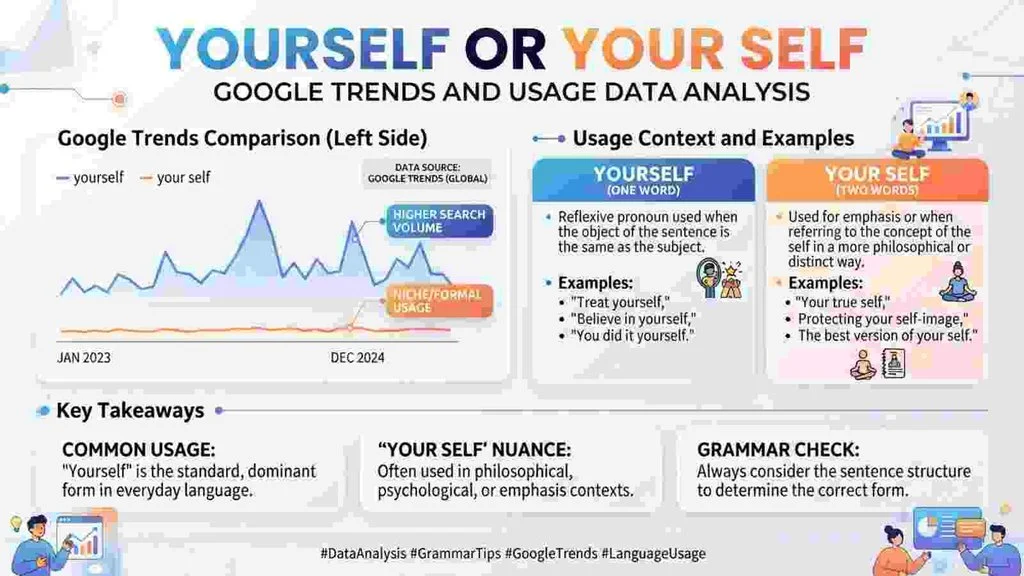
People search for “yourself or your self” when they want to check spelling, grammar, or correct word usage. The question is especially relevant to students, English learners, editors, and online content writers.
The single-word form yourself is the standard choice in ordinary sentences. It appears in common expressions such as “help yourself,” “be yourself,” and “believe in yourself.”
The phrase your self appears in more specific contexts. Writers may use it when discussing identity, personal development, or the difference between a person’s inner and outer life.
Popularity by Country
English-language searches may come from the United States, the United Kingdom, Canada, Australia, Pakistan, India, and other countries where people study or use English.
However, the spelling rule does not change from country to country.
| Search Context | Likely User Need | Recommended Guidance |
| United States | Grammar and spelling | Use yourself as a pronoun |
| United Kingdom | Correct word usage | Follow the same grammar rule |
| Canada and Australia | English writing help | Use meaning to choose the form |
| Pakistan and India | English learning | Learn the pronoun and noun difference |
| Global audiences | Clear professional writing | Use the standard form for the intended meaning |
Google Trends data changes over time and depends on the selected date range, region, and search category. Without a verified Trends report, exact search volumes or country rankings should not be claimed.
Comparison Table: Yourself vs Your Self
| Feature | Yourself | Your Self |
| Word type | Reflexive pronoun or emphatic pronoun | Possessive determiner plus noun |
| Main meaning | The person being referred to is you | Your identity or inner nature |
| Common use | Actions and emphasis | Identity and personal growth |
| Example | Believe in yourself. | Your true self matters. |
| British spelling | Yourself | Your self |
| American spelling | Yourself | Your self |
| Everyday frequency | Very common | More context-specific |
| Main rule | Write as one word | Write as two words when self is a noun |
Frequently Asked Questions
1. Is yourself one word or two words?
Yourself is one word when used as a reflexive or emphatic pronoun. For example, “You should trust yourself.”
2. Is your self ever correct?
Yes. Your self is correct when self is a separate noun. For example, “Your true self deserves love.”
3. Do British people write yourself differently?
No. British English uses yourself, just like American English. The grammatical distinction between yourself and your self is the same.
4. Which is correct: believe in yourself or believe in your self?
“Believe in yourself” is the standard expression. It uses a reflexive pronoun and is the natural choice in everyday English.
5. What does your true self mean?
“Your true self” refers to the person you are beneath outside pressures, appearances, or expectations. Here, self is a noun.
6. Can I use yourself for emphasis?
Yes. For example, “You can complete the project yourself.” In this sentence, yourself emphasizes that you can do the work without another person’s help.
7. Is yourself or your self better for SEO writing?
Use the phrase that matches the search intent and grammatical meaning. An article about the spelling difference may use both forms, but ordinary sentences should use yourself when a reflexive pronoun is needed. Natural, correct language is more important than repeating a keyword.
8. What does yourself mean?
Yourself means you, as the same person who does an action — the reflexive or emphatic pronoun for you, as in “You did it yourself.”
9. Yourself or your self — which is correct?
Yourself is correct in most sentences — use your self only when self is a separate noun, as in “your true self.”
10. How do you spell yourself?
Spell it Y-O-U-R-S-E-L-F: yourself, one word — your plus self.
Conclusion
Choosing between yourself or your self becomes easy when you understand the role of self in a sentence.
In most everyday writing, yourself is the correct form. It is a reflexive pronoun that refers back to the person addressed.
Examples include “Believe in yourself,” “Prepare yourself,” and “You can do it yourself.”
The two-word phrase your self is also correct in certain contexts. It appears when self works as a separate noun and refers to identity, personality, or inner nature.
For example, “Your true self deserves respect” uses the phrase correctly.
British and American English follow the same spelling rules. Neither country uses a different standard spelling for the reflexive pronoun. The real difference lies in grammar and meaning.
When writing an email, school assignment, website article, or social media post, ask yourself one simple question: Am I using a reflexive pronoun, or am I talking about a person’s identity? If you need the pronoun, write yourself. If it is a separate noun, write your self.
Following this rule will help you write clearly, avoid common mistakes, and use both forms with confidence.
Continue Reading:
- Bearer vs. Barer: Meaning, Differences, and Usage ( for 2026)
- Wandering vs. Wondering: Meaning, Usage, and Examples ( for 2026)
- Emigrate or Immigrate: Definitions, Examples, and Rules ( for 2026)
- Cuter or Cutier: Correct Spelling, Meaning, and Usage ( for 2026)
- Selfs or Selves: Meaning, Grammar, and Examples (for 2026)

Here’s a concise 2-line author bio suitable for Simifind.com:
James Dashner is an American bestselling author best known for The Maze Runner series and other popular young-adult fiction.
On Simifind.com, he shares clear, engaging insights and helpful content for readers interested in books, writing, and popular literature.








3 thoughts on “Yourself vs Your Self: Grammar, and Sentence Examples ( for 2026)”