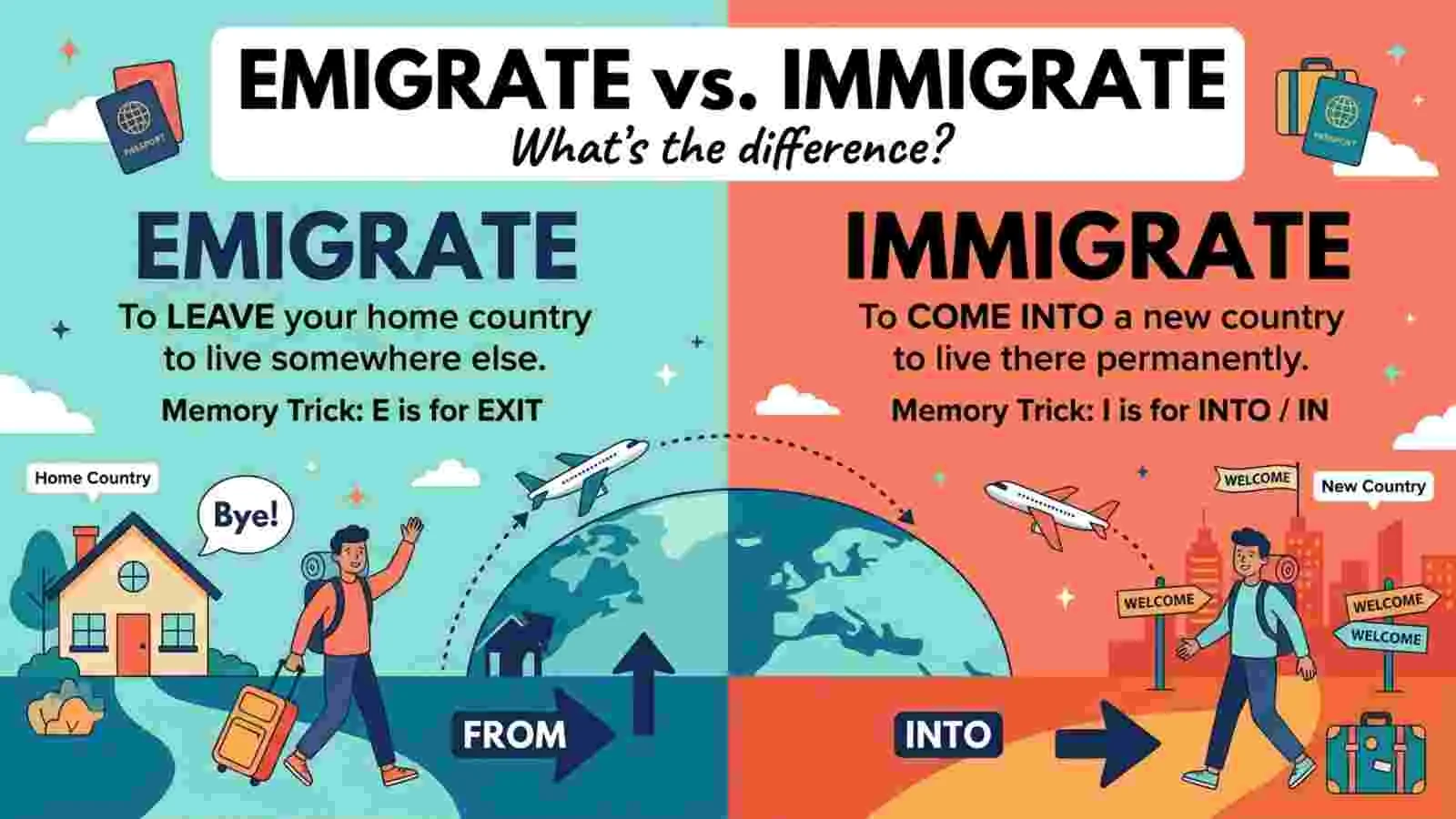
Emigrate and immigrate are different words. Emigrate = to leave your own country to live in another (she emigrated from Italy). Immigrate = to come into a new country to live there (she immigrated to Canada). Remember: emigrate = exit, immigrate = in.
Moving to another country can involve many forms, documents, and decisions. It can also create a simple English problem: should you say emigrate or immigrate?
These two words look almost the same, and both describe international movement.
That is why many English learners, students, writers, and even native speakers sometimes confuse them.
The good news is that the difference is easy once you understand the direction of movement.
Emigrate focuses on leaving a country. Immigrate focuses on entering and settling in a new country. For example, a person can emigrate from Pakistan and immigrate to Canada.
The same person is described with both words, but each word shows a different side of the move.
This guide explains emigrate or immigrate in simple English. You will learn their meanings, origins, British and American usage, common mistakes, examples, and practical rules.
By the end, you should be able to choose the correct word with confidence.
Emigrate or Immigrate – Quick Answer
The easiest rule is:
- Emigrate = leave a country
- Immigrate = enter a new country
Think of the first letters:
E = Exit → Emigrate
I = In → Immigrate
For example:
Maria emigrated from Spain to Canada.
Here, the focus is on Maria leaving Spain.
Maria immigrated to Canada from Spain.
Here, the focus is on Maria entering and settling in Canada.
Both sentences can describe the same move. The difference is the point of view.
| Word | Main meaning | Common preposition | Example |
| Emigrate | Leave a country to live elsewhere | from | He emigrated from India. |
| Immigrate | Enter another country to live there | to | He immigrated to Australia. |
| Migrate | Move from one place to another | to/from | Many people migrate to cities. |
Major dictionaries define emigrate as leaving one’s country to live in another, while immigrate means coming to another country to live there.
A simple memory trick
Remember:
Emigrate = Exit
Immigrate = Into
If you are talking about the country someone left, use emigrate.
If you are talking about the country someone entered, use immigrate.
The Origin of Emigrate or Immigrate
The two words come from Latin and share the root related to movement.
Emigrate comes from Latin emigrare, meaning “to move away” or “depart.” Its e- element is related to the idea of moving out.
Immigrate comes from Latin immigrare, meaning “to move into.” Its im- element is connected with the idea of moving in or entering.
This explains why the words look so similar. They share the Latin root related to movement, but their prefixes show opposite directions.
Emigrate
The basic idea is:
move out → leave → emigrate
Example:
My grandparents emigrated from Ireland.
Immigrate
The basic idea is:
move in → enter → immigrate
Example:
My grandparents immigrated to Canada.
The distinction has been used in English for centuries. Immigrate entered English from Latin in the early 17th century, while emigrate developed from Latin and became established in English later.
British English vs American English Spelling
There is no major spelling difference between British English and American English for these words.
Both varieties spell them:
- emigrate
- immigrate
- emigrated
- immigrated
- emigration
- immigration
The important difference is not spelling. It is meaning and direction.
| Feature | British English | American English |
| Leave a country | emigrate | emigrate |
| Enter another country | immigrate | immigrate |
| Noun for leaving | emigration | emigration |
| Noun for entering | immigration | immigration |
| Spelling difference | None | None |
| Main issue | Direction | Direction |
For example:
British English:
She emigrated from India.
American English:
She emigrated from India.
Both are correct.
Likewise:
British English:
He immigrated to Britain.
American English:
He immigrated to the United States.
The spelling remains the same. Cambridge and Oxford also distinguish the words by meaning rather than by a British-versus-American spelling rule.
Important point about “emigrate to”
You may sometimes see:
She emigrated to Canada.
This construction is used in real English, especially when the speaker is focusing on the act of leaving rather than the destination. Collins records this usage.
However, if you want maximum clarity, use:
She emigrated from India to Canada.
or:
She immigrated to Canada from India.
Which Spelling Should You Use?
You do not need to choose between British and American spelling here. Emigrate and immigrate are spelled the same in both varieties.
Instead, choose the word according to your meaning.
If you focus on the country someone left
Use emigrate.
They emigrated from Pakistan.
If you focus on the country someone entered
Use immigrate.
They immigrated to the United Kingdom.
If you want to describe movement generally
Use migrate.
Thousands of workers migrate to cities each year.
For international movement, emigrate and immigrate are more precise because they show direction.
In professional writing, especially immigration, government, academic, and news contexts, clear direction is important.
For global readers
If your audience includes people from different English-speaking countries, a sentence such as this is very clear:
She emigrated from Mexico and immigrated to the United States.
This removes almost all possible confusion.
Common Mistakes with Emigrate or Immigrate
These words are often confused because they describe the same journey from different viewpoints.
Mistake 1: Using immigrate for leaving
Incorrect or unclear:
He immigrated from Canada.
Better:
He emigrated from Canada.
If the focus is on leaving Canada, emigrated is the clearer choice.
Mistake 2: Using emigrate when the focus is arrival
Less precise:
She emigrated from India to Australia.
This can be grammatically acceptable because the sentence emphasizes leaving India.
But if the focus is arrival in Australia:
She immigrated to Australia.
Mistake 3: Confusing immigrant and emigrant
An immigrant is a person who comes into a country to live there.
An emigrant is a person who leaves their country to live somewhere else.
Example:
Ahmed was an emigrant from Pakistan and an immigrant in Canada.
The person is the same. The viewpoint changes.
Mistake 4: Confusing immigration and emigration
Immigration focuses on entering a country.
Emigration focuses on leaving a country.
Immigration increased this year.
Emigration increased after the economic crisis.
Mistake 5: Treating migrate as exactly the same
Migrate is broader.
People can migrate between regions, cities, or countries. Animals and birds can also migrate.
Birds migrate south in winter.
You would not normally use immigrate for ordinary seasonal bird movement.
Emigrate or Immigrate in Everyday Examples
Knowing the rule is useful, but examples make the difference easier to remember.
In Emails
My family plans to emigrate from Pakistan next year.
This focuses on leaving the current country.
My brother recently immigrated to Canada.
This focuses on entering the new country.
In News Writing
Thousands of workers emigrated from the region in search of better opportunities.
The report focuses on departure.
More skilled workers immigrated to the country last year.
The report focuses on arrival.
In Social Media
We finally immigrated to Australia after years of planning.
My grandparents emigrated from Italy many years ago.
Both are natural when the direction is clear.
In Formal Writing
The family emigrated from Germany and later immigrated to the United States.
This is especially clear because both directions are stated.
In Academic Writing
Economic conditions may influence decisions to emigrate from developing countries.
Employment opportunities can attract people who wish to immigrate to wealthier nations.
In Everyday Conversation
When did your family emigrate?
We emigrated from India in 2005.
Or:
When did you immigrate to Canada?
I immigrated in 2005.
Emigrate or Immigrate – Google Trends & Usage Data

Search interest in emigrate and immigrate is closely connected to international migration, relocation, citizenship, visas, and language questions.
However, Google Trends does not provide a permanent worldwide ranking that can be treated as a fixed measure of word popularity. Search interest changes by country, time period, news events, and migration patterns.
The two words also appear in different contexts.
Emigrate is commonly connected with:
- leaving a country
- moving abroad
- emigrating from a country
- overseas employment
- permanent relocation
- expatriation
- people leaving their homeland
Immigrate is commonly connected with:
- moving into a country
- immigration
- immigration policy
- visas
- permanent residence
- citizenship
- newcomers
- immigration law
Search behavior can also be affected by major immigration debates, policy changes, elections, economic conditions, wars, and changes in visa rules.
Importantly, emigrate and immigrate are not British-versus-American spellings. Both words are standard in British and American English. Their difference is primarily one of direction and perspective.
Emigrate vs Immigrate Comparison Table
| Word | Meaning | Direction | Example |
| Emigrate | Leave a country | Out | She emigrated from France. |
| Immigrate | Enter another country | In | She immigrated to Canada. |
| Emigrant | Person who leaves | Out | He became an emigrant from Spain. |
| Immigrant | Person who enters | In | He became an immigrant in Canada. |
| Emigration | Act of leaving | Out | Emigration rose last year. |
| Immigration | Act of entering | In | Immigration rose last year. |
| Migrate | Move from one place to another | General | People migrate for work. |
FAQs About Emigrate or Immigrate
1. What is the difference between emigrate and immigrate?
Emigrate means to leave a country to live elsewhere. Immigrate means to enter another country to live there.
2. Is it emigrate from or immigrate from?
The clearest traditional pattern is emigrate from and immigrate to.
She emigrated from India.
She immigrated to Canada.
However, immigrate from can also appear when the origin is being stated.
3. Can one person both emigrate and immigrate?
Yes. A person can emigrate from one country and immigrate to another.
He emigrated from Pakistan and immigrated to Canada.
4. Which comes first, emigration or immigration?
From the traveler’s point of view, the person leaves one country and then enters another. So the same move can be described as emigration from the first country and immigration into the second.
5. Is “emigrate to” wrong?
Not always. Real English uses emigrate to, especially when the destination is emphasized. However, emigrate from is the clearest choice when you want to show departure.
6. What is the difference between an emigrant and an immigrant?
An emigrant is viewed from the country they leave. An immigrant is viewed from the country they enter.
7. Is migrate the same as immigrate?
No. Migrate is a broader word for movement. It can describe people or animals moving from one place to another. Immigrate usually focuses on entering another country or region to settle.
8. Emigrate or immigrate — which is correct?
Both emigrate and immigrate are correct words — they are not two spellings of one word. Use emigrate when the focus is leaving a country; use immigrate when the focus is entering a new country.
9. What does emigrate mean?
Emigrate means to leave your own country to live in another country. Example: “She emigrated from Italy in 1990.” Remember: emigrate = exit.
10. What does immigrate mean?
Immigrate means to come into a new country to live there. Example: “She immigrated to Canada in 1990.” Remember: immigrate = in.
11. How do you spell emigrate?
E-M-I-G-R-A-T-E — emigrate. Remember: it starts with e-, like exit. Do not confuse it with immigrate, which starts with im-, like into.
Conclusion
The difference between emigrate or immigrate is mainly about direction.
Emigrate means to leave a country, while immigrate means to enter another country and settle there. A simple memory trick can make the rule easy: E means Exit, while I means Into.
For example, someone can emigrate from Pakistan and immigrate to Canada. The person has made one international move, but each word describes a different side of that move.
There is also no British-versus-American spelling difference between these words. Both British and American English use emigrate and immigrate in the same basic way. The key is choosing the word that matches your focus.
For formal, academic, professional, and SEO writing, clear direction is best. Use emigrate when discussing departure and immigrate when discussing arrival. When you need a broader word, use migrate.
Once you remember E = Exit and I = Into, choosing between these commonly confused words becomes much easier.
Continue Reading:
- Bony or Boney: Meaning, Spelling, and Usage ( for 2026)
- Mat or Matt: Meaning, Spelling, and Usage ( for 2026)
- Palette or Pallet: Meaning, Spelling, and Correct Usage ( for 2026)

Mary Roach is an American science writer and bestselling author known for making unusual and complex scientific topics engaging, accessible, and humorous. Her books include Stiff, Packing for Mars, Gulp, and Fuzz.
Author at Simifind.com, sharing clear, informative content designed to help readers understand interesting topics and everyday questions.






3 thoughts on “Emigrate or Immigrate: Definitions, Examples, and Rules ( for 2026)”