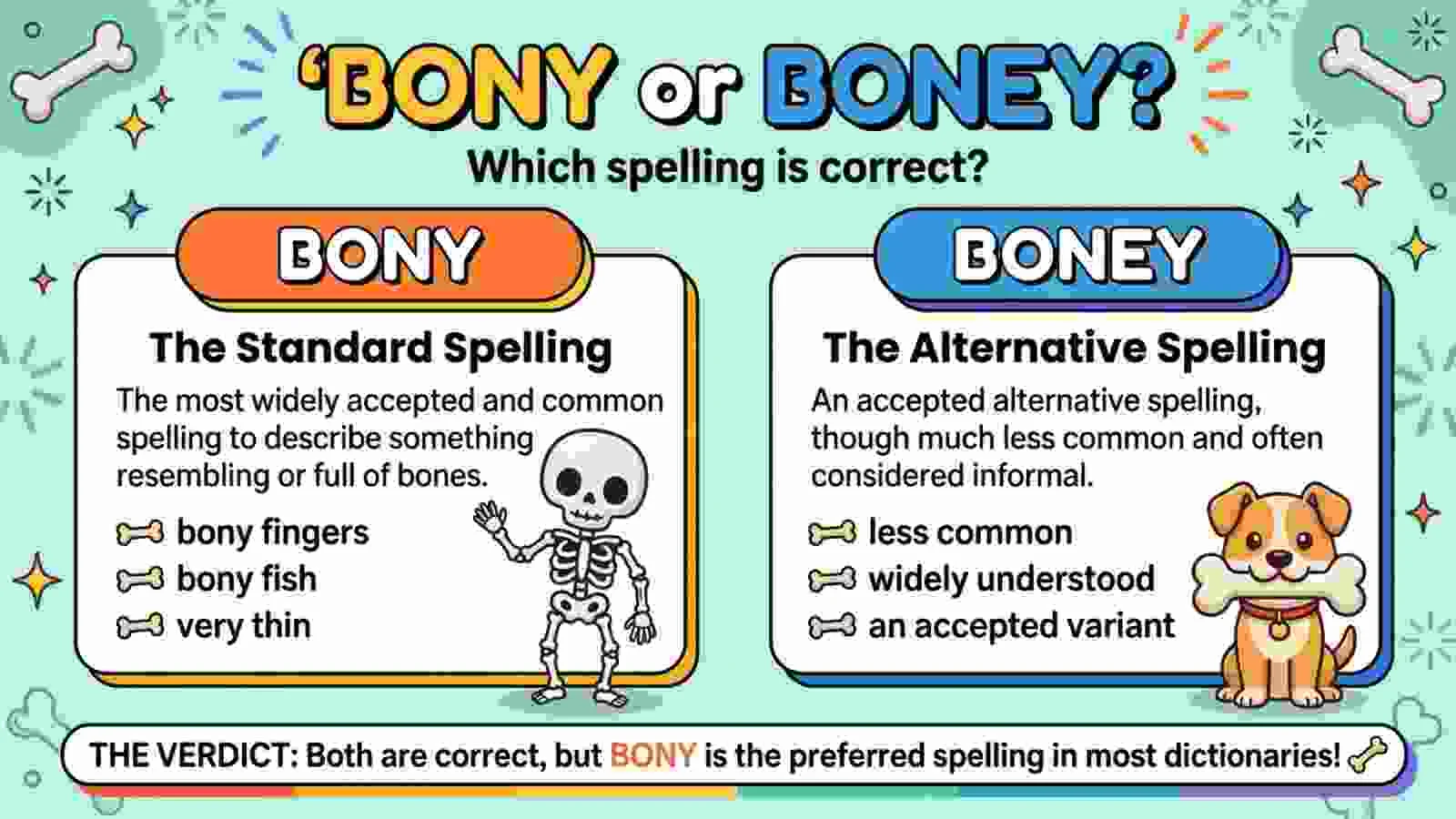
Bony is correct. Boney is incorrect as a spelling of bony (it is sometimes used as a name, but not the adjective). Bony = thin, with bones showing, or made of bone — e.g. bony fingers, a bony fish.
When you need to describe something with very little flesh, the words bony and boney can cause confusion. They look almost the same, sound the same, and both appear in English writing. So which one should you use?
The answer is simple: bony is the standard and preferred spelling in modern English.
It can describe a person, animal, body part, or object that is thin, full of bones, or has a noticeable bone structure. For example, you can say, “The dog has a bony body.”
Boney is also a real word, but it is much less common. It may appear as a variant spelling, a proper name, or in older or informal writing.
Most writers should choose bony when they mean “relating to or showing bones.”
People often search for bony or boney because both spellings appear in dictionaries, books, online searches, and names.
Understanding the difference helps you choose the right form for school, work, websites, emails, and formal writing.
Bony or Boney – Quick Answer
Bony is the standard spelling in modern English.
Boney is an uncommon variant and is sometimes used in names or older writing.
| Spelling | Commonness | Best Use |
| bony | Very common | Standard English |
| boney | Uncommon | Variant, names, or special contexts |
Examples with Bony
- The horse looked bony after being sick.
- He has a bony face.
- The fish has a bony skeleton.
- Her wrists looked bony.
Example with Boney
- Boney may appear as a surname or proper name.
- Older texts may sometimes use boney as a spelling variant.
Quick rule: If you mean “having many bones” or “showing the bones,” use bony.
The Origin of Bony or Boney
The word bony comes from the noun bone. English speakers have used forms related to bone for many centuries.
The suffix -y is commonly added to nouns to create adjectives. It often means “having,” “containing,” or “characterized by.”
For example:
- bone → bony
- cloud → cloudy
- dirt → dirty
- rain → rainy
The spelling bony follows a common English spelling pattern. When the word bone takes the suffix -y, the final e is removed:
bone + y → bony
The form boney developed as a variant spelling. English has many words with competing spellings, especially when pronunciation remains the same. However, not every variant becomes equally common.
Over time, bony became the normal spelling in standard modern English. Boney still exists, but it is far less common and has special uses.
British English vs American English Spelling
Both British and American English generally use bony as the standard spelling.
Unlike some words that have different British and American forms, such as colour/color or centre/center, bony does not normally change between British and American English.
| English Variety | Preferred Spelling | Example |
| American English | bony | He has a bony face. |
| British English | bony | The dog looked bony. |
| Canadian English | bony | The horse was very bony. |
| Australian English | bony | The animal looked bony. |
| General international English | bony | The fish has a bony skeleton. |
Why Not Boney?
The spelling boney is understandable, but it is not the usual choice in modern standard English.
For professional writing, academic work, journalism, websites, and formal documents, bony is the safer choice.
Which Spelling Should You Use?
Choose bony in almost every normal situation.
For American English
Use bony in school, business, websites, emails, and everyday writing.
Example:
The patient appeared very bony after losing weight.
For British English
Use bony as well.
Example:
The cat had a narrow, bony face.
For Global English
Bony is also the clearest choice for international readers because it is the standard form.
When Could Boney Be Correct?
Boney can be correct when it is:
- A proper name
- A surname
- A historical spelling
- A quoted spelling
- A specific name or title
Therefore, do not automatically change Boney to bony if it is part of someone’s official name.
Common Mistakes with Bony or Boney
Mistake 1: Using Boney in Formal Writing
❌ The man had a boney face.
✅ The man had a bony face.
Mistake 2: Thinking Both Forms Are Equally Common
Both forms exist, but they are not equally common.
For normal English writing, choose bony.
Mistake 3: Changing a Proper Name
If Boney is someone’s name, do not replace it with bony.
❌ Bony M. Smith
✅ Boney M. Smith — if that is the person’s official name.
Mistake 4: Confusing Bony With Bone
Bone is a noun.
Bony is an adjective.
- The bone is broken.
- His hand looks bony.
Bony or Boney in Everyday Examples
In Emails
The rescued dog is quite bony, so it needs proper nutrition.
In News Writing
The animal was found weak and bony after months without proper food.
In Social Media
My face looks so bony after losing weight!
In Formal Writing
The specimen has a thin body and a prominent bony structure.
In Medical or Scientific Writing
The examination showed a prominent bony structure around the joint.
In Everyday Conversation
That dog looks really bony.
Bony or Boney – Google Trends & Usage Data

Search interest can vary by country and context, but bony is the much more established spelling in standard English.
People searching for bony or boney may be looking for:
- Correct spelling
- Dictionary meaning
- Grammar help
- Medical or physical descriptions
- Bone-related vocabulary
- Names containing “Boney”
- Historical references
The difference becomes clearer when the words are used in context. Bony is normally an adjective, while Boney may appear as a name or unusual spelling.
For current search-volume comparisons, Google Trends can be useful because search interest changes over time and differs by country. Search results can also be affected by names, songs, brands, and historical references, so raw search popularity does not always represent standard English usage.
Bony vs Boney: Comparison Table
| Feature | Bony | Boney |
| Standard spelling | Yes | No, generally |
| Common in modern English | Yes | No |
| Adjective | Yes | Rarely as a variant |
| Means related to bones | Yes | Sometimes |
| Suitable for formal writing | Yes | Usually avoid |
| Used in names | Sometimes | Yes |
| Used in older writing | Yes | Yes |
| Best choice for learners | Yes | Usually no |
FAQs About Bony or Boney
1. Is bony or boney correct?
Bony is the standard spelling for normal modern English. Boney is a much less common variant or may be a proper name.
2. Is boney a real word?
Yes. Boney can be found as a variant spelling, but it is much less common than bony.
3. What does bony mean?
Bony means having many bones, showing bones clearly, or relating to bones.
4. Is bony American or British English?
Bony is used in both American and British English. It is not normally spelled differently between the two varieties.
5. Can I use boney in formal writing?
It is better to use bony in formal writing unless Boney is a proper name or you are preserving a specific spelling.
6. Is bony an adjective?
Yes. Bony is an adjective.
Example:
The animal had a bony body.
7. Why does bony have no e?
The word comes from bone + y. In this formation, the final e is normally dropped, producing bony.
8. What is the difference between bony and boney?
Bony is the standard spelling for the adjective meaning thin or full of bones; boney is an uncommon variant that is mainly seen in names or older writing. They mean the same thing when used as the adjective, but bony is the form to use.
9. How do you spell bony?
Spell it B-O-N-Y: bony, from bone + y, with the final e dropped.
Conclusion
When choosing between bony or boney, the best answer for most writers is bony.
It is the standard and widely accepted spelling in modern English. It describes something that has a noticeable bone structure, contains many bones, or is related to bones.
Boney is not simply a spelling mistake in every situation. It can appear as a variant spelling, in older sources, or as part of a proper name. However, it is much less common in ordinary English.
The good news is that British and American English generally agree on this word. You can safely use bony in school assignments, professional emails, articles, websites, news writing, and everyday communication.
A simple rule will help you remember it: bone + y = bony. If you are describing a thin person, an animal with visible bones, or a structure connected with bones, choose bony.
Use Boney only when the context specifically requires that spelling.
Continue Reading:
- Mat or Matt: Meaning, Spelling, and Usage ( for 2026)
- Palette or Pallet: Meaning, Spelling, and Correct Usage ( for 2026)
- Reins vs Reigns: Meaning, Spelling, and Usage ( for 2026)
- Cuter or Cutier: Correct Spelling, Meaning, and Usage ( for 2026)
- Selfs or Selves: Meaning, Grammar, and Examples (for 2026)

Here’s a concise 2-line author bio suitable for Simifind.com:
James Dashner is an American bestselling author best known for The Maze Runner series and other popular young-adult fiction.
On Simifind.com, he shares clear, engaging insights and helpful content for readers interested in books, writing, and popular literature.




3 thoughts on “Bony or Boney: Meaning, Spelling, and Usage ( for 2026)”