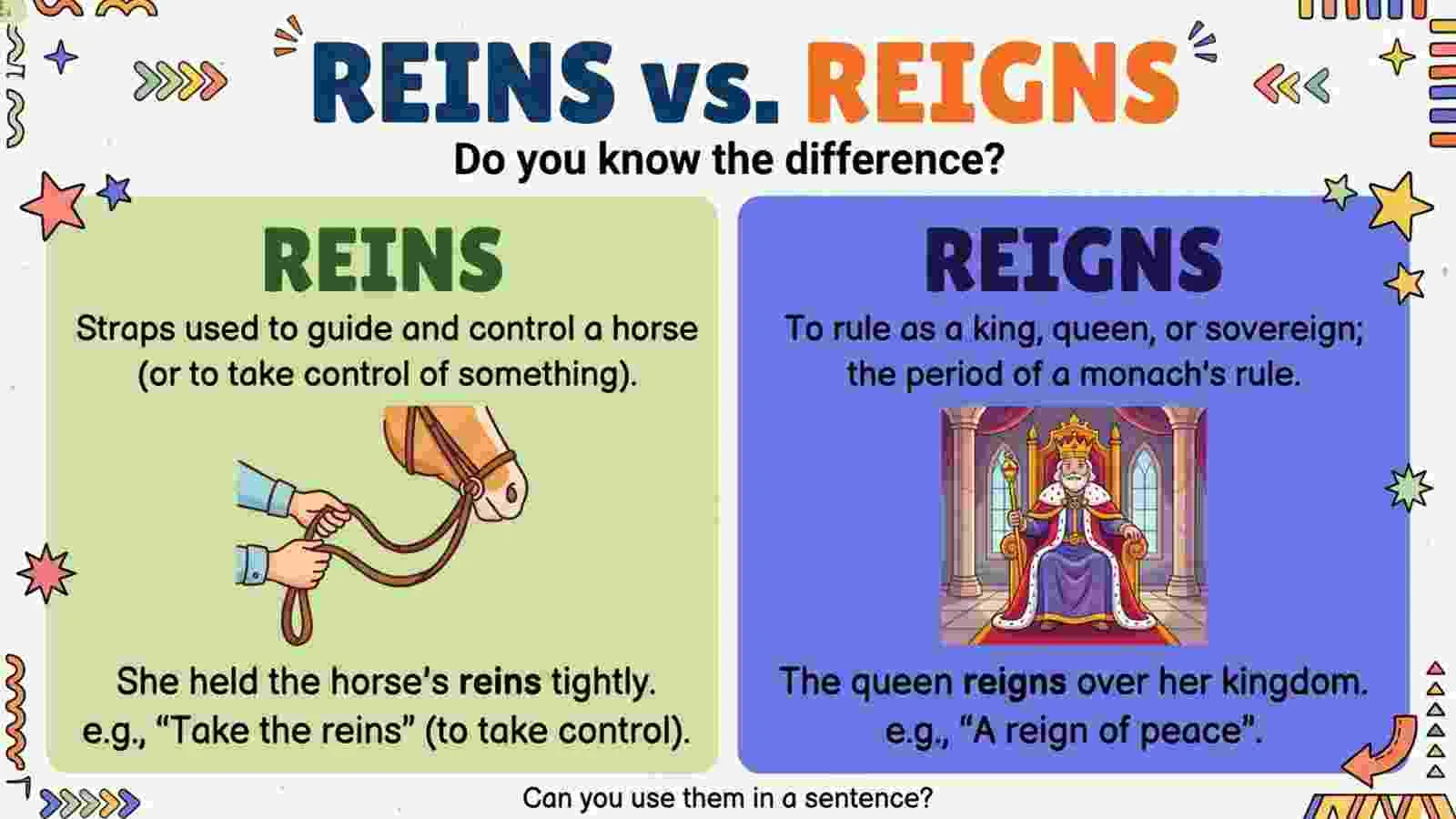
Reins = the straps used to control a horse. Reigns = the period a king or queen rules, or the act of ruling. Rain = water falling from the sky. They sound the same but mean different things.
Have you ever stopped while writing because you could not decide between reins or reigns?
These two words sound alike, but they have very different meanings. This makes them a common source of confusion in English.
Reins usually refers to the straps used to control a horse. It can also describe control or direction in a figurative sense, as in “take the reins.”
Reigns, on the other hand, refers to the period when a king, queen, or ruler holds power. It comes from the verb reign, which means to rule.
People often search for reins or reigns because both words are pronounced almost the same.
The difference becomes clear when you look at their meanings and spelling. Learning the correct word can help you avoid mistakes in emails, essays, articles, social media posts, and formal writing.
This guide explains reins vs. reigns, their origins, spelling, common mistakes, everyday examples, and the situations where each word belongs.
Reins or Reigns – Quick Answer
Reins means straps used to guide or control a horse. It can also mean control or leadership.
Reigns means a period of rule by a king, queen, or other ruler.
Examples
- The rider pulled the reins to slow the horse.
- She took the reins of the company after her father retired.
- Queen Elizabeth II had one of the longest reigns in British history.
- The king’s reign lasted for 30 years.
Simple memory trick
Think:
- Reins = riding or control
- Reigns = ruling or a period of rule
If you are talking about a horse, use reins. If you are talking about a monarch or ruler, use reigns.
The Origin of Reins or Reigns
The words reins and reigns look and sound similar, but they developed from different historical roots.
Reins comes from the Old French word resne, meaning a strap or bridle used to control a horse. It entered Middle English through French and became associated with the leather straps held by a rider.
Over time, reins also developed a figurative meaning. If someone “takes the reins,” they take control of a situation, organization, or activity.
Reigns comes from reign, which is related to Latin regnum, meaning rule, kingdom, or royal power. The word passed through Old French before becoming part of English.
The spelling difference exists because the words have different origins and meanings, even though their pronunciation is very similar.
This makes reins and reigns a classic example of English homophones: words that sound alike but have different meanings and spellings.
British English vs American English Spelling
There is no major spelling difference between American and British English for reins and reigns.
Both varieties use:
- reins for horse straps or control
- reign for a ruler’s period of power
- reigns for the plural form or third-person singular verb
| Word | American English | British English | Meaning |
| Reins | Reins | Reins | Horse straps or control |
| Reign | Reign | Reign | Rule or period of rule |
| Reigns | Reigns | Reigns | Rules or periods of rule |
| Reined | Reined | Reined | Controlled with reins |
| Reigning | Reigning | Reigning | Currently ruling |
Examples in Both Varieties
American English:
“The rider held the reins tightly.”
British English:
“The rider held the reins tightly.”
American English:
“The king’s reign lasted forty years.”
British English:
“The king’s reign lasted forty years.”
Unlike words such as color/colour or center/centre, there is no standard US-versus-UK spelling issue with reins or reigns.
Which Spelling Should You Use?
Your choice depends on what you mean, not where your audience lives.
Use “reins” when talking about:
- Horses
- Riding
- Control
- Leadership
- Direction
Example:
“The new manager took the reins of the project.”
Use “reigns” when talking about:
- Kings
- Queens
- Monarchs
- Rulers
- Periods of political or royal power
Example:
“The queen’s reign lasted several decades.”
For US English
Use the same spellings: reins and reigns.
For UK and Commonwealth English
Use the same spellings: reins and reigns.
For global English
The same rule applies. Focus on the meaning rather than regional spelling.
Common Mistakes with Reins or Reigns
Because these words are homophones, writers often use one in place of the other.
Mistake 1: “The king took the reins.”
This may be correct if you mean the king took control of something.
But if you mean the king began ruling, use:
“The king began his reign.”
Mistake 2: “The rider pulled the reigns.”
Incorrect.
Correct:
“The rider pulled the reins.”
Remember that horse riders use reins.
Mistake 3: “During her reins as queen”
Incorrect.
Correct:
“During her reign as queen.”
Mistake 4: “He took the reigns of the company.”
Usually incorrect when you mean leadership.
Correct:
“He took the reins of the company.”
Easy way to remember
Reins → horse and control
Reigns → ruler and royal power
Reins or Reigns in Everyday Examples
Understanding real-world examples makes the difference easier to remember.
In Emails
“After the director retired, Sarah took the reins of the department.”
Here, reins means control or leadership.
In News Writing
“The monarch’s reign came to an end after several decades.”
Here, reign refers to the ruler’s period of power.
On Social Media
“It is time to take the reins and build your own future.”
Here, reins is used figuratively to mean control.
In Formal Writing
“The emperor’s reign had a major impact on the country’s history.”
Here, reign means the period during which the emperor ruled.
In Horse Riding
“Keep the reins loose while the horse is walking.”
Here, reins means the straps attached to the horse’s bridle.
Reins or Reigns – Comparison Table
| Word | Part of Speech | Meaning | Example |
| Reins | Noun | Straps used to control a horse | She held the reins firmly. |
| Reins | Noun | Control or leadership | He took the reins of the team. |
| Reign | Noun | Rule of a monarch | His reign lasted 20 years. |
| Reigns | Noun | More than one period of rule | Several short reigns followed. |
| Reign | Verb | To rule | The king continued to reign. |
| Reigns | Verb | Rules | The queen reigns over the kingdom. |
Reins or Reigns – Google Trends & Usage Data
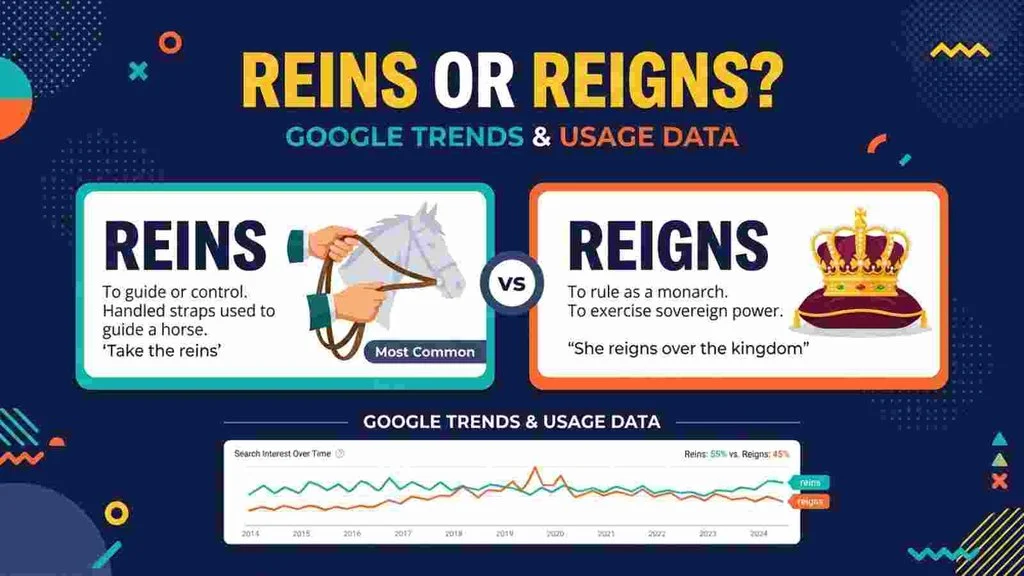
Search interest for reins or reigns usually comes from people checking spelling and meaning. The two words have different contexts, so their search patterns can vary.
Reins is strongly connected with horse riding, equestrian sports, leadership, and phrases such as take the reins.
Reigns is more closely connected with history, monarchy, royal families, politics, and historical writing.
Interest can therefore vary by country and topic. Countries with strong interest in horse riding may produce more searches related to reins, while countries where monarchy and royal history receive significant attention may show more interest in reign and reigns.
Search volume also changes around major historical anniversaries, royal events, educational topics, and popular discussions about leadership.
For SEO content, the best approach is to address both meanings clearly. A page targeting reins or reigns should explain the homophone relationship, give examples, and answer the spelling question directly.
FAQs About Reins or Reigns
1. What is the difference between reins and reigns?
Reins are straps used to control a horse and can also mean control. Reigns refers to periods of rule or the act of ruling.
2. Is it “take the reins” or “take the reigns”?
The correct phrase is “take the reins.” It means to take control or become responsible for something.
3. Is it “horse reins” or “horse reigns”?
The correct phrase is “horse reins.” Reins are used by riders to guide and control horses.
4. What does “reign” mean?
Reign means to rule as a king, queen, or other monarch. It can also mean the period during which that person rules.
5. Are reins and reigns pronounced the same?
Yes. Reins and reigns are homophones, so they normally have the same pronunciation but different meanings and spellings.
6. Is “reigns” the plural of “reign”?
Yes. Reigns can be the plural noun meaning multiple periods of rule. It can also be the third-person singular form of the verb reign.
7. How can I remember reins vs. reigns?
Think of reins as connected to riding and control. Think of reigns as connected to rulers and ruling.
8. What does reins mean?
Reins means the straps used to control a horse, or control and leadership in a figurative sense — for example, “She held the reins firmly.”
9. What does reigns mean?
Reigns means more than one period of rule, or the third-person form of the verb reign — for example, “The queen reigns over the kingdom.”
10. Reins or reigns — which is correct?
Both are correct, but they mean different things: use reins for horse straps or control, and reigns for periods of rule or ruling.
11. What is the difference between reins, reigns and rain?
Reins are horse straps or control, reigns are periods of rule, and rain is water falling from the sky — they sound the same but are spelled differently.
12. How do you spell reigns?
Spell it R-E-I-G-N-S: reigns, with the silent g — reign plus s.
Conclusion
Choosing between reins or reigns is simple once you understand their meanings. Although the two words sound alike, they are not interchangeable.
Use reins when you mean the straps used to guide a horse. The word can also describe control or leadership, especially in the phrase “take the reins.” Use reign or reigns when discussing a king, queen, monarch, or period of rule.
There is no major difference between American and British spelling. Both varieties use reins for horse straps and control, and reign/reigns for royal rule.
The easiest way to remember the difference is to connect reins with riding and reigns with ruling. This simple memory trick can prevent common spelling errors in schoolwork, professional writing, emails, articles, and everyday communication.
When you are unsure, look at the context. If the sentence involves a horse or taking control, choose reins. If it involves a monarch or a period of rule, choose reign or reigns.
Continue Reading:
- Mat or Matt: Meaning, Spelling, and Usage ( for 2026)
- Palette or Pallet: Meaning, Spelling, and Correct Usage ( for 2026)
- Chord or Cord: Definitions, Examples, and Usage ( for 2026)
- Cuter or Cutier: Correct Spelling, Meaning, and Usage ( for 2026)
- Selfs or Selves: Meaning, Grammar, and Examples (for 2026)

Mary Roach is an American science writer and bestselling author known for making unusual and complex scientific topics engaging, accessible, and humorous. Her books include Stiff, Packing for Mars, Gulp, and Fuzz.
Author at Simifind.com, sharing clear, informative content designed to help readers understand interesting topics and everyday questions.








1 thought on “Reins vs Reigns: Meaning, Spelling, and Usage ( for 2026)”