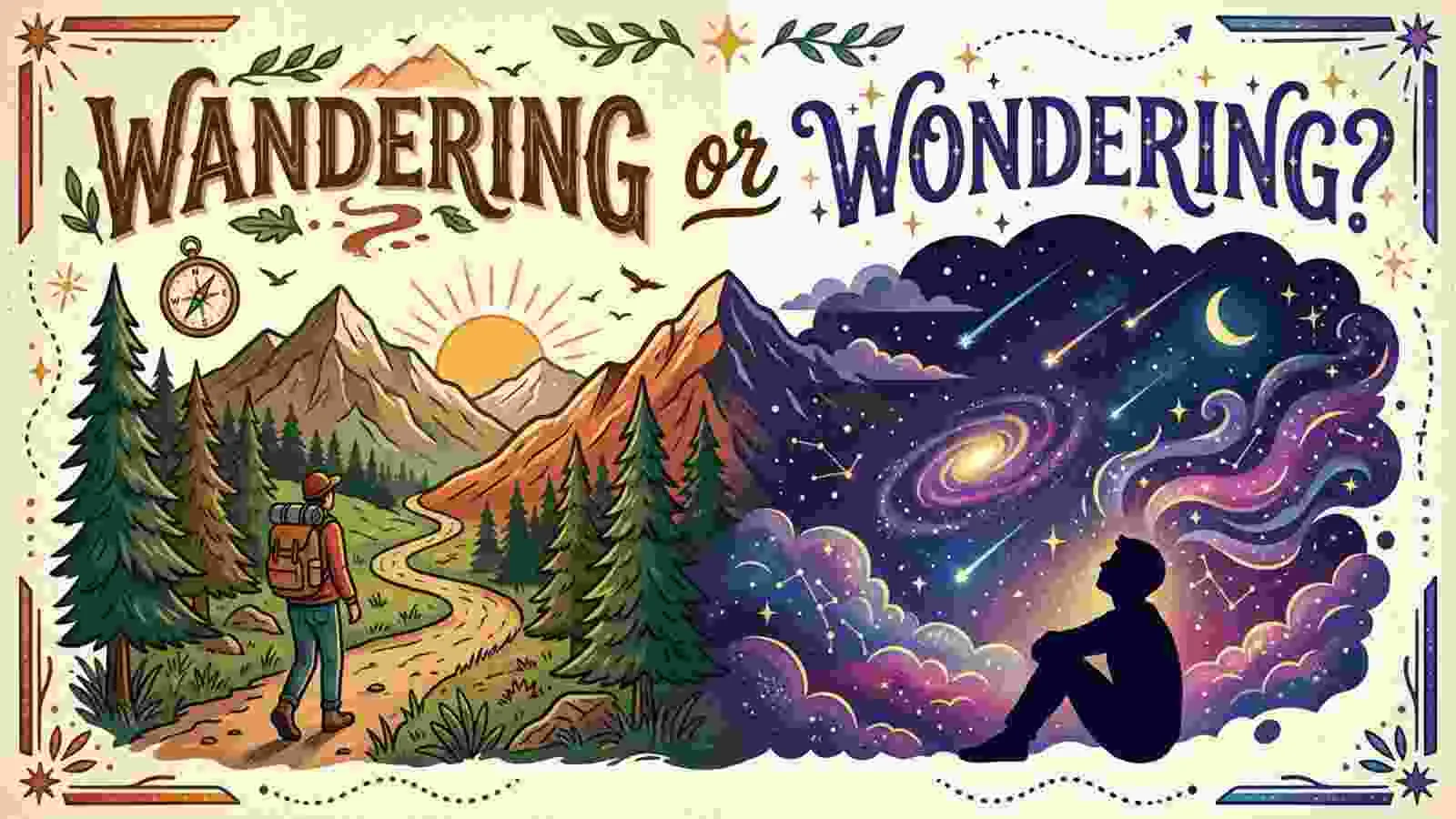
Wandering = moving around without a fixed direction. Wondering = thinking or asking yourself about something. They are different words.
Have you ever typed “wandering” when you meant “wondering”?
These words look and sound similar, but they have very different meanings. Choosing the wrong word can change the meaning of your sentence.
The good news is that learning the difference is simple.
People often search for wandering or wondering because both words end in “-ering” and can sound alike in fast speech.
However, each word has its own meaning and use. Wandering means moving from place to place without a clear path or goal.
Wondering means thinking about something, asking yourself a question, or feeling curious.
For example, “I was wandering around the city” means you were walking around without a fixed destination.
In contrast, “I was wondering where you went” means you were thinking about someone’s location.
In this guide, you will learn the meanings, origins, spelling rules, and common uses of both words.
You will also find easy examples, a comparison table, common mistakes, and answers to frequently asked questions.
By the end, you will know which word to use in emails, schoolwork, social media posts, and professional writing.
Wandering or Wondering – Quick Answer
Wandering means moving around without a clear direction or destination. Wondering means thinking, questioning, or feeling curious about something.
Here is a simple way to remember the difference:
- Wandering = Walking or moving.
- Wondering = Thinking or asking.
Examples of Wandering
- We spent the afternoon wandering through the park.
- The lost dog was wandering along the road.
- My mind kept wandering during the lesson.
Examples of Wondering
- I am wondering where my keys are.
- She was wondering why he had not called.
- I wonder if it will rain tomorrow.
Both words are correct English words. The right choice depends on what you want to say.
Wondering Around – Meaning and Definition
“Wondering around” is not a standard phrase in English. Wondering means thinking or feeling curious, so it does not describe moving around a place. When you mean moving from place to place without a fixed direction, the correct phrase is “wandering around” — for example, “We spent the afternoon wandering around the city.”
Wondering Around vs. Wandering Around – What’s the Difference?
Wandering around means moving around a place without a fixed plan — for example, “They were wandering around the market.” Wondering means thinking about something — for example, “I was wondering where the market was.” You can wonder about a place while you wander around it, but the two words are not interchangeable: use wandering for movement and wondering for thought.
Is Wondering Around Grammatically Correct?
“Wondering around” is not a standard English phrase. Wondering describes thinking, not movement, so it does not fit with “around” the way wandering does. The correct phrase is “wandering around” — “We were wondering around the town” should be “We were wandering around the town.” If you want to use wondering, pair it with a question or a thought: “I was wondering where the town square is.”
Examples of Wondering and Wandering in Everyday English
Wandering: “Let’s go wandering around the old town.” “My mind kept wandering during the lesson.” Wondering: “I was wondering if the shop is open.” “She was wondering why the bus was late.”
Common Mistakes When Using Wondering Around
The most common mistake is writing “wondering around” when you mean moving around — “We spent the day wondering around the town” should be “wandering around the town.” Another mistake is using wandering for a question: “I am wandering why you are late” should be “I am wondering why you are late.” Remember: wandering = moving around; wondering = thinking or asking.
The Origin of Wandering or Wondering
The words wandering and wondering come from different English words with different histories.
Where Does Wandering Come From?
Wandering comes from the verb wander. It entered English through older Germanic language forms and has long been used to describe moving without a fixed route.
Over time, the word developed several meanings. It can describe walking without a plan, traveling from place to place, or losing focus while thinking.
Examples:
- The travelers were wandering through the forest.
- My thoughts started wandering during the meeting.
Where Does Wondering Come From?
Wondering comes from the verb wonder. The word has Old English roots and has been used to express surprise, curiosity, and a desire to know something.
Today, it often appears when someone thinks about a question or wants to learn more.
Examples:
- I am wondering what time the train arrives.
- He wondered why the lights were off.
Why Are These Words Often Confused?
The words share a similar spelling pattern and can sound alike in some accents. Both also describe things that happen in daily life. However, their meanings are different.
Remember that wander is linked to movement, while wonder is linked to curiosity or thought.
Wandering and Wondering: What Is the Difference?
Wandering Meaning
Wandering means walking or moving around without a specific destination or direction. It can also describe someone whose attention or thoughts keep moving from one thing to another.
For example, “She was wandering through the park.” Here, she is walking around without a fixed destination.
Wondering Meaning
Wondering means thinking about something, feeling curious, or wanting to know the answer to a question.
It often describes a person who is uncertain or interested in learning something. For example, “I am wondering where he went.” Here, the person is curious about his location.
Wandering vs. Wondering: Key Differences
The main difference is that wandering usually refers to moving around, while wondering refers to thinking or being curious.
Both words sound similar, but their meanings and uses are different. Remember: wandering is about roaming, whereas wondering is about questioning or imagining.
Examples of Wandering and Wondering in Sentences
- Wandering: The tourists were wandering around the old city.
- Wandering: My mind keeps wandering during the lecture.
- Wondering: I am wondering why she is late.
- Wondering: He was wondering what to do next.
How to Remember Wandering and Wondering
A simple trick can help you remember these words. Wandering = walking around, while wondering = thinking about something.
Use wandering when describing movement or a drifting mind, and use wondering when expressing curiosity or asking yourself a question.
British English vs American English Spelling
There is no spelling difference between British English and American English for these two words. Both varieties use wandering and wondering.
The difference lies in meaning, not regional spelling rules.
| Feature | Wandering | Wondering |
| Base word | Wander | Wonder |
| Part of speech | Verb form; also an adjective | Verb form |
| Main meaning | Moving without a fixed direction | Thinking or feeling curious |
| British spelling | Wandering | Wondering |
| American spelling | Wandering | Wondering |
| Example | We were wandering downtown. | I was wondering about the result. |
| Common context | Travel, movement, attention | Questions, thoughts, curiosity |
Spelling Rules for Wandering
The base word is wander. To form the present participle, add -ing:
- Wander → Wandering
- Wander around → Wandering around
- Wander off → Wandering off
Example: The child was wandering around the garden.
Spelling Rules for Wondering
The base word is wonder. Add -ing to form wondering:
- Wonder → Wondering
- Wonder about → Wondering about
- Wonder why → Wondering why
Example: I am wondering why the shop is closed.
Neither word requires a different spelling in British or American English.
Which Spelling Should You Use?
The correct word depends on your intended meaning, not your country.
For American English
Use wandering when describing movement and wondering when describing curiosity.
Examples:
- We were wandering around New York.
- I was wondering if you could help me.
For British English and Commonwealth Countries
The same rules apply in the United Kingdom, Australia, Canada, New Zealand, and other Commonwealth contexts.
Examples:
- The tourists were wandering through London.
- I was wondering whether the train was delayed.
For Global English
If you write for an international audience, use the standard spellings and make the meaning clear through context.
For schoolwork, business emails, blogs, and formal reports, check whether you are describing movement or asking a question.
Professional tip: If you can replace the word with “walking around,” use wandering. If you can replace it with “thinking about” or “asking myself,” use wondering.
Common Mistakes with Wandering or Wondering
These mistakes are common because the two words look alike. The examples below show how to correct them.
Mistake 1: Using Wandering for a Question
Incorrect: I am wandering why you are late.
Correct: I am wondering why you are late.
Why? The sentence describes a question in your mind, not physical movement.
Mistake 2: Using Wondering for Physical Movement
Incorrect: We spent the day wondering around the town.
Correct: We spent the day wandering around the town.
Why? The sentence describes moving from place to place.
Mistake 3: Confusing a Wandering Mind with a Question
Both words can relate to mental activity, but they express different ideas.
- My mind was wandering during the lecture. (My attention was drifting.)
- I was wondering what the teacher meant. (I was trying to understand.)
Mistake 4: Using the Wrong Word in an Email
Incorrect: I am wandering if you received my message.
Correct: I am wondering if you received my message.
The second sentence is correct because it expresses a polite question.
Mistake 5: Assuming One Spelling Is British
Neither word is exclusive to British or American English. Both spellings are standard in both varieties.
Wandering or Wondering in Everyday Examples
You can use both words in daily conversations, emails, news reports, social media, and formal writing.
In Emails
Wandering:
“During my trip, I enjoyed wandering through the old streets and visiting small shops.”
Wondering:
“Hello, I was wondering if you could share the meeting details.”
The second example is a polite way to make a request.
In News Writing
Wandering:
“The missing hiker was found wandering near a rural road.”
Wondering:
“Residents are wondering when the new public transport service will begin.”
News writers use wandering to describe movement and wondering to describe people’s questions or concerns.
On Social Media
Wandering:
“Just wandering through the city and enjoying the view!”
Wondering:
“Wondering where everyone is going this weekend.”
Both expressions are natural in casual online posts.
In Formal Writing
Wandering:
“The report describes animals wandering beyond their usual habitat.”
Wondering:
“The researchers were wondering whether the results could be repeated.”
In formal writing, choose the word that clearly matches the intended meaning.
In Everyday Conversation
- “I was wandering around the mall when I saw you.”
- “I was wondering if you wanted to get coffee.”
- “The conversation kept wandering away from the main topic.”
- “I am wondering how this machine works.”
These examples show that wandering can describe physical movement or a drifting topic, while wondering expresses thought or curiosity.
Wandering or Wondering – Google Trends and Usage Data
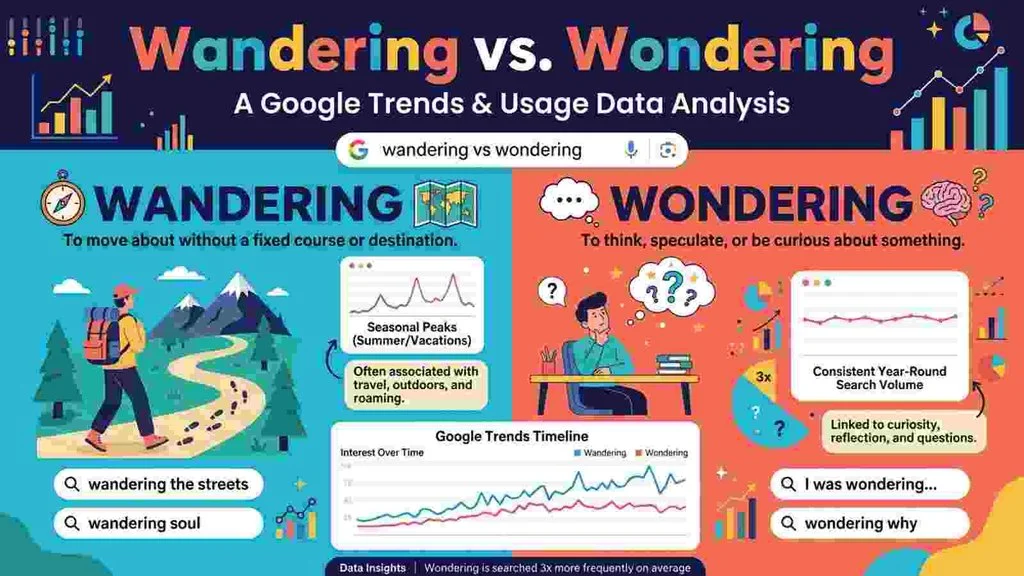
Both words are common in English-speaking countries, including the United States, the United Kingdom, Canada, and Australia. They appear in different contexts because their meanings serve different purposes.
- Wandering often appears in travel writing, nature articles, stories, and discussions about attention.
- Wondering often appears in questions, personal messages, discussions, and polite requests.
People may search for “wandering or wondering” when checking spelling, editing an email, completing homework, or learning English.
Which Word Is More Popular?
Search popularity can change by country, season, and context. A reliable comparison requires checking the exact search terms and selected time range in Google Trends.
Google Trends measures relative search interest, not the total number of words used in everyday writing. Without a live comparison, it would be misleading to claim that one word is more popular worldwide.
For current data, compare both terms in Google Trends and select your target country and time period.
Wandering vs Wondering: Comparison of Word Forms
| Word or phrase | Meaning | Example |
| Wander | Move without a fixed destination | I like to wander through the park. |
| Wandering | Moving without a clear direction | They are wandering around town. |
| Wandered | Moved without a fixed destination | We wandered through the village. |
| Wonder | Feel curious or ask yourself a question | I wonder what happened. |
| Wondering | Thinking or feeling curious | She is wondering about the answer. |
| Wondered | Thought about or felt curious | He wondered why she left. |
This table also shows why the words cannot be exchanged freely. Each belongs to a different base verb.
Frequently Asked Questions
1. What is the main difference between wandering and wondering?
Wandering means moving without a fixed direction or destination. Wondering means thinking about something, asking a question, or feeling curious.
2. Is it “wandering if” or “wondering if”?
The correct phrase is “wondering if.”
Example: “I was wondering if you were available tomorrow.”
Use wondering because you are asking yourself about a possibility.
3. Is it “wandering around” or “wondering around”?
The correct phrase is “wandering around.”
Example: “We spent the morning wandering around the city.”
It describes moving from one place to another without a strict plan.
4. Can wandering describe your thoughts?
Yes. Wandering can describe thoughts or attention that move away from the main subject.
Example: “My mind was wandering during the meeting.”
This does not mean you are asking a question. It means your attention has drifted.
5. Can wondering be used to make a polite request?
Yes. People often use I was wondering if… to make requests sound polite.
Example: “I was wondering if you could send me the report.”
This phrase is common in professional emails and everyday conversation.
6. Are wandering and wondering spelled differently in British and American English?
No. Both British and American English use the same spellings. The correct choice depends on meaning rather than location.
7. How can I remember wandering vs wondering?
Use this simple memory trick:
- Wandering = Walking around.
- Wondering = Wanting to know.
If the sentence is about movement, use wandering. If it is about curiosity or a question, use wondering.
8. What does wandering mean?
Wandering means moving around without a fixed direction or destination — for example, “We spent the afternoon wandering through the park.”
9. What does wondering mean?
Wondering means thinking about something, asking yourself a question, or feeling curious — for example, “I am wondering where my keys are.”
10. Wandering or wondering — which is correct?
Both are correct, but they mean different things: use wandering for moving around and wondering for thinking or asking.
11. How do you use wondering in a sentence?
Use wondering when you are thinking or asking: “I am wondering if it will rain tomorrow.”
Conclusion
Understanding the difference between wandering and wondering will help you write more clearly and avoid common spelling mistakes.
Although these words look and sound similar, they have different meanings. Wandering describes movement without a fixed path or destination.
It can also describe thoughts or attention that drift away from a subject. Wondering, on the other hand, describes thinking, asking yourself a question, or feeling curious about something.
Remember that neither word is limited to British or American English. Both spellings are correct in each variety. What matters most is choosing the word that matches your intended meaning.
Before using either word, read your sentence and ask yourself what you want to express. Are you describing someone walking around, or are you describing a question in someone’s mind? This simple check can help you choose the right word every time.
Whether you are writing a school assignment, a business email, a blog post, or a social media caption, using wandering and wondering correctly will make your English more accurate and professional. With regular practice, the difference will soon become easy to remember.
Continue Reading:
- Emigrate or Immigrate: Definitions, Examples, and Rules ( for 2026)
- Bony or Boney: Meaning, Spelling, and Usage ( for 2026)
- Mat or Matt: Meaning, Spelling, and Usage ( for 2026)
- Cuter or Cutier: Correct Spelling, Meaning, and Usage ( for 2026)
- Selfs or Selves: Meaning, Grammar, and Examples (for 2026)

Here’s a concise 2-line author bio suitable for Simifind.com:
James Dashner is an American bestselling author best known for The Maze Runner series and other popular young-adult fiction.
On Simifind.com, he shares clear, engaging insights and helpful content for readers interested in books, writing, and popular literature.


3 thoughts on “Wandering vs. Wondering: Meaning, Usage, and Examples ( for 2026)”