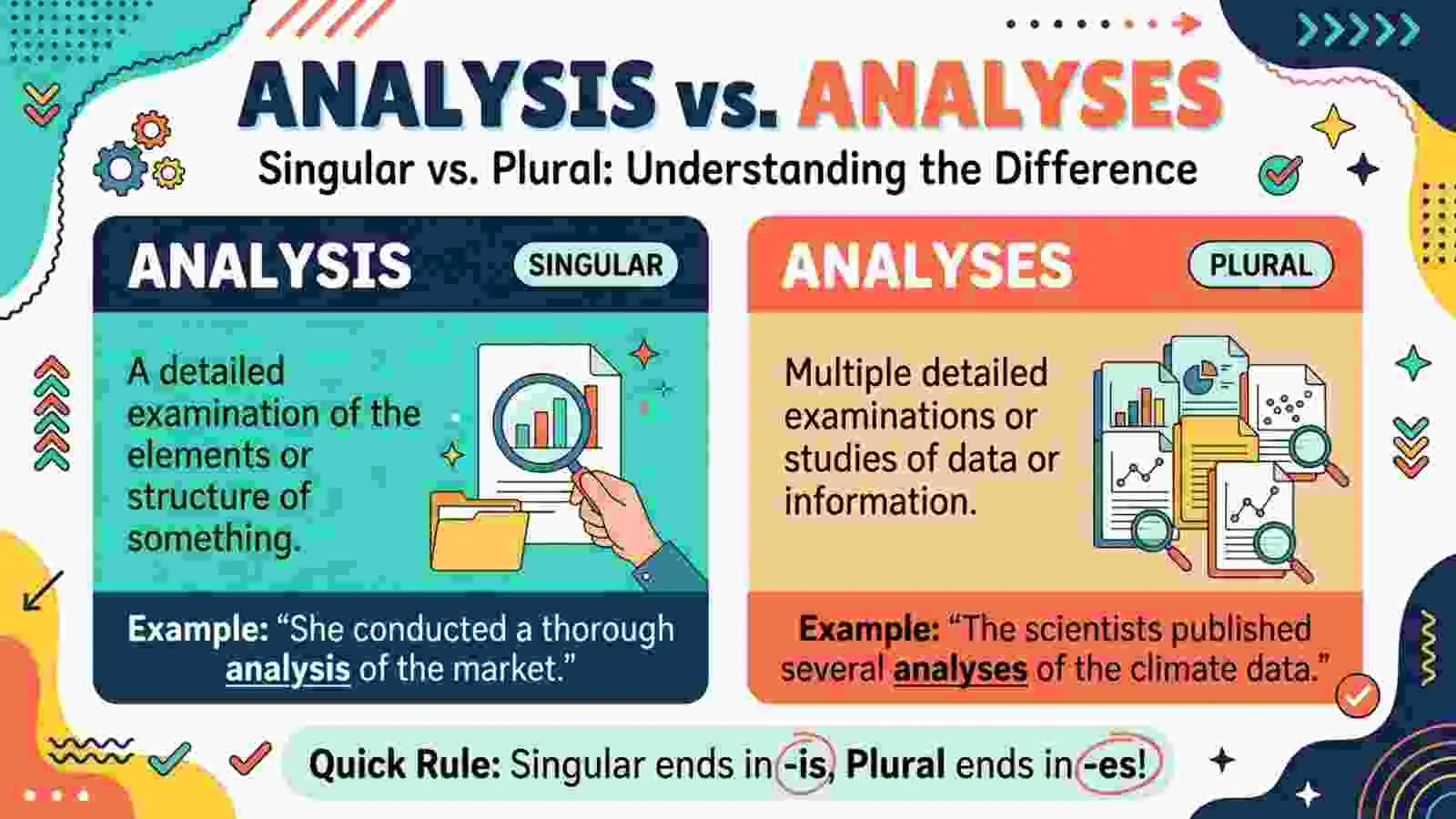
Analysis is correct (singular). Analyses is also correct — it is the plural of analysis. Analysis = a detailed study of something; analyses = more than one such study.
Have you ever written the word analysis and wondered if analyses was the correct choice?
You are not alone. Many people mix up these two words because they look almost the same. However, they have different meanings in a sentence.
Knowing when to use each word can make your writing clear and correct.
The main difference between analysis or analyses is number. Analysis is the singular form. It means a close study of something.
Analyses is the plural form. It means more than one study. For example, a student may write one analysis of a book, while a teacher may review several analyses of the same book.
People often search for these words when writing essays, reports, emails, research papers, and business documents.
The spelling can also be confusing because the plural form does not follow the usual rule of adding -s or -es to a word.
In this guide, you will learn the meaning, origin, spelling rules, and correct use of both words. You will also see simple examples and common mistakes. By the end, you will know which word to use in everyday and formal writing.
Analysis or Analyses – Quick Answer
Analysis is singular, while analyses is plural.
Use analysis when talking about one study or examination. Use analyses when talking about two or more studies.
Examples:
- Correct: The analysis shows a clear result.
- Correct: The analyses show different results.
- Correct: Our team completed one analysis of the report.
- Correct: Our team completed three analyses of the report.
The word analysis is used for a close study of facts, data, ideas, or problems. The word analyses refers to several such studies.
Remember this simple rule:
- One = analysis
- More than one = analyses
The pronunciation also changes. Analysis is commonly pronounced uh-NAL-uh-sis. Analyses is commonly pronounced uh-NAL-uh-seez.
The Origin of Analysis and Analyses
The word analysis comes from the Greek word analysis, which relates to breaking something apart or loosening it. It entered English through Latin and French.
The word describes the process of breaking a complex subject into smaller parts to understand it better. Today, it is common in science, education, business, literature, and research.
The plural form analyses follows a pattern found in some words that come from Greek. These words often change their endings instead of simply adding -s.
For example:
- Analysis → Analyses
- Thesis → Theses
- Crisis → Crises
- Diagnosis → Diagnoses
These changes can seem unusual, but they follow established English spelling patterns.
The important point is that analysis and analyses are not British and American spelling variations. They are different grammatical forms of the same word. Both forms are correct in British and American English.
British English vs American English Spelling
British and American English use the same spellings for analysis and analyses. The difference depends on whether you mean one study or several, not which English variety you use.
| Feature | British English | American English |
| Singular | Analysis | Analysis |
| Plural | Analyses | Analyses |
| One study | This analysis is useful. | This analysis is useful. |
| Several studies | These analyses are useful. | These analyses are useful. |
| Pronunciation of singular | uh-NAL-uh-sis | uh-NAL-uh-sis |
| Pronunciation of plural | uh-NAL-uh-seez | uh-NAL-uh-seez |
Why Do People Confuse the Spellings?
The main reason is that the words look similar. The only spelling change is near the end.
Another reason is that many English nouns form their plurals by adding -s. For example, report becomes reports. However, analysis changes to analyses.
This rule is also found in words such as thesis and crisis.
Examples in Both English Varieties
British English:
- The analysis of the results is complete.
- The researchers published two analyses.
American English:
- The analysis of the results is complete.
- The researchers published two analyses.
Both forms follow the same rules in the UK and the US.
Which Spelling Should You Use?
The right choice depends on how many studies you mean. Your audience does not change the spelling.
Use Analysis for One Study
Choose analysis when you discuss one report, one review, or one detailed examination.
Examples:
- The analysis of the data is complete.
- Her analysis of the novel is excellent.
- The financial analysis found a problem.
Use Analyses for Several Studies
Choose analyses when you discuss two or more separate studies or examinations.
Examples:
- The analyses support our findings.
- We compared three analyses of the issue.
- The company reviewed several market analyses.
Advice for Global and Professional Writing
If you write for readers in the United States, the United Kingdom, Canada, Australia, Pakistan, or other countries, use the same number rule.
In academic writing, check whether you are referring to one study or multiple studies. In business reports, use analysis for one examination and analyses for multiple examinations.
For SEO content, use the form that matches the reader’s search and the meaning of the sentence. Do not use analyses just because it looks more formal. Correct grammar matters more than appearance.
Common Mistakes with Analysis or Analyses
Writers often make a few simple mistakes when using these words. Here are the most common ones and how to fix them.
Mistake 1: Using Analysis for More Than One Study
Incorrect: The three analysis were useful.
Correct: The three analyses were useful.
Why? The sentence refers to three studies, so the plural form is needed.
Mistake 2: Using Analyses for One Study
Incorrect: This analyses explains the problem.
Correct: This analysis explains the problem.
Why? The sentence refers to one study.
Mistake 3: Adding -es to Make the Wrong Form
Incorrect: Analysises
Correct: Analyses
Why? The accepted plural form changes the ending from -is to -es. Do not add another ending.
Mistake 4: Using the Wrong Verb
Incorrect: The analyses shows a clear pattern.
Correct: The analyses show a clear pattern.
Why? Analyses is plural, so it normally takes a plural verb, such as show, are, or have.
Mistake 5: Confusing the Noun with the Verb
The word analyses can also be a verb form. It is the third-person singular form of analyse in British English or analyze in American English.
Examples:
- The researcher analyses the results. (British English)
- The researcher analyzes the results. (American English)
In these sentences, analyses describes an action. It is not a plural noun.
Analysis or Analyses in Everyday Examples
These words appear in schoolwork, business, news reports, social media, and research. The correct choice depends on the meaning of the sentence.
1. In Emails
Analysis:
Subject: Project Analysis
Dear Team,
Please review the analysis attached to this email. It explains the project’s main results.
Best regards,
Alex
Analyses:
Subject: Research Analyses
Dear Team,
Please review the three analyses attached to this email. Each document covers a different part of the project.
Best regards,
Alex
2. In News Reports
- The analysis of the election results points to a close race.
- Several political analyses explain why voters changed their choices.
The first sentence discusses one examination. The second refers to multiple examinations.
3. On Social Media
- I shared my analysis of the latest match.
- These analyses of the game offer different views.
Both sentences are correct because the noun matches the number of studies.
4. In Academic Writing
- This analysis examines the causes of climate change.
- The two analyses use different research methods.
Academic writers should use the singular or plural form with care because it helps readers understand the number of studies being discussed.
5. In Business Reports
- Our sales analysis shows steady growth.
- The financial and market analyses support the new plan.
The first example refers to one study. The second refers to two different types of study.
Analysis or Analyses – Google Trends and Usage Data

People search for analysis or analyses when they need to check grammar, spelling, or academic usage. Students, teachers, researchers, editors, and business writers may all need to understand the difference.
Search interest can vary by country and context. However, it is important to separate general language use from actual search data.
Where Are These Words Used?
Both words are used in:
- United States: Research papers, business reports, and school assignments.
- United Kingdom: Academic writing, news articles, and professional reports.
- Canada and Australia: Education, research, and workplace communication.
- Pakistan and other English-learning markets: Grammar searches, examinations, essays, and formal writing.
These are examples of common contexts, not a ranking of search popularity.
What About Google Trends?
Google Trends can help compare search interest for analysis and analyses across countries and over time. Its values are normalized on a scale from 0 to 100, rather than showing exact search counts.
No live Google Trends results are provided here, so a reliable country-by-country ranking or numerical comparison cannot be confirmed.
To research this topic, compare both terms in Google Trends, select your target countries, and review the results over the same time period. You can also compare related searches such as analysis meaning, analyses plural, and analysis vs analyses.
Which Word Is More Common?
Analysis is widely used because people often refer to one study, report, or examination. Analyses is used when several studies are discussed.
The more useful choice depends on the sentence. Search popularity should not determine which form you use.
Comparison Table: Analysis vs Analyses
| Feature | Analysis | Analyses |
| Word form | Singular noun | Plural noun |
| Main meaning | One detailed study | Two or more detailed studies |
| Example | The analysis is ready. | The analyses are ready. |
| Typical verb | Is, shows, has | Are, show, have |
| British spelling | Analysis | Analyses |
| American spelling | Analysis | Analyses |
| Common mistake | Using it for multiple studies | Using it for one study |
| Related meaning | One examination | Multiple examinations |
Note that analyses can also be a verb in British English, as in “She analyses the data.” Context tells you which form is being used.
Frequently Asked Questions
1. Is analyses the plural of analysis?
Yes. Analysis is singular, and analyses is its plural form. For example, one analysis and two analyses.
2. Is analysis American or British English?
Both American and British English use analysis for the singular form. Both use analyses for the plural form.
3. How do you spell the plural of analysis?
The correct plural spelling is analyses. Do not write analysises.
4. Is analyses singular or plural?
As a noun, analyses is plural. For example, “The analyses are complete.” However, in British English, analyses can also be a singular verb form, as in “She analyses the results.”
5. What is the difference between analysis and analyses?
Analysis means one detailed study or examination. Analyses means more than one. The difference is grammatical number, not regional spelling.
6. Can I use analyses in an academic paper?
Yes. Use analyses when discussing multiple studies, examinations, or separate ways of studying a topic. Use analysis when referring to one.
7. What is the easiest way to remember the difference?
Remember this simple rule: one analysis, two analyses. If you can replace the word with “one study,” use analysis. If you mean “several studies,” use analyses.
8. Is analysis plural?
No. Analysis is singular — it means one detailed study. Analyses is the plural form, for more than one study.
9. What does analysis mean?
Analysis means a detailed study of something — examining its parts to understand it. For example, “The report includes an analysis of sales data.”
10. Analysis or analyses — which is correct?
Both are correct — they are different forms of the same word. Use analysis for one study and analyses for more than one study.
Conclusion
Understanding the difference between analysis or analyses is simple once you learn the basic rule.
Analysis is the singular form, used when you mean one detailed study or examination.
Analyses is the plural form, used when you mean two or more studies.
These spellings are the same in British and American English. The choice does not depend on your country, writing style, or level of formality.
It depends on the number of studies you are discussing.
Remember to check the verb as well. For example, “The analysis shows” is correct, while “The analyses show” is correct when you mean several studies. Avoid incorrect forms such as analysises.
Whether you are writing an essay, preparing a research paper, sending a business email, or publishing an online article, choosing the correct word helps your writing sound clear and professional.
When in doubt, ask yourself one simple question: Am I talking about one study or more than one? That answer will guide you to the correct form every time.
Continue Reading:
- Yourself vs Your Self: Grammar, and Sentence Examples ( for 2026)
- Bearer vs. Barer: Meaning, Differences, and Usage ( for 2026)
- Wandering vs. Wondering: Meaning, Usage, and Examples ( for 2026)
- Cuter or Cutier: Correct Spelling, Meaning, and Usage ( for 2026)
- Selfs or Selves: Meaning, Grammar, and Examples (for 2026)

Mary Roach is an American science writer and bestselling author known for making unusual and complex scientific topics engaging, accessible, and humorous. Her books include Stiff, Packing for Mars, Gulp, and Fuzz.
Author at Simifind.com, sharing clear, informative content designed to help readers understand interesting topics and everyday questions.








3 thoughts on “Analysis or Analyses: Definition, Pronunciation, and Usage( for 2026)”