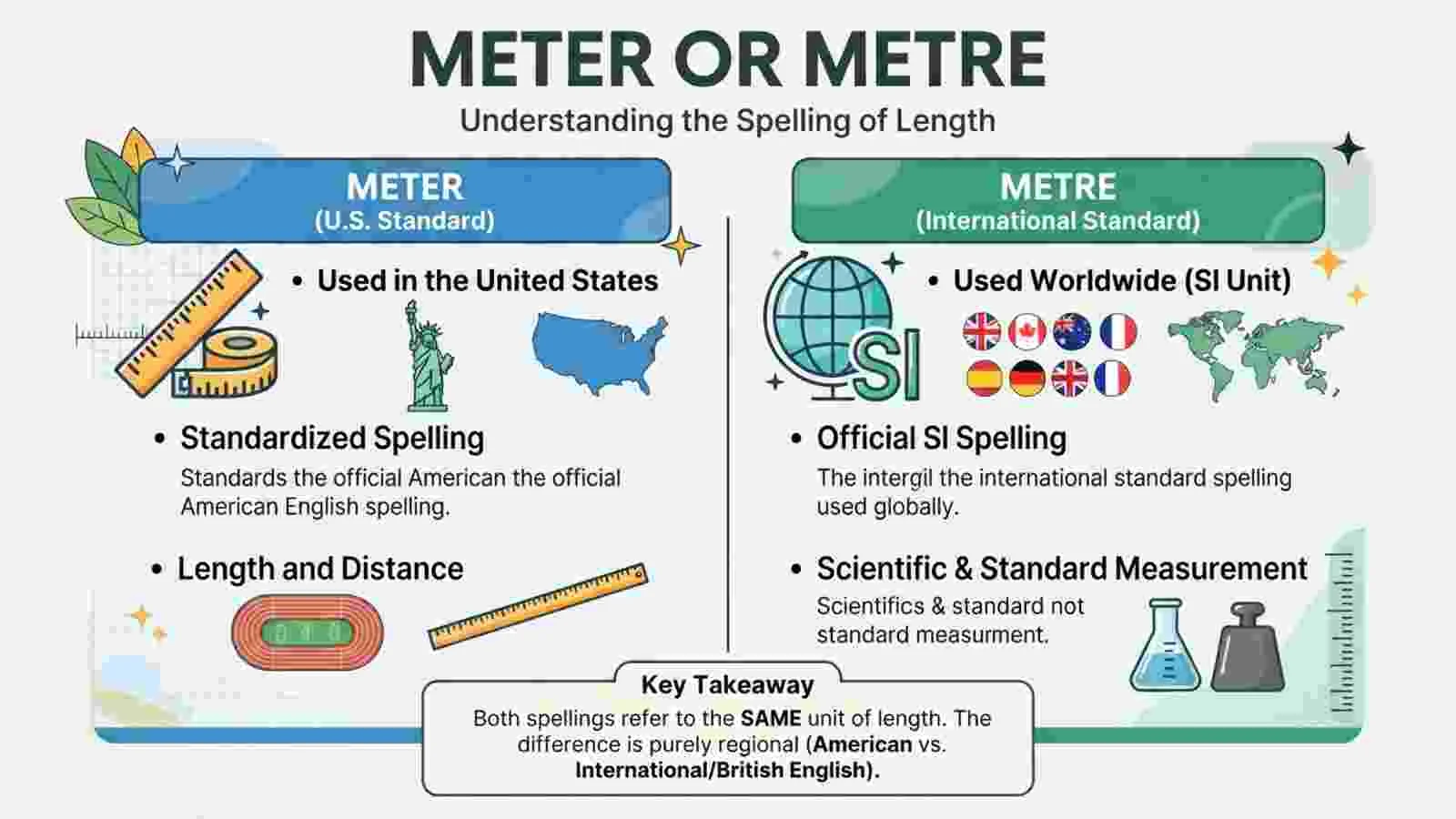
Both metre and meter are correct. Metre is British English (the unit of length), meter is American English. Meter is also the device that measures (electricity meter, parking meter) in both British and American English.
Have you ever wondered whether to write metre or meter?
Both spellings are correct, but the right choice depends on where you live and how you use the word.
This small spelling difference can confuse students, writers, bloggers, and people learning English.
The word refers to a unit of length in the metric system. One metre or meter equals 100 centimetres or 1,000 millimetres.
However, British English uses metre, while American English uses meter for this unit.
There is another important point. In both British and American English, meter can also mean a device that measures something, such as an electricity meter, a parking meter, or a water meter.
People often search for this keyword because they want to choose the correct spelling for schoolwork, professional documents, websites, or everyday messages.
Knowing the difference helps you write clearly and avoid spelling errors.
In this guide, you will learn the meaning, origin, spelling rules, and correct use of both words. You will also find examples, a comparison table, and answers to common questions.
Metre or Meter – Quick Answer
Both metre and meter are correct spellings. The main difference is regional English usage.
- Metre: British English spelling for a unit of length.
- Meter: American English spelling for a unit of length.
- Meter: The standard spelling for a measuring device in both British and American English.
For example, a British writer may say, “The room is five metres long.” An American writer would usually write, “The room is five meters long.”
Both sentences have the same meaning. The only difference is the spelling used in each English variety.
What Does Metre or Meter Mean?
A metre or meter is a standard unit of length in the metric system. It is used to measure the length, height, width, or distance of something.
For example:
- The table is two metres long.
- The road is 500 meters wide.
- The child is one metre tall.
- The runner completed a 100-meter race.
The word meter also refers to a device that measures or records something. For example, an electricity meter records power use, while a parking meter helps manage paid parking.
The Origin of Metre or Meter
The word metre comes from the French word mètre. Its deeper roots are linked to the Greek word metron, which means “measure.”
The metric system developed in France during the late eighteenth century. The metre became a key unit for measuring length and helped create a standard system used across countries.
As the word spread into English, different spelling traditions developed. British English adopted metre, following the French-style spelling. American English adopted meter, following spelling reforms that favored simpler forms for several words.
This difference is also found in other English words. For example, British English uses centre, while American English uses center. Similarly, British writers often use litre, while American writers use liter.
The word meter has a separate but related use. It refers to a device that measures something, such as gas, electricity, water, or distance. This spelling is standard in both British and American English.
Understanding this history helps explain why both spellings are correct. Neither form is wrong. Each follows a recognized spelling tradition.
British English vs American English Spelling
British and American English often use different spellings for the same word. The difference between metre and meter is one of the most common examples.
In British English, metre is the usual spelling for a unit of length. It appears in schoolbooks, news reports, official documents, and everyday writing.
In American English, meter is used for the same unit. It is common in science, education, sports, and daily communication.
However, both varieties use meter when referring to a measuring device.
Metre vs Meter: Comparison Table
| Feature | Metre | Meter |
| Main use | Unit of length in British English | Unit of length in American English |
| British English | Standard spelling for length | Standard spelling for a measuring device |
| American English | Not the usual spelling for length | Standard spelling for length and measuring devices |
| Pronunciation | Usually the same | Usually the same |
| Meaning as a unit | One unit of length | One unit of length |
| Example | Three metres long | Three meters long |
| Correctness | Correct in British English | Correct in American English |
Examples of British and American Usage
British English:
- The swimming pool is 25 metres long.
- The runner won the 100-metre race.
- The garden is ten metres wide.
American English:
- The swimming pool is 25 meters long.
- The runner won the 100-meter race.
- The garden is ten meters wide.
The meaning stays the same in every example. Only the spelling changes.
Metre or Meter in Measurement
When measuring length, choose the spelling that matches your audience.
For instance, a British school assignment should normally use metre. An American science report should use meter.
The same rule applies to related forms. British English often uses metres, while American English uses meters. In compound terms, British writers may use metre-long, while American writers may use meter-long, depending on the sentence and style guide.
Which Spelling Should You Use?
The best spelling depends on your readers, location, and writing purpose. Both forms are accepted, but using the correct regional form makes your writing more natural.
Use Metre for British English
Choose metre when writing for readers in the United Kingdom. It is also common in other countries that follow British spelling, including Pakistan, India, Australia, and New Zealand.
Examples:
- The building is 40 metres tall.
- The school has a 200-metre running track.
- The rope is three metres long.
If you are writing an academic assignment in Pakistan, British English is often a suitable choice unless your school, university, or examination board requires American English.
Use Meter for American English
Choose meter when writing for an American audience. This spelling is used in US schools, newspapers, websites, and official documents.
Examples:
- The building is 40 meters tall.
- The school has a 200-meter running track.
- The rope is three meters long.
American English also uses meter for measuring devices, such as a gas meter or a parking meter.
Which Spelling Is Better for Global Websites?
For a website with readers around the world, consistency matters most. Choose one spelling style based on your main audience and use it throughout your content.
If most readers come from the United States, use meter. If your audience is mainly in the UK or Commonwealth countries, use metre.
For SEO, both spellings can attract search traffic. You can mention the alternative spelling naturally when it helps readers understand the difference. Avoid repeating both words without a clear reason.
Common Mistakes with Metre or Meter
Writers sometimes confuse these spellings because they sound alike. Learning a few simple rules can help you avoid common errors.
Mistake 1: Using Metre in American English
Incorrect for standard American English: The room is five metres long.
Correct: The room is five meters long.
American English normally uses meter for length.
Mistake 2: Using Meter in British English for Length
Less suitable for standard British English: The room is five meters long.
Preferred: The room is five metres long.
British English normally uses metre for a unit of length.
Mistake 3: Spelling a Measuring Device as Metre
Incorrect: The electricity metre is broken.
Correct: The electricity meter is broken.
Use meter for a device that measures or records something in both British and American English.
Mistake 4: Mixing Spelling Styles
A writer may use metre in one paragraph and meter in another when referring to length. This can make an article look inconsistent.
To avoid this problem, choose British or American English before you begin writing. Then check your work for consistent spelling.
Mistake 5: Confusing Metre with Centimetre
A metre and a centimetre are both units of length, but they are not the same size.
One metre equals 100 centimetres. For example, a desk that is 120 centimetres long is also 1.2 metres long.
Remember this simple rule: choose the correct regional spelling, and use the right unit for the measurement.
Metre or Meter in Everyday Examples
These words appear in many kinds of writing, from emails and news stories to social media posts and formal reports.
1. Examples in Emails
British English:
“Hello, the office table is two metres long. Please confirm whether it will fit in the meeting room.”
American English:
“Hello, the office table is two meters long. Please confirm whether it will fit in the meeting room.”
Both messages are correct for their respective audiences.
2. Examples in News Reports
British English: “The athlete won the 100-metre race at the school sports event.”
American English: “The athlete won the 100-meter race at the school sports event.”
News organizations usually follow a consistent regional style guide.
3. Examples on Social Media
British English: “My new bookshelf is almost two metres tall!”
American English: “My new bookshelf is almost two meters tall!”
These examples show how the spelling changes while the meaning remains the same.
4. Examples in Formal Writing
British English: “The proposed bridge will extend 300 metres across the river.”
American English: “The proposed bridge will extend 300 meters across the river.”
In reports, research papers, and technical documents, use the spelling preferred by your organization or publisher.
5. Examples with Measuring Devices
The word meter is used for a measuring device in both varieties of English.
Examples:
- The electricity meter needs to be checked.
- Please read the water meter before leaving.
- The parking meter accepts card payments.
These sentences use meter correctly in both British and American English.
Metre or Meter – Google Trends and Usage Data
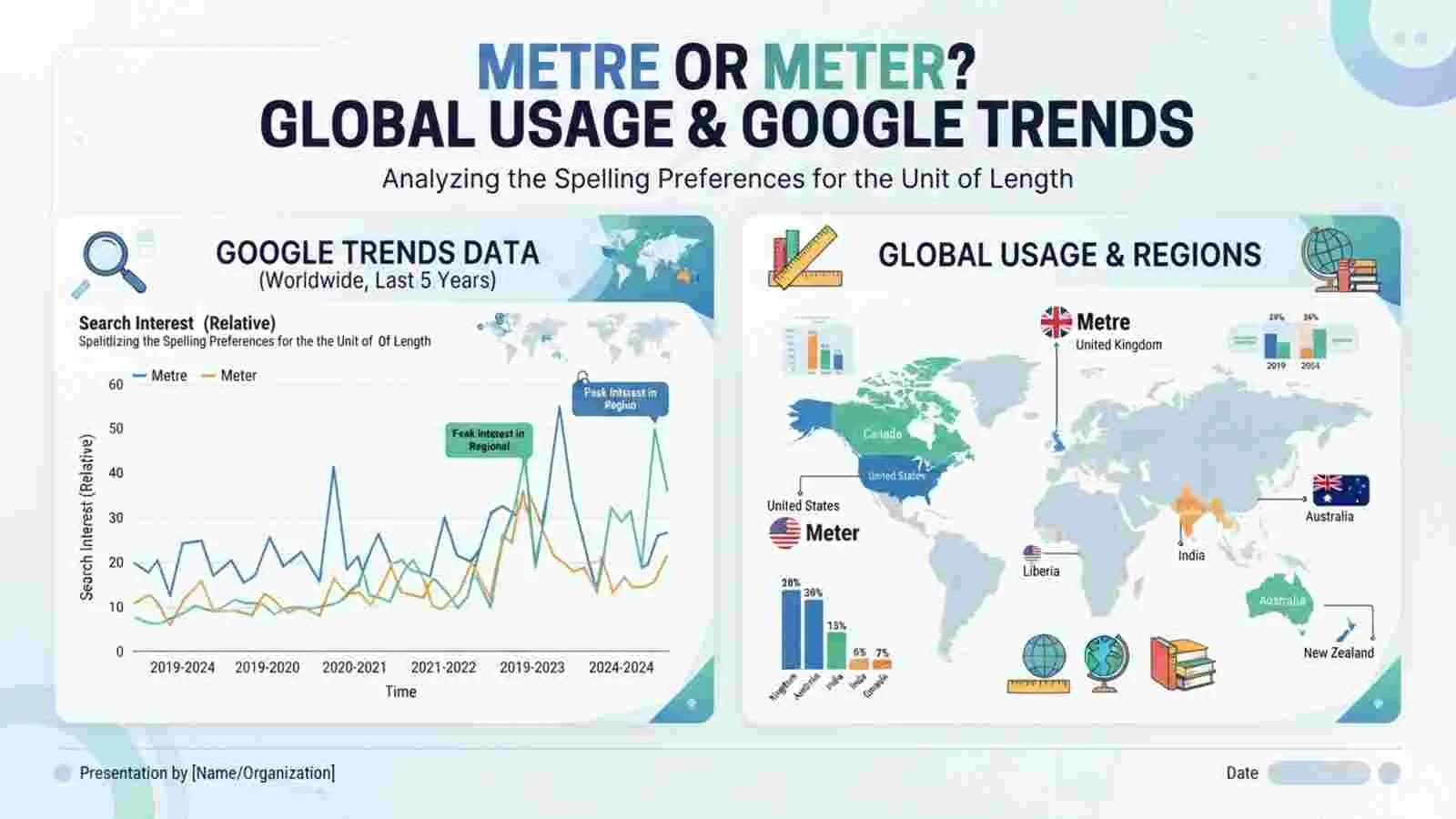
People search for metre or meter because they want to know which spelling is correct. Search interest can vary by country, audience, and subject.
In the United States, meter is the normal spelling for a unit of length. In the United Kingdom, metre is the usual form. Other countries may follow British or American conventions depending on their education systems, publishers, and local writing practices.
Searches may also reflect different meanings. Someone looking for meter could be searching for a unit of length, an electricity meter, a parking meter, or a device used in science. The search term alone does not reveal which meaning the person wants.
Google Trends can help compare interest in metre and meter over time and across locations. However, search interest is not the same as total word usage, and it does not prove that one spelling is more correct than the other.
No live Google Trends figures are included here, so exact rankings, search volumes, and popularity percentages should not be assumed. For accurate research, compare both terms by country and select the topic most relevant to your article.
Metre vs Meter: Keyword Variations
| Keyword variation | Main search intent |
| Metre or meter | Find the correct spelling |
| Meter vs metre | Compare the two spellings |
| Metre meaning | Understand the British spelling |
| Meter meaning | Understand the American spelling or measuring device |
| One metre in cm | Convert metres to centimetres |
| One meter in feet | Convert meters to feet |
| Metres to meters | Understand spelling and measurement |
| Metre or meter UK | Find British English usage |
| Metre or meter US | Find American English usage |
| Electricity meter | Learn about a measuring device |
These keyword variations can help you plan useful supporting sections. Use them naturally, and focus on answering the reader’s question rather than repeating keywords.
Frequently Asked Questions
1. Is metre or meter correct?
Both are correct. Metre is the standard British English spelling for a unit of length, while meter is the standard American English spelling.
2. Is metre British or American?
Metre is British English. It is also used in many countries that follow British spelling conventions, including Pakistan, India, Australia, and New Zealand.
3. Is meter American or British?
Meter is the standard American spelling for a unit of length. British English also uses meter when referring to a measuring device.
4. Do metre and meter mean the same thing?
Yes, when they refer to a unit of length. Both describe the same metric unit. The difference is spelling, not measurement.
5. How many centimetres are in one metre?
One metre equals 100 centimetres. The same measurement applies when the unit is written as meter in American English.
6. Should I use metre or meter in Pakistan?
British English spelling is commonly used in Pakistan, so metre is often the preferred choice for a unit of length. However, follow the style guide used by your school, university, employer, or publisher.
7. Why is a measuring device called a meter in British English?
British English uses meter for devices that measure or record values, such as electricity, gas, and water use. This spelling is standard in both British and American English, even though the unit of length is spelled differently.
8. What does metre mean?
Metre means a unit of length in the metric system, equal to 100 centimetres — for example, “The room is five metres long.”
9. What does meter mean?
Meter means a unit of length in American English, or a device that measures something — for example, “The electricity meter shows how much power was used.”
10. Is metre a word?
Yes, metre is a real English word — it is the British English spelling of the metric unit of length.
11. How do you spell metre?
Spell it M-E-T-R-E: metre, with -re at the end, not -er.
Conclusion
The choice between metre and meter is simple once you know the difference between British and American English. Both spellings are correct, but each has a preferred place in writing.
Use metre when writing about length for a British English audience. For example, you might write, “The classroom is eight metres long.” Use meter for the same measurement when writing for an American audience: “The classroom is eight meters long.”
Remember that meter also refers to a measuring device in both varieties of English. You can correctly write electricity meter, water meter, and parking meter regardless of whether your audience uses British or American spelling.
For students, bloggers, and professional writers, the best approach is to follow the spelling rules of your intended audience. If you are writing for readers in Pakistan or other Commonwealth countries, metre is usually a suitable choice for length. For US readers, choose meter.
In short, neither spelling is wrong. Choose the version that fits your readers, stay consistent throughout your work, and use the correct word for the intended meaning.
Continue Reading:
- Liter vs Litre: Meaning, Difference, and Usage ( for 2026)
- Analysis or Analyses: Definition, Pronunciation, and Usage( for 2026)
- Yourself vs Your Self: Grammar, and Sentence Examples ( for 2026)
- Cuter or Cutier: Correct Spelling, Meaning, and Usage ( for 2026)
- Selfs or Selves: Meaning, Grammar, and Examples (for 2026)

Here’s a concise 2-line author bio suitable for Simifind.com:
James Dashner is an American bestselling author best known for The Maze Runner series and other popular young-adult fiction.
On Simifind.com, he shares clear, engaging insights and helpful content for readers interested in books, writing, and popular literature.








3 thoughts on “Metre vs Meter: Meaning, Spelling, and Usage Explained ( for 2026)”