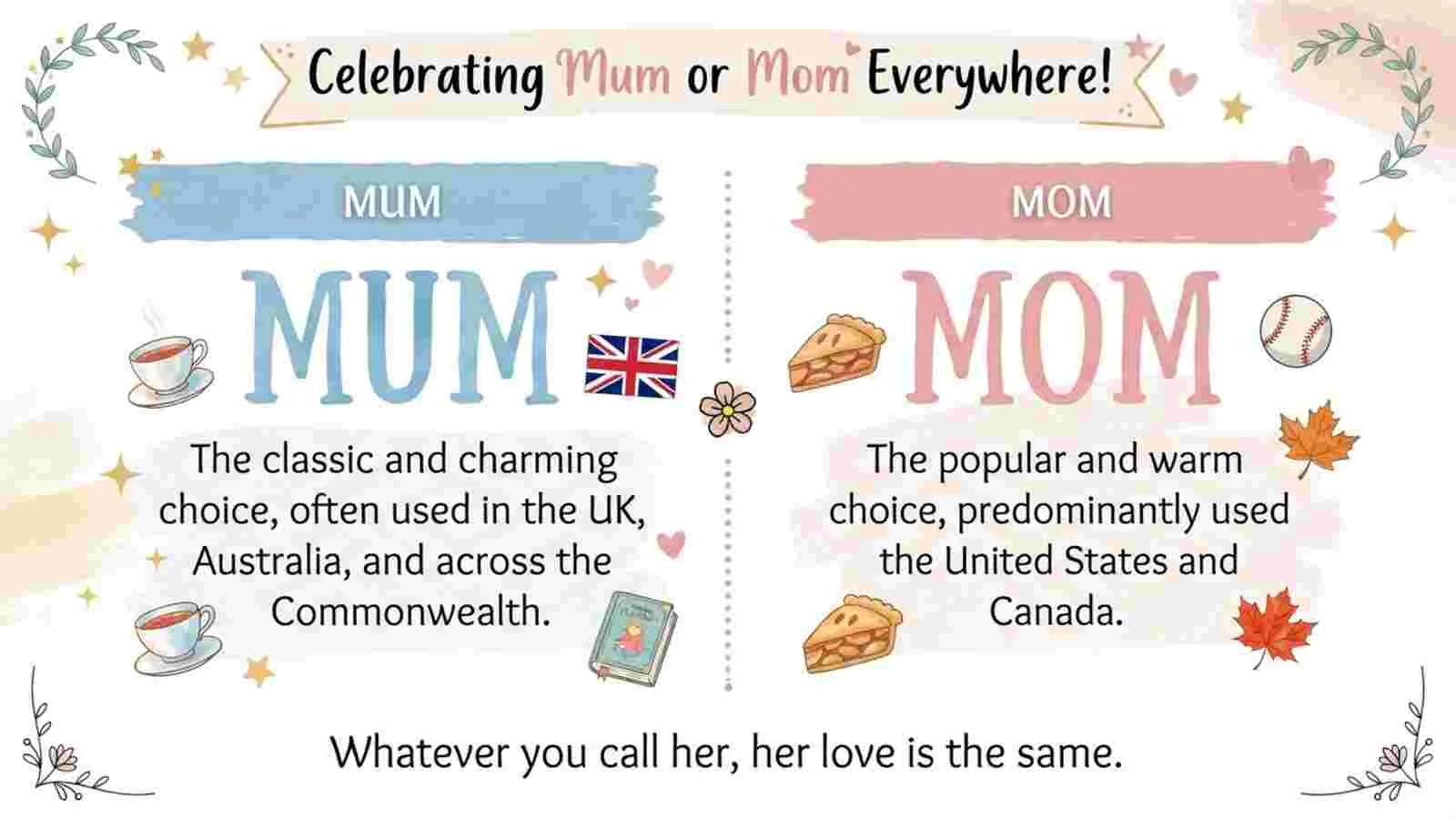
Both mum and mom are correct and mean mother. Mum is the usual word in British English; mom is the usual word in American English.
Have you ever wondered whether to write mum or mom?
Both words mean the same thing: a mother. However, the correct spelling depends on where you live and which type of English you use.
People often search for this difference when writing messages, school assignments, blog posts, or social media captions.
The main difference is simple. Mum is common in British English, while mom is common in American English.
Both words are correct, and neither is better than the other. The choice depends on your audience and location.
For example, someone in the United Kingdom might write, “My mum is very kind.”
In the United States, the same person would usually write, “My mom is very kind.” Both sentences are correct and have the same meaning.
In this guide, you will learn the meaning, origin, and spelling rules of mum and mom.
You will also see examples, common mistakes, regional differences, and answers to popular questions.
By the end, you will know which spelling to use in everyday writing and formal content.
Mum or Mom – Quick Answer
Mum is the usual British English spelling, while mom is the usual American English spelling. Both words mean a female parent and are often used as warm, informal names for a mother.
Here are two simple examples:
- British English: My mum makes the best tea.
- American English: My mom makes the best cookies.
Both sentences are correct. The only difference is the spelling of the word.
In the United Kingdom, Australia, and many other English-speaking communities, people commonly use mum. In the United States, mom is the standard choice.
The word mum can also mean silent or quiet in British informal speech, as in “Keep mum about the surprise.” This is a separate use of the word. In the comparison between mum and mom, both refer to a mother.
Quick rule: Use mum for a British audience and mom for an American audience.
The Origin of Mum or Mom
The words mum and mom developed from familiar forms of the word mother. Across many languages, young children use short sounds such as “ma,” “mama,” and “mamma” when speaking to their mothers.
These simple sounds are easy for babies to make. Over time, they became common words for mothers in many cultures.
How Did the Word Mum Develop?
Mum became a familiar word for mother in British English. It is widely used in everyday conversations, family messages, books, and television shows.
For example:
- “I love my mum.”
- “Mum, can you help me?”
- “My mum is coming home today.”
The spelling is especially common in the United Kingdom and Australia.
How Did the Word Mom Develop?
Mom became the standard informal word for mother in American English. It is used throughout the United States in family conversations, school writing, films, and popular culture.
For example:
- “My mom is at work.”
- “Mom, where are my shoes?”
- “I bought a gift for my mom.”
Although the spellings differ, both words have the same basic meaning.
Why Do the Spellings Differ?
English has several regional differences in spelling and vocabulary. Some words change because of historical language development and local usage.
For example, British English often uses colour, while American English uses color. Similarly, British speakers commonly write mum, while Americans usually write mom.
These differences are a normal part of English. They do not make one spelling more correct than the other.
British English vs American English Spelling
The main difference between mum and mom is regional preference. British English normally uses mum, while American English normally uses mom.
Both words are nouns. They can refer to a person’s mother or be used directly when speaking to her.
Comparison Table: Mum vs Mom
| Feature | Mum | Mom |
| Main variety | British English | American English |
| Meaning | Mother | Mother |
| Word type | Noun | Noun |
| Common use | UK, Australia | United States |
| Example | My mum is kind. | My mom is kind. |
| Informal tone | Yes | Yes |
| Correct spelling | Yes | Yes |
Examples in British English
British speakers commonly use mum in everyday situations.
- My mum is making dinner.
- I called my mum yesterday.
- Mum, I need your help.
- My mum works at a school.
These sentences sound natural to many British English speakers.
Examples in American English
American speakers usually prefer mom in the same situations.
- My mom is making dinner.
- I called my mom yesterday.
- Mom, I need your help.
- My mom works at a school.
These sentences are natural in American English.
What About Australia and Canada?
Australia generally uses mum. Canada commonly uses mom, although regional and personal preferences can vary. Other English-speaking countries may use one form more often than the other.
When writing for a particular country, follow the spelling used by your audience.
Which Spelling Should You Use?
The best spelling depends on your readers, your location, and the type of content you are writing. Both forms are correct, so you should focus on consistency.
Use Mum for British English
Choose mum when writing for readers in the United Kingdom or Australia. It is also a familiar spelling in many other Commonwealth settings.
Examples:
- My mum loves gardening.
- I am buying a card for my mum.
- My mum taught me to be kind.
If you write a British lifestyle blog or a school assignment in British English, mum is usually the right choice.
Use Mom for American English
Choose mom when writing for an American audience. It is the standard spelling in the United States.
Examples:
- My mom loves gardening.
- I am buying a card for my mom.
- My mom taught me to be kind.
If you write for an American website, newspaper, or school, mom is generally the better choice.
What Should Global Writers Use?
If your content targets readers around the world, think about your main audience. For a US-based website, use mom. For a UK-based website, use mum.
You can also mention both forms when explaining English spelling differences. This helps readers understand the topic without suggesting that either form is wrong.
Professional tip: Choose one variety of English for each article and use it consistently. Avoid switching between mum and mom without a clear reason.
Common Mistakes with Mum or Mom
Although these words are easy to understand, writers sometimes use them incorrectly. Here are common mistakes and simple ways to avoid them.
Mistake 1: Thinking One Spelling Is Wrong
Incorrect idea: “Mom is always wrong in British English, and mum is always wrong in American English.”
Correction: Both are valid English words. However, mum is standard in British English, and mom is standard in American English.
Mistake 2: Mixing Regional Spellings
Example:
“My mum lives in London, and my mom loves visiting her.”
This sentence is grammatically possible if the writer is referring to two different people or deliberately mixing regional language. However, using both spellings for the same person in one article may look inconsistent.
Better approach: Follow one regional spelling throughout your content.
Mistake 3: Using the Wrong Word in Direct Address
When speaking directly to your mother, capitalize the word when it functions as a name.
- Correct: “Mum, can you help me?”
- Correct: “Mom, can you help me?”
When you use the word as a general noun, lowercase it.
- Correct: “My mum is here.”
- Correct: “My mom is here.”
Mistake 4: Confusing Mum with Mummy or Mom with Mommy
Mummy and mommy are affectionate forms of mother. They are often used by young children or in loving family conversations.
- British English: “I love you, Mummy.”
- American English: “I love you, Mommy.”
These words are related to mum and mom, but they have their own spelling conventions.
Mistake 5: Using Mum or Mom in Every Formal Context
In formal writing, mother may be more suitable than either informal term.
For example:
- Informal: “My mom called me.”
- More formal: “My mother called me.”
However, mum and mom are perfectly suitable when the subject or tone calls for familiar, personal language.
Mum or Mom in Everyday Examples
Both words appear in everyday conversations, emails, news stories, social media posts, and personal writing. The correct choice depends on the intended audience and tone.
1. In Emails
Informal email:
“Hi Sarah, I am taking my mum to the doctor tomorrow.”
American version:
“Hi Sarah, I am taking my mom to the doctor tomorrow.”
For a formal email, you might write “my mother” if that better suits the situation.
2. In News and Articles
A British news article might say:
“The child went shopping with her mum.”
An American article might say:
“The child went shopping with her mom.”
Both sentences communicate the same information. News outlets generally follow their chosen style guide and regional English conventions.
3. On Social Media
People often use these words in birthday wishes, family photos, and Mother’s Day posts.
Examples:
- “Happy birthday to my wonderful mum!”
- “My mom is my biggest supporter.”
- “Thank you, Mum, for everything.”
- “Love you, Mom!”
Choose the spelling that feels natural for your audience and personal style.
4. In School Assignments
Students should follow the spelling conventions required by their school or teacher.
British English example: “My mum inspires me because she works hard.”
American English example: “My mom inspires me because she works hard.”
If no particular variety is required, either spelling is understandable. Consistency is the key.
5. In Formal Writing
The word mother is often more appropriate in academic or professional writing.
Example:
“My mother has always encouraged me to study.”
However, if you are writing a personal story, interview, quotation, or family-focused article, mum or mom may be the more natural choice.
Mum or Mom – Google Trends and Usage Data
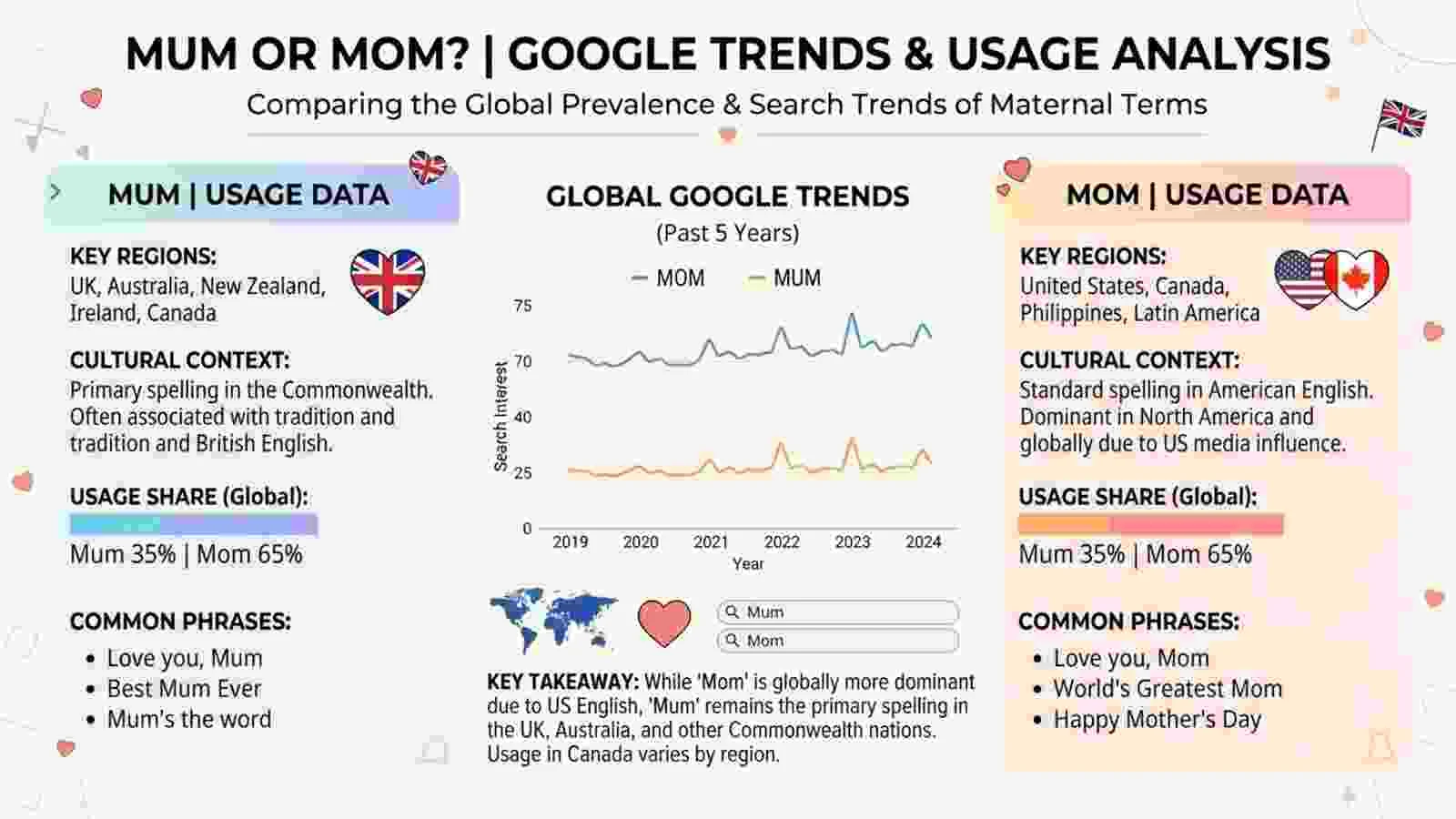
People may search for mum or mom because they want to know which spelling is correct, which country uses each word, or which version will work best for their content.
In general, the regional pattern is clear:
- United States: Mom is the usual spelling.
- United Kingdom: Mum is the usual spelling.
- Australia: Mum is widely used.
- Canada: Mom is common, though individual preferences can vary.
These patterns describe general usage, not an exact ranking of search popularity.
How Can You Check Google Trends?
Google Trends lets you compare search interest for mum and mom across countries and time periods. To get meaningful results, select the same date range, compare the same search type, and check the countries separately.
You can explore the comparison using the Google Trends website.
Keep these points in mind:
- Search interest changes over time.
- Results vary by country and selected period.
- A search term may have different meanings in different contexts.
- Search interest does not prove that one spelling is more correct.
- Related phrases, such as “my mum” or “my mom,” may show different patterns.
Without a verified, current comparison, it is better not to claim exact search volumes or percentages. For SEO content, choose the spelling that matches your target audience and explain the alternative naturally.
Comparison Table: Mum, Mom, Mummy, and Mommy
| Word | Main usage | Example |
| Mum | British English | My mum is here. |
| Mom | American English | My mom is here. |
| Mummy | Common British affectionate form | I love my mummy. |
| Mommy | Common American affectionate form | I love my mommy. |
| Mother | Neutral or formal | My mother is a teacher. |
All five words can refer to a mother, but their tone and regional use differ.
Frequently Asked Questions
1. Is It Mum or Mom?
Both are correct. Mum is standard in British English, while mom is standard in American English.
2. Do British People Say Mum or Mom?
British people usually say mum. It is the common spelling in the United Kingdom.
3. Do Americans Say Mum or Mom?
Americans usually say mom. This is the standard informal word for mother in the United States.
4. Is Mum Correct in American English?
Mum is a valid English word, but mom is the usual spelling for mother in American English. Use mom when writing for a typical US audience.
5. Is Mom Correct in British English?
Yes, readers will understand mom, but mum is the standard British spelling. Use mum when following British English conventions.
6. Does Mum Mean the Same as Mom?
Yes. When referring to a mother, mum and mom have the same basic meaning. The difference is mainly regional spelling and usage.
7. Should I Use Mum or Mom for SEO?
Choose the spelling that matches your target audience. Use mom for content aimed mainly at Americans and mum for content aimed mainly at British readers. You can mention the alternative spelling in the article to help readers searching for either version.
8. What does mum mean?
Mum means mother — it is the usual informal word for a mother in British English (and in Australia). For example: “My mum is very kind.” Note: mum can also mean silent or quiet, as in “Keep mum about the surprise.”
9. How do you spell mum?
M-U-M — mum. It is spelled with one m at the beginning and one m at the end. Do not confuse it with mom (the American spelling) or mummy (the affectionate form).
Conclusion
Choosing between mum or mom is easy once you understand the difference between British and American English. Both words mean mother, and both are correct. The main difference is regional preference.
Use mum when writing for readers in the United Kingdom or Australia. Use mom when writing for an American audience. In Canada and other English-speaking countries, consider local usage and your readers’ expectations.
Remember that mummy and mommy are affectionate forms, while mother is often better suited to formal writing. You should also keep your spelling consistent throughout an article, email, or school assignment.
For SEO writers, the best choice depends on the location and language preferences of the target audience. You can explain both spellings in a comparison article, but your main spelling should match your intended readers. Google Trends can help you explore regional search interest, although popularity alone does not determine correctness.
In short, neither mum nor mom is wrong. Choose the form that fits your audience, use it consistently, and write with confidence.
Continue Reading:
- Metre vs Meter: Meaning, Spelling, and Usage Explained ( for 2026)
- Liter vs Litre: Meaning, Difference, and Usage ( for 2026)
- Analysis or Analyses: Definition, Pronunciation, and Usage( for 2026)

Mary Roach is an American science writer and bestselling author known for making unusual and complex scientific topics engaging, accessible, and humorous. Her books include Stiff, Packing for Mars, Gulp, and Fuzz.
Author at Simifind.com, sharing clear, informative content designed to help readers understand interesting topics and everyday questions.


3 thoughts on “Mum vs Mom: Meaning, Differences, and Usage ( for 2026)”