
Bearer is correct. Barer is also a real word, but it means something different — barer = more bare (the comparative of bare), e.g. a barer branch. Bearer = a person or thing that carries something (a bearer of good news, a ring bearer).
Have you ever stopped while writing because you were unsure whether to use bearer or barer?
You are not alone. These two words sound the same, but they have very different meanings. Choosing the wrong word can change the meaning of your sentence.
The word bearer often appears in formal writing, legal documents, news reports, and everyday speech.
For example, a ticket bearer is a person who holds a ticket. The word barer, on the other hand, means more bare, uncovered, or less decorated.
For example, a barer wall has fewer decorations than another wall.
Many people search for “bearer or barer” because both words have the same pronunciation.
This can make spelling difficult, especially when writing emails, school assignments, reports, or professional documents.
However, learning their meanings makes the choice much easier.
In this guide, you will learn the difference between bearer and barer, their origins, spelling rules, and correct usage in British and American English.
You will also find simple examples, common mistakes, and answers to frequently asked questions.
Bearer or Barer – Quick Answer
Bearer means a person who carries, holds, or presents something. Barer is the comparative form of bare, meaning more uncovered or less decorated.
Here is a simple way to remember the difference:
- Bearer: A person who carries or holds something.
- Barer: More bare, exposed, or uncovered.
Examples:
- The bearer of the letter delivered it to the office.
- The room looked barer after we removed the furniture.
- The ticket bearer entered the event.
- The walls became barer when we took down the pictures.
Both words are correct English words. The right choice depends on what you want to say.
The Origin of Bearer or Barer
The words bearer and barer come from different word forms and have different meanings.
The Origin of Bearer
The word bearer comes from the verb bear, which has roots in Old English. The verb can mean to carry, support, endure, or hold something.
The suffix -er often describes a person or thing that performs an action. Therefore, a bearer is someone or something that bears or carries something.
Examples include:
- Pallbearer: A person who helps carry a coffin at a funeral.
- Bearer of news: A person who brings news.
- Bearer bond: A financial instrument payable to the person who holds it.
- Ticket bearer: A person who holds a ticket.
The word is common in formal, legal, financial, and everyday contexts.
The Origin of Barer
The word barer comes from the adjective bare, which means uncovered, plain, or without something extra.
Adding -er makes the adjective comparative. It means that one thing is more bare than another.
For example:
- This room is bare.
- This room is barer than the other room.
- The winter trees look barer without their leaves.
The spelling follows a common English rule: when an adjective ends in a silent e, the final e is usually dropped before adding -er.
Therefore:
- Bare → Barer
- Large → Larger
- Nice → Nicer
The different origins explain why bearer and barer have different meanings even though they sound alike.
British English vs American English Spelling
There is no spelling difference between British English and American English for these two words. Both varieties use bearer and barer with the same meanings.
The difference depends on the word’s meaning, not the country where you write.
| Word | British English | American English | Meaning |
| Bearer | Bearer | Bearer | A person or thing that carries or holds something |
| Barer | Barer | Barer | More bare or uncovered |
| Bare | Bare | Bare | Uncovered or plain |
| Bear | Bear | Bear | To carry, support, or endure |
Examples in British English
- The bearer presented the document at the entrance.
- The room looked barer after the old furniture was removed.
Examples in American English
- The bearer showed his ticket to the guard.
- The walls looked barer after the decorations came down.
Both examples follow the same spelling rules in the UK and the US.
Which Spelling Should You Use?
The best spelling depends on your intended meaning and your audience. Since bearer and barer are both correct, you should focus on the context.
For American English
Use bearer when referring to someone who carries or holds something. Use barer when comparing uncovered or plain things.
Examples:
- The bearer signed the document.
- The room became barer after the renovation.
For British English and Commonwealth Countries
The same rules apply in the United Kingdom, Pakistan, Australia, Canada, and other Commonwealth countries.
Examples:
- The bearer of the message arrived early.
- The garden looked barer in winter.
For Global and Professional Writing
If you write for an international audience, choose the word that expresses your intended meaning clearly.
For formal documents, pay special attention to the word bearer. In legal and financial contexts, it can have a specific technical meaning. If you are describing a plain room, an uncovered surface, or a lack of decoration, barer is the correct choice.
Professional tip: Replace the word with its meaning before you use it. If you mean “a person who carries something,” use bearer. If you mean “more bare,” use barer.
Common Mistakes with Bearer or Barer
Writers often confuse these words because they sound alike. Here are some common mistakes and their corrections.
Mistake 1: Using Barer for a Person Who Carries Something
Incorrect: The barer of the letter waited outside.
Correct: The bearer of the letter waited outside.
Why? A person who carries or presents something is a bearer.
Mistake 2: Using Bearer to Describe an Empty Room
Incorrect: The room looked bearer after the chairs were removed.
Correct: The room looked barer after the chairs were removed.
Why? The sentence compares how uncovered or empty the room looks.
Mistake 3: Thinking Barer Is Always Incorrect
Incorrect belief: Barer is not a real English word.
Correct explanation: Barer is a valid comparative adjective formed from bare.
Example: The second shelf looks barer than the first.
Mistake 4: Confusing Bearer with Bear
Incorrect: He is the bear of bad news.
Correct: He is the bearer of bad news.
Why? Bear is the base verb or noun, while bearer identifies someone who brings or carries something.
Mistake 5: Choosing by Pronunciation Alone
Incorrect approach: Both words sound alike, so either spelling is acceptable.
Correct approach: Choose based on meaning.
Remember that words with the same sound can have different spellings and meanings. These words are examples of homophones.
Bearer or Barer in Everyday Examples
Understanding everyday usage will help you choose the right word in different situations.
1. In Emails
Bearer:
Dear Sir,
The bearer of the attached authorization letter will collect the documents tomorrow.
Barer:
The office looks barer now that we have removed the old furniture.
2. In News Reports
Bearer:
The bearer of the official document presented it to the authorities.
Barer:
The landscape looked barer after the trees were cut down.
3. On Social Media
Bearer:
Be a bearer of hope and kindness wherever you go.
Barer:
My room looks barer without its colorful decorations.
4. In Formal Writing
Bearer:
The bearer of this certificate is entitled to the stated benefits, subject to the applicable terms.
Barer:
The report describes how the removal of trees left the hillside barer and more exposed.
5. In Everyday Conversation
Bearer:
Who is the bearer of this package?
Barer:
This shelf looks barer than it did yesterday.
These examples show how the correct word depends on the message you want to communicate.
Bearer or Barer – Google Trends and Usage Data
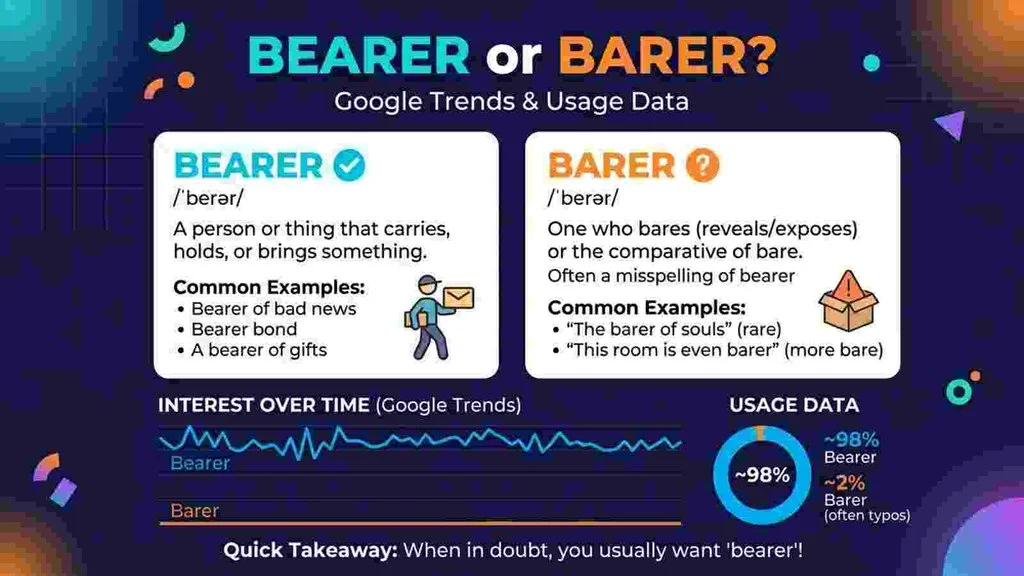
People may search for “bearer or barer” when checking spelling, learning English, or editing written content. However, the two words serve different purposes, so their search popularity does not tell you which one is correct in a sentence.
Bearer: Common Search and Usage Contexts
The word bearer may appear in searches about:
- Meaning and definition
- Bearer of bad news
- Ticket bearer and document bearer
- Bearer bonds and legal terminology
- Pallbearer meaning
Its use is linked to carrying, holding, presenting, and formal terminology.
Barer: Common Search and Usage Contexts
The word barer may appear in searches about:
- Bare vs barer
- Comparative adjectives
- Grammar and spelling
- Describing empty rooms or exposed surfaces
- Examples of words ending in -er
Its use is mainly connected to grammar and comparisons.
Popularity by Country
Both words can be used in the United States, United Kingdom, Canada, Australia, Pakistan, and other English-speaking regions. Their spellings do not change between these countries.
No verified live Google Trends figures are provided here, so specific search volumes or country rankings should not be assumed. You can compare interest over time using Google Trends by entering “bearer” and “barer” and selecting your preferred country and date range.
For SEO writers, it is useful to answer the spelling question directly, explain both meanings, and include natural examples. This approach helps readers understand the difference without relying on unsupported popularity claims.
Bearer vs Barer: Comparison Table
| Feature | Bearer | Barer |
| Part of speech | Noun | Comparative adjective |
| Base word | Bear | Bare |
| Main meaning | A person or thing that carries something | More uncovered or plain |
| Common context | Documents, tickets, messages, formal writing | Rooms, walls, land, surfaces |
| Example | The bearer delivered the package. | The room looked barer. |
| British spelling | Bearer | Barer |
| American spelling | Bearer | Barer |
| Correct usage | Someone who carries or holds something | Something that is more bare |
The easiest way to remember the difference is to connect bearer with carrying and barer with being more bare.
Frequently Asked Questions
1. Is It Bearer or Barer?
Both are correct words, but they have different meanings. Bearer means someone or something that carries or holds something. Barer means more bare or uncovered.
2. What Does Bearer Mean?
A bearer is a person or thing that carries, holds, or presents something.
Example: The bearer of the letter delivered it to the manager.
3. What Does Barer Mean?
Barer is the comparative form of bare. It describes something that is more uncovered, plain, or empty than another thing.
Example: The room looks barer without its curtains.
4. Are Bearer and Barer Homophones?
Yes. In standard English pronunciation, bearer and barer sound alike but have different spellings and meanings. They are homophones.
5. Is Barer a Real Word?
Yes. Barer is a grammatically correct comparative adjective formed from bare.
Example: This wall is barer than the wall in the next room.
6. Is There a Difference Between British and American Usage?
No spelling difference exists between British and American English. Both varieties use bearer for someone who carries something and barer for something more bare.
7. How Can I Remember the Difference?
Remember that bearer comes from bear, meaning to carry or support. Barer comes from bare, meaning uncovered or plain. If you mean a person carrying something, choose bearer. If you mean more uncovered, choose barer.
8. What is the difference between bearer and barer?
Bearer is a noun for a person or thing that carries something; barer is the comparative of bare, meaning more uncovered or plain. They sound the same but have different meanings and spellings.
9. How do you spell bearer?
Spell it B-E-A-R-E-R: bearer, from bear + er, with the word ‘bear’ at the start.
Conclusion: Bearer or Barer
Choosing between bearer and barer becomes easy once you understand their meanings.
Although the words sound alike, they serve different purposes in English.
Bearer is a noun that describes a person or thing that carries, holds, or presents something.
You may see it in phrases such as “bearer of bad news,” “ticket bearer,” and “bearer of a certificate.”
In contrast, barer is the comparative form of the adjective bare. It describes something that is more uncovered, plain, or empty than another thing.
For example, a room may look barer after its furniture is removed, or a tree may appear barer after losing its leaves.
Neither spelling is exclusive to British or American English. Both countries use the same forms, so your decision should always depend on the meaning of your sentence.
When writing emails, articles, assignments, or formal documents, take a moment to check the context.
Ask yourself whether you mean someone who carries something or something that is more bare.
This simple test will help you choose the right word, avoid common spelling mistakes, and communicate clearly in any writing situation.
Continue Reading:
- Wandering vs. Wondering: Meaning, Usage, and Examples ( for 2026)
- Emigrate or Immigrate: Definitions, Examples, and Rules ( for 2026)
- Bony or Boney: Meaning, Spelling, and Usage ( for 2026)
- Cuter or Cutier: Correct Spelling, Meaning, and Usage ( for 2026)
- Selfs or Selves: Meaning, Grammar, and Examples (for 2026)

Mary Roach is an American science writer and bestselling author known for making unusual and complex scientific topics engaging, accessible, and humorous. Her books include Stiff, Packing for Mars, Gulp, and Fuzz.
Author at Simifind.com, sharing clear, informative content designed to help readers understand interesting topics and everyday questions.








3 thoughts on “Bearer vs. Barer: Meaning, Differences, and Usage ( for 2026)”