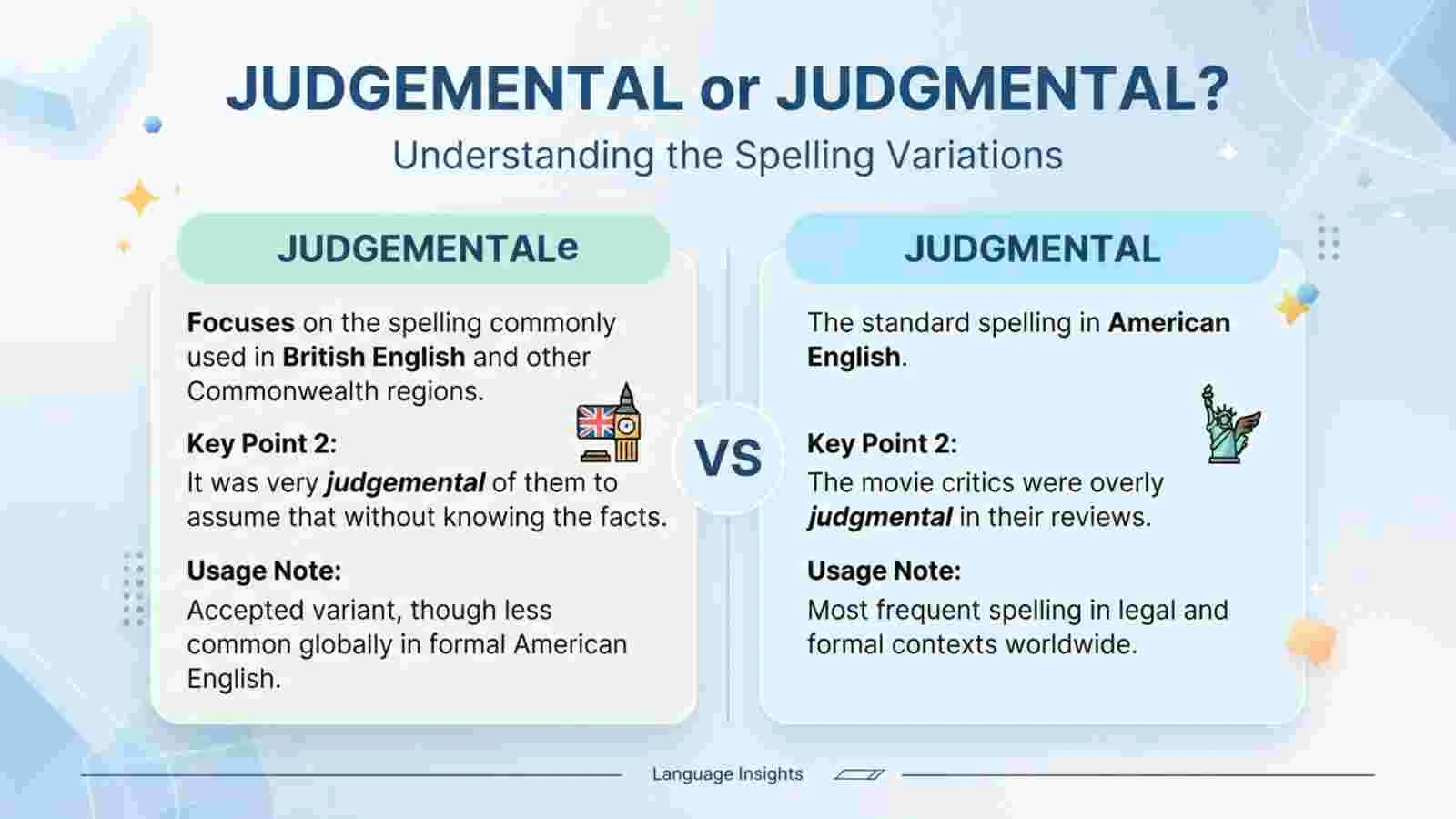
Both judgemental and judgmental are correct. Judgmental (without the e) is American English and the more common spelling worldwide; judgemental (with the e) is British English. Both mean the same thing — judging others critically.
Have you ever stopped while writing a word because you were unsure which spelling was right? You are not alone.
Many people search for judgemental or judgmental because both spellings appear in books, websites, emails, and daily conversations.
The good news is that both forms are correct, but the best choice depends on the type of English you use.
The word describes someone who is quick to judge other people, often without knowing all the facts.
For example, a person who criticizes others without understanding their problems may be called judgmental or judgemental.
The main difference is the letter e. American English usually uses judgmental, while British English often uses judgemental. Both words have the same meaning and pronunciation.
In this guide, you will learn the spelling rules, word origin, common mistakes, and everyday uses of both forms.
You will also discover which spelling works best for school, work, websites, and formal writing. By the end, you will know how to choose the right form for your readers.
Judgemental or Judgmental – Quick Answer
Judgmental is the standard spelling in American English. Judgemental is a common spelling in British English and other English varieties that often retain the letter e in judgement.
Both spellings mean the same thing: being quick to judge people or their actions, often in a critical or unfair way.
Examples:
- American English: She is too judgmental about other people’s choices.
- British English: He seemed judgemental when he heard the news.
- Formal writing: A good leader should listen without being judgmental.
- Everyday speech: Try not to be so judgemental about your friends.
| Spelling | Main usage | Example |
| Judgmental | American English | He is very judgmental. |
| Judgemental | British English and other varieties | She sounded judgemental. |
Quick rule: Use judgmental for American readers and judgemental when following a British English style guide that prefers the traditional spelling.
The Origin of Judgemental
The word judgmental comes from judgment, which refers to the act of forming an opinion or making a decision. The word judgement is an alternative spelling of the same noun.
Both forms have roots in Old French and Latin words linked to judging and deciding. Over time, English developed different spelling habits on either side of the Atlantic.
In American English, judgment became the standard spelling, especially in formal and legal writing. The letter e is often left out in this form.
British English commonly uses judgement in general writing. As a result, many British writers also use judgemental.
The suffix -al helps form the adjective. It turns the noun into a word that describes a person or attitude connected with judging.
Examples:
- Judgment → Judgmental
- Judgement → Judgemental
The spelling difference does not change the meaning. Both words describe a person who tends to form opinions about others, especially in a critical way.
It is also worth noting that the spelling judgment is widely used in legal English in both the United States and the United Kingdom. Therefore, British writers may use judgment in legal contexts while using judgement in general writing.
British English vs American English Spelling
British and American English often use different spellings for the same word. The difference between judgemental and judgmental is one example.
American English generally prefers the shorter form, judgmental. British English commonly accepts judgemental, although judgmental is also used.
Comparison Table
| Feature | American English | British English |
| Common spelling | Judgmental | Judgemental |
| Base noun | Judgment | Judgement |
| Meaning | Critical or quick to judge | Critical or quick to judge |
| Pronunciation | Same | Same |
| Formal usage | Judgmental | Judgemental or judgmental |
| Example | He is judgmental. | He is judgemental. |
Why Does the Letter E Matter?
The letter e appears in the British spelling judgement. When the suffix -al is added, the spelling becomes judgemental.
In American English, the standard noun is judgment, so the adjective becomes judgmental.
The same difference can appear in other words, such as acknowledgment and acknowledgement. However, not every word follows the same spelling pattern. Always check the standard form used in your chosen variety of English.
Is One Spelling More Correct?
No. Both spellings are accepted in English. However, the preferred form depends on your audience and the style guide you follow.
If you are writing for an American publication, use judgmental. If you are writing for a British publication that follows British spelling conventions, judgemental may be the better choice.
Which Spelling Should You Use?
The best spelling depends on where your readers live and what type of writing you are doing.
For American Readers
Choose judgmental when writing for readers in the United States. This spelling is common in American books, newspapers, academic work, and professional communication.
Example: The manager should not be judgmental when reviewing employee mistakes.
For British and Commonwealth Readers
Choose judgemental if your British English style guide prefers judgement. This form is also seen in other Commonwealth varieties of English.
Example: It is unfair to be judgemental without hearing both sides.
However, spelling conventions can vary across countries and organizations. Some British publications also use judgmental.
For Global Websites and SEO
If your website serves readers around the world, either form can work. The most important thing is to choose one spelling and use it consistently.
For a US-focused website, use judgmental. For a UK-focused website, judgemental may suit your audience better.
You can mention both spellings in the article title or body when relevant. This helps readers who search for either version find the information they need.
Do not repeat both forms in every sentence just to target search engines. Clear, natural writing is more useful than keyword repetition.
Common Mistakes with Judgemental
Writers often confuse these spellings or use the word in the wrong context. Here are common mistakes to avoid.
Mistake 1: Thinking One Spelling Is Always Wrong
Incorrect belief: Judgemental is always wrong.
Correction: Both judgemental and judgmental are accepted spellings. The preferred form depends on the variety of English and the style guide.
Mistake 2: Mixing Spellings in One Article
Example: The writer is judgmental in one section and judgemental in another.
Correction: Choose one spelling for the article and use it consistently, unless you are directly quoting a source.
Mistake 3: Confusing Judgmental with Judicious
These words have different meanings.
- Judgmental: Quick to criticize or form opinions about others.
- Judicious: Showing good sense and careful judgment.
Example: A judicious leader considers the facts before making a decision.
Mistake 4: Using Judgmental for Every Opinion
Having an opinion does not always make someone judgmental. The word often suggests that a person is overly critical or unfair.
Example: She shared her opinion politely without being judgmental.
Mistake 5: Forgetting the Correct Spelling in Formal Work
In exams, reports, and business writing, use the spelling that matches the required English variety. Consistency is especially important in professional documents.
Judgemental or Judgmental in Everyday Examples
Both spellings can be used in many types of writing. The meaning stays the same.
In Emails
American English: Please keep your feedback helpful rather than judgmental.
British English: Please keep your comments fair and avoid sounding judgemental.
These sentences are polite and suitable for workplace communication.
In News Writing
American English: The report warned against judgmental attitudes toward people in need.
British English: The article challenged judgemental views about young people.
News writers should follow their publication’s spelling rules.
On Social Media
American English: Do not be judgmental about someone else’s journey.
British English: Being judgemental online can hurt people.
Both forms are common in discussions about kindness, relationships, and personal choices.
In Formal and Academic Writing
American English: A judgmental approach can prevent fair discussion.
British English: A judgemental attitude may affect how people respond to criticism.
In formal work, use neutral language when possible. Instead of labeling a person as judgmental, you can describe the specific behavior.
For example: The reviewer criticized the proposal without considering the evidence.
This wording is more precise and avoids making a broad claim about someone’s character.
Judgemental or Judgmental – Google Trends and Usage Data
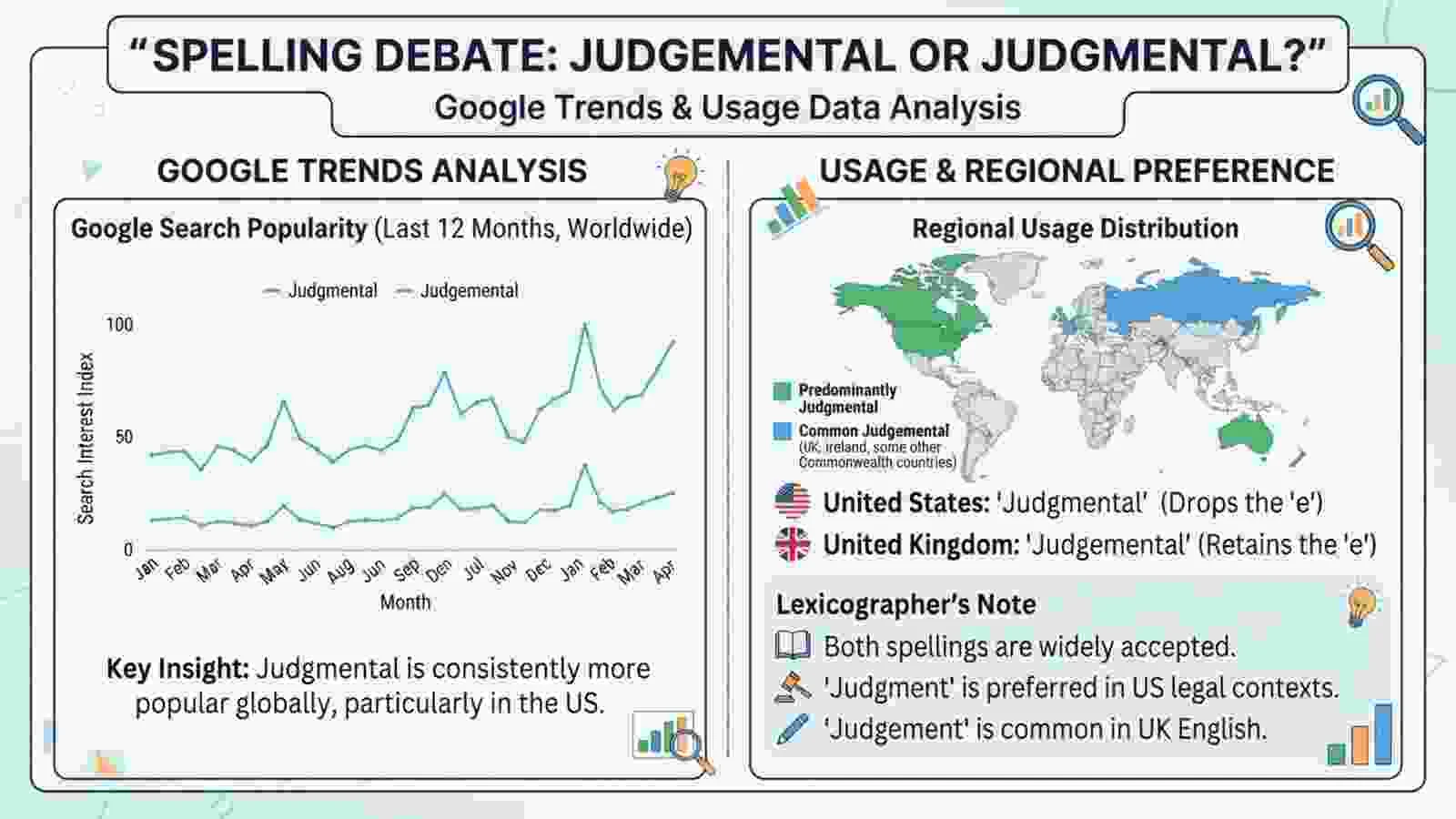
People may search for both spellings because they encounter different English standards in books, school lessons, websites, and online discussions.
The likely spelling preferences are:
- United States: Judgmental is the usual choice.
- United Kingdom: Judgemental is common, though judgmental also appears.
- Canada: Both forms may appear, depending on the publication and style guide.
- Australia and New Zealand: Judgemental is commonly encountered in British-influenced writing, but usage can vary.
- International websites: Both forms may be used to reach readers from different English-speaking regions.
These are general spelling patterns, not verified search-volume rankings.
How Can You Check Google Trends?
Google Trends can help compare interest in judgemental and judgmental over time and across countries.
To make a useful comparison:
- Open Google Trends.
- Enter judgemental and judgmental as separate search terms.
- Select the same time period for both.
- Compare countries or regions.
- Review related queries and changes in interest.
Remember that Google Trends shows relative search interest, not exact search volume. Its values are usually scaled from 0 to 100 within the selected comparison.
Without a live, region-specific comparison, it would be misleading to claim that one spelling receives a precise number of searches or a specific percentage more traffic.
For SEO, consider your audience, use the preferred spelling in your main heading, and include the alternative spelling naturally in the content.
Judgemental vs Judgmental: Comparison Table
| Point | Judgemental | Judgmental |
| Correct spelling | Yes | Yes |
| Main association | British English | American English |
| Meaning | Critical or quick to judge | Critical or quick to judge |
| Pronunciation | Same | Same |
| Base word | Judgement | Judgment |
| Best use | British-style writing | American-style writing |
| SEO value | Useful for UK-focused content | Useful for US-focused content |
Both spellings are valid. The main difference is regional preference, not meaning.
Frequently Asked Questions
1. Is it judgemental or judgmental?
Both are correct. Judgmental is the standard American spelling, while judgemental is common in British English.
2. Is judgemental British or American?
Judgemental is commonly associated with British English. American English usually prefers judgmental.
3. Does judgemental mean critical?
Yes. It describes someone who is quick to form opinions about others, often in a critical or unfair way.
4. Is judgmental more correct than judgemental?
Neither spelling is universally more correct. Choose the form preferred by your audience or style guide.
5. Do judgemental and judgmental sound different?
No. They are generally pronounced the same way. The difference is in spelling, not pronunciation.
6. Which spelling should I use in an academic essay?
Follow the spelling rules required by your school, university, or examination board. If no rule is given, choose the appropriate regional standard and remain consistent.
7. Which spelling is better for SEO?
Use judgmental for a mainly American audience and judgemental for a mainly British audience. You can include both naturally to help readers find your page through either spelling.
8. Is judgemental a word?
Yes, judgemental is a real English word. It is the British English spelling of judgmental.
9. What does judgemental mean?
Judgemental means quick to judge other people critically, often without knowing all the facts — for example, “Don’t be so judgemental.”
10. What is the difference between judgemental and judgmental?
The only difference is spelling: judgemental is British English, judgmental is American English. The meaning and pronunciation are the same.
11. How do you spell judgmental?
Spell it J-U-D-G-M-E-N-T-A-L: judgmental, without an e after the g — the American English spelling.
Conclusion
The choice between judgemental and judgmental is simple once you know the spelling rules. Both words are correct, and both have the same meaning.
They describe someone who is quick to judge others, often without understanding the full situation.
The main difference is regional preference. American English generally uses judgmental, while British English commonly uses judgemental.
However, you may see both forms in different publications, including British writing.
For school assignments, professional emails, reports, and website content, always consider your readers.
Use the spelling recommended by your teacher, publisher, organization, or style guide. If you are writing for a global audience, explain both forms and choose one as your main spelling.
For SEO, include the alternative spelling naturally so readers can find your content regardless of which version they search for. Avoid making claims about search popularity without checking reliable data.
The final rule is easy: use judgmental for American English and judgemental when following a British English style that prefers the letter e. Consistent spelling makes your writing clearer and more professional.
Continue Reading:
- Goodbye or Good Bye: Definition, Origin, and Usage ( for 2026)
- Tardies vs Tardys: Meaning, Spelling, and Usage ( for 2026)
- Autumn or Fall: Meaning, Usage, and Differences ( for 2026)
- Cuter or Cutier: Correct Spelling, Meaning, and Usage ( for 2026)
- Selfs or Selves: Meaning, Grammar, and Examples (for 2026)

Here’s a concise 2-line author bio suitable for Simifind.com:
James Dashner is an American bestselling author best known for The Maze Runner series and other popular young-adult fiction.
On Simifind.com, he shares clear, engaging insights and helpful content for readers interested in books, writing, and popular literature.







3 thoughts on “Judgemental or Judgmental: Meaning, Spelling, and Usage ( for 2026)”