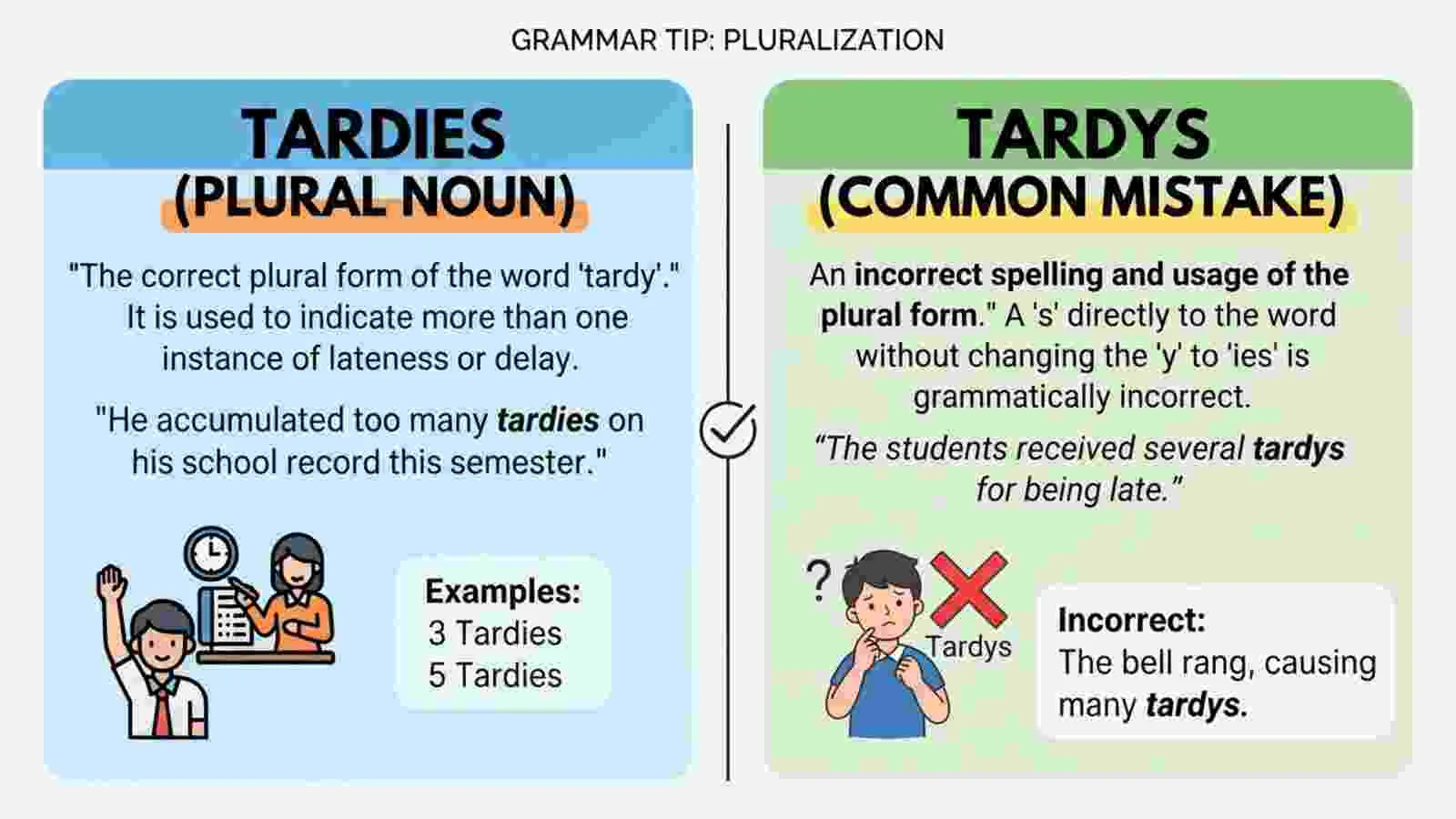
Tardies is correct. Tardys is incorrect. Tardies is the plural of tardy — tardy becomes tardies (y changes to ies).
Have you ever wondered whether to write tardies or tardys?
You may see these words when reading school rules, writing a report, or talking about students who arrive late.
The spelling can seem confusing, especially if you know that many English words ending in y change when they become plural.
The good news is that there is a simple rule to follow. Tardies is the correct plural form of tardy. The spelling tardys is generally incorrect in standard English.
A tardy is a person or event marked by being late, often used in schools to describe a student’s late arrival.
People search for “tardies or tardys” because they want to use the right spelling in school records, emails, reports, and daily writing.
The confusion comes from English plural rules. Some words ending in y add s, while others change y to ies.
In this guide, you will learn the difference between these spellings, their origins, and how to use them in real sentences. You will also find examples, spelling rules, and answers to common questions.
Tardies or Tardys – Quick Answer
Tardies is the correct spelling. Tardys is not the standard plural form of tardy.
The word tardy means late or delayed. In schools, a tardy can refer to a late arrival or a record of being late.
Examples:
- Correct: The student has three tardies this month.
- Incorrect: The student has three tardys this month.
- Correct: The teacher recorded two tardies today.
- Correct: Please avoid being tardy for class.
Why Is Tardies Correct?
English has a simple rule for many words that end in a consonant followed by y. To make these words plural, change the y to ies.
For example:
- Tardy → Tardies
- Baby → Babies
- City → Cities
- Party → Parties
- Story → Stories
This rule explains why tardies is correct.
The Origin of Tardies
The word tardy has a long history. It comes from the Old French word tardif, which means late or slow. This word is linked to the Latin word tardus, meaning slow or delayed.
Over time, English adopted tardy to describe someone or something that is late.
Today, the word appears in many settings. Schools often use it to record late arrivals. Workplaces may use tardy to describe an employee who arrives after the expected time.
How Did Tardies Become the Plural?
The word tardy follows a common English spelling rule. When a noun ends in a consonant plus y, the usual plural form changes y to ies.
For example:
- One tardy, two tardies
- One baby, two babies
- One city, two cities
The spelling tardys does not follow this rule. It may appear in informal writing because people try to add only an s. However, standard English uses tardies.
British English vs American English Spelling
British and American English often use different spellings. For example, British English uses colour, while American English uses color. But not every word has a regional spelling difference.
Tardies is correct in both British and American English. The plural does not change between these varieties.
| Feature | American English | British English |
| Singular | Tardy | Tardy |
| Plural | Tardies | Tardies |
| Incorrect plural | Tardys | Tardys |
| General meaning | Late or delayed | Late or delayed |
| School use | Records of late arrivals | May describe late arrivals, depending on local usage |
Examples in American English
- The school recorded five tardies this week.
- Students must report to the office after their third tardy.
- Too many tardies may lead to a warning.
Examples in British English
- The pupil was tardy for the lesson.
- The school recorded several late arrivals.
- The teacher noted that the student had arrived late again.
In British schools, phrases such as late arrival or lateness may sound more natural than tardy in many situations. However, the spelling rule remains the same wherever the word is used.
Which Spelling Should You Use?
Use tardies whenever you need the plural form of tardy. The correct choice does not depend on your country.
For American Readers
Use tardies in school reports, attendance records, emails, and other formal writing.
Example: “Your child has accumulated four tardies this term.”
For British and Commonwealth Readers
Use tardies if you choose the word tardy. In everyday school communication, late arrivals or instances of lateness may be clearer.
Example: “The school recorded three late arrivals this week.”
For Global and Professional Writing
Choose words that your audience will understand easily. If you are writing for an international audience, late arrivals may be clearer than tardies.
However, when you specifically need the plural of tardy, always write tardies.
Common Mistakes with Tardies
Writers often make spelling and usage mistakes when using tardy. Here are the most common ones.
1. Writing Tardys Instead of Tardies
Incorrect: The student has two tardys.
Correct: The student has two tardies.
The word ends in a consonant followed by y. Change y to ies to make it plural.
2. Using Tardies as a Verb
Incorrect: He tardies every morning.
Better: He arrives late every morning.
Tardies is commonly used as a plural noun. To describe the action, use a phrase such as arrives late or is tardy.
3. Confusing Tardy and Tardies
Use tardy for one late arrival or to describe someone who is late. Use tardies for more than one recorded late arrival.
- Singular: She received one tardy.
- Plural: She received three tardies.
4. Using the Word in the Wrong Context
Tardy can sound formal or school-related. In casual conversation, late is often more natural.
Formal: The employee was tardy for the meeting.
Simple: The employee was late for the meeting.
Tardies in Everyday Examples
The word tardies can appear in school records, emails, reports, and online conversations. Here are examples of how to use it correctly.
In Emails
“Dear Parent, our records show that your child has received three tardies this month. Please help your child arrive on time.”
This example is suitable for a school attendance email.
In News Reports
“The school district introduced a new policy to reduce student tardies and improve classroom attendance.”
This sentence shows how the word can appear in education-related news.
On Social Media
“Trying to start the new term with fewer tardies and better habits!”
This is a casual example of how someone might use the word online.
In Formal Writing
“Frequent tardies may affect a student’s attendance record and lead to further review under school policy.”
This sentence is suitable for an attendance policy or formal report.
In Everyday Conversation
“I need to leave home earlier so I do not get any more tardies.”
This example uses the word in a simple, natural way.
Tardies – Google Trends and Usage Data
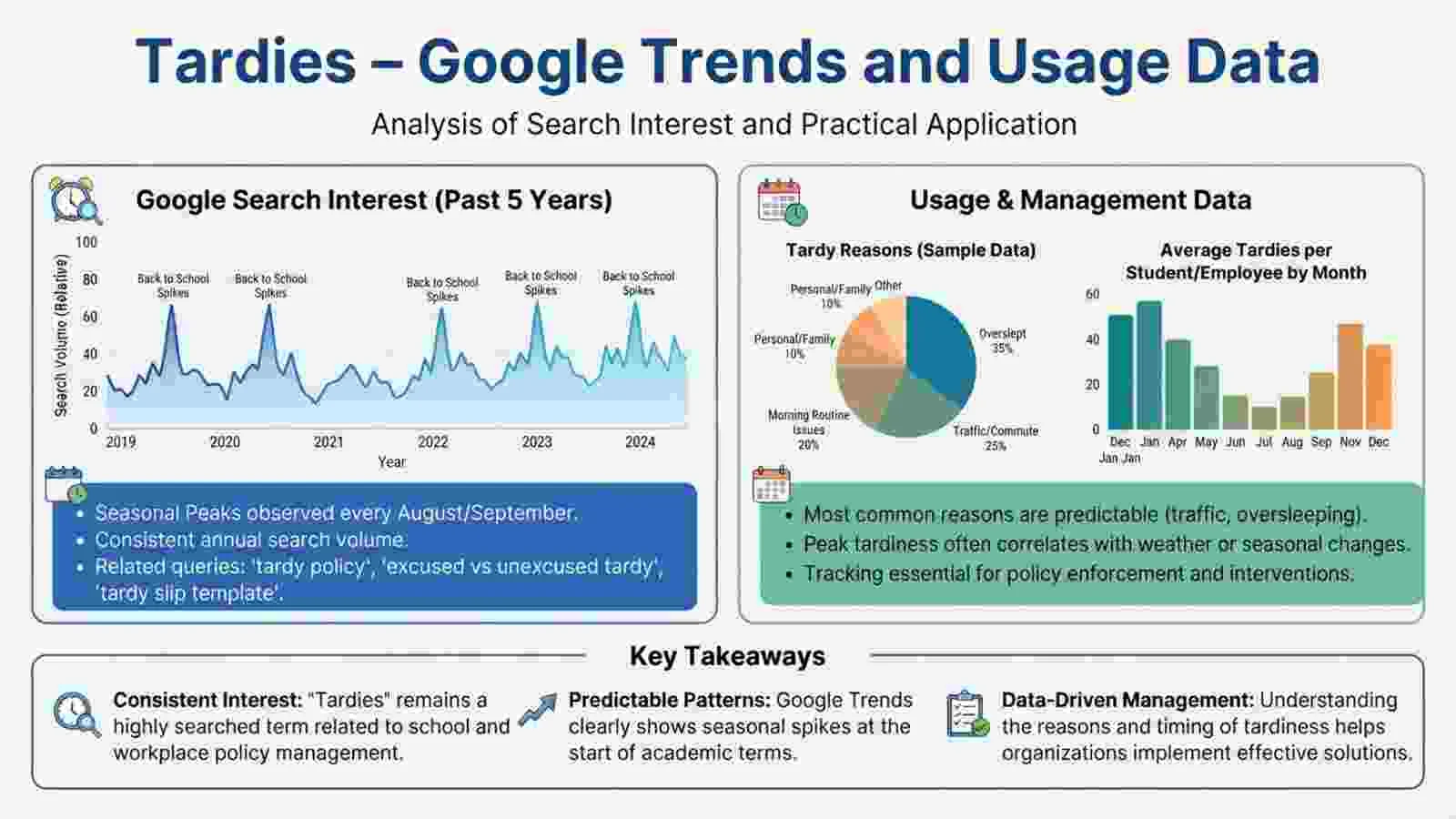
People search for “tardies or tardys” when they are unsure how to spell the plural form of tardy. The question is especially relevant to school attendance, student records, and education policies.
Where Might People Search for This Term?
The word may be useful to readers in countries where English is widely used in schools and workplaces, including:
- United States: School attendance systems often use tardy and tardies.
- United Kingdom: Readers may search for the spelling, although late arrival and lateness are also common.
- Canada: The word may appear in school communications and attendance records.
- Australia and New Zealand: Readers may encounter the word in English-language education materials.
These are reasonable contexts for the term, not verified rankings of search volume by country.
What About Google Trends?
Google Trends can help compare interest in tardies and tardys over time or by region. However, no live Google Trends figures are provided here, so exact search volumes, popularity rankings, and country-level results cannot be confirmed.
For SEO content, the main search intent is clear: users want to know which spelling is correct and how to use it. An article that answers the question early, explains the plural rule, and provides real examples can meet that need.
Keyword Variations
| Keyword variation | Correct? | Explanation |
| Tardy | Yes | Singular form |
| Tardies | Yes | Standard plural form |
| Tardys | No | Incorrect standard plural |
| Being tardy | Yes | Describes the state of being late |
| Tardy student | Yes | Describes a student who is late |
| Late arrivals | Yes | A clear alternative phrase |
| Tardiness | Yes | The state or habit of being late |
FAQs About Tardies or Tardys
1. Is Tardies or Tardys Correct?
Tardies is correct. It is the standard plural form of tardy. The spelling tardys is incorrect in standard English.
2. What Is the Plural of Tardy?
The plural of tardy is tardies. For example, “The student received two tardies this week.”
3. Why Does Tardy Change to Tardies?
When a word ends in a consonant followed by y, the plural usually changes y to ies. This is why tardy becomes tardies.
4. Is Tardies Correct in American English?
Yes. American English uses tardies when referring to multiple late arrivals or school attendance records.
5. Is Tardies Correct in British English?
Yes. The spelling is correct in British English too. However, phrases such as late arrivals may be more common in some British contexts.
6. Can Tardies Be Used in a School Report?
Yes. A school may use tardies to describe multiple recorded late arrivals. For example, “The student has four tardies this month.”
7. What Is the Difference Between Tardies and Tardiness?
Tardies usually refers to individual late arrivals or attendance records. Tardiness means the state or habit of being late.
Example: “The student has three tardies. Repeated tardiness is a concern.”
8. Is tardys a word?
No, tardys is not a word. The correct plural of tardy is tardies — change the y to ies.
9. What does tardies mean?
Tardies means several late arrivals — for example, “The student has three tardies this month.”
10. How do you spell tardies?
Spell it T-A-R-D-I-E-S: tardies, with ies at the end — tardy with the y changed to ies.
Conclusion
Choosing between tardies or tardys is easy once you know the English plural rule. Tardies is the correct spelling, while tardys is not accepted as the standard plural form of tardy.
The rule is simple: when a word ends in a consonant followed by y, change the y to ies to make it plural. This rule also applies to words such as baby, city, and party.
The correct spelling stays the same in both American and British English. However, the word tardy is often linked to school attendance, especially in American usage. If you are writing for a global audience, late arrivals may be a clearer alternative.
Remember the difference between tardy, tardies, and tardiness. Use tardy for the singular form, tardies for multiple late arrivals, and tardiness for the state of being late.
Whether you are writing a school email, an attendance report, or an SEO article, using the right spelling makes your writing clearer and more professional. When in doubt, choose tardies.
Continue Reading:
- Autumn or Fall: Meaning, Usage, and Differences ( for 2026)
- Teammate vs. Team Mate: Meaning, Spelling, and Usage ( for 2026)
- Onward vs Onwards: Meaning, Difference, and Usage ( for 2026)
- Cuter or Cutier: Correct Spelling, Meaning, and Usage ( for 2026)
- Selfs or Selves: Meaning, Grammar, and Examples (for 2026)

Here’s a concise 2-line author bio suitable for Simifind.com:
James Dashner is an American bestselling author best known for The Maze Runner series and other popular young-adult fiction.
On Simifind.com, he shares clear, engaging insights and helpful content for readers interested in books, writing, and popular literature.








3 thoughts on “Tardies vs Tardys: Meaning, Spelling, and Usage ( for 2026)”