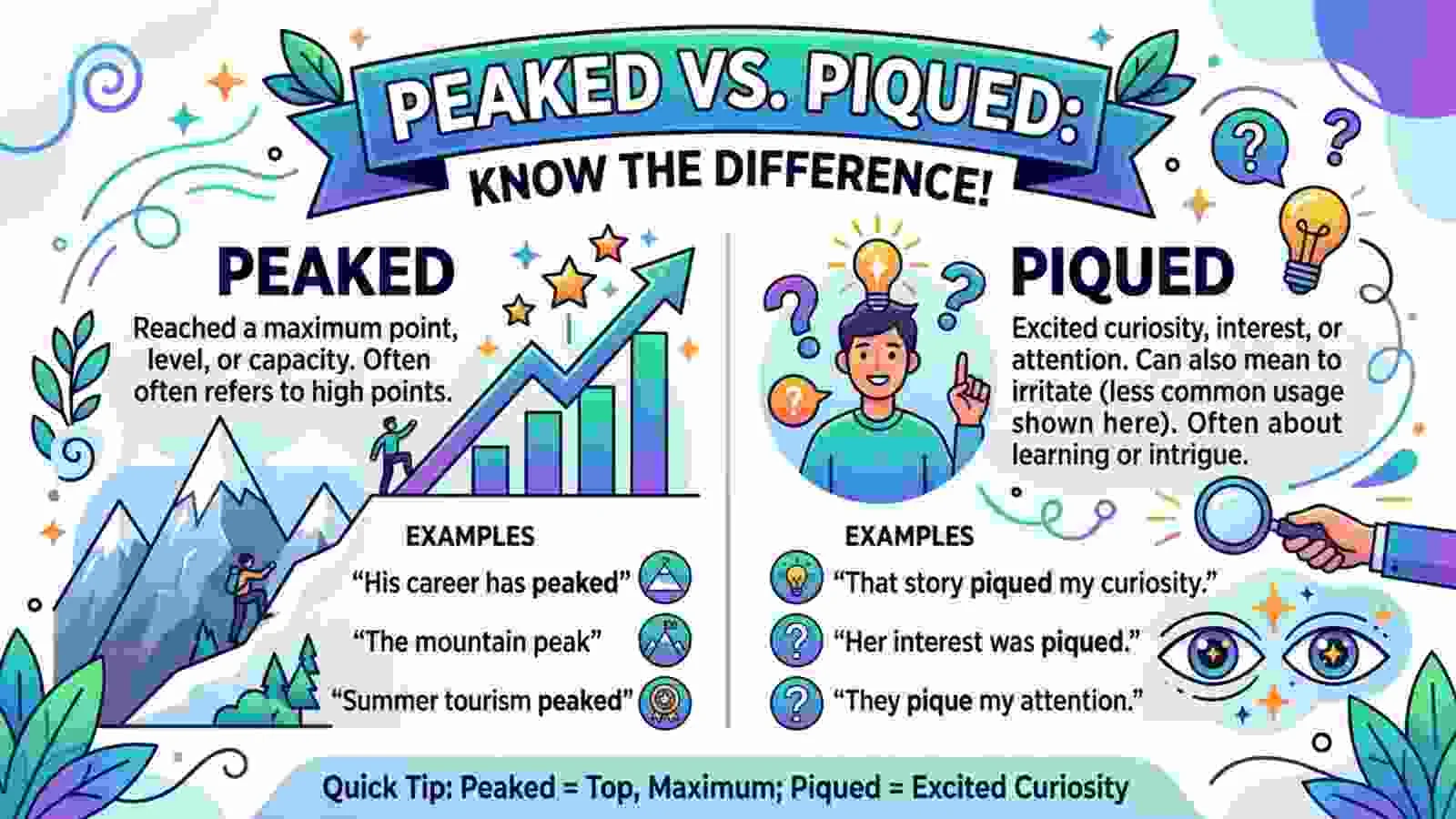
Peaked = reached the highest point. Piqued = aroused interest or curiosity (as in ‘piqued my interest’). Peeked = took a quick look. They are three different words.
Have you ever written “peaked my interest” or “piqued my interest” and wondered which one is correct?
You are not alone. Peaked and piqued sound almost the same, but they have very different meanings. This small spelling difference can change the meaning of a sentence.
People often search for “peaked or piqued” because the phrases “peaked my interest” and “piqued my interest” are easy to confuse. The correct phrase is usually “piqued my interest.”
The verb pique means to arouse curiosity, interest, or attention. Peaked, on the other hand, comes from peak and means reached the highest point or became pointed.
Understanding these words helps you avoid common spelling mistakes in emails, essays, social media posts, and professional writing.
In this guide, you will learn their meanings, origins, differences, spelling rules, common mistakes, and everyday examples.
Peaked or Piqued – Quick Answer
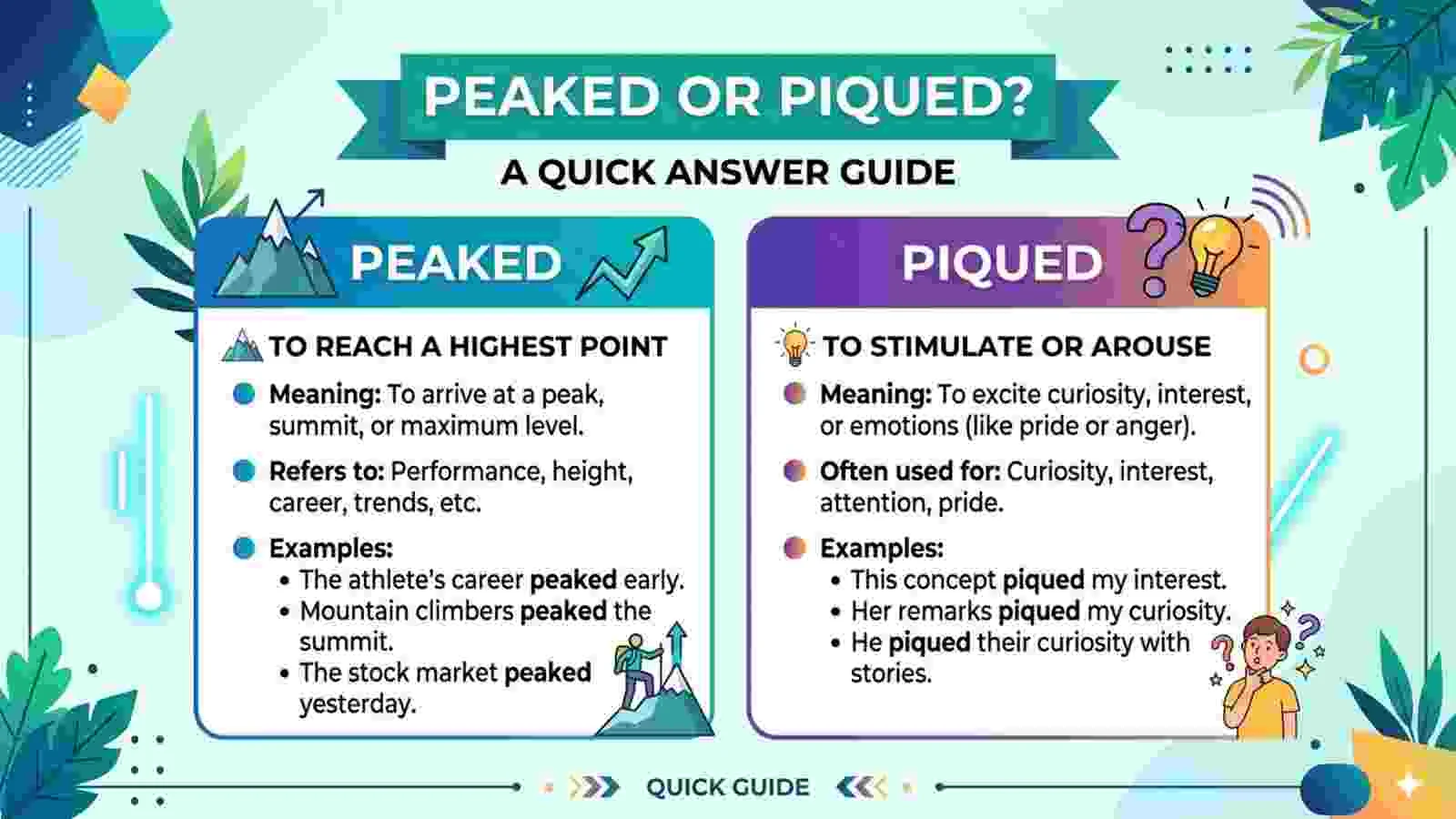
Piqued is correct when you mean aroused someone’s interest, curiosity, or attention.
- Correct: The article piqued my interest.
- Correct: Her story piqued my curiosity.
- Incorrect: The article peaked my interest.
Peaked is the past tense of peak. It means reaching the highest point, level, or value.
- Sales peaked in December.
- His performance peaked at age 30.
- The mountain peaked above the clouds.
Easy way to remember
Piqued = curiosity or interest
Peaked = highest point
So, if something makes you curious, it piques your interest.
The Origin of Peaked or Piqued
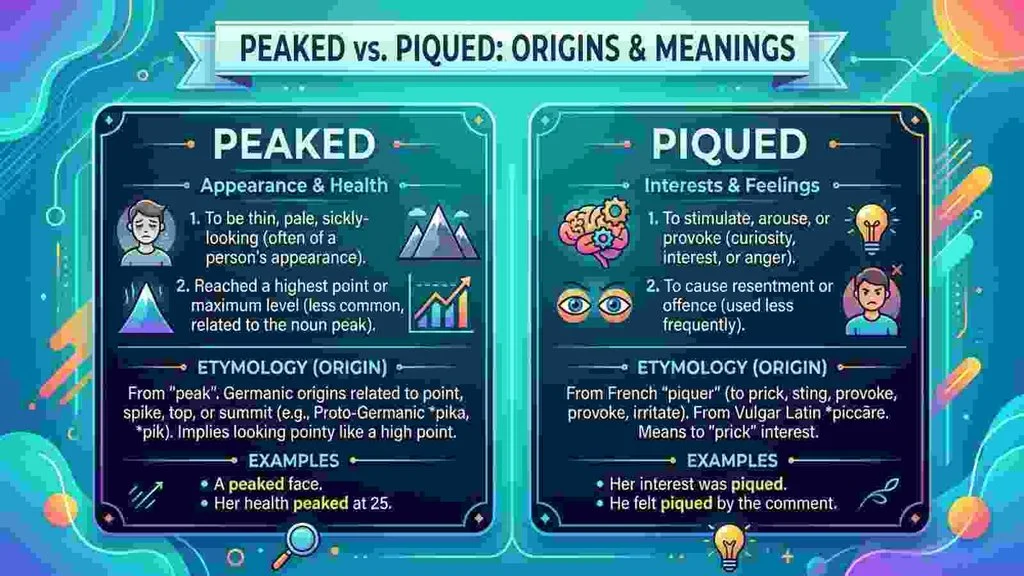
Although peaked and piqued sound similar, they come from different words.
Peak
Peak refers to the highest point of something. It can describe a mountain, level, performance, period, or trend.
The word comes from Middle English and is related to the idea of a pointed top or summit.
Examples:
- The mountain has a snowy peak.
- Demand peaked during the holiday season.
- Her career peaked in the early 2000s.
Pique
Pique comes from French piquer, meaning “to prick” or “to sting.” Over time, English developed the figurative meaning of stimulating someone’s curiosity or interest.
Examples:
- The mystery piqued my curiosity.
- The headline piqued her interest.
- His unusual answer piqued my attention.
The different spellings exist because these words have different histories and meanings, even though they are pronounced similarly.
British English vs American English Spelling
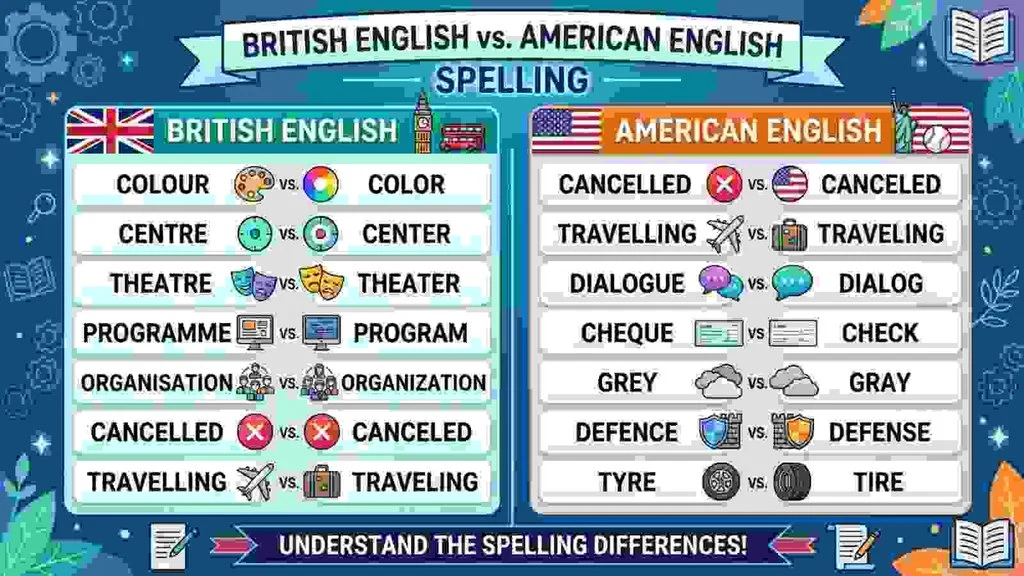
There is no major British-versus-American spelling difference between peaked and piqued.
Both British and American English use:
| Meaning | American English | British English |
|---|---|---|
| Highest point | peaked | peaked |
| Aroused curiosity | piqued | piqued |
| Highest level | peak | peak |
| Arouse interest | pique | pique |
Examples
American English:
The news piqued my interest.
British English:
The news piqued my interest.
The spelling stays the same in both varieties of English.
The confusion comes mainly from pronunciation. Peaked and piqued are commonly pronounced the same, making them easy to mix up when writing.
Which Spelling Should You Use: Peaked or Piqued?
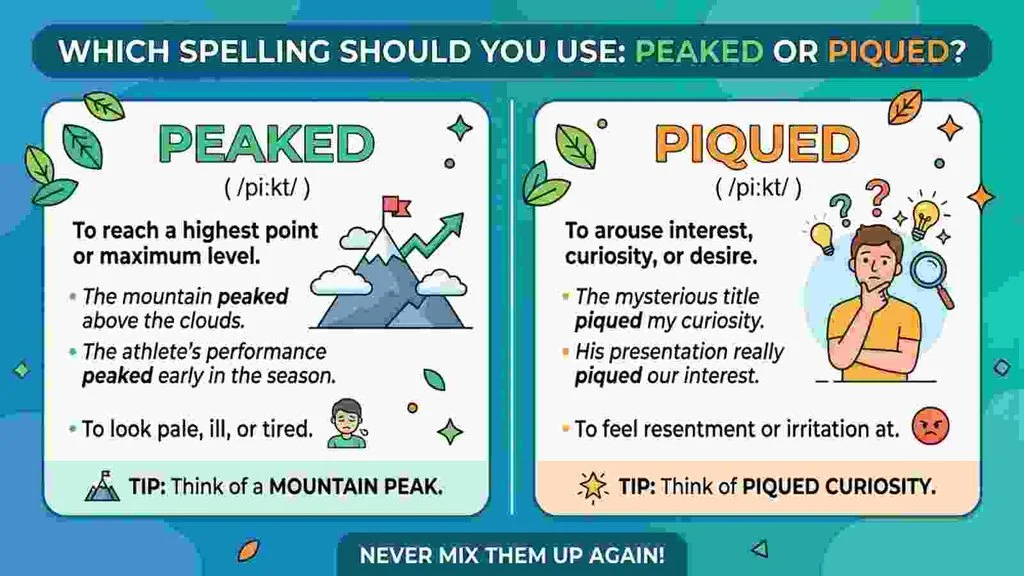
Your choice depends on the meaning, not the country where you are writing.
Use “piqued” for interest or curiosity
Use piqued when something causes you to become interested, curious, or intrigued.
- The documentary piqued my interest.
- Her question piqued his curiosity.
- The mysterious message piqued everyone’s interest.
Use “peaked” for the highest point
Use peaked when something reaches its maximum or highest level.
- Prices peaked in June.
- The team’s performance peaked during the final.
- Traffic peaked at 8 a.m.
For US readers
Use piqued for curiosity and peaked for a maximum point.
For UK and Commonwealth readers
Follow the same rule. British English does not change these spellings.
For global English
The safest approach is to focus on meaning:
Interest → piqued
Highest point → peaked
Common Mistakes with Peaked or Piqued
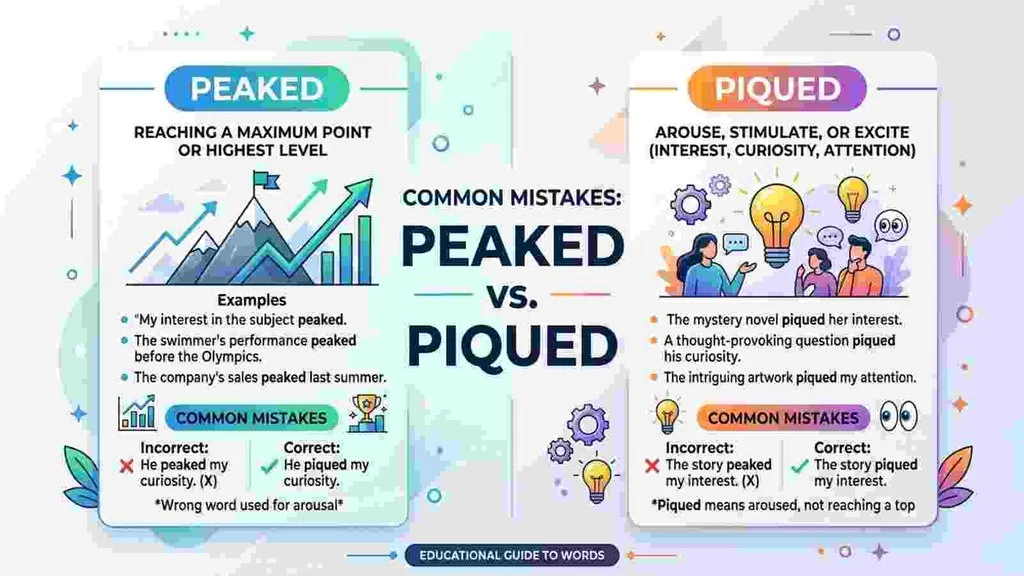
1. “Peaked my interest”
❌ The book peaked my interest.
✅ The book piqued my interest.
Here, the writer means the book aroused interest, so piqued is correct.
2. “Piqued at the highest level”
❌ Sales piqued last month.
✅ Sales peaked last month.
Here, peaked means sales reached their highest level.
3. “Piqued my curiosity”
✅ The strange photograph piqued my curiosity.
This is correct because pique can mean to stimulate curiosity.
4. Confusing “peek” with “peak”
Peek means to take a quick look.
- I took a peek inside the room.
Peak means the highest point.
- The mountain peak was covered with snow.
Pique means to stimulate interest or curiosity.
- The mystery piqued my curiosity.
Simple memory trick
Think of the three words this way:
Peek = look
Peak = highest point
Pique = interest
Peaked or Piqued in Everyday Examples
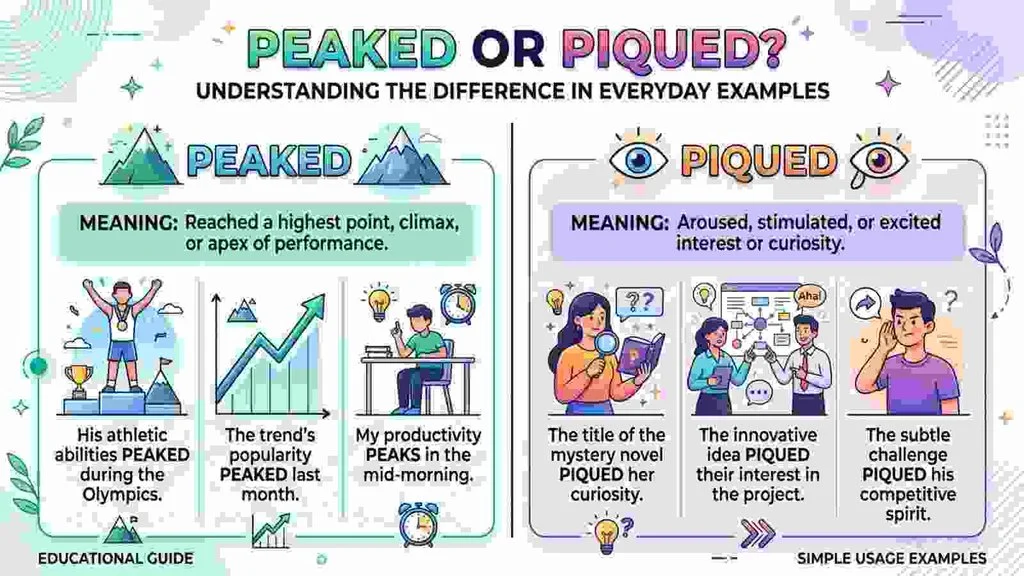
In Emails
Your proposal piqued my interest, and I would like to learn more.
This sounds natural and professional.
In News Writing
Consumer demand peaked during the holiday season.
Here, peaked describes the highest level of demand.
On Social Media
That movie trailer really piqued my interest!
The writer means the trailer made them curious.
In Academic Writing
Public interest peaked after the report was released.
Here, peaked means interest reached its highest level.
In Formal Writing
The unusual findings piqued the researchers’ curiosity.
This is a suitable formal use of piqued.
Peaked or Piqued – Comparison Table
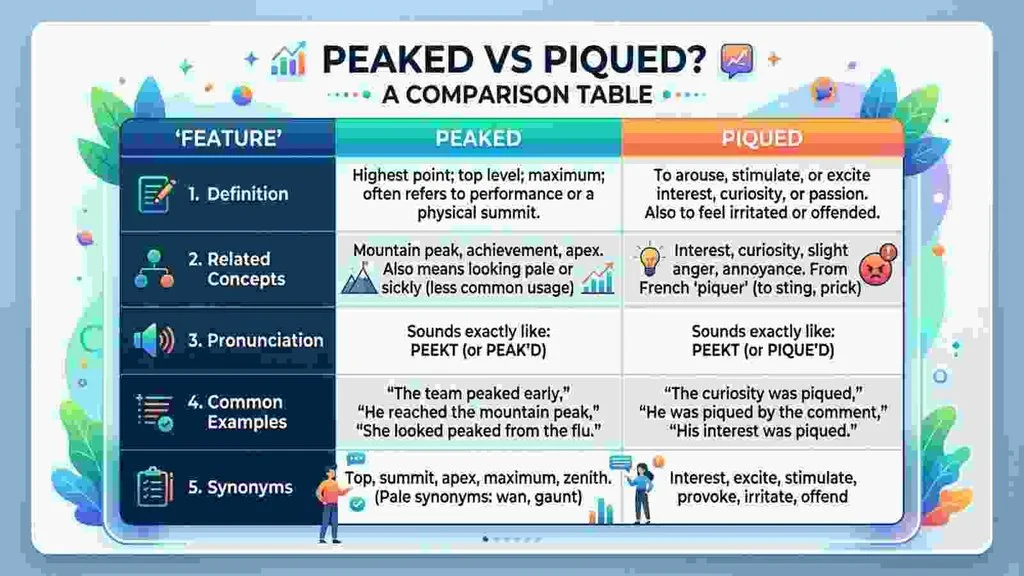
| Word | Meaning | Example |
|---|---|---|
| Peaked | Reached the highest point | Sales peaked in December. |
| Piqued | Aroused interest or curiosity | The story piqued my interest. |
| Peak | Highest point | The mountain has a high peak. |
| Pique | Stimulate interest | The mystery may pique her curiosity. |
| Peek | Take a quick look | I took a peek inside. |
The most important distinction is simple:
Piqued my interest is correct. Peaked is correct for the highest point.
Peaked or Piqued – Google Trends & Usage Data
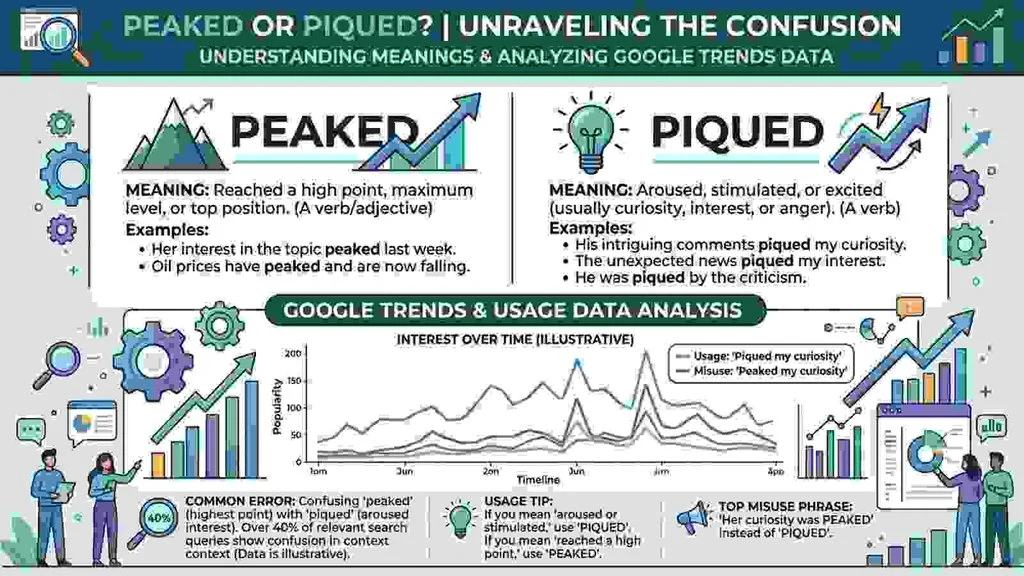
Search interest for “peaked or piqued” usually comes from people trying to solve a spelling or word-choice problem. The confusion is especially common because the words are homophones in standard English.
Searches for phrases such as:
- piqued my interest
- peaked my interest
- peaked or piqued
- pique my interest
- peak my interest
show that many writers encounter this problem when using the common expression about curiosity.
Usage also changes by context. Peaked appears frequently in writing about statistics, business, sports, prices, trends, and performance. Piqued appears more often with words such as interest, curiosity, attention, and intrigue.
Because search rankings and Google Trends figures change over time, exact popularity should be checked directly for the country and date range being studied.
FAQs About Peaked or Piqued
Is it “peaked my interest” or “piqued my interest”?
The correct phrase is “piqued my interest.” It means something made you interested or curious.
Is “peaked my curiosity” correct?
No. The standard expression is “piqued my curiosity.”
What does “peaked” mean?
Peaked means reached the highest point, level, amount, or stage.
What does “piqued” mean?
Piqued means stimulated or aroused someone’s interest, curiosity, or attention.
Are peaked and piqued pronounced the same?
Yes. In standard English, they are generally pronounced the same, which is why they are often confused.
Is “piqued my interest” formal?
Yes. “Piqued my interest” is correct and suitable for both everyday and professional writing.
What is the easiest way to remember peaked and piqued?
Remember: peak = highest point, while pique = interest or curiosity.
8. Peaked or piqued — which is correct?
Both are correct, but they mean different things: use peaked for the highest point and piqued for aroused interest or curiosity — for example, “piqued my interest.”
9. What is the difference between peaked, piqued and peeked?
Peaked means reached the highest point, piqued means aroused interest or curiosity, and peeked means took a quick look — for example, “I peeked through the door.”
Conclusion
The difference between peaked and piqued is simple once you connect each word with its meaning. Peaked comes from peak and describes something reaching its highest point. You might say that sales peaked, temperatures peaked, or an athlete’s performance peaked.
Piqued comes from pique and means that something stimulated interest, curiosity, or attention. Therefore, the correct expression is “piqued my interest,” not “peaked my interest.” You can also say that something piqued my curiosity or piqued my attention.
These spellings are the same in both American and British English. The main challenge is not regional spelling but understanding the meaning behind each word.
When you are unsure, use this simple rule: peak means highest point, pique means interest, and peek means a quick look. Remembering these three words will help you write more accurately in emails, essays, professional documents, and everyday communication.
Continue Reading:
- Macaroon vs Macaron: Meaning, Spelling, and Taste ( for 2026)
- Boss’s vs Boss’: Difference, Rules, and Examples ( for 2026)
- Accompanied By or With: Difference, Rules, and Examples ( for 2026)
- Cuter or Cutier: Correct Spelling, Meaning, and Usage ( for 2026)
- Selfs or Selves: Meaning, Grammar, and Examples (for 2026)

Here’s a concise 2-line author bio suitable for Simifind.com:
James Dashner is an American bestselling author best known for The Maze Runner series and other popular young-adult fiction.
On Simifind.com, he shares clear, engaging insights and helpful content for readers interested in books, writing, and popular literature.








3 thoughts on “Peaked or Piqued: Definitions, Examples, and Usage ( for 2026)”