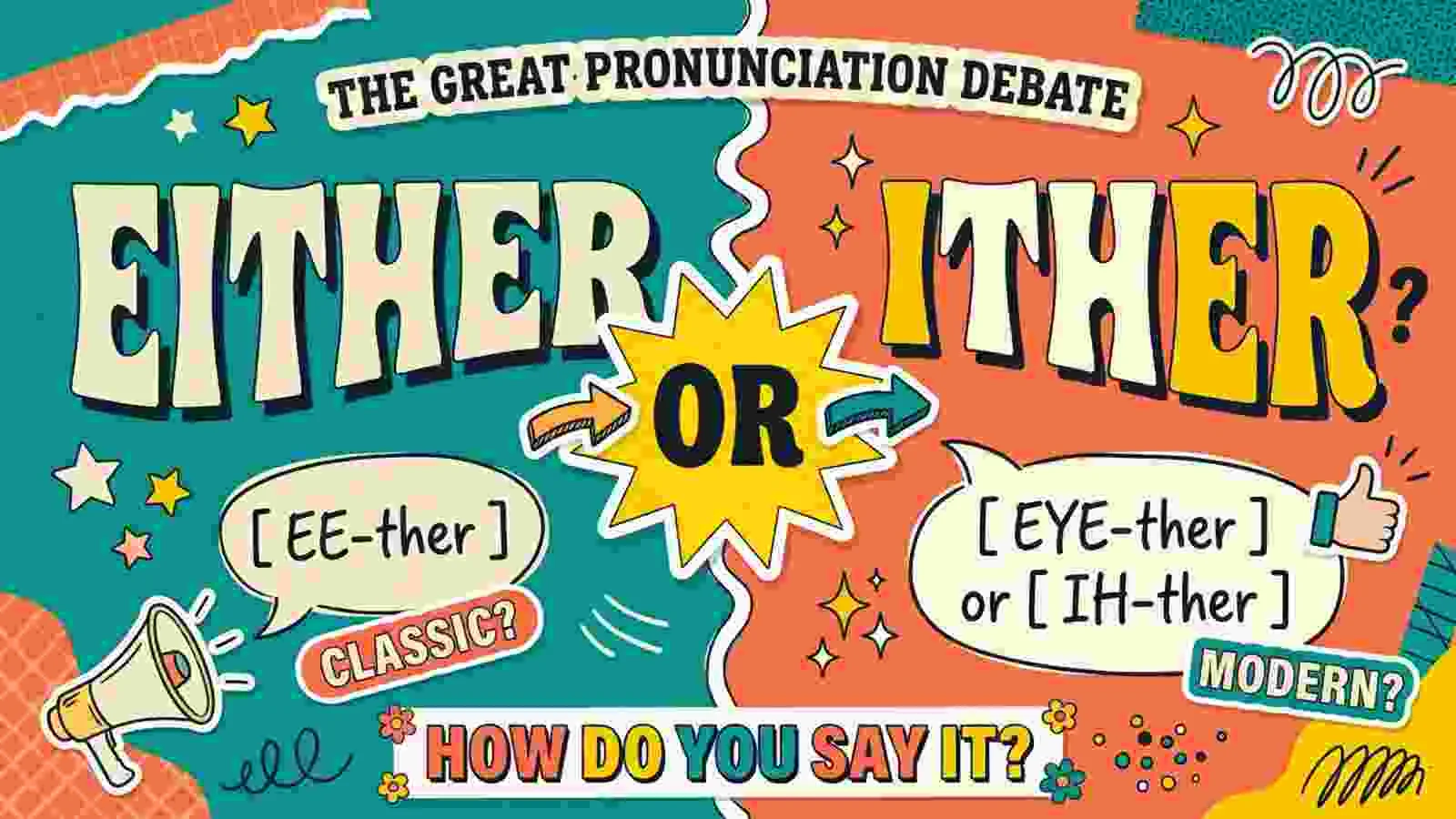
Either is correct. Ither is incorrect — it is a common misspelling of either. Either = one or the other of two things, or (in negative sentences) also not — e.g. ‘I don’t like it either.’
Have you ever typed “either” and wondered if “ither” could also be correct?
You are not alone. People often search for “either or ither” because the two forms look similar, especially when typing quickly or hearing the word spoken.
The good news is simple: either is the correct standard English spelling, while ither is not normally accepted as a modern English word.
The word either has several uses. It can show a choice between two things, as in “You can choose either option.”
It can also mean “one or the other,” or appear with or in the structure “either…or.” In negative sentences, it can mean “also,” as in “I do not like it either.”
This guide explains either or ither, their origins, spelling rules, common mistakes, and everyday examples.
It also explains how British and American English use either, so you can write with confidence.
Either or Ither – Quick Answer
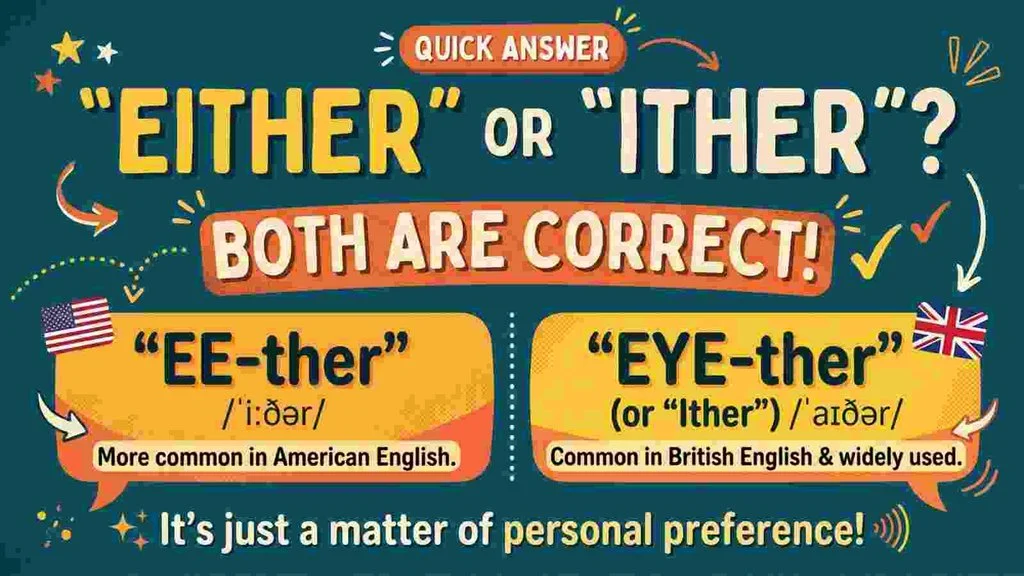
Either is the correct spelling in standard modern English.
Ither is generally an incorrect spelling when you mean either.
| Word | Correct? | Meaning |
| either | ✅ Yes | One of two choices; also; each of two |
| ither | ❌ No | Usually a misspelling of “either” |
Correct examples
- You can choose either tea or coffee.
- Either answer is acceptable.
- I do not want it either.
- We can go either today or tomorrow.
Incorrect example
- ❌ You can choose ither tea or coffee.
The correct sentence is:
- ✅ You can choose either tea or coffee.
The Origin of Either or Ither
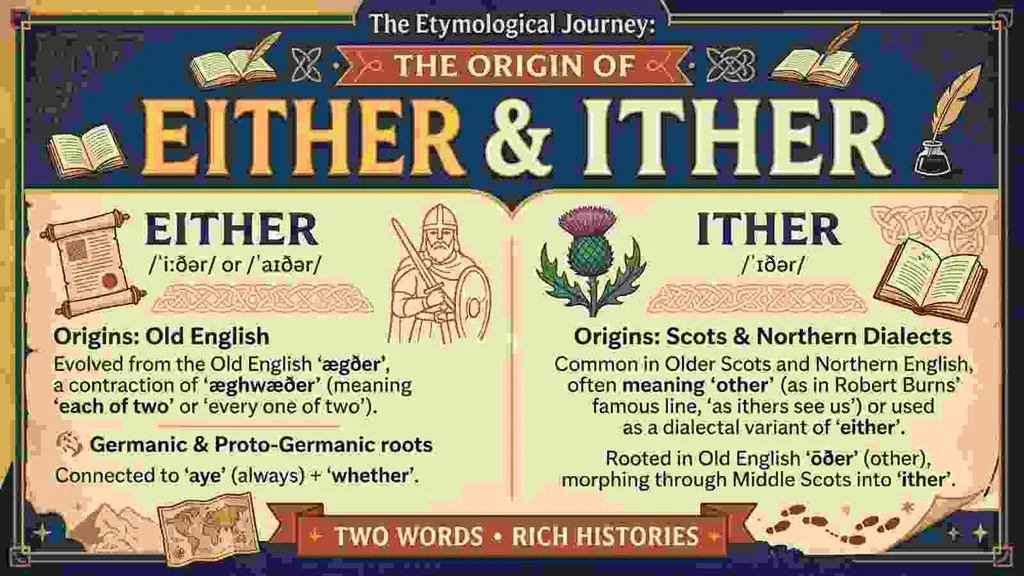
The word either has a long history in English. It comes from Old English forms related to the idea of each of two or one of two.
Over time, the spelling developed into the modern form either. The spelling ither may appear when people shorten the word while typing or write it based on pronunciation.
The confusion can also come from the way either is pronounced. English speakers use more than one common pronunciation, including versions beginning with an ee sound or an eye sound.
However, pronunciation does not change the spelling.
So, even when the word sounds different in different accents, the standard spelling remains:
either
British English vs American English Spelling
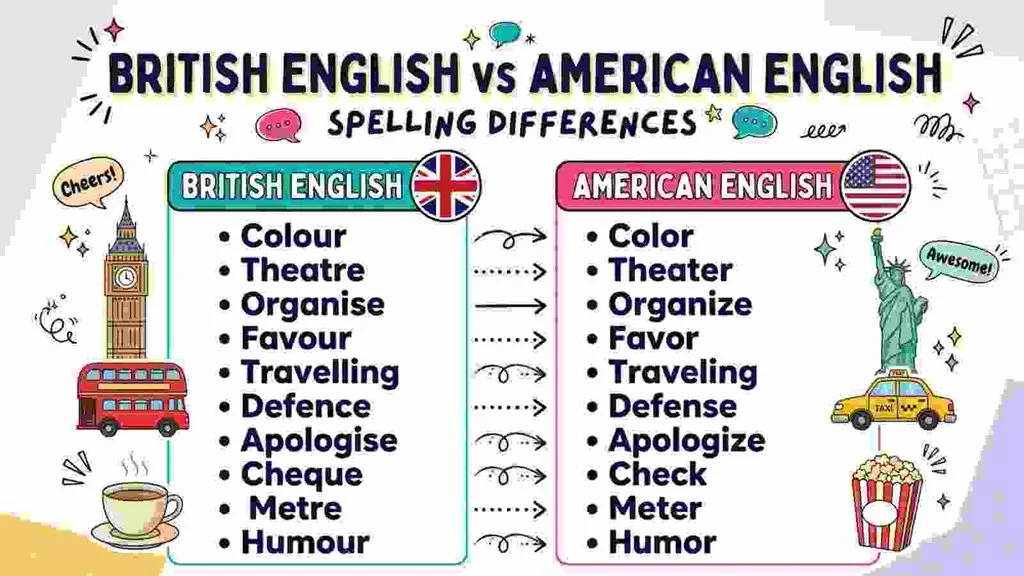
Unlike many British and American spelling differences, either does not have separate standard British and American spellings.
| Usage | British English | American English |
| Correct spelling | either | either |
| Incorrect form | ither | ither |
| Choice structure | either…or | either…or |
| Negative use | either | either |
| Formal writing | either | either |
Both British and American English use either.
Examples in both varieties
British English:
You can either stay here or come with us.
American English:
You can either stay here or come with us.
The spelling stays the same.
Which Spelling Should You Use: Either or Ither?
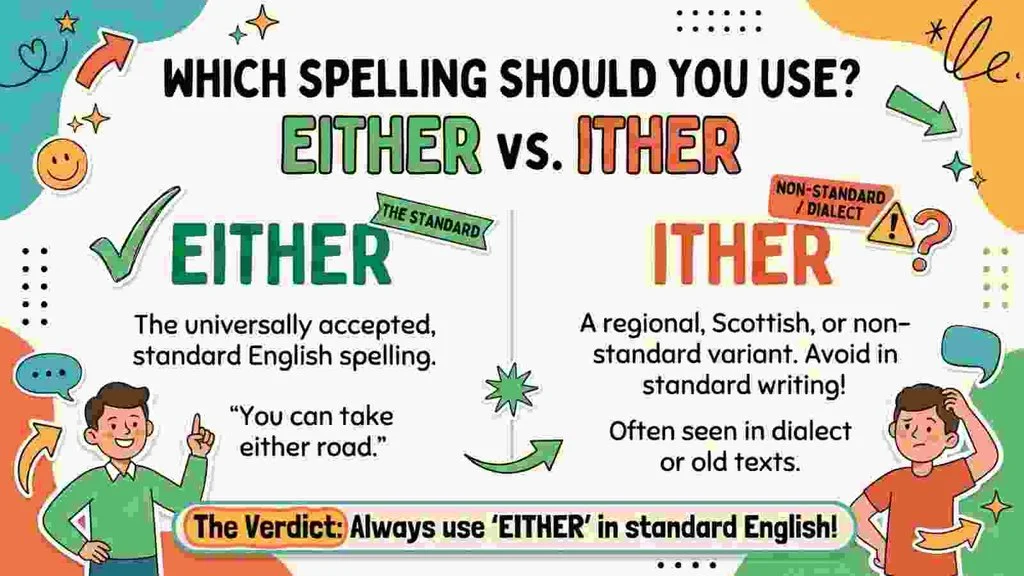
Use either in almost every standard English situation.
For American English
Use either in schoolwork, business writing, emails, websites, and everyday communication.
For British English
Use either in the same way. British English does not normally use ither as an alternative spelling.
For Global English
If you write for an international audience, either is the safest and correct choice.
For formal writing
Always use either when you mean the standard English word.
Simple rule:
If you mean the choice word, spell it either—not ither.
Common Mistakes with Either or Ither
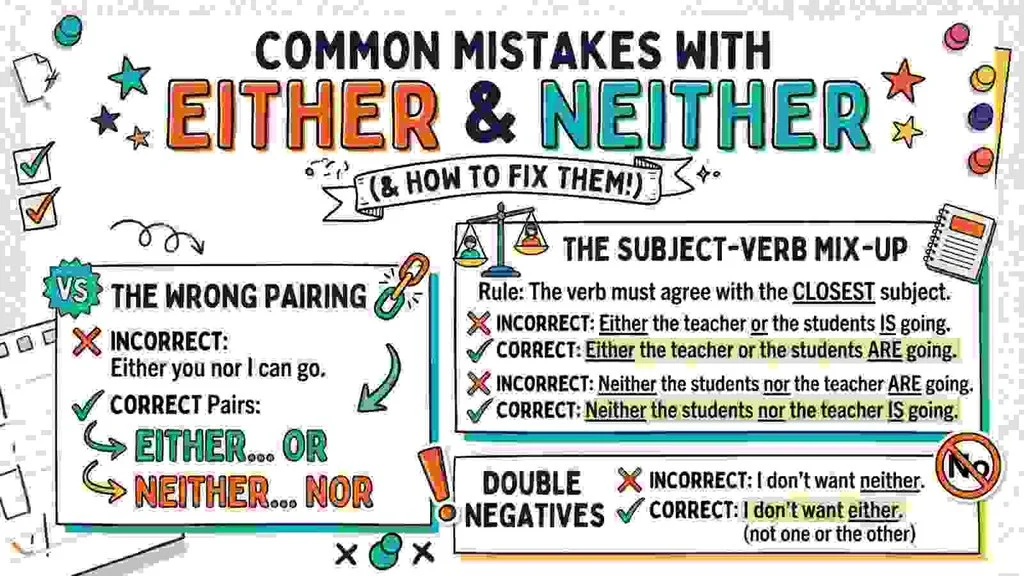
1. Writing “ither”
❌ I can choose ither one.
✅ I can choose either one.
2. Forgetting the “e”
Because people sometimes type quickly, the first e can be missed.
❌ ither
✅ either
3. Confusing pronunciation with spelling
Different speakers may pronounce either differently. This does not create a new spelling.
Both common pronunciations use:
either
4. Misusing “either…or”
The standard paired structure is:
either + option A + or + option B
Example:
You can either call me or send an email.
Not:
❌ You can either call me and send an email.
5. Using “either” when there are many choices
In many contexts, either refers to one of two choices.
Example:
You can take either the bus or the train.
For several choices, any may be more suitable:
You can choose any of these three options.
Either or Ither in Everyday Examples
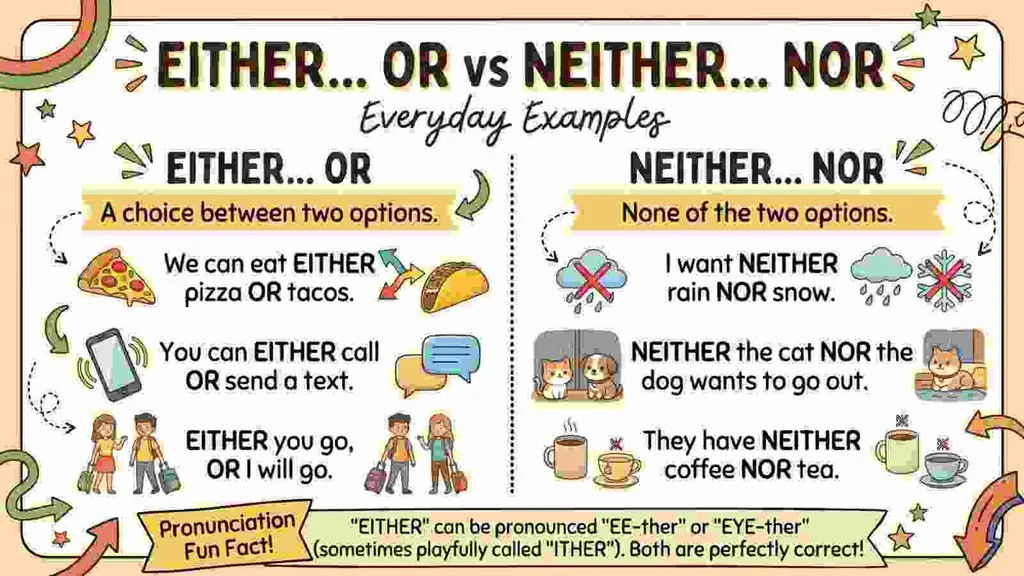
In Emails
You can either reply today or send the information tomorrow.
This is clear and professional.
In News Writing
Voters can choose either candidate in the final round.
The word shows two available choices.
In Social Media
I cannot decide either way!
Here, either appears in a common expression.
In Formal Writing
Either explanation could account for the results.
This sounds natural in academic or professional writing.
In Everyday Conversation
Do you want either pizza or pasta?
More naturally, many speakers would say:
Do you want pizza or pasta?
But either is useful when emphasizing two possible choices.
Either or Ither – Google Trends & Usage Data
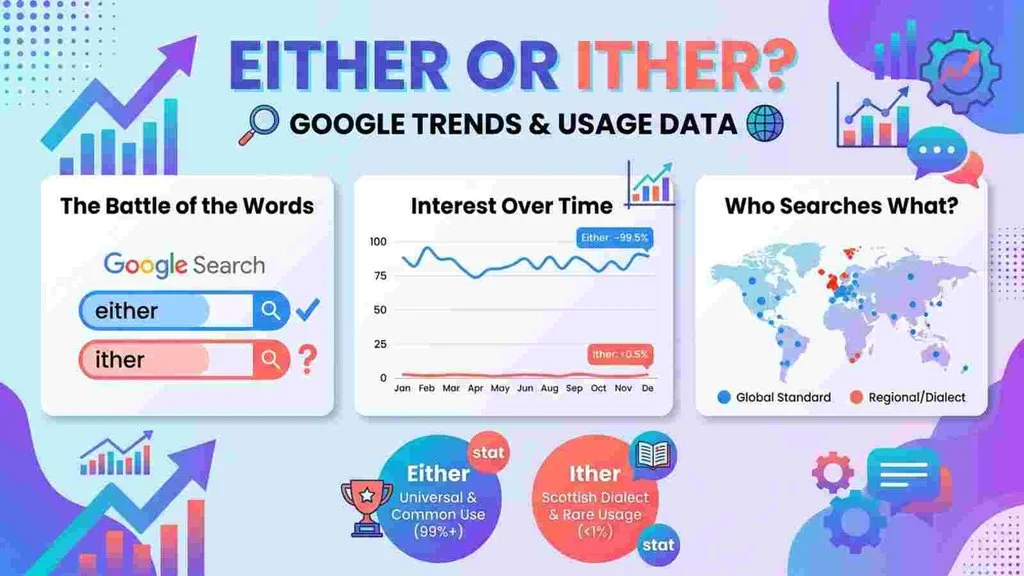
Searches for “either or ither” usually come from spelling uncertainty. People may hear the word, type the sound they remember, and then search both forms to check which spelling is correct.
The important usage pattern is clear: either is the established standard English spelling.
Search interest can also vary by country, language background, education level, and typing habits. People learning English may be especially likely to search for spelling comparisons such as either or ither.
For SEO content, the useful approach is to answer the spelling question immediately, then explain pronunciation, grammar, origin, and examples. This matches both quick-answer and detailed search intent.
Either vs Ither Comparison Table
| Feature | Either | Ither |
| Standard English | ✅ Yes | ❌ No |
| Correct spelling | ✅ | ❌ |
| Used for two choices | ✅ | ❌ |
| Used in “either…or” | ✅ | ❌ |
| Used after negative statements | ✅ | ❌ |
| British English | ✅ | ❌ |
| American English | ✅ | ❌ |
| Suitable for formal writing | ✅ | ❌ |
FAQs About Either or Ither
1. Is “either” or “ither” correct?
Either is correct. Ither is normally an incorrect spelling.
2. Is “ither” a real English word?
In standard modern English, ither is not normally used as the spelling of either. Treat it as a spelling error in ordinary English writing.
3. Do British people spell “either” as “ither”?
No. British English uses either as the standard spelling.
4. Do Americans spell “either” differently?
No. American English also uses either.
5. Why do people write “ither”?
It is usually a typing or spelling mistake. The first e may be omitted because the word is written quickly or remembered incorrectly.
6. How do you use “either” in a sentence?
Use it for one of two choices:
You can choose either option.
We can also use it in either…or:
You can either stay or leave.
7. Is “either or” correct?
Yes, when used as the paired structure either…or.
Example:
Either we leave now or we miss the train.
8. What does either mean?
Either means one or the other of two things. In a negative sentence it can also mean “also not” — for example, “I don’t like it either.”
9. What is the difference between either and ither?
Either is the correct standard spelling; ither is a misspelling. They are not two forms of the same word — either is the only standard form to use.
10. How do you spell either?
Spell it E-I-T-H-E-R: either, beginning with “ei.”
Conclusion
When comparing either or ither, the answer is simple: either is the correct standard English spelling. Ither is normally a misspelling and should not be used in professional, academic, or everyday standard English.
The word either can describe one of two choices, work in the structure either…or, or appear in negative sentences with the meaning “also.” It is used in both British and American English, so there is no need to change the spelling based on your audience.
If you are unsure, remember one easy rule: either always begins with “ei.” Pronunciation may vary between speakers, but the spelling does not change.
For emails, school assignments, articles, social media, business documents, and formal writing, choose either. If you see ither, check the sentence carefully. In most cases, the writer simply forgot the first e.
Learning this small spelling difference can help you avoid a common error and make your English writing more accurate.
Continue Reading:
- Caftan or Kaftan: Meaning, Spelling, and Usage ( for 2026)
- Peaked or Piqued: Definitions, Examples, and Usage ( for 2026)
- Macaroon vs Macaron: Meaning, Spelling, and Taste ( for 2026)
- Cuter or Cutier: Correct Spelling, Meaning, and Usage ( for 2026)
- Selfs or Selves: Meaning, Grammar, and Examples (for 2026)

Here’s a concise 2-line author bio suitable for Simifind.com:
James Dashner is an American bestselling author best known for The Maze Runner series and other popular young-adult fiction.
On Simifind.com, he shares clear, engaging insights and helpful content for readers interested in books, writing, and popular literature.








3 thoughts on “Either or Ither: Correct Spelling and Usage ( for 2026)”