
Out loud (two words) is correct. Outloud (one word) is incorrect — it is a common misspelling. Out loud means speaking so others can hear you, not silently.
Have you ever typed “out loud” and wondered if it should be written as “outloud”?
You are not alone. This is a common spelling question because the two words are often spoken together as one sound.
When people hear a phrase many times, it can feel natural to write it as one word.
The good news is simple: “out loud” is the correct spelling. It is written as two separate words. “Outloud” is not the standard spelling in modern English.
People often search for “out loud or outloud” when writing emails, school assignments, social media posts, or professional documents. Knowing the correct form helps you avoid a small but noticeable spelling mistake.
In this guide, you will learn the difference between out loud and outloud, where the phrase comes from, how British and American English use it, common mistakes, and examples from everyday writing. By the end, you will know exactly which form to use.
Out Loud or Outloud – Quick Answer
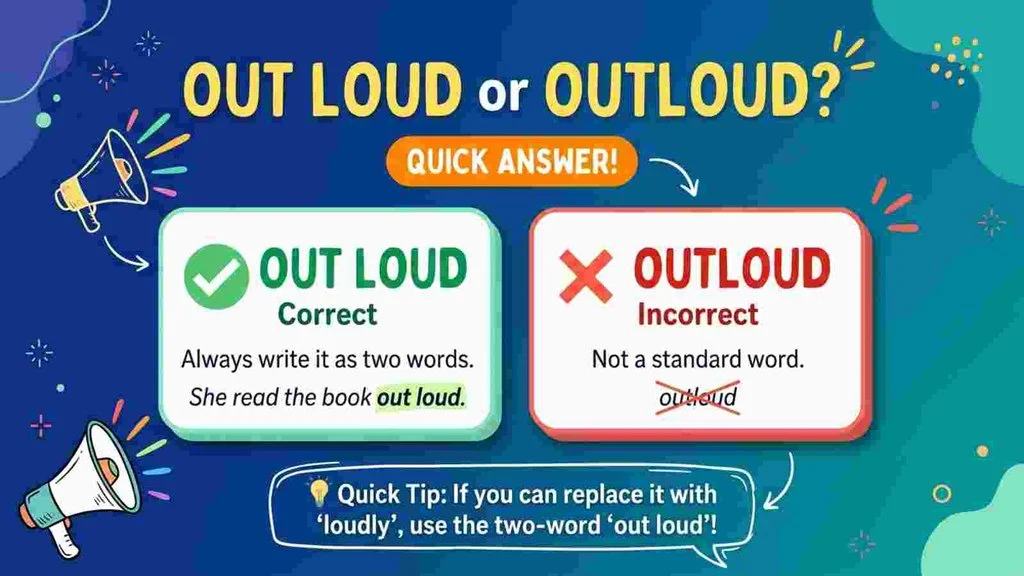
The correct spelling is out loud — two separate words.
Out loud means speaking so that other people can hear you rather than speaking silently or only thinking.
Correct:
- Please read the sentence out loud.
- She laughed out loud.
- He said the answer out loud.
- I was thinking out loud.
Incorrect:
- Please read the sentence outloud.
- She laughed outloud.
Outloud is generally considered a misspelling when used as the standard English phrase.
| Form | Correct? | Example |
| out loud | ✅ Yes | Read it out loud. |
| outloud | ❌ No | Read it outloud. |
| Out Loud | ✅ Yes in a title | She spoke Out Loud. |
The key point is simple: always write “out loud” as two words in standard English.
The Origin of Out Loud

The phrase out loud is made from two ordinary English words: out and loud.
Out has long been used to describe something that moves from inside to outside or becomes openly expressed. Loud describes a sound that can be heard clearly.
Together, out loud developed the meaning of expressing something through audible speech.
For example:
“She read the letter out loud.”
This means she read the letter using her voice so that people could hear it.
The phrase is not a compound word. That is why out loud remains separated.
English has many phrases that sound like one word when spoken. However, pronunciation does not always determine spelling. This is one reason people sometimes write outloud by mistake.
Similar examples include:
- at least, not atleast
- a lot, not alot
- of course, not ofcourse
- in front, not infront
The same basic idea applies to out loud: the words are pronounced together in normal speech, but they remain separate in writing.
British English vs American English Spelling
There is no major spelling difference between British and American English for this phrase.
Both varieties use:
out loud
| English variety | Correct form | Example |
| American English | out loud | Read the question out loud. |
| British English | out loud | Read the question out loud. |
| Canadian English | out loud | Say it out loud. |
| Australian English | out loud | She laughed out loud. |
| International English | out loud | Please say it out loud. |
Unlike words such as color/colour or center/centre, out loud does not change based on regional spelling.
Why Do People Write “Outloud”?
The main reason is pronunciation.
When people say out loud, the two words flow together naturally. This can make the phrase sound like a single word.
However, spoken pronunciation and written form are not always the same.
For standard writing, keep the words separate:
out + loud = out loud
Which Spelling Should You Use: Out Loud or Outloud?
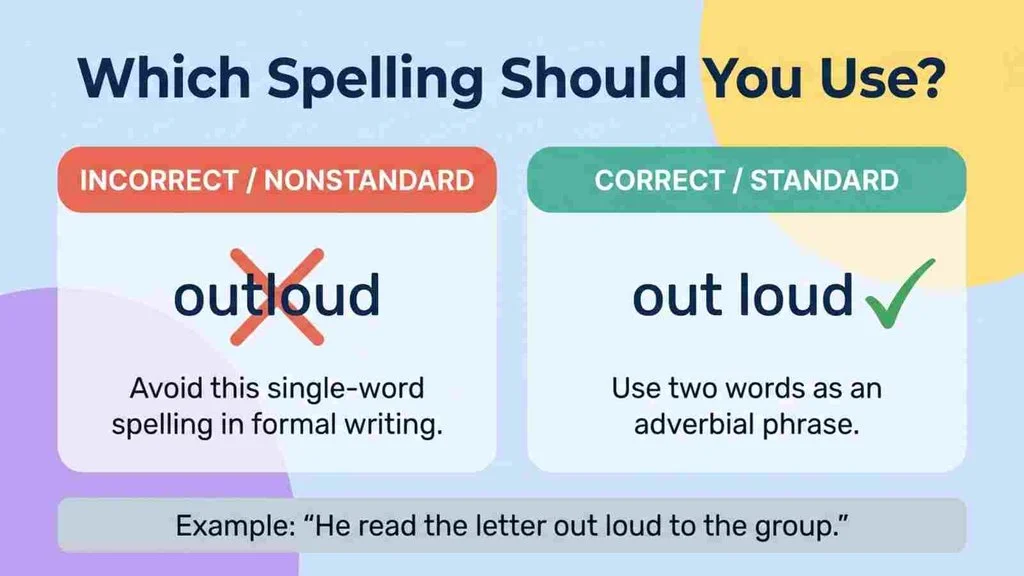
You should use out loud in almost every standard English situation.
For American English
Use out loud in:
- School assignments
- Emails
- Business writing
- Articles
- Books
- Social media
- Text messages
For British English
Use the same spelling:
out loud
There is no need to change it to outloud.
For Global English
If you are writing for an international audience, out loud is also the safest choice.
It is widely understood and follows standard English spelling.
Professional Advice
When writing, remember this simple rule:
If you mean “so that people can hear it,” write “out loud.”
Common Mistakes with Out Loud or Outloud
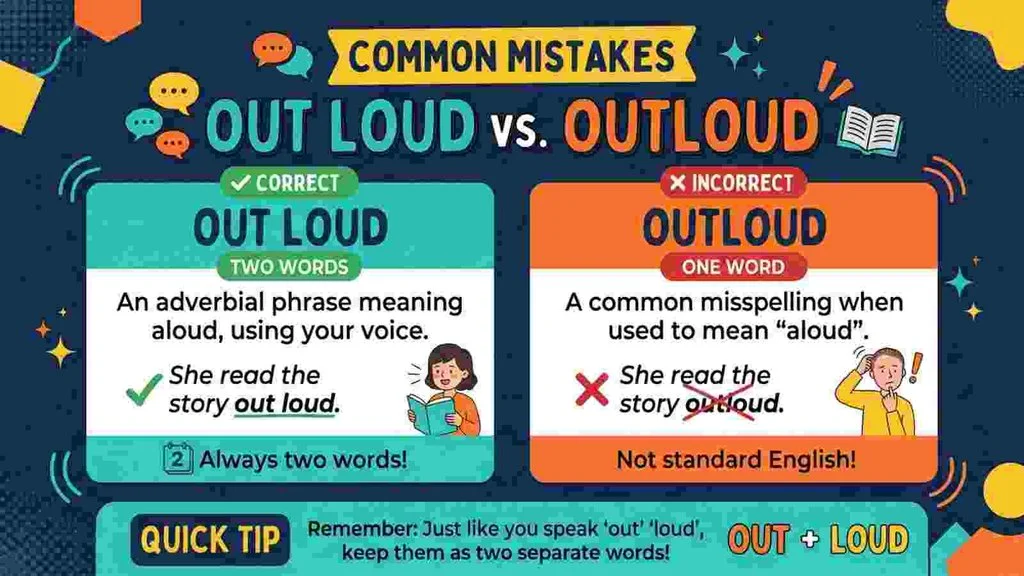
1. Writing “outloud”
Incorrect:
She read the poem outloud.
Correct:
She read the poem out loud.
2. Treating It Like One Word
Because the phrase sounds connected when spoken, writers sometimes join it together.
Incorrect:
He said his thoughts outloud.
Correct:
He said his thoughts out loud.
3. Confusing “Out Loud” With “Loudly”
The two expressions can sometimes have similar meanings, but they are not identical.
Out loud focuses on speaking so that something can be heard.
She read the message out loud.
Loudly describes the volume or manner of sound.
She spoke loudly.
4. Using “Out Loud” When Silent Reading Is Meant
Compare:
I read the book silently.
with:
I read the book out loud.
The first means you did not speak the words. The second means you used your voice.
Out Loud in Everyday Examples

In Emails
Could you please read the instructions out loud during the meeting?
I practiced the presentation out loud before the interview.
In News Writing
The witness read the statement out loud in court.
The students read the names out loud.
In Social Media
I just laughed out loud at this post!
Sometimes I say my ideas out loud to understand them better.
In Formal Writing
The researcher asked participants to read each sentence out loud.
The teacher asked the student to explain the answer out loud.
In Everyday Conversation
Say it out loud.
Why are you thinking out loud?
Can you read this out loud for me?
Out Loud or Outloud: Comparison Table
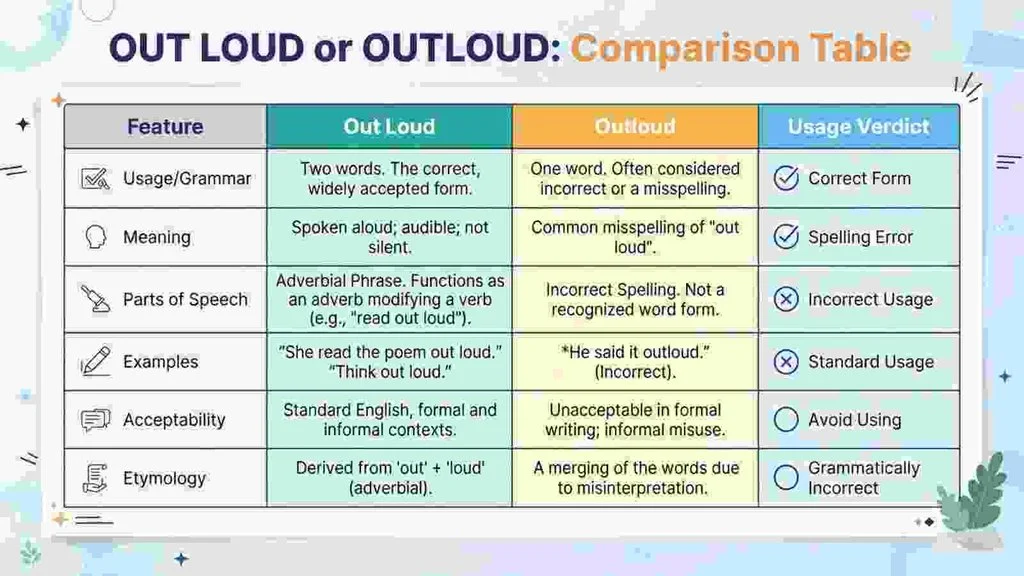
| Variation | Standard English? | Meaning | Example |
| out loud | ✅ Yes | Audibly; so others can hear | Say your answer out loud. |
| outloud | ❌ No | Intended to mean “out loud” | Avoid this spelling. |
| out-loud | ❌ Usually unnecessary | Hyphenated form | Avoid in normal writing. |
| loudly | ✅ Yes | In a loud manner | She spoke loudly. |
| aloud | ✅ Yes | Audibly | He read the letter aloud. |
Out loud and aloud can often be used in similar contexts.
She read the story out loud.
She read the story aloud.
Both mean that she used her voice rather than reading silently.
However, out loud is very common in everyday English.
Out Loud – Google Trends & Usage Data

Searches for “out loud or outloud” usually come from people who are unsure whether the phrase should be written as one word or two.
The phrase out loud is widely used in English-speaking countries, including the United States, United Kingdom, Canada, and Australia.
The search intent is mainly related to:
- Spelling
- Grammar
- Word usage
- English learning
- Writing correction
- Meaning
- Everyday communication
A common reason for the search is that out loud sounds like one connected unit during normal speech. This creates uncertainty when people type it.
Search interest can also vary by country because English learners and native speakers use different search habits. However, the standard written form remains the same across major English varieties: out loud.
For accurate current popularity figures, Google Trends should be checked for the exact country, date range, and search terms being compared. Search volume can change over time, so trend data should be treated as a snapshot rather than a permanent rule.
FAQs About Out Loud or Outloud
1. Is “out loud” one word or two?
Out loud is two words. This is the standard spelling.
2. Is “outloud” grammatically correct?
No. Outloud is generally considered a misspelling of the standard phrase out loud.
3. Is “out loud” correct in American English?
Yes. Out loud is the standard form in American English.
4. Is “out loud” correct in British English?
Yes. British English also uses out loud.
5. Can I use “aloud” instead of “out loud”?
Often, yes. Both can mean that something is spoken so it can be heard.
6. What does “out loud” mean?
Out loud means speaking or making a sound so that it can be heard rather than keeping it silent.
7. Is “out-loud” correct?
In normal modern writing, out-loud is not the standard form of the phrase. Use out loud.
8. What is the difference between out loud and outloud?
There is no difference in meaning — outloud is just a misspelling of out loud. Out loud (two words) is the correct spelling; outloud (one word) is not standard English.
9. How do you spell out loud?
Spell it O-U-T L-O-U-D: out loud, as two separate words.
Conclusion
The answer to “out loud or outloud” is clear: out loud is the correct standard spelling. Always write it as two separate words when you mean something is spoken so that it can be heard.
The confusion comes mainly from pronunciation. When we speak naturally, out loud can sound like one connected word. But spoken sounds do not always tell us how words should be written.
There is also no British-versus-American spelling difference here. American, British, Canadian, Australian, and international English all normally use out loud.
You can use the phrase in casual conversations, emails, schoolwork, professional writing, news reports, and social media. If you want a shorter alternative, aloud can often work in similar sentences.
The easiest rule to remember is simple: write “out loud” as two words, not “outloud.” Once you learn this small spelling rule, you can use the phrase confidently in almost any type of English writing.
Continue Reading:
- Either or Ither: Correct Spelling and Usage ( for 2026)
- Caftan or Kaftan: Meaning, Spelling, and Usage ( for 2026)
- Peaked or Piqued: Definitions, Examples, and Usage ( for 2026)
- Cuter or Cutier: Correct Spelling, Meaning, and Usage ( for 2026)
- Selfs or Selves: Meaning, Grammar, and Examples (for 2026)

Mary Roach is an American science writer and bestselling author known for making unusual and complex scientific topics engaging, accessible, and humorous. Her books include Stiff, Packing for Mars, Gulp, and Fuzz.
Author at Simifind.com, sharing clear, informative content designed to help readers understand interesting topics and everyday questions.






2 thoughts on “Out Loud or Outloud: Definition, Usage, and Examples ( for 2026)”