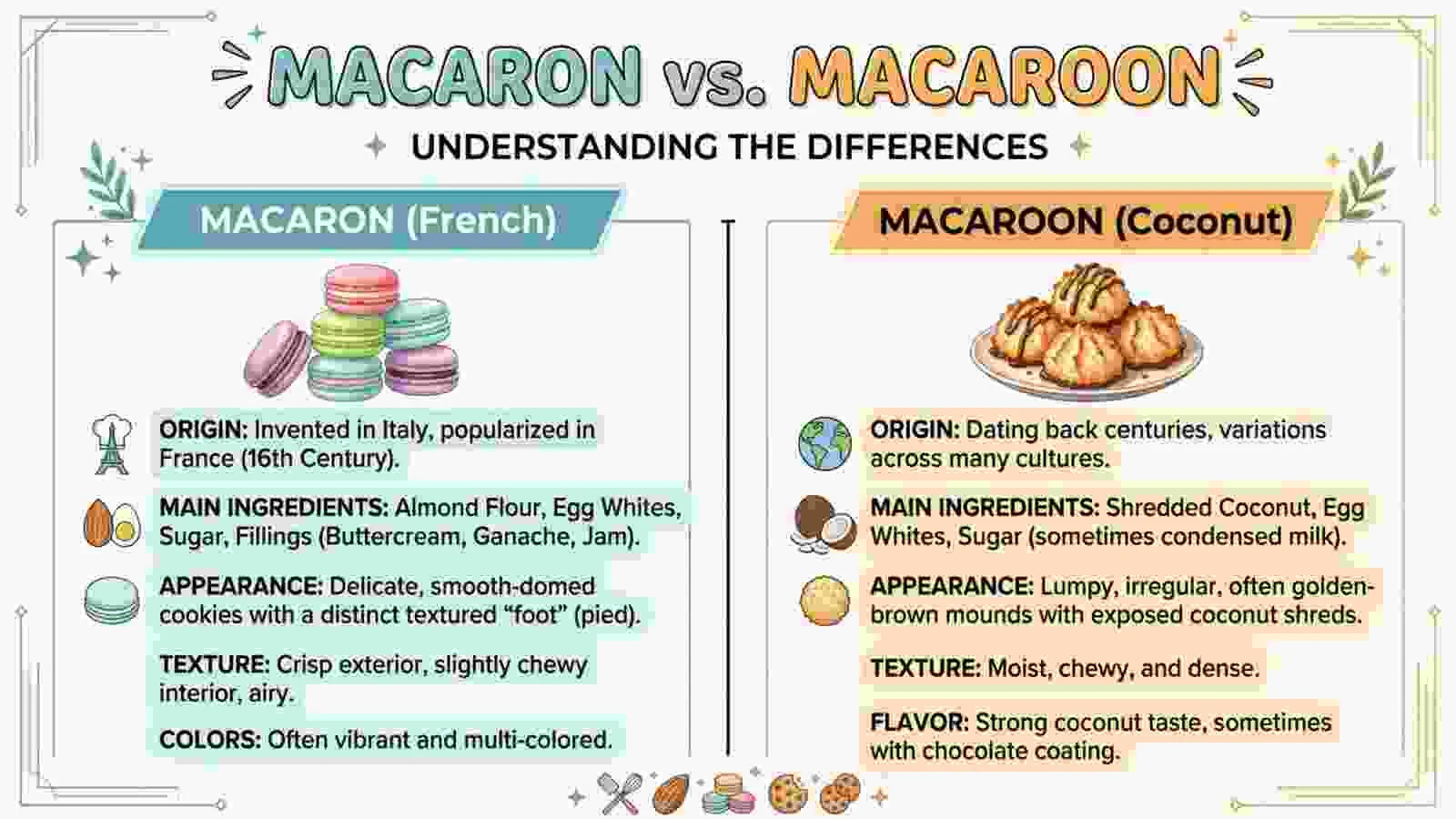
Macaroon and macaron are two different cookies, not two spellings of the same word. A macaroon (double o) is a chewy coconut cookie. A macaron (single o) is a delicate French almond sandwich cookie with a filling. Use macaroon for coconut, macaron for the French almond cookie.
Have you ever seen the words “macaroon” and “macaron” and wondered if they mean the same thing?
You are not alone. These two words look very similar, sound alike in some places, and both refer to sweet treats. But they are not the same dessert.
A macaroon is a small, chewy cookie. It is often made with coconut, egg whites, and sugar. A macaron is a French cookie made with almond flour.
It has two light shells with a soft filling in the middle. It often comes in bright colors and many flavors.
People search for “macaroon or macaron” because the words are easy to mix up.
Some people also think one spelling is British and the other is American. This is not true. The two words name two different foods.
In this guide, you will learn their meanings, origins, spelling rules, and correct use. You will also see clear examples, common mistakes, and simple tips to help you choose the right word every time.
Macaroon or Macaron – Quick Answer
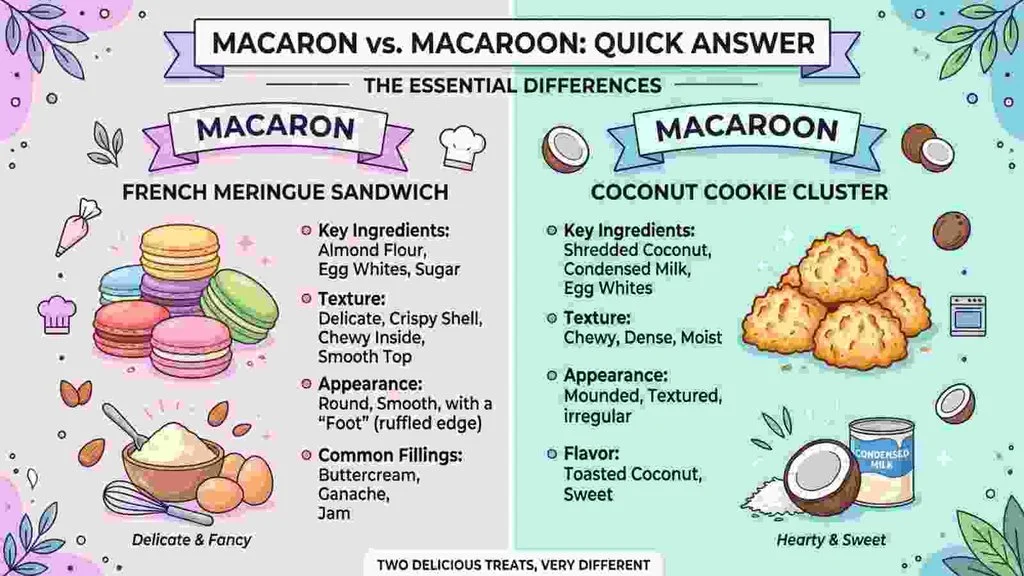
Both macaroon and macaron are correct English words, but they mean different things.
- Macaroon: A small, chewy cookie often made with coconut.
- Macaron: A French sandwich cookie made with almond flour and filled with cream, jam, or ganache.
Macaroon
Chewy, often made with coconut.
Macaron
Smooth shells with a soft filling.
Examples:
- I bought a coconut macaroon from the bakery.
- She served colorful macarons at the party.
The key difference is simple: a macaroon is often a coconut cookie, while a macaron is a French almond-based cookie.
Neither spelling is wrong. The correct choice depends on the dessert you mean.
The Origin of Macaroon and Macaron
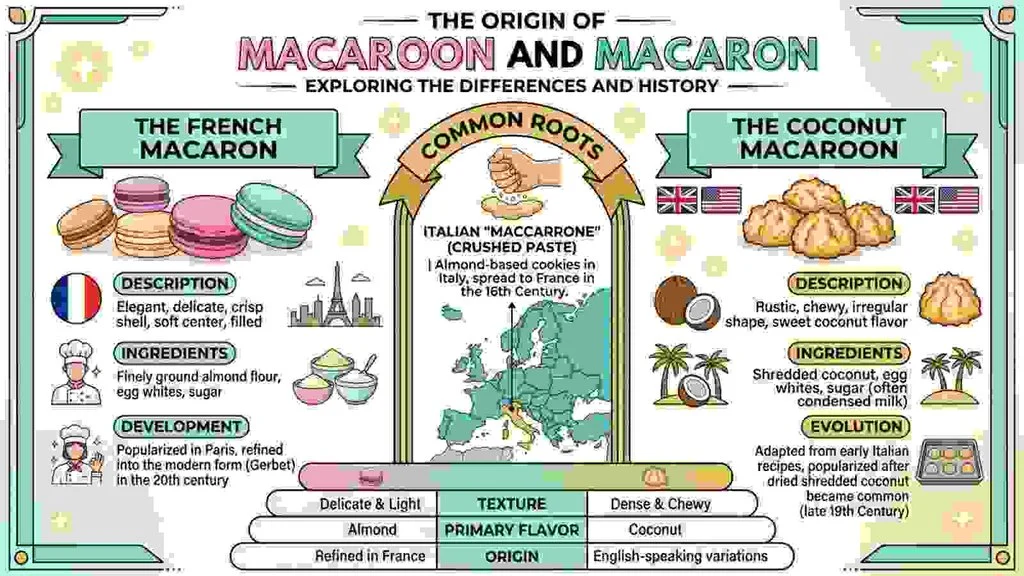
The words “macaroon” and “macaron” share the same history. Both came from an old Italian word, maccarone, which referred to a type of food made from dough or paste.
The word later moved into French as macaron. English then adopted the word as “macaroon.” The spelling changed, but the link between the two words remained.
The word “macaroon” appeared in English in the early 1600s. At that time, it often meant a small cake made with ground almonds, sugar, and egg whites. Coconut became a popular ingredient in many later recipes.
How Did Macarons Become Different?
The French macaron changed over time. Bakers began making two light shells and joining them with a sweet filling.
This style became famous in France. Today, French macarons are known for their smooth tops, bright colors, and soft centers.
Macaroons also changed. Many bakers began using coconut instead of almonds. This helped create the chewy coconut cookie that many people know today.
So, the two desserts have a shared past, but they now have different forms and meanings.
British English vs American English Spelling

The words “macaroon” and “macaron” are not simply British and American spellings of the same word.
Both forms are used in British and American English. The main difference is the type of dessert they describe.
In the United States, “macaron” is often used for the French sandwich cookie. “Macaroon” usually means a chewy cookie made with coconut.
In the UK, the word “macaroon” can also refer to an almond-based sweet biscuit. Some British bakeries still use “macaroon” for treats that may look like French macarons.
British and American Comparison Table
| Feature | British English | American English |
| French sandwich cookie | Macaron | Macaron |
| Coconut cookie | Macaroon | Macaroon |
| Almond-based sweet biscuit | Macaroon may be used | Macaroon may be used |
| French spelling | Macaron | Macaron |
| Plural of macaron | Macarons | Macarons |
| Plural of macaroon | Macaroons | Macaroons |
| Spelling difference | No fixed regional difference | No fixed regional difference |
Important: The spelling depends on the dessert, not the country.
For clear writing, use “macaron” for the French sandwich cookie and “macaroon” for the chewy coconut cookie.
Which Spelling Should You Use: Macaroon or Macaron?
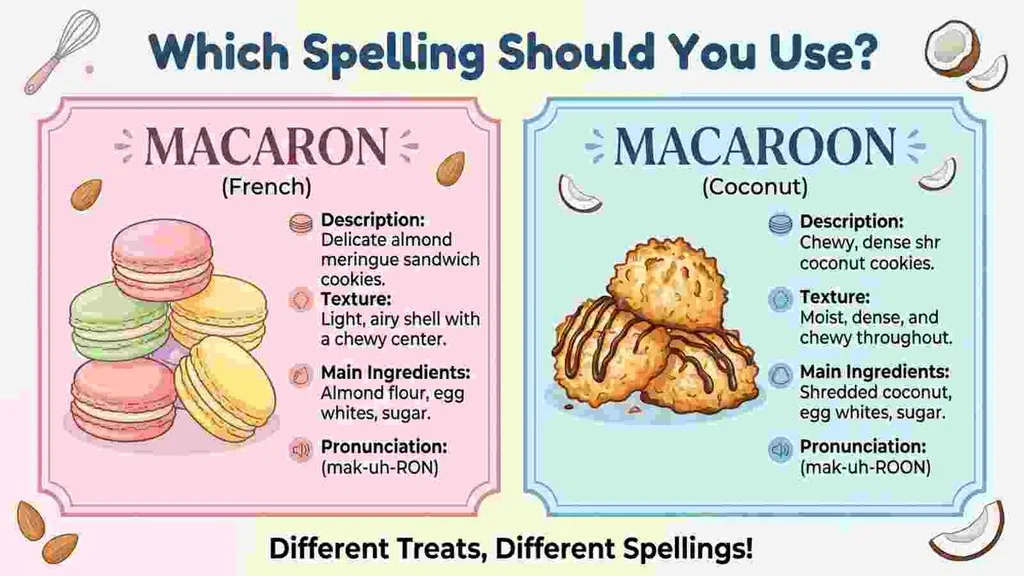
The best spelling depends on your reader and the dessert you want to describe.
For US Readers
Use “macaron” for the colorful French cookie with filling.
Use “macaroon” for a chewy coconut cookie.
Example:
- I bought a box of chocolate macarons.
- My grandmother made coconut macaroons.
For UK and Commonwealth Readers
Both words are understood, but some bakeries may use “macaroon” more broadly.
If you mean the French sandwich cookie, “macaron” is the clearest choice.
If you mean a coconut or almond drop cookie, use “macaroon.”
For Global Readers
Use the French spelling “macaron” when talking about the famous French sandwich cookie.
Use “coconut macaroon” when talking about the chewy coconut treat.
Adding a word like “French” or “coconut” can help readers understand your meaning.
For Food Writers and Businesses
Use the correct term on menus, websites, recipes, and product labels.
For example:
- French almond macarons
- Chocolate coconut macaroons
- Raspberry-filled macarons
- Toasted coconut macaroons
This helps customers know what they are buying.
Common Mistakes with Macaroon and Macaron
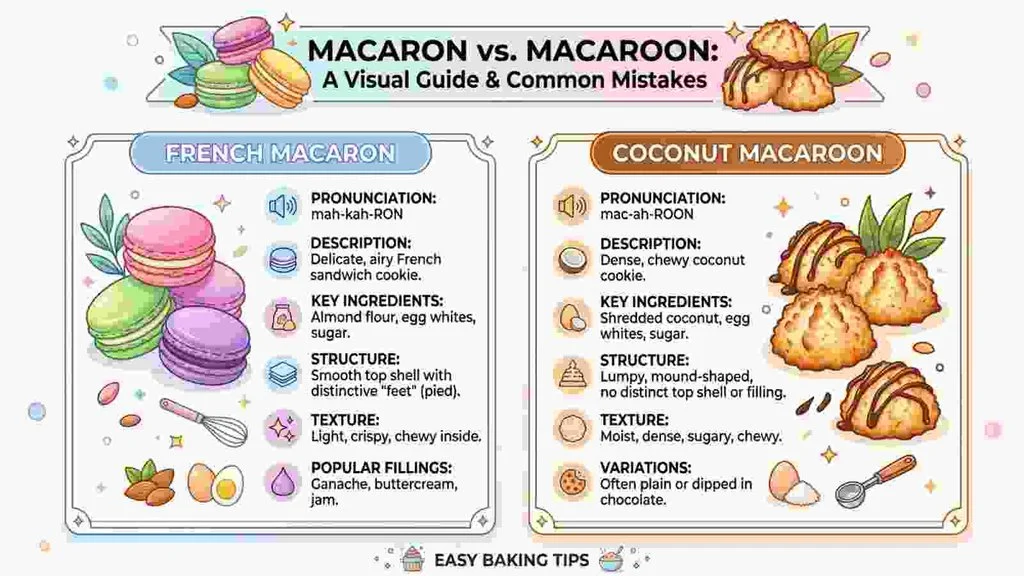
These words are easy to mix up. Here are some common mistakes and their corrections.
| Common mistake | Better wording | Why? |
| Coconut macaron | Coconut macaroon | Usually describes the coconut cookie |
| French macaroon | French macaron | Clearer name for the sandwich cookie |
| Macarons (for coconut cookies) | Macaroons | Correct plural for coconut cookies |
| Macaroons (for French sandwich cookies) | Macarons | More precise spelling |
| Macaroon’s | Macaroons | Use no apostrophe for a plural |
| Macaron’s | Macarons | Use no apostrophe for a plural |
Easy Ways to Remember
Here are two simple memory tricks:
- Macaroon has two O’s, like the word “coconut.”
- Macaron has one O, like the French word used for the French cookie.
You can also remember the shape:
- Macaroon = chewy cookie, often in a rough round shape.
- Macaron = two smooth shells with filling in the middle.
One more tip: Do not use an apostrophe to make either word plural.
Correct: I bought six macarons.
Incorrect: I bought six macaron’s.
Macaroon and Macaron in Everyday Examples
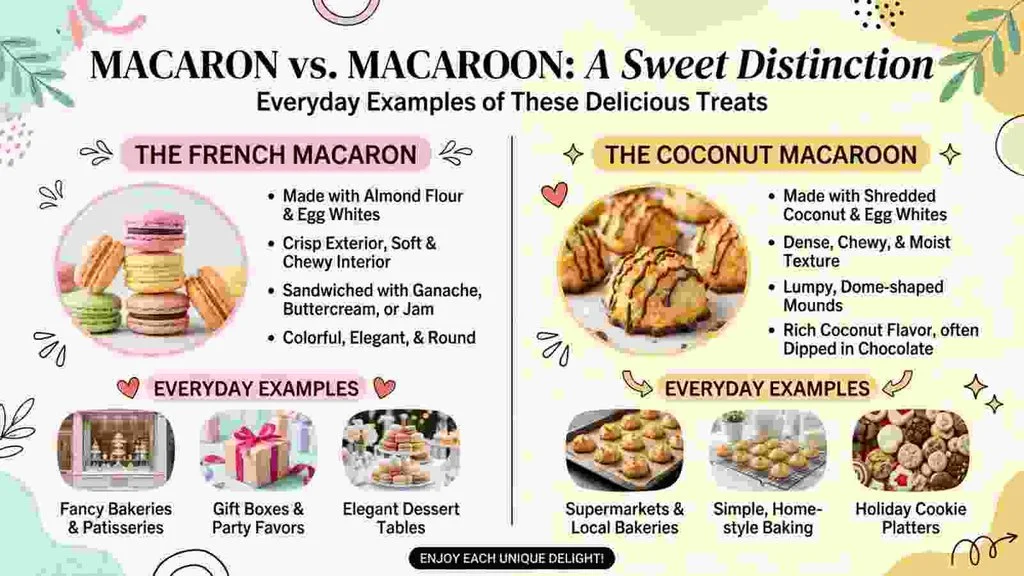
Both words are common in food writing, menus, recipes, and social media.
In Emails
Macaroon:
Could you please order two boxes of coconut macaroons for the event?
Macaron:
Please include a box of French macarons with the dessert order.
In News
Macaroon:
The bakery has added chocolate-dipped coconut macaroons to its menu.
Macaron:
The French bakery opened a new shop selling handmade macarons.
On Social Media
Macaroon:
Fresh coconut macaroons are ready! Sweet, soft, and full of flavor.
Macaron:
These pink and purple macarons are almost too pretty to eat!
In Formal Writing
Macaroon:
The dessert menu includes coconut macaroons made with egg whites and sugar.
Macaron:
The restaurant offers French macarons filled with chocolate ganache.
In Recipes
Macaroon:
Mix coconut, sugar, and egg whites. Shape the mixture into small rounds and bake.
Macaron:
Prepare almond flour, egg whites, and sugar. Pipe small shells, bake them, and add your chosen filling.
These examples show why the right word matters. It helps readers picture the correct dessert.
Macaroon or Macaron – Google Trends & Usage Data
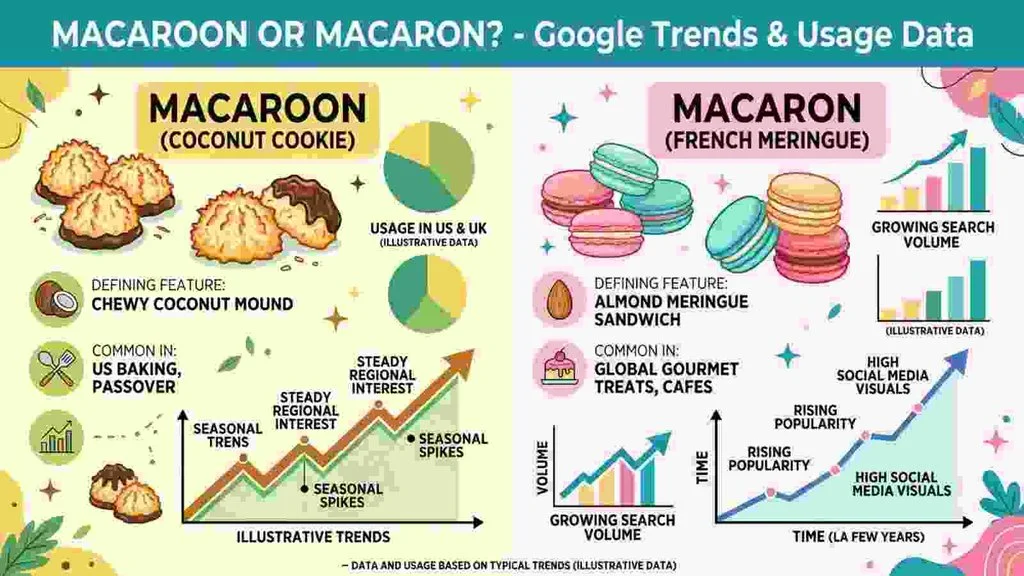
People search for “macaroon or macaron” because the two words look alike. They also share a common history and are both names for sweet treats.
Search interest can come from different needs, such as:
- Finding the correct spelling.
- Learning the difference between the two desserts.
- Looking for recipes.
- Searching for French desserts.
- Finding bakeries and dessert shops.
- Learning food-related English words.
Popularity by Country
Both words are used in many English-speaking countries. However, search interest may change based on food habits, culture, and local bakery trends.
| Country | Common search context |
| United States | French macarons, coconut macaroons, and recipes |
| United Kingdom | Bakery products, spelling, and dessert names |
| France | Traditional macarons and French pastry |
| Canada | French desserts and coconut cookies |
| Australia | Bakery products and baking recipes |
| Pakistan | English spelling, food meanings, and recipes |
| India | French desserts, recipes, and English learning |
These are possible search contexts, not verified Google Trends rankings.
What Does Google Trends Show?
Google Trends measures search interest on a scale from 0 to 100. It does not show the exact number of searches.
A score of 100 means the highest relative search interest for the selected time and place. A lower score means less interest compared with that peak.
You can compare these search terms:
- Macaroon
- Macaron
- Macaroon vs macaron
- Macaron recipe
- Coconut macaroon recipe
The results may change based on the country and time range.
Which Keyword Should You Target for SEO?
If you write about French sandwich cookies, target macaron.
If your article is about coconut cookies, target macaroon.
For an article that explains both words, use the keyword “macaroon or macaron” in the title, introduction, and relevant headings.
This helps your article answer both spelling questions and food-related searches.
Macaroon vs Macaron – Comparison Table
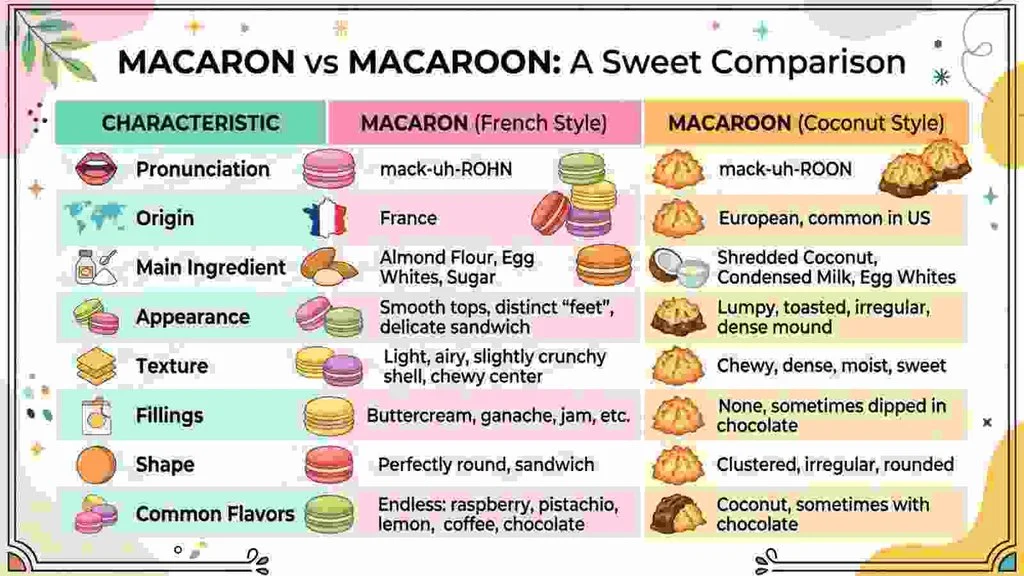
Here is a complete side-by-side comparison to help you understand both words.
| Feature | Macaroon | Macaron |
| Spelling | Macaroon | Macaron |
| Correct word? | Yes | Yes |
| Origin | Italian and French roots | French |
| Common type | Coconut cookie | French sandwich cookie |
| Main ingredients | Coconut, sugar, egg whites | Almond flour, sugar, egg whites |
| Shape | Rough or round mound | Two smooth round shells |
| Texture | Chewy and moist | Crisp outside, soft inside |
| Filling | Often no filling | Usually has filling |
| Common flavors | Coconut, chocolate, almond | Vanilla, raspberry, chocolate, pistachio |
| Appearance | Golden or brown | Often colorful |
| Plural | Macaroons | Macarons |
| Example | Coconut macaroon | French macaron |
Quick memory tip: Macaroon has two O’s, like coconut. Macaron has one O and is the name of the French sandwich cookie.
Frequently Asked Questions (FAQs)
1. Is it macaroon or macaron?
Both are correct words. A macaroon is often a chewy coconut cookie. A macaron is a French sandwich cookie made with almond flour and filling.
2. Are macarons and macaroons the same thing?
No. They share a history, but they are different desserts. Macarons have two light shells with filling. Macaroons are often made with coconut.
3. Why are macarons spelled with one O?
“Macaron” comes from the French spelling. It is used in English to name the French sandwich cookie.
4. Is macaron French or English?
“Macaron” is a French word. English also uses it to describe the famous French sandwich cookie.
5. Are coconut macaroons the same as French macarons?
No. Coconut macaroons are chewy cookies made with shredded coconut. French macarons are delicate cookies made with almond flour and a sweet filling.
6. Which is correct in British English: macaroon or macaron?
Both are correct, but they describe different treats. British speakers may also use “macaroon” for some almond-based biscuits. “Macaron” is the clearest choice for the French sandwich cookie.
7. Why are macarons so expensive?
Macarons can cost more because they need careful preparation. Their shells can crack or fail to rise. They also need special ingredients and skill to make well.
8. What is the plural of macaron?
The plural is “macarons.”
Example: I bought twelve macarons for the party.
9. How can I remember the difference between macaroon and macaron?
Remember that macaroon has two O’s, like coconut. Macaron has one O and usually means the colorful French cookie.
10. What does macaron mean?
Macaron means a delicate French sandwich cookie made with almond flour, with two smooth shells and a soft filling (cream, jam or ganache) in the middle.
11. Is macaroon a word?
Yes. Macaroon is a real English word — the name of a small, chewy cookie, most often made with coconut, egg whites and sugar.
12. How do you spell macaron?
M-A-C-A-R-O-N — macaron, with one o. Do not add a second o; ‘macaroon’ (double o) is the coconut cookie.
Conclusion
The choice between macaroon or macaron depends on the dessert you mean. Both spellings are correct, but they do not have the same meaning.
A macaroon is a soft and chewy cookie. It is often made with coconut, sugar, and egg whites. A macaron is a French sandwich cookie. It has two light shells and a sweet filling in the middle.
Both words share the same history. They came from an old Italian word and later became part of French and English. Over time, the two desserts developed their own styles.
There is no simple British or American spelling rule that changes one word into the other. Both words are used in different English-speaking countries.
For clear writing, use “macaron” for French sandwich cookies and “macaroon” for coconut cookies. If you write recipes, menus, blogs, or product descriptions, choosing the right word helps readers understand your meaning.
The easiest way to remember is simple: macaroon has two O’s, like coconut. Macaron has one O. Now you can use both words with confidence.
Continue Reading:
- Boss’s vs Boss’: Difference, Rules, and Examples ( for 2026)
- Accompanied By or With: Difference, Rules, and Examples ( for 2026)
- Caliber vs Calibre: Meaning, Spelling, and Usage ( for 2026)
- Cuter or Cutier: Correct Spelling, Meaning, and Usage ( for 2026)
- Selfs or Selves: Meaning, Grammar, and Examples (for 2026)

Mary Roach is an American science writer and bestselling author known for making unusual and complex scientific topics engaging, accessible, and humorous. Her books include Stiff, Packing for Mars, Gulp, and Fuzz.
Author at Simifind.com, sharing clear, informative content designed to help readers understand interesting topics and everyday questions.








3 thoughts on “Macaroon vs Macaron: Meaning, Spelling, and Taste ( for 2026)”