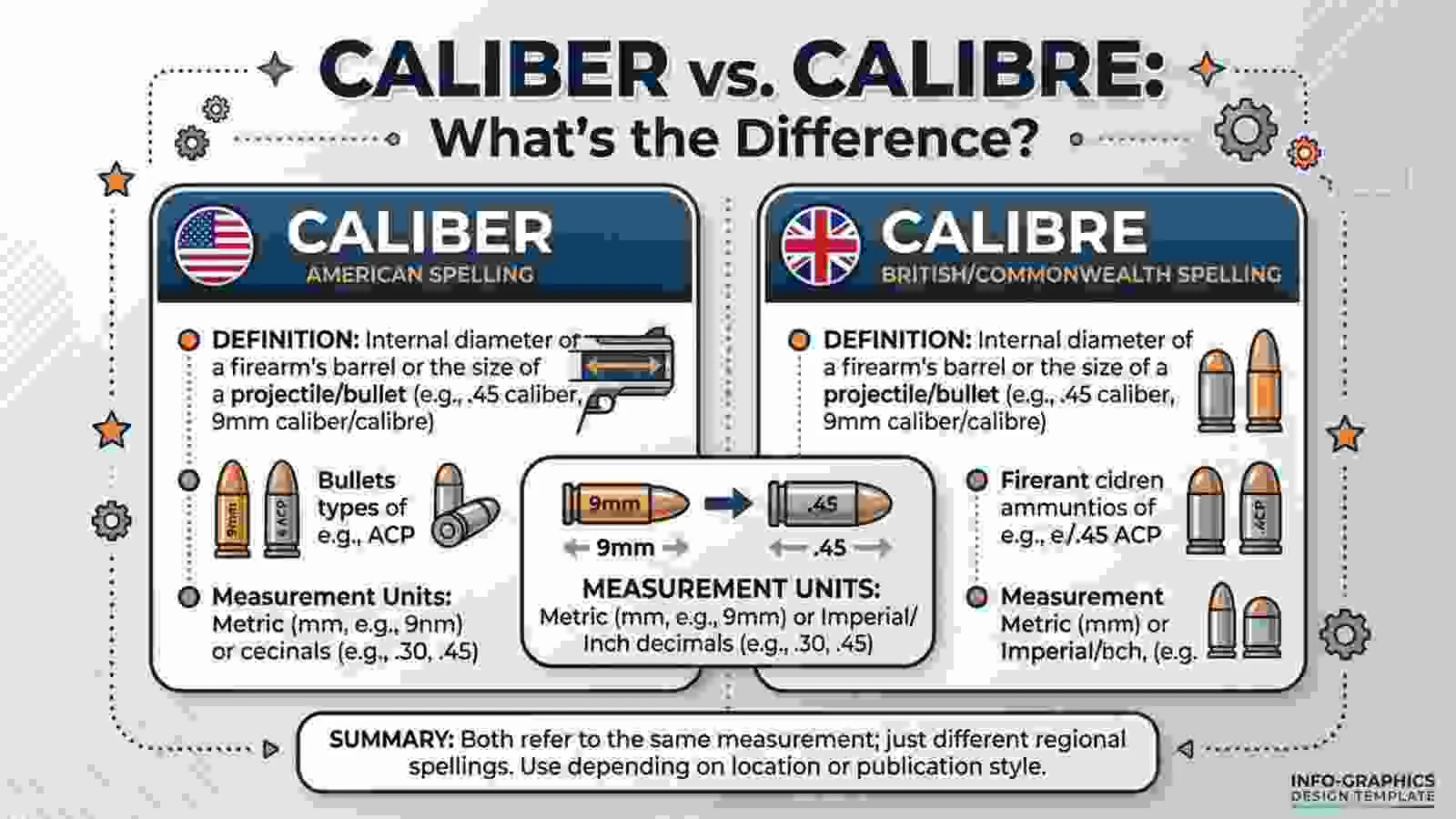
Both caliber and calibre are correct. Caliber (with -er) is American English, calibre (with -re) is British English. Both mean the same thing — the diameter of a gun barrel, or the quality/ability of a person or thing.
Have you ever wondered whether to write “caliber” or “calibre”? Both words look correct, and both are used in English. But which one should you choose?
The answer depends on where you are writing. “Caliber” is the standard spelling in American English, while “calibre” is used in British English and many other English-speaking countries. Both words have the same meaning and sound.
People often search for “caliber or calibre” because they want to avoid spelling mistakes in emails, essays, reports, and other forms of writing.
The two spellings can be confusing, especially for students and people who write for readers around the world.
This guide explains the difference between caliber and calibre in simple words. You will learn their meanings, history, spelling rules, and common uses.
We will also compare British and American English, show real-life examples, and answer common questions.
By the end, you will know which spelling to use and how to keep your writing clear and correct.
Caliber or Calibre – Quick Answer
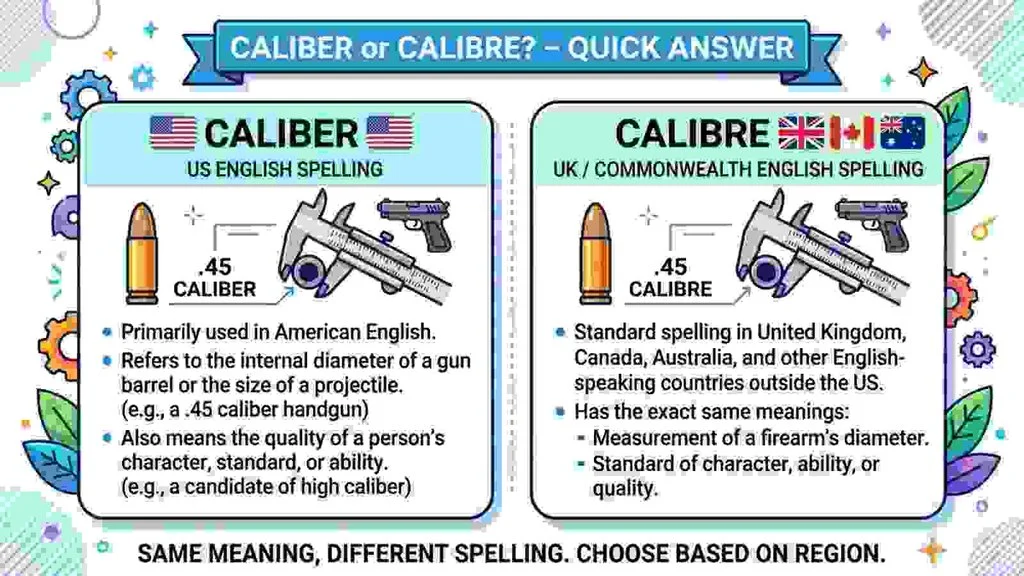
Both caliber and calibre are correct spellings.
The main difference is regional:
- Caliber: American English
- Calibre: British English, Canadian English, Australian English, and other Commonwealth varieties
Both words have the same meaning.
Examples:
- American: She is a writer of great caliber.
- British: She is a writer of great calibre.
The word can describe the quality, skill, or worth of a person or thing. It can also refer to the diameter of a gun barrel or bullet.
Remember: Use “caliber” for American readers and “calibre” for British readers.
The Origin of Caliber

The word “caliber” or “calibre” has an interesting history. It came into English from French, which took it from Italian.
The French word was “calibre.” It referred to the size or width of something. It may also have roots in the Arabic word qālib, meaning a mould or shape. Some sources give a different possible origin, so its full history is not certain.
The word first appeared in English around the 16th century. It was used to describe the size of a gun barrel. Later, people began to use it in a wider sense.
Today, it has two main meanings:
- Size: The width of a tube or the inside of a gun barrel.
- Quality: The level of skill, ability, or worth of a person or thing.
For example:
- The pipe has a large calibre.
- She is a singer of great caliber.
The spelling difference came from regional English rules. American English dropped the final “re” and uses “er.” British English kept the older “re” form.
British English vs American English Spelling
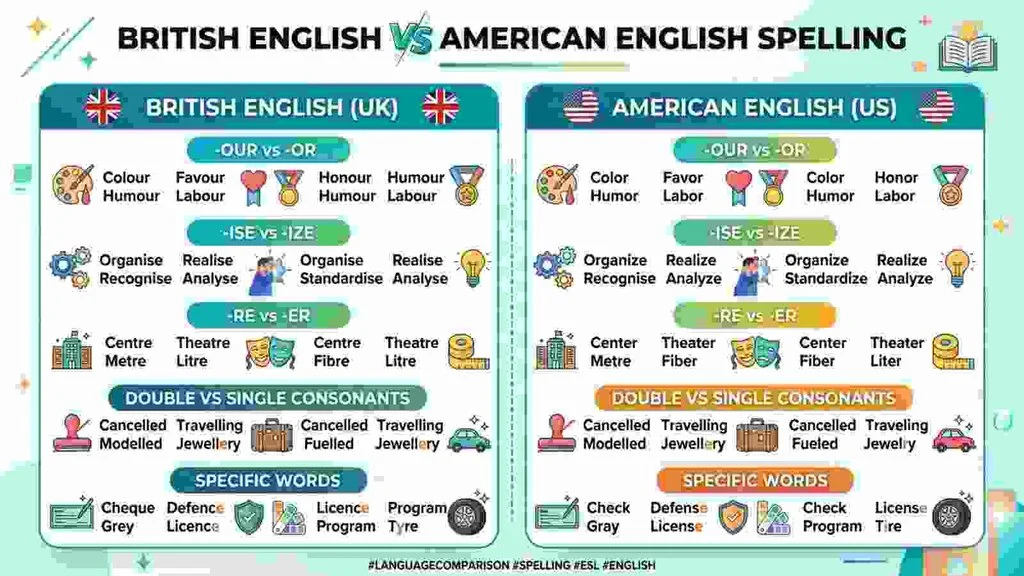
One common difference is the ending “re” in British English and “er” in American English.
For example:
| British English | American English |
| Calibre | Caliber |
| Centre | Center |
| Theatre | Theater |
| Metre | Meter |
| Fibre | Fiber |
| Litre | Liter |
Both “calibre” and “caliber” are correct. The choice depends on your audience.
Examples in Sentences
British English:
- He is a leader of great calibre.
- The team needs players of high calibre.
- The report discusses the calibre of the service.
American English:
- He is a leader of great caliber.
- The team needs players of high caliber.
- The report discusses the caliber of the service.
The meaning does not change. Only the spelling is different.
One important point: “calibre” is not wrong in American writing if it appears in a name, title, or quotation. However, “caliber” is the usual American form.
Which Spelling Should You Use: Caliber or Calibre?
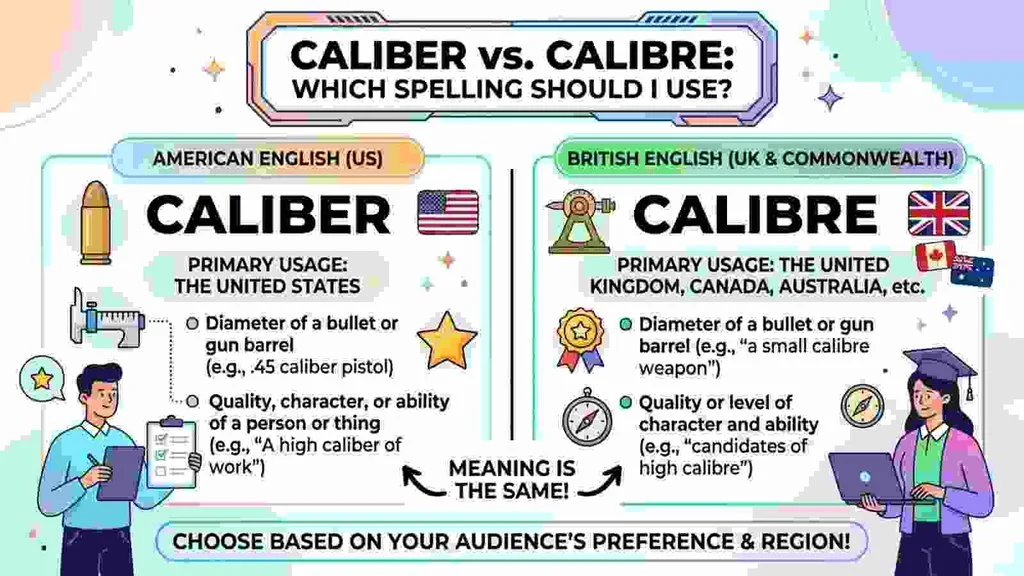
The best spelling depends on your readers. Both forms are correct, but you should use one form throughout your writing.
For US Readers
Use caliber.
This is the standard American spelling. Use it in school work, business emails, reports, and online content for US readers.
Example: The company hired a manager of high caliber.
For UK Readers
Use calibre.
This is the standard British spelling. It is common in British books, newspapers, and formal writing.
Example: The company hired a manager of high calibre.
For Commonwealth Readers
Use calibre in countries such as the UK, Australia, and New Zealand. Canadian English also commonly uses “calibre.”
For Global Readers
Choose the spelling that matches your main audience.
If most readers are from the US, use “caliber.”
If most readers are from the UK or Commonwealth countries, use “calibre.”
If your audience is mixed, either form is clear. The most important rule is to stay consistent.
Professional tip: Follow the spelling guide used by your school, company, or website. Do not switch between “caliber” and “calibre” in the same article without a good reason.
Common Mistakes with Caliber or Calibre
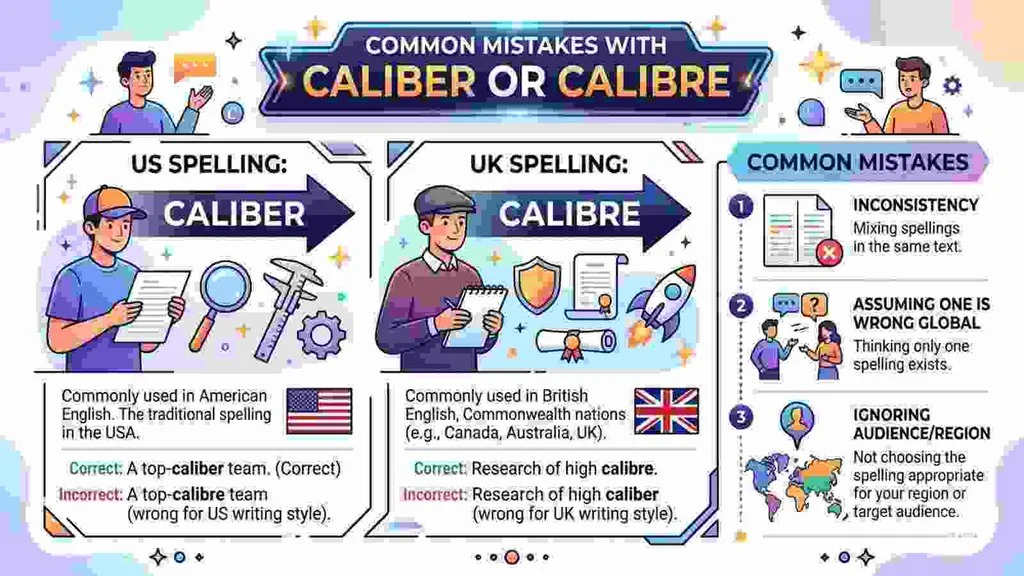
Many people confuse these spellings because they sound the same. Here are some common mistakes and their correct forms.
| Incorrect or confused form | Correct form | Explanation |
| Calibre (in standard US writing) | Caliber | Use American spelling |
| Caliber (in standard UK writing) | Calibre | Use British spelling |
| Calibar | Caliber / Calibre | Wrong vowel |
| Caliberre | Caliber / Calibre | Extra letters |
| Calibre’s (plural meaning) | Calibres | Use plural form |
| Calibers (British plural) | Calibres | Match British spelling |
| High calibar | High caliber / high calibre | Wrong spelling |
Mistake 1: Mixing Both Spellings
Incorrect: The company has high calibre staff and offers services of great caliber.
Better: The company has high-calibre staff and offers services of great calibre.
Mistake 2: Using the Wrong Regional Form
If you write for a US audience, “calibre” may look out of place. For UK readers, “caliber” may look like American spelling.
Neither is a spelling error in all English. The issue is matching your audience.
Mistake 3: Forgetting the Meaning
The word can refer to size or quality.
For example:
- A bullet’s calibre refers to its size.
- A person of high calibre has great skill or quality.
Always check the sentence to make sure the meaning is clear.
Caliber or Calibre in Everyday Examples
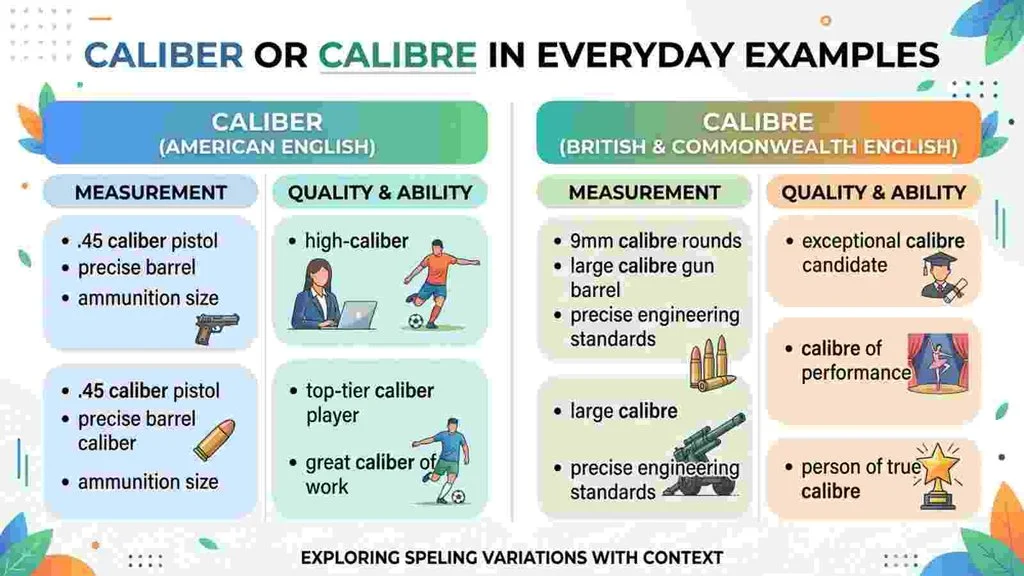
Both spellings are used in daily writing. The meaning stays the same, but the spelling should match your chosen style.
In Emails
American English:
- We are looking for employees of high caliber.
- Your work shows a high level of caliber.
British English:
- We are looking for employees of high calibre.
- Your work shows a high level of calibre.
In News
- The team has players of international calibre.
- The country needs leaders of high caliber.
- Experts praised the calibre of the research.
On Social Media
- A singer of such high calibre!
- This is a team of great caliber.
- We need content creators of this calibre.
In Formal Writing
American English:
The company aims to attract workers of the highest caliber.
British English:
The company aims to attract workers of the highest calibre.
In Education
- She is a student of high calibre.
- The school provides education of excellent caliber.
- The award recognizes students of outstanding calibre.
These examples show that both spellings work in the same way. You only need to choose the form that suits your readers.
Caliber or Calibre – Google Trends & Usage Data
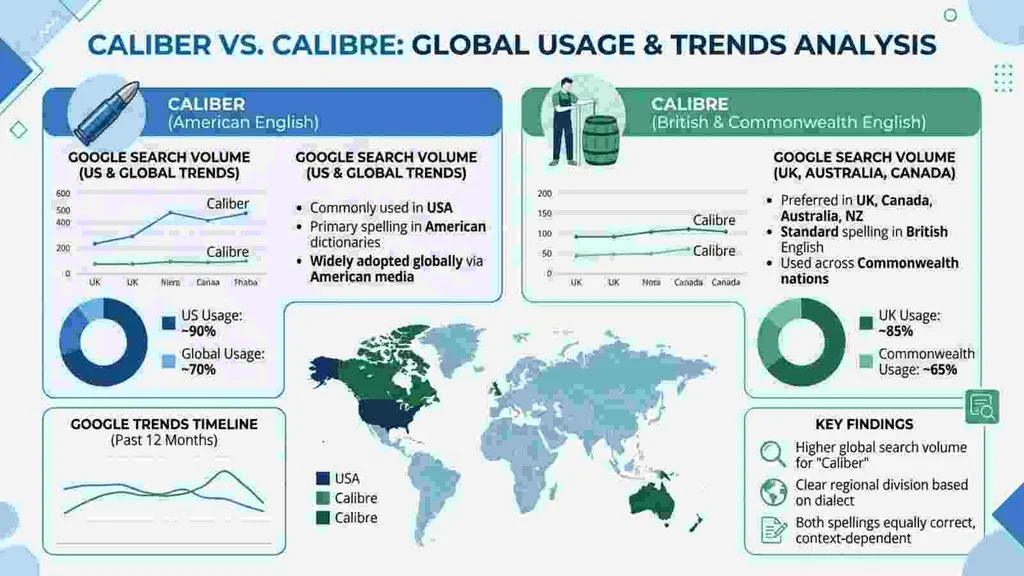
Google Trends helps users compare search interest across countries and over time. It can show where people search for “caliber” and “calibre” more often.
However, Google Trends does not provide exact search counts. It uses a relative score from 0 to 100. A score of 100 shows the highest interest in the selected period and area.
Popularity by Country
The spelling people use often follows their local form of English.
| Country | Common spelling | Main context |
| United States | Caliber | American English |
| United Kingdom | Calibre | British English |
| Canada | Calibre | Canadian English |
| Australia | Calibre | Australian English |
| New Zealand | Calibre | New Zealand English |
| Pakistan | Calibre / Caliber | Both forms may appear in English writing |
| India | Calibre / Caliber | Both forms may appear in English writing |
This table shows common spelling patterns, not verified Google Trends rankings.
Why Do People Search for These Words?
People often search for “caliber or calibre” when they:
- Write school or college assignments.
- Prepare professional reports.
- Edit articles for a global audience.
- Learn British or American English.
- Check the spelling of a word in a sentence.
What Does Google Trends Tell Us?
Google Trends can help content writers understand regional search interest. But it is important to compare the same search terms, time periods, and locations.
Google also notes that some spelling variations may not be shown as separate results in every comparison. This can affect how users read the data.
For SEO, it is useful to include both “caliber” and “calibre” naturally in an article. This helps readers from different regions find the answer they need.
Caliber and Calibre – Comparison Table
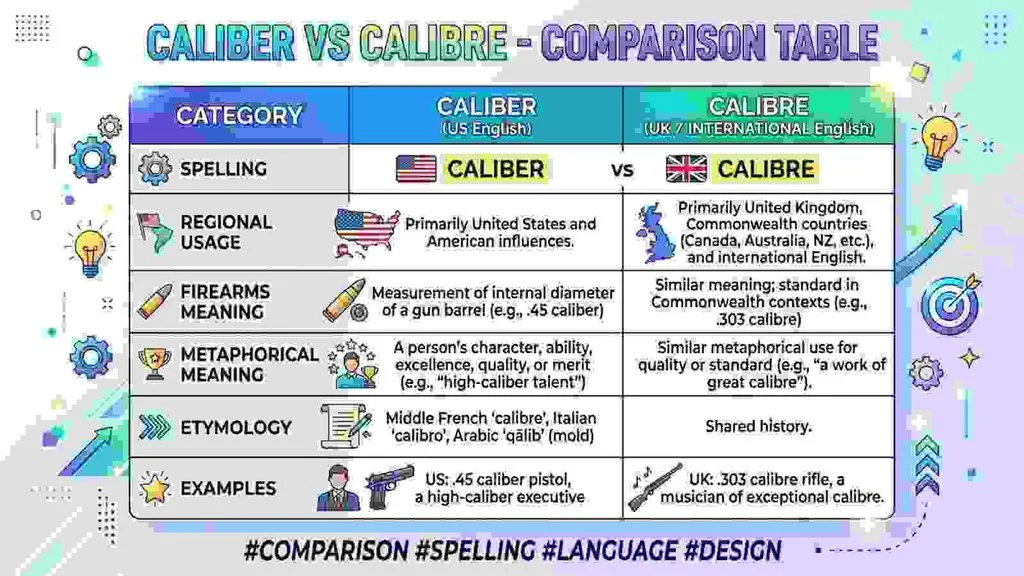
Here is a quick table of common forms and related words.
| Word | Correct? | Use or meaning |
| Caliber | Yes | American English spelling |
| Calibre | Yes | British and Commonwealth spelling |
| Calibers | Yes | American plural |
| Calibres | Yes | British plural |
| High caliber | Yes | American form for high quality |
| High calibre | Yes | British form for high quality |
| Calibered | Yes | American adjective |
| Calibred | Yes | British adjective |
| Calibar | No | Common spelling error |
| Calibre’s | Yes, in context | Possessive form, not the normal plural |
Quick rule: Use “caliber” in American English and “calibre” in British English.
Frequently Asked Questions (FAQs)
1. Is it caliber or calibre?
Both spellings are correct. “Caliber” is used in American English, while “calibre” is used in British English and many Commonwealth countries.
2. What is the main difference between caliber and calibre?
There is no difference in meaning. The only difference is spelling. Both words can describe size, quality, or ability.
3. Is calibre British or American?
“Calibre” is the standard British spelling. It is also common in Canada, Australia, and New Zealand.
4. Is caliber American English?
Yes. “Caliber” is the standard American English spelling.
5. Does caliber mean quality?
Yes. It can describe the level of skill, ability, or excellence of a person or thing.
Example: She is a teacher of high caliber.
6. What is the plural of calibre?
The British plural is “calibres.”
Example: The two products are of different calibres.
7. What is the plural of caliber?
The American plural is “calibers.”
Example: The report compares several calibers.
8. Can I use caliber and calibre in the same article?
It is better not to mix them. Choose one spelling based on your audience and use it throughout the article.
9. Which spelling is better for SEO?
Neither spelling is always better. Choose the spelling that matches your target audience. You can also use both naturally when explaining the difference.
10. What does caliber mean?
Caliber means the diameter of a gun barrel, or the quality, skill or ability of a person or thing. For example, “She is a writer of great caliber.”
11. What does calibre mean?
Calibre means the same as caliber — the diameter of a gun barrel, or the quality, skill or ability of a person or thing. It is the British English spelling. For example, “She is a writer of great calibre.”
12. How do you spell calibre?
Spell it C-A-L-I-B-R-E: calibre, with -re at the end — the British spelling; the American spelling is caliber, ending in -er.
Conclusion
The words “caliber” and “calibre” have the same meaning, but their spelling depends on the type of English you use. “Caliber” is correct in American English, while “calibre” is correct in British English and many Commonwealth countries.
Both words can describe the size of something or the quality of a person or thing. For example, a person of high calibre has great skill or ability.
If you write for American readers, choose “caliber.” If you write for British, Australian, or New Zealand readers, choose “calibre.” For Canadian readers, “calibre” is the common choice.
There is no need to worry about which spelling is more correct. Both are accepted forms of English. The key is to understand your audience and keep your writing consistent.
For students, writers, and professionals, this small spelling rule can make a big difference. Always follow your chosen style guide and check your work before sharing it. Once you learn this simple rule, you can use both forms with confidence.
Continue Reading:
- Address vs Adress: Meaning, Spelling, and Usage ( for 2026)
- Loose vs. Lose: Meaning, Spelling, and Examples ( for 2026)
- Complete vs. Completed: Meaning, Difference, and Usage ( for 2026)
- Cuter or Cutier: Correct Spelling, Meaning, and Usage ( for 2026)
- Selfs or Selves: Meaning, Grammar, and Examples (for 2026)

Here’s a concise 2-line author bio suitable for Simifind.com:
James Dashner is an American bestselling author best known for The Maze Runner series and other popular young-adult fiction.
On Simifind.com, he shares clear, engaging insights and helpful content for readers interested in books, writing, and popular literature.








4 thoughts on “Caliber vs Calibre: Meaning, Spelling, and Usage ( for 2026)”