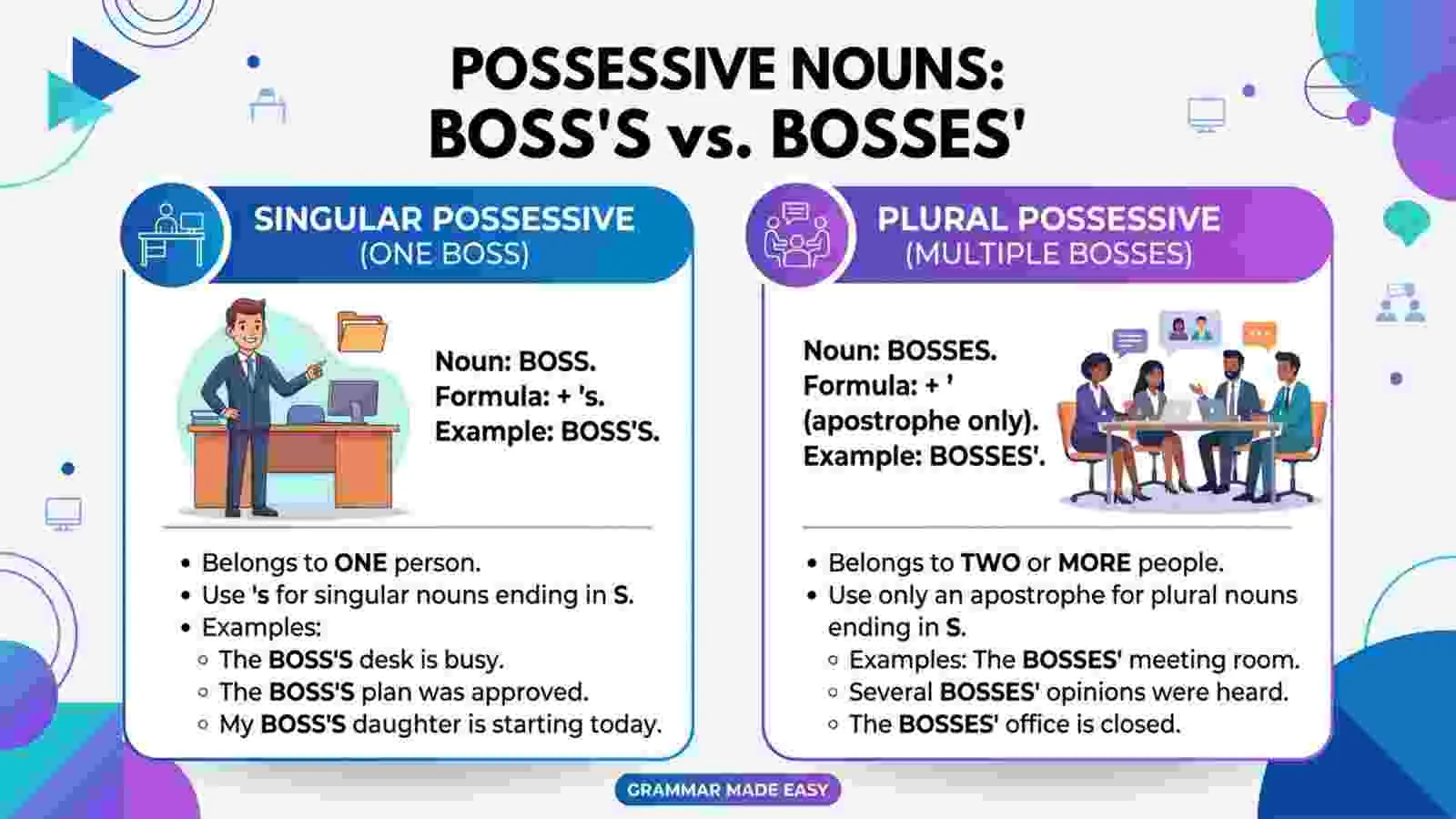
Boss’s is the usual possessive form — my boss’s office. Boss’ is accepted by some style guides. Bosss is incorrect. Bosses = more than one boss. Bosses’ = belonging to more than one boss.
Have you ever stopped while writing a sentence and wondered whether to use “boss’s” or “boss’”? You are not alone. Many people find it hard to use apostrophes when showing ownership. This small mark can change how a sentence looks and reads.
Both forms are used in English, but they follow different style rules. The main question is simple: how do you show that something belongs to one boss?
In most cases, boss’s is the preferred form. For example, “My boss’s office is on the second floor.”
Some style guides also accept “boss’” as a shorter form. This is why people often search for “boss’s or boss’” when writing emails, reports, or school work.
In this guide, you will learn the difference between these two forms.
We will explain their grammar, history, and use in British and American English. You will also see common mistakes, simple examples, and helpful tips.
By the end, you will know which form to use and how to write it with confidence.
Boss’s or Boss’ – Quick Answer
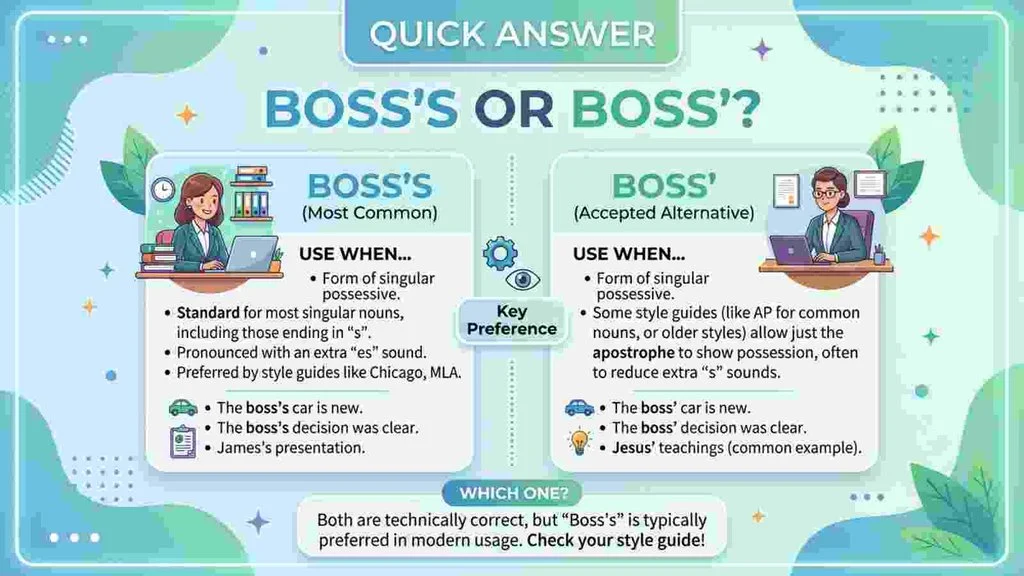
Both boss’s and boss’ can show that something belongs to one boss.
However, boss’s is the most common choice in many modern style guides.
Examples:
- My boss’s car is new.
- I went to my boss’s office.
- My boss’ car is new. (Accepted by some style guides.)
The difference is the style rule.
| Form | Use |
| Boss’s | Common singular possessive form |
| Boss’ | Alternative form accepted by some style guides |
Easy rule: Use “boss’s” unless your school, company, or style guide asks you to use “boss’.”
Boss Possessive: Meaning
The phrase “boss possessive” refers to the possessive form of the noun boss, which shows that something belongs to, is associated with, or is connected to a boss. The correct possessive form is boss’s in most modern English style guides.
For example, if you want to talk about an office belonging to your boss, you can write “my boss’s office.” Similarly, “the boss’s decision” means a decision made by the boss, while “the boss’s car” means a car belonging to the boss.
What Is the Possessive Form of Boss?
The word boss is a singular noun ending in s. To make it possessive, most style guides recommend adding an apostrophe and another s, creating boss’s.
Examples:
- Boss’s office: The office belonging to the boss.
- Boss’s decision: A decision made by the boss.
- Boss’s responsibility: A responsibility assigned to the boss.
- Boss’s instructions: Instructions given by the boss.
- Boss’s meeting: A meeting led by or associated with the boss.
Example sentence: My boss’s instructions were clear, so I completed the project on time.
Boss’s vs. Bosses: Difference?
Boss’s shows possession, while bosses is the plural form of boss. For example, “My boss’s decision was final” shows ownership or association.
In contrast, “The bosses attended the meeting” refers to more than one boss. Understanding this difference helps you avoid common grammar mistakes.
How to Use Boss’s in a Sentence
Use boss’s when talking about something belonging to one boss, such as their office, car, instructions, or opinion.
For example, “I followed my boss’s instructions carefully.” This form is common in professional emails, workplace conversations, and formal writing.
Is Boss’ or Boss’s Correct?
Both boss’s and boss’ are accepted by some style guides, but boss’s is generally preferred in modern American English.
For example, “The boss’s desk is clean” is a widely accepted construction. Follow your workplace or publication’s style guide if it specifies a particular rule.
Boss Possessive: What Is the Correct Possessive Form of Boss?
The correct possessive form of boss is boss’s. It shows that something belongs to or is associated with one boss. For example, “The boss’s office is on the second floor.” Understanding this form helps you use apostrophes correctly in professional writing.
Boss’s vs. Bosses’: Understanding the Difference
Boss’s refers to something belonging to one boss, while bosses’ shows ownership by multiple bosses. For example, “My boss’s decision” refers to one boss, whereas “The bosses’ meeting” refers to several bosses.
How to Use Boss’s in Everyday Sentences
The possessive form boss’s is commonly used in workplace conversations, emails, reports, and professional writing. Examples include “My boss’s instructions were clear” and “I attended my boss’s meeting.” These examples show how apostrophes indicate ownership.
Common Mistakes When Writing Boss Possessive
Writers sometimes confuse boss’s, bosses, and bosses’ because they look similar. Remember that bosses is the plural form, boss’s indicates singular possession, and bosses’ indicates plural possession.
Boss’s – Meaning and Definition
“Boss’s” is the possessive form of the singular noun “boss.” It shows that something belongs to one boss or is associated with that person.
For example, “the boss’s office” means the office belonging to the boss. The apostrophe and s indicate ownership or a relationship.
Boss’s vs. Bosses: What Is the Difference?
“Boss’s” indicates possession by one boss, while “bosses” is the plural form of “boss,” meaning more than one manager.
For example, “the boss’s car” refers to one boss’s car, whereas “the bosses attended the meeting” refers to multiple managers. Understanding the apostrophe helps you use both forms correctly in writing.
The Origin of Boss’s and Boss’
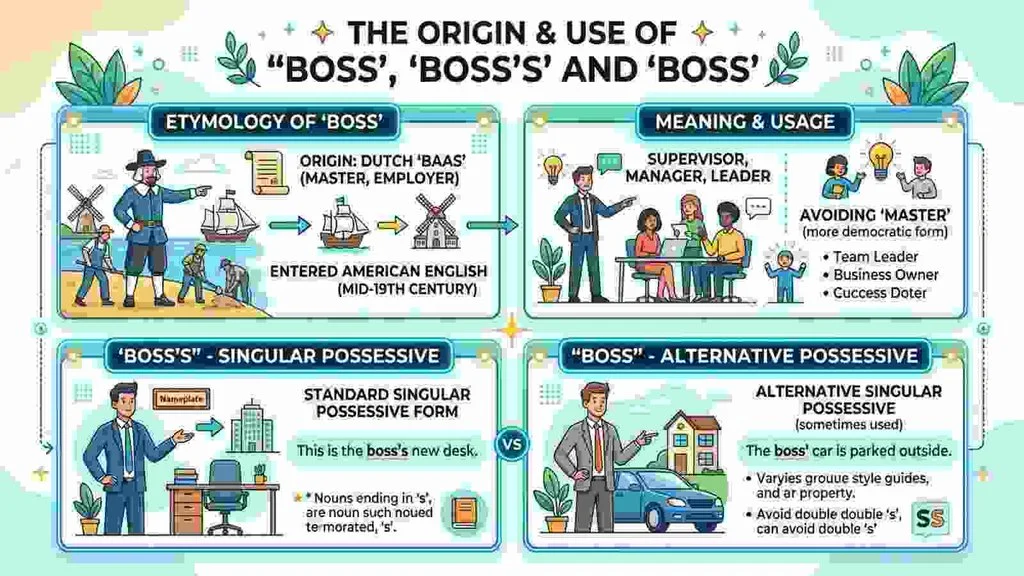
To understand “boss’s” and “boss’,” we first need to understand the word “boss.”
The word “boss” comes from the Dutch word baas. It means a master or person in charge. Dutch settlers brought the word to America in the 17th century.
Over time, English speakers began using “boss” for a person who leads workers or manages a team.
The apostrophe has a different history. In English, we use an apostrophe to show ownership. For example:
- The boy’s book.
- The teacher’s desk.
- The boss’s office.
When a noun is singular, we often add an apostrophe and S to show that something belongs to it.
But some words already end in S. This can make the possessive form look strange. That is why some writers use only an apostrophe after the final S.
For example:
- Boss’s desk.
- Boss’ desk.
Both forms have been used in English writing. The choice depends on the style guide you follow.
British English vs American English Spelling
British and American English both use apostrophes to show ownership. However, style guides may have different rules for words ending in S.
The word “boss” is a singular noun. So, the standard possessive form in many style guides is “boss’s.”
Some guides allow “boss’” to avoid adding another S sound or letter.
American English
In American English, many style guides prefer adding apostrophe + S to singular nouns ending in S.
Examples:
- My boss’s office is large.
- The class’s schedule changed.
- The witness’s statement was clear.
Some American newspapers and style guides may use “boss’” under their own rules.
British English
British English also commonly uses “boss’s.”
However, some British publications follow rules that use only an apostrophe after certain words ending in S.
Examples:
- The boss’s car is outside.
- The boss’ car is outside.
Both forms may appear in British writing, depending on the publication’s style.
Comparison Table
| Feature | American English | British English |
| Common possessive form | Boss’s | Boss’s |
| Alternative form | Boss’ | Boss’ |
| Plural form | Bosses | Bosses |
| Plural possessive | Bosses’ | Bosses’ |
| General rule | Often add ‘s | Often add ‘s |
| Style variation | Depends on guide | Depends on guide |
Important: This is mainly a style difference, not a difference in meaning. Both forms show ownership by one boss.
Which Spelling Should Use Boss’s or Boss’ ?
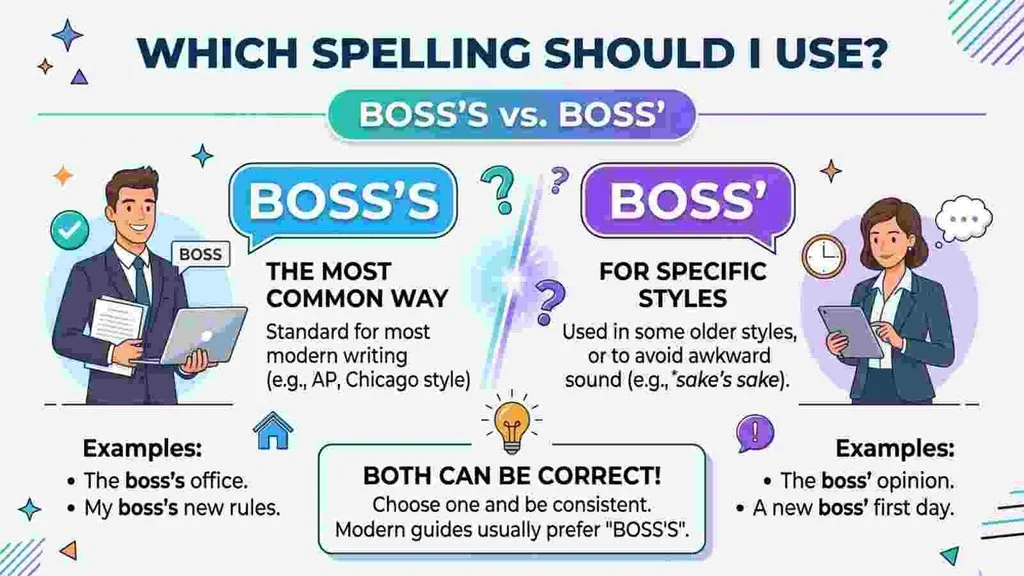
Choosing between “boss’s” and “boss’” depends on your audience and writing rules.
For US Readers
Use “boss’s” in most school, business, and formal writing.
Example:
My boss’s decision changed the project.
If your workplace follows a special style guide, use its preferred form.
For UK and Commonwealth Readers
“Boss’s” is also a safe choice in British, Pakistani, Australian, and other Commonwealth writing.
Example:
I left the report on my boss’s desk.
Some newspapers and publishers may prefer “boss’.” Follow their rules when writing for them.
For Global Readers
Use “boss’s” for clear and simple writing.
It is easy to understand and follows a widely used possessive rule.
For Students and Professionals
If your teacher, editor, or employer has not given a style rule, choose “boss’s.”
Do not switch between “boss’s” and “boss’” in the same document. Consistency makes your writing look neat and professional.
Common Mistakes with Boss’s or Boss’
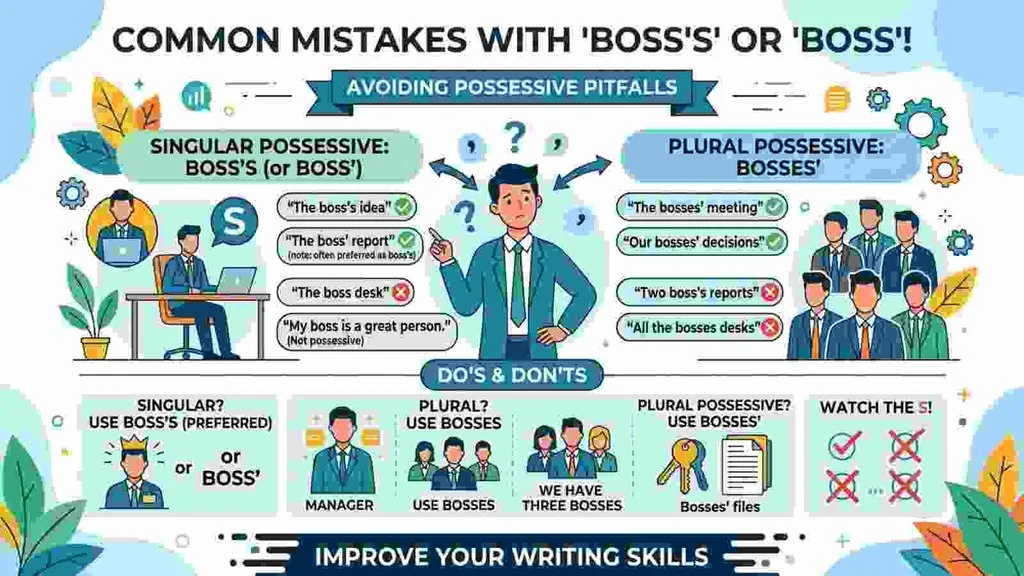
Writers often make mistakes when they use apostrophes. Here are some common errors and their corrections.
| Incorrect or confusing form | Correct form | Explanation |
| Bosses office | Boss’s office | Missing apostrophe |
| Boss’s’ office | Boss’s office | Extra apostrophe |
| Bosss office | Boss’s office | Missing apostrophe |
| Bosses’ office | Bosses’ office (plural) | Used for more than one boss |
| Boss’s are here | Bosses are here | No apostrophe for a simple plural |
| My boss’ car | My boss’s car (preferred in many guides) | Style-dependent alternative |
| The boss’s’ car | The boss’s car | Extra apostrophe |
Mistake 1: Using an Apostrophe for a Plural
Wrong: Two boss’s are coming.
Correct: Two bosses are coming.
Apostrophes do not make most nouns plural.
Mistake 2: Confusing Singular and Plural Possession
Singular:
The boss’s office is clean.
Plural:
The bosses’ offices are clean.
Use “boss’s” for one boss and “bosses’” for more than one boss.
Mistake 3: Adding Two Apostrophes
Wrong: My boss’s’ phone is new.
Correct: My boss’s phone is new.
Only one apostrophe is needed.
Mistake 4: Changing Forms in One Document
Avoid using “boss’s” in one paragraph and “boss’” in another without a clear reason.
Choose one style and use it throughout your writing.
Boss’s or Boss’ in Everyday Examples
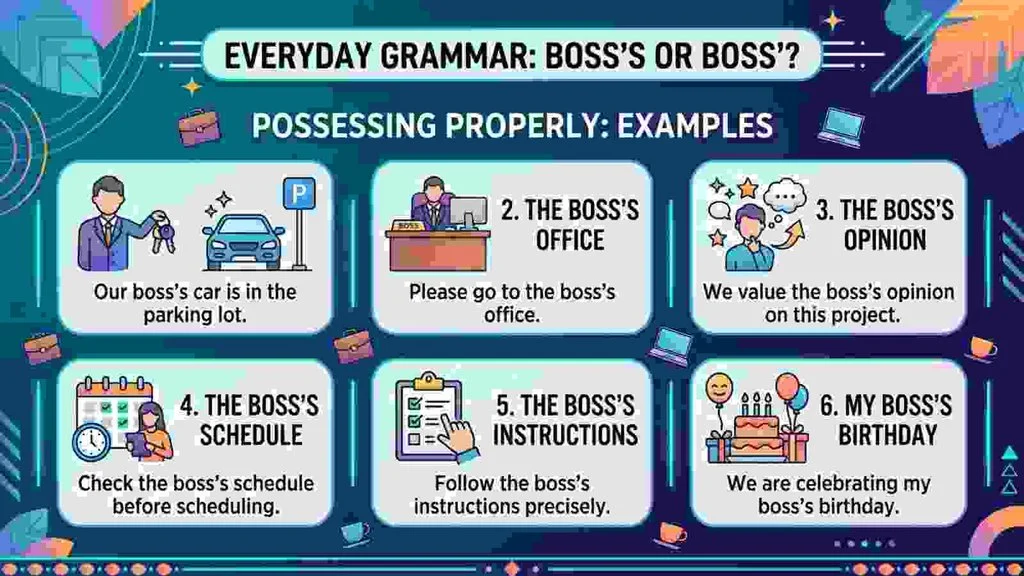
Both forms can appear in everyday writing. The meaning stays the same, but “boss’s” is a safe choice for most situations.
In Emails
Using boss’s:
- I have placed the file on my boss’s desk.
- My boss’s approval is still pending.
- I will ask my boss’s assistant for help.
Using boss’:
– I have placed the file on my boss’ desk.
This form may be used when a style guide prefers a final apostrophe.
In News
- The boss’s decision caused a major change.
- The company announced its boss’s new plan.
- The boss’ statement was shared online.
News writing may follow a house style, so the spelling can vary.
On Social Media
- My boss’s advice helped me a lot.
- I finally met my boss’s team.
- My boss’ new office looks great.
For casual posts, both forms may be seen. Still, using “boss’s” helps avoid confusion.
In Formal Writing
- The boss’s approval is required before work begins.
- The report is on the boss’s desk.
- The manager discussed the boss’s new policy.
For formal documents, follow the required style guide. If there is no guide, “boss’s” is a clear and safe choice.
Boss’s or Boss’ – Google Trends & Usage Data
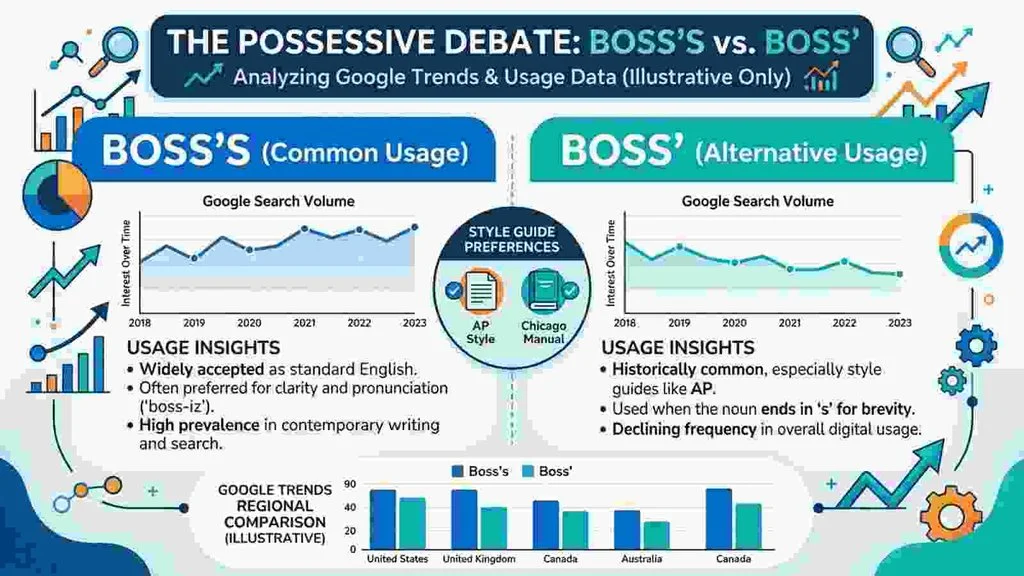
People often search for “boss’s or boss’” because they want to know the correct way to show ownership.
This keyword is linked to grammar, apostrophe rules, English learning, and professional writing.
Common search terms include:
- Boss’s or boss’
- Boss’s meaning
- Boss’ meaning
- Bosses or boss’s
- Boss’s plural
- Boss possessive form
Popularity by Country
The search may be useful to English learners and writers in many countries.
| Country | Common search context |
| United States | Grammar rules and business writing |
| United Kingdom | British English and apostrophe rules |
| Pakistan | English learning and school work |
| India | Grammar and writing practice |
| Canada | Professional and academic writing |
| Australia | English spelling and grammar |
These are possible search contexts, not verified search rankings.
What Does Google Trends Show?
Google Trends can help compare search interest over time and across countries.
It uses a score from 0 to 100. A score of 100 shows the highest relative interest in the selected time and place.
For this keyword, search interest may be low because it is a narrow grammar question. Low search data does not mean the topic is not useful.
It is also important to know that search popularity does not decide which form is correct.
Grammar rules and style guides are better sources for choosing between “boss’s” and “boss’.”
SEO tip: Writers can use related keywords such as “boss possessive form,” “boss’s meaning,” and “boss apostrophe rule” to cover the same search intent.
Boss’s or Boss’ – Comparison Table
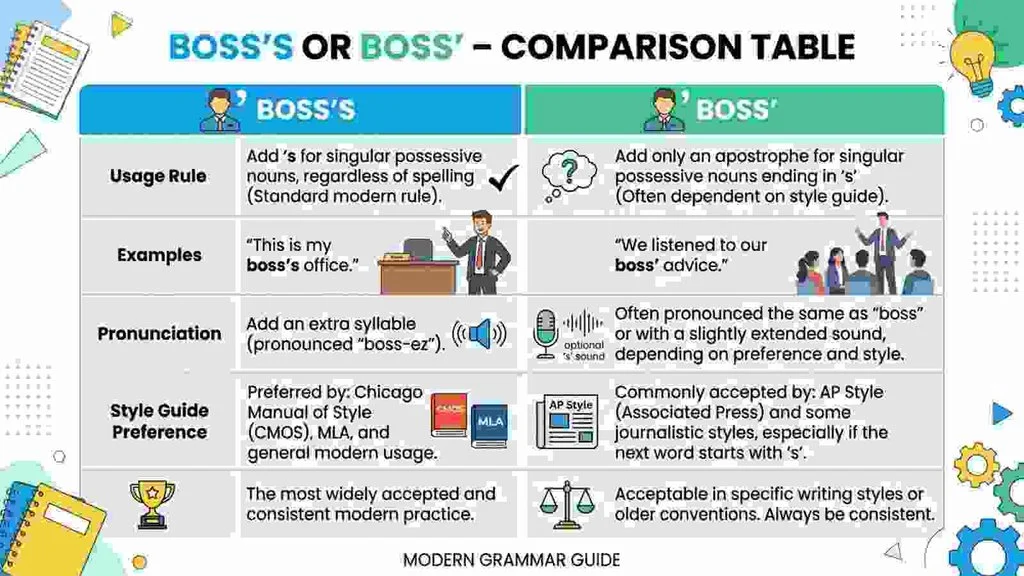
Here is a quick table showing the main forms and their uses.
| Word | Correct? | Meaning |
| Boss | Yes | A person in charge |
| Boss’s | Yes | Possession by one boss |
| Boss’ | Yes, style-dependent | Alternative singular possessive |
| Bosses | Yes | More than one boss |
| Bosses’ | Yes | Possession by more than one boss |
| Bosses’s | No | Incorrect plural possessive |
| Bosss | No | Incorrect spelling |
| Boss’s’ | No | Extra apostrophe |
| My boss’s car | Yes | Car belongs to one boss |
| My bosses’ cars | Yes | Cars belong to more than one boss |
Quick Grammar Rule
- One boss: boss’s
- More than one boss: bosses
- Something belonging to more than one boss: bosses’
Example:
My boss’s office is next to my bosses’ office.
The first office belongs to one boss. The second belongs to more than one boss.
Frequently Asked Questions (FAQs)
1. Is it boss’s or boss’?
Both forms can be correct, depending on the style guide. “Boss’s” is the preferred form in many modern writing guides.
2. Is boss’s grammatically correct?
Yes. “Boss’s” is the singular possessive form of “boss.”
Example: My boss’s phone is ringing.
3. Is boss’ wrong?
No. “Boss’” is accepted by some style guides. However, “boss’s” is a common and safe choice.
4. What is the plural of boss?
The plural of “boss” is “bosses.”
Example: The bosses are in a meeting.
5. What is the plural possessive of boss?
The plural possessive form is “bosses’.”
Example: The bosses’ offices are on the second floor.
6. Should I use boss’s in formal writing?
Yes. If no special style guide is given, “boss’s” is a good choice for formal writing.
7. Is boss’s American or British English?
Both American and British English use “boss’s.” Some style guides in both regions may accept “boss’.”
8. Does boss’s mean more than one boss?
No. “Boss’s” shows possession by one boss. “Bosses” means more than one boss.
9. Why does boss’s have two S’s at the end?
The word “boss” already ends in S. The possessive form adds apostrophe + S, giving “boss’s.”
10. Can I write my boss’ office?
Yes, if your chosen style guide allows it. However, “my boss’s office” is the safer choice for general writing.
11. Is bosss a word?
No, bosss is not a word. The correct possessive form is boss’s, and the plural is bosses.
12. What does boss’s mean?
Boss’s means something belonging to one boss — for example, ‘my boss’s office’ means the office belonging to my boss’s office.
13. What is the possessive form of boss?
The possessive form of boss is usually boss’s — add an apostrophe and s to show that something belongs to one boss. Boss’ is also accepted by some style guides.
Conclusion
Both “boss’s” and “boss‘” can show ownership by one boss. However, “boss’s” is the preferred form in many modern English style guides. It is also a safe choice for students, professionals, and general writers.
The main difference comes from writing style, not meaning. Some guides add apostrophe + S to singular nouns ending in S. Others allow only an apostrophe after the final S.
Remember the simple rule: use “boss’s” when talking about something owned by one boss. Use “bosses’” when talking about something owned by more than one boss. Also, use “bosses” when you mean more than one boss without showing ownership.
For example, “My boss’s car” means one boss owns the car. “My bosses’ cars” means more than one boss owns the cars.
If you are writing an email, report, school assignment, or formal document, check the style rules first. If no rules are given, use “boss’s” and stay consistent throughout your writing. This will help you write clearly and avoid common apostrophe mistakes.
Continue Reading:
- Accompanied By or With: Difference, Rules, and Examples ( for 2026)
- Caliber vs Calibre: Meaning, Spelling, and Usage ( for 2026)
- Address vs Adress: Meaning, Spelling, and Usage ( for 2026)
- Cuter or Cutier: Correct Spelling, Meaning, and Usage ( for 2026)
- Countries or Country’s: Spelling, Grammar, and Examples (for 2026)

Here’s a concise 2-line author bio suitable for Simifind.com:
James Dashner is an American bestselling author best known for The Maze Runner series and other popular young-adult fiction.
On Simifind.com, he shares clear, engaging insights and helpful content for readers interested in books, writing, and popular literature.







2 thoughts on “Boss’s vs Boss’: Difference, Rules, and Examples ( for 2026)”