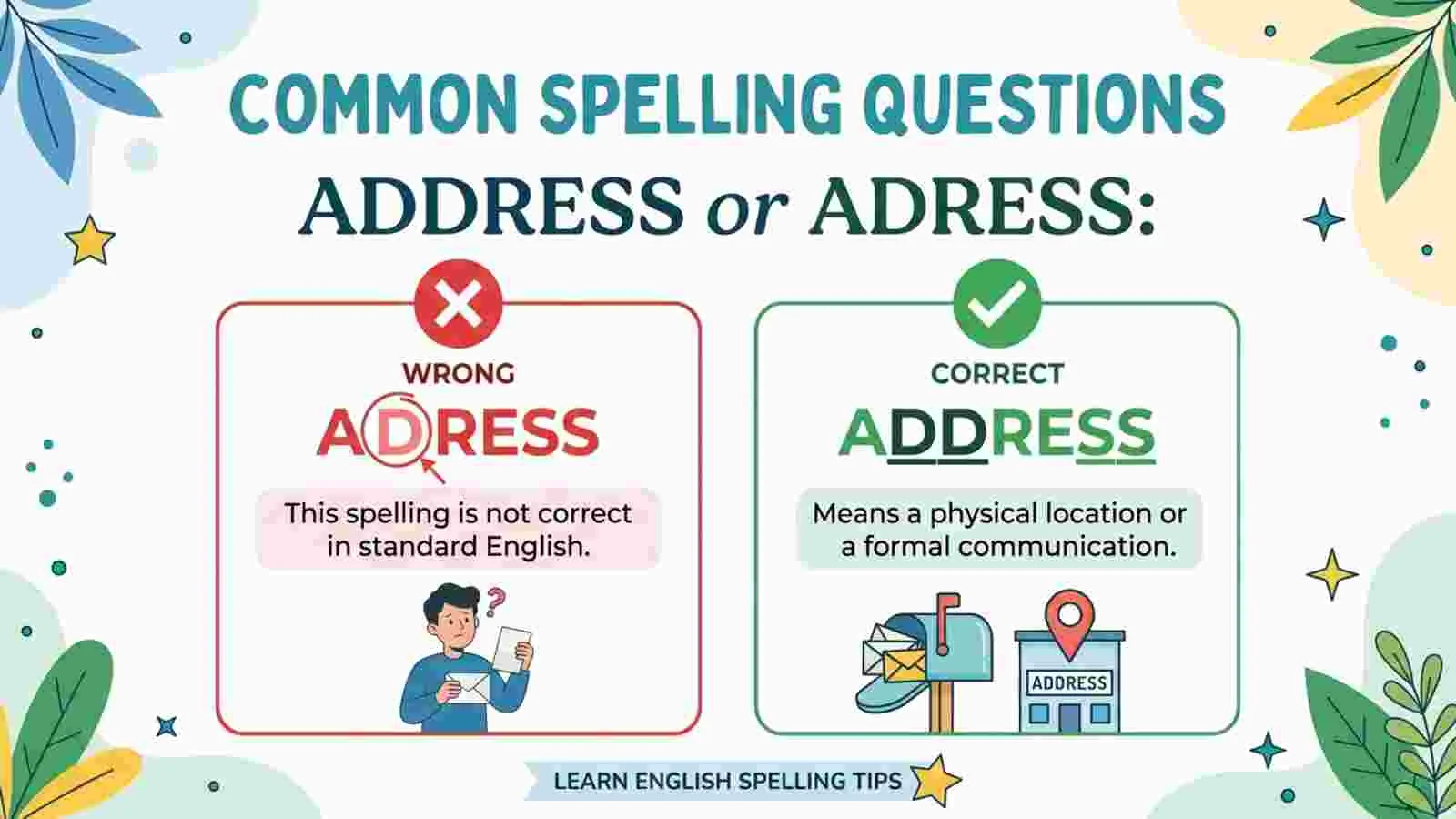
Address is correct. Adress is incorrect. Address has two d’s and two s’s — ad-dress. It means a location (home address, email address) or to speak to someone / deal with a problem.
You are not alone. Many people make this mistake when writing emails, filling out forms, or creating documents.
The two words look almost the same, but only one is correct in standard English.
The correct spelling is address, with two D’s and two S’s. The word “adress” is a common spelling mistake. It is not accepted as a standard English word.
People often search for “address or adress” because English spelling can be tricky.
Some words have silent letters, double letters, or different forms in British and American English. This can make simple words hard to spell.
In this guide, you will learn the correct spelling, its history, and how to use it in daily life.
We will also look at British and American English, common mistakes, and real examples. You will find a simple comparison table and answers to common questions.
By the end, you will know when to use “address” and how to avoid this spelling error in your writing.
Address or Adress – Quick Answer
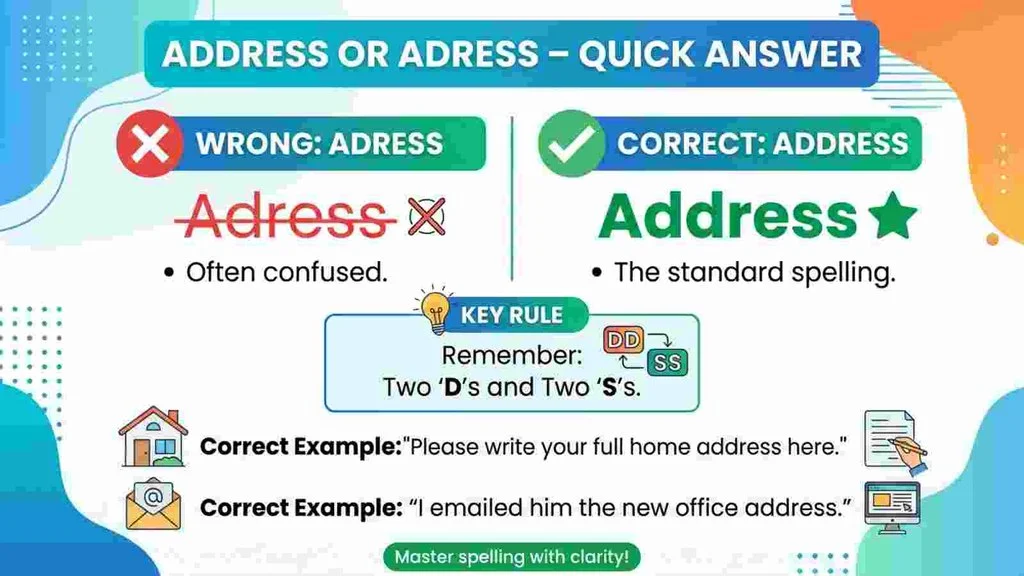
The correct spelling is address.
- Address: Correct spelling.
- Adress: Incorrect spelling.
Examples:
- Please send me your home address.
- What is your email address?
- I need to address this problem.
The word “address” can mean a place, a way to contact someone, or the act of speaking to someone.
Remember: Address has two D’s and two S’s.
The Origin of Address
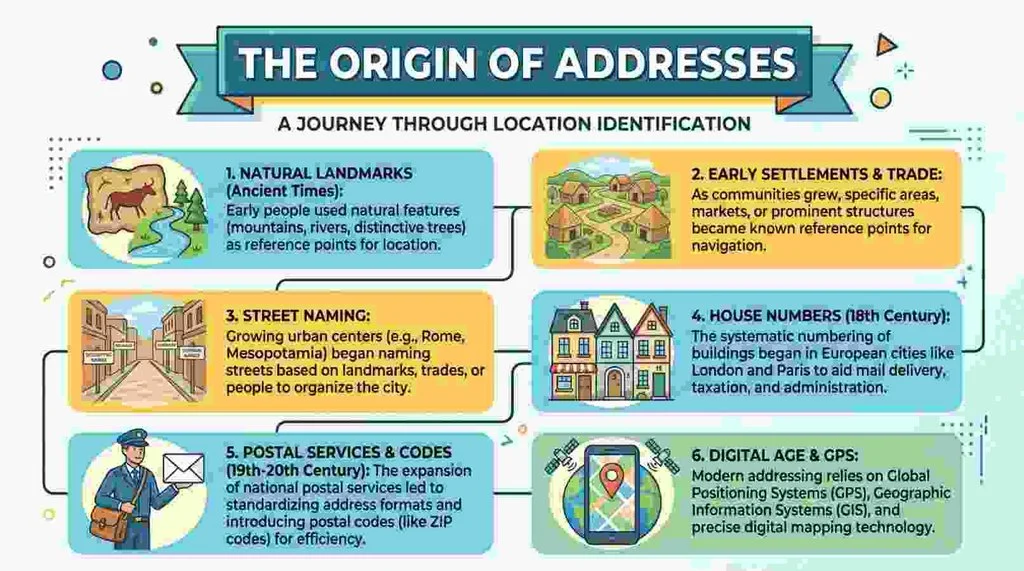
The word “address” has a long history. It came into English from Old French and Latin.
The Old French word adrecier meant to guide, straighten, or direct. It came from Latin words linked to the idea of moving in a straight direction.
The word entered Middle English around the 14th century. At first, it meant to guide or direct something. Later, it gained new meanings.
By the 15th century, people used “address” for writing directions on letters. Over time, it came to mean a person’s home or business location.
Today, the word has several meanings:
- A home or office location.
- An email or web location.
- A formal speech.
- The act of speaking to someone.
- The act of dealing with a problem.
The spelling also has an interesting history. English kept the double D, even though the French form has one D.
This is why “address” is the accepted English spelling, while “adress” is not.
Adress or Address: Correct?
Address is the correct spelling in standard English, while adress is a common spelling mistake.
An address refers to the details of a person’s home, a business location, or an email account. You should use “address” in formal writing, emails, applications, and everyday communication. Remember that the word contains two d letters and one r after them.
What Does Address Mean?
The word address has several meanings depending on the context. It can refer to a physical location, such as a house or office, or an email address used for online communication.
It can also mean speaking to someone directly or dealing with a particular issue. For example, “The manager will address the team tomorrow” shows speaking to someone directly, and “We need to address this problem” shows dealing with an issue.
Adress vs. Address: Differences
The main difference between adress and address is spelling. “Adress” is incorrect in standard English, whereas “address” is the accepted spelling in American and British English.
People often misspell this word because they forget to double the letter d. To avoid this mistake, remember the correct spelling whenever you write a mailing address, business location, or email address.
Examples of Address in Sentences
Here are some simple examples to help you understand how to use address correctly:
- Please write your complete address on the application form.
- I sent an email to the wrong address.
- The company changed its office address last month.
- The teacher will address the students during the meeting.
- We need to address this problem before it gets worse.
These examples show that “address” can refer to a location or the act of speaking to someone or handling an issue.
British English vs American English Spelling
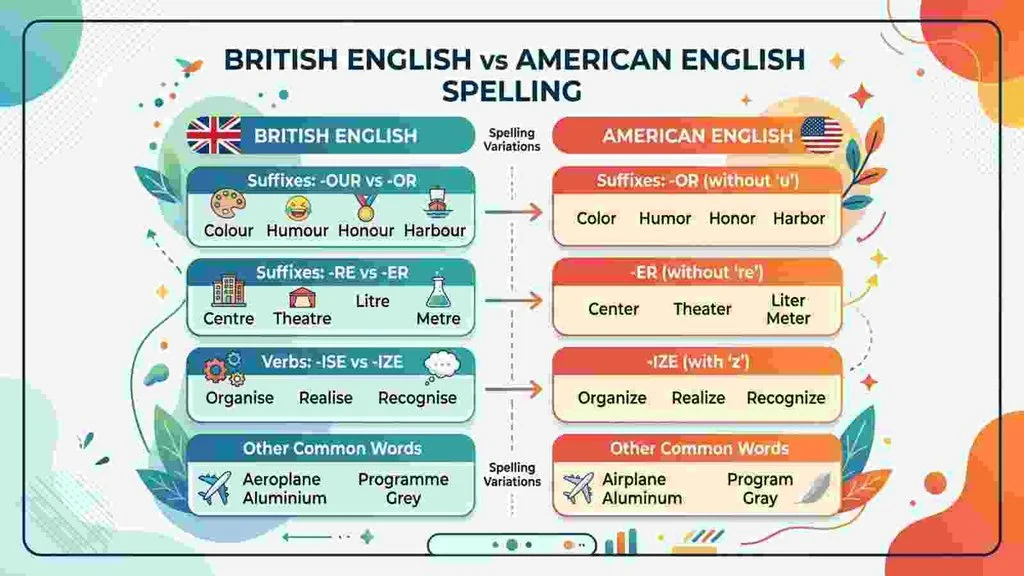
Some English words have different spellings in the UK and the US.
For example:
- Colour (British) vs Color (American)
- Centre (British) vs Center (American)
- Organise (British) vs Organize (American)
However, “address” follows the same spelling in both forms of English.
Comparison Table
| Feature | British English | American English |
| Correct spelling | Address | Address |
| Incorrect spelling | Adress | Adress |
| Home location | Address | Address |
| Email location | Email address | Email address |
| Verb form | Address | Address |
| Past tense | Addressed | Addressed |
| Present participle | Addressing | Addressing |
There is no British or American spelling difference here.
Both countries use two D’s and two S’s. The same rule applies in Canada, Australia, New Zealand, and other English-speaking regions.
Remember: Do not remove a letter just because another English word has a different spelling in another country.
Which Spelling Should You Use: Address or Adress?
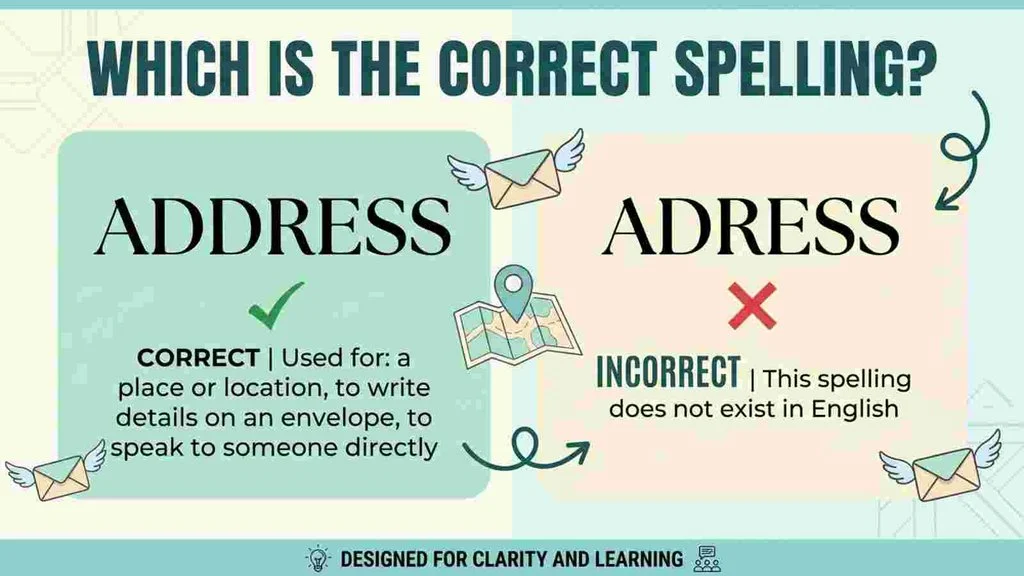
The answer is simple: always use “address” in standard English.
However, your audience and writing style still matter.
For US Readers
Use “address” in emails, reports, school work, and business documents.
Example:
Please confirm your mailing address.
For UK and Commonwealth Readers
Use “address” in the same way.
Example:
Please provide your postal address.
For Global Readers
Use “address” when writing for an international audience.
It is understood across English-speaking countries.
For Students and Professionals
Always use “address” in exams, applications, resumes, and formal letters.
Using “adress” can make your writing look careless. Spell-check tools may catch the mistake, but it is better to learn the correct form.
Common Mistakes with Address
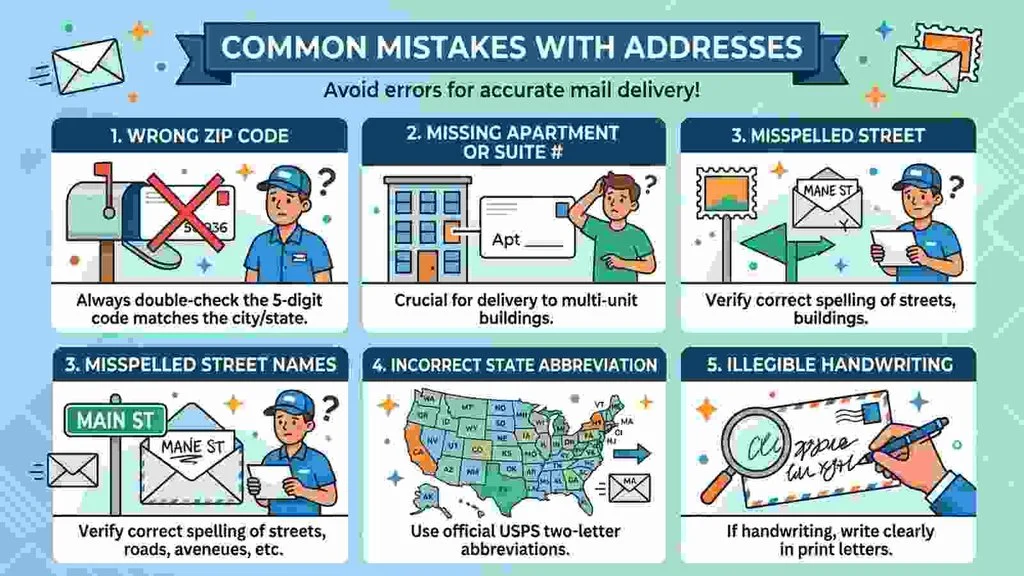
Many people make spelling mistakes because they forget one of the repeated letters.
Here are common errors and their corrections.
| Incorrect | Correct | Explanation |
| Adress | Address | Missing one D |
| Addres | Address | Missing one S |
| Adres | Address | Missing one D and S |
| Addresss | Address | Extra S |
| Adresses | Addresses | Incorrect spelling |
| Adressing | Addressing | Missing one D |
| Adressed | Addressed | Missing one D |
Easy Ways to Remember
- Address has two D’s.
- Address has two S’s.
- Think of the word as AD + DRESS.
- Check the spelling before sending important emails.
A simple memory trick is to remember that “address” contains the word “dress” with an extra D before it.
Address in Everyday Examples
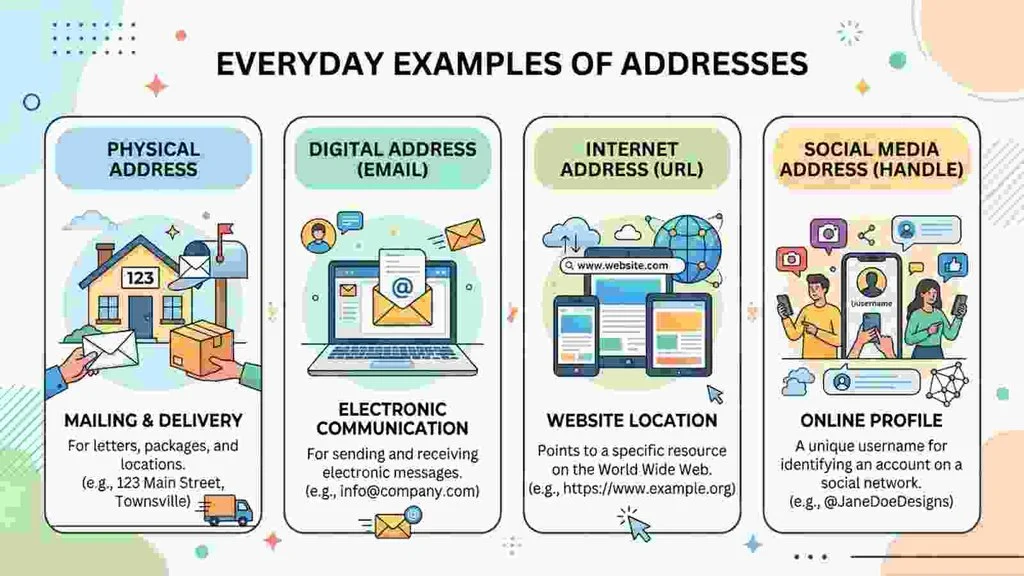
The word “address” is common in daily English. It can be a noun or a verb.
In Emails
- Please send your full address.
- I have updated my email address.
- Could you confirm your delivery address?
In News
- The leader will address the public tonight.
- The report highlights ways to address climate issues.
- The minister gave a formal address.
On Social Media
- Send me your email address.
- Please update your profile address.
- The event address is in my bio.
Formal Writing
- Please enter your current residential address.
- The company address is listed below.
- All questions should be addressed to the manager.
School Work
- Write your home address at the top of the form.
- The essay should address the main topic.
- The teacher asked us to address the question clearly.
In all these examples, the spelling stays the same.
Address – Google Trends & Usage Data

Google Trends helps people understand how often users search for a word over time and across different countries.
For the keyword “address or adress,” search interest is linked to spelling questions, grammar help, and word meanings.
People may search for:
- Address or adress
- How to spell address
- Correct spelling of address
- Address meaning
- Adress meaning
- Email address spelling
Popularity by Country
English spelling questions can come from many countries.
| Country | Common search context |
| United States | School work, forms, and emails |
| United Kingdom | British English spelling |
| India | English learning and grammar |
| Pakistan | English writing and spelling help |
| Canada | Formal and daily writing |
| Australia | Education and business writing |
These are examples of likely search contexts, not verified country rankings.
Google Trends does not show exact search totals. It uses a score from 0 to 100 to show relative search interest. A score of 100 means the highest interest in the selected time and place.
Also, Google Trends may not show reliable data for very low-volume searches. This means you should not treat a lack of data as proof that nobody searches for “adress.”
What Does Usage Data Tell Us?
The main point is that search popularity does not decide correct spelling.
People may search for a wrong spelling because they are unsure. A dictionary is a better source for checking whether a word is correct.
For this keyword, standard dictionaries list “address” as the accepted English spelling.
Address and Adress – Comparison Table
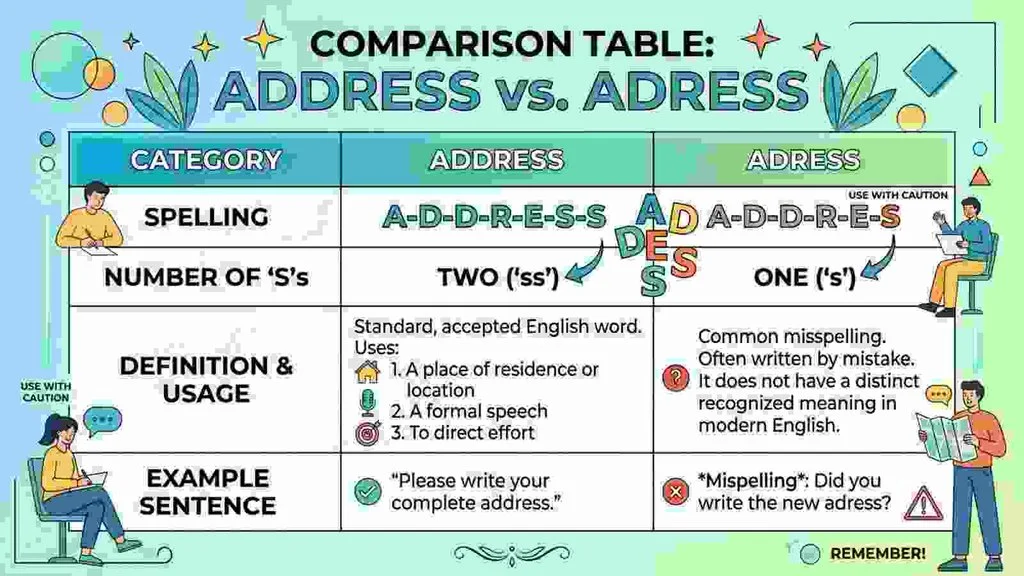
Here is a quick comparison of common word forms.
| Word or variation | Correct? | Meaning or use |
| Address | Yes | Correct base word |
| Adress | No | Common spelling error |
| Addresses | Yes | Plural noun or verb form |
| Addressed | Yes | Past tense |
| Addressing | Yes | Present participle |
| Addressee | Yes | Person who receives a letter |
| Addressable | Yes | Able to be addressed |
| Email address | Yes | Electronic contact details |
| Postal address | Yes | Physical mailing location |
| Home address | Yes | Place where someone lives |
The key rule is simple: keep both D’s and both S’s in the word “address.”
Frequently Asked Questions (FAQs)
1. Is it address or adress?
“Address” is correct. “Adress” is a spelling mistake. Always use two D’s and two S’s.
2. Is adress a real English word?
No. “Adress” is not a standard English word. It is a common misspelling of “address.”
3. Why does address have two D’s?
The spelling comes through French and Latin word history. English kept the double D in its modern form.
4. Is address British or American English?
It is used in both British and American English. There is no spelling difference between the two.
5. How do you spell address correctly?
Write it as A-D-D-R-E-S-S. It has six letters, two D’s, and two S’s.
6. What is the plural of address?
The plural is “addresses.”
Example: The company has three office addresses.
7. Is email adress or email address correct?
“Email address” is correct. The word “adress” is incorrect, even when used for email.
8. How can I remember the correct spelling?
Remember this simple trick: address = AD + DRESS. The word has two D’s and two S’s.
9. What does address mean?
Address means a location, such as a home or email address, or, as a verb, to speak to someone or deal with a problem.
10. Is address a noun or a verb?
Address is both: as a noun it means a location or contact details (home address, email address), and as a verb it means to speak to someone or deal with a problem.
Conclusion
The correct spelling is always address, not “adress.” This rule applies to British English, American English, and other forms of English around the world.
The word “address” has two D’s and two S’s. It comes from old French and Latin roots linked to the idea of guiding or directing. Over time, it gained meanings related to locations, emails, speeches, and communication.
Although English has many spelling differences between countries, this word stays the same. You should use “address” in emails, school work, business documents, social media, and formal writing.
If you often forget the spelling, use the simple trick: AD + DRESS. This can help you remember both D’s.
Also, remember that “addresses,” “addressed,” and “addressing” are correct forms. The spelling changes only follow normal grammar rules, not regional spelling rules.
When in doubt, check a trusted dictionary or use a spelling tool. Most importantly, learn the correct form and use it with confidence. A small spelling detail can make your writing clearer and more professional.
Continue Reading:
- Loose vs. Lose: Meaning, Spelling, and Examples ( for 2026)
- Complete vs. Completed: Meaning, Difference, and Usage ( for 2026)
- Muah vs Mwah: Meaning, Spelling, and Usage ( for 2026)
- Cuter or Cutier: Correct Spelling, Meaning, and Usage ( for 2026)
- Selfs or Selves: Meaning, Grammar, and Examples (for 2026)

Mary Roach is an American science writer and bestselling author known for making unusual and complex scientific topics engaging, accessible, and humorous. Her books include Stiff, Packing for Mars, Gulp, and Fuzz.
Author at Simifind.com, sharing clear, informative content designed to help readers understand interesting topics and everyday questions.








3 thoughts on “Address vs Adress: Meaning, Spelling, and Usage ( for 2026)”