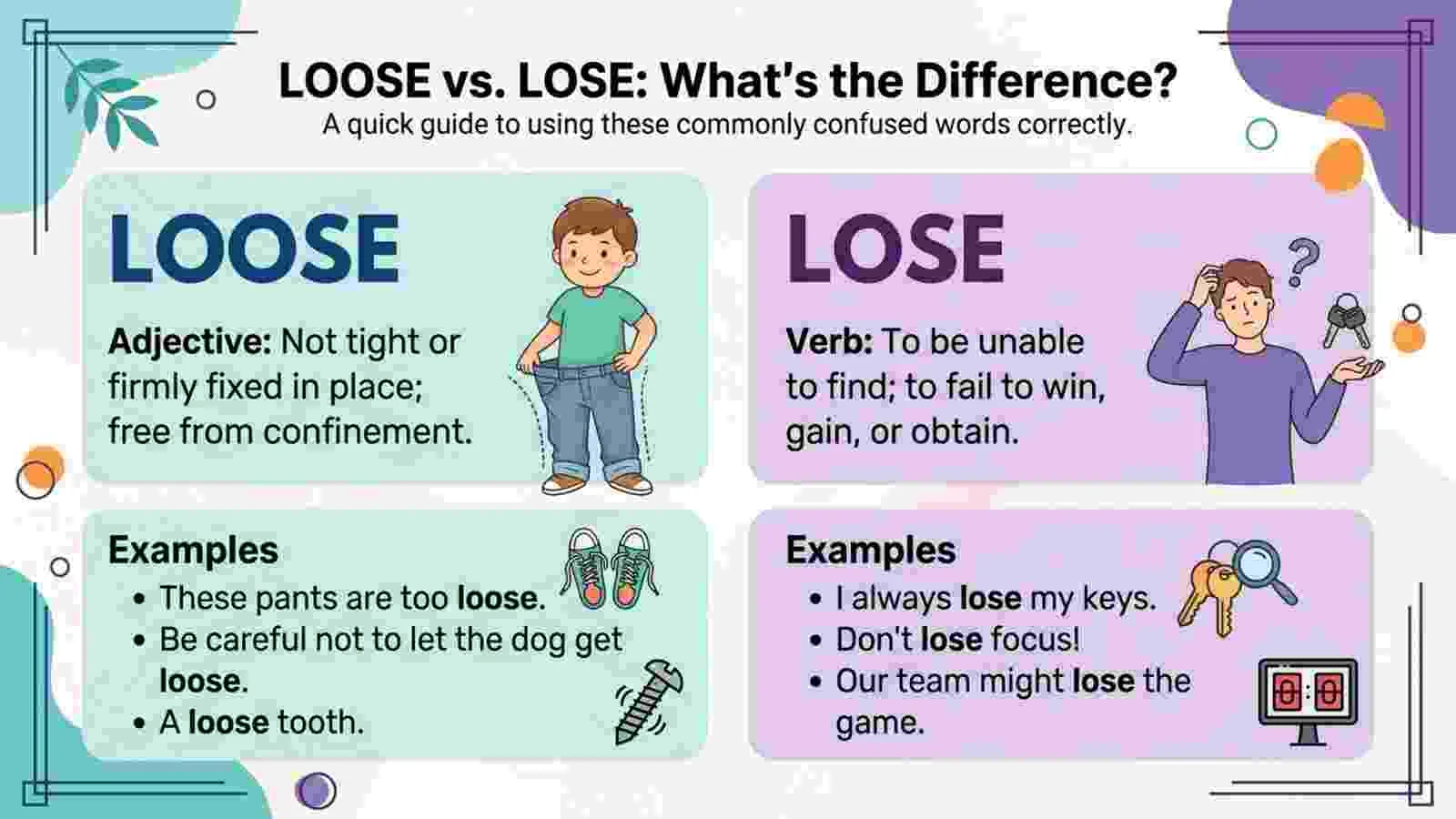
Do you write “loose” or “lose”? Many people mix up these two words. They look almost the same, but they have very different meanings. One small letter can change the whole meaning of your sentence.
For example, you may want to say, “I do not want to lose my keys.” But you may write, “I do not want to loose my keys.” This is a common spelling mistake.
So, what is the correct word? And how can you remember the difference?
The confusion often comes from the way these words sound and look. Both have similar spellings, but they are used in different ways.
This can cause problems in school work, emails, social media posts, and business writing.
In this guide, you will learn the meaning of loose and lose, their history, and how to use them correctly. You will also see simple examples, spelling tips, and common mistakes.
Whether you write in British English, American English, or global English, this guide will help you choose the right word every time.
Loose or Lose – Quick Answer
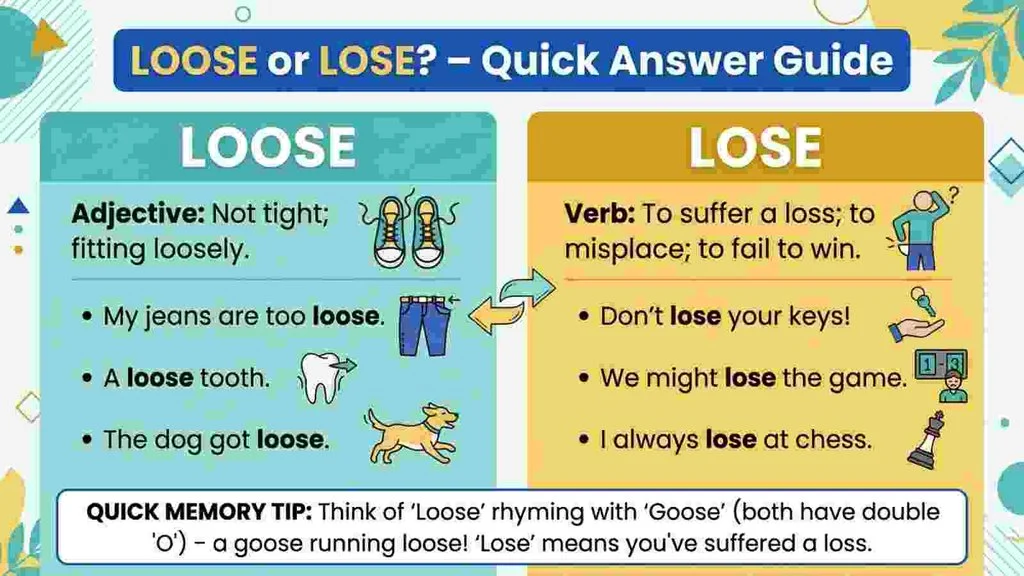
The words loose and lose have different meanings.
- Loose means not tight, not fixed, or free.
- Lose means to misplace something, fail to win, or no longer have something.
Simple examples
Loose:
- My shirt is too loose.
- The dog broke its loose chain.
- I like to wear loose clothes.
Lose:
- Do not lose your phone.
- Our team may lose the game.
- You can lose weight through healthy habits.
Easy trick: Loose has two “o” letters, like something wide or not tight. Lose has one “o” and means something is gone or missing.
Remember: Loose is about being free or not tight. Lose is about losing something.
The Origin of Loose or Lose
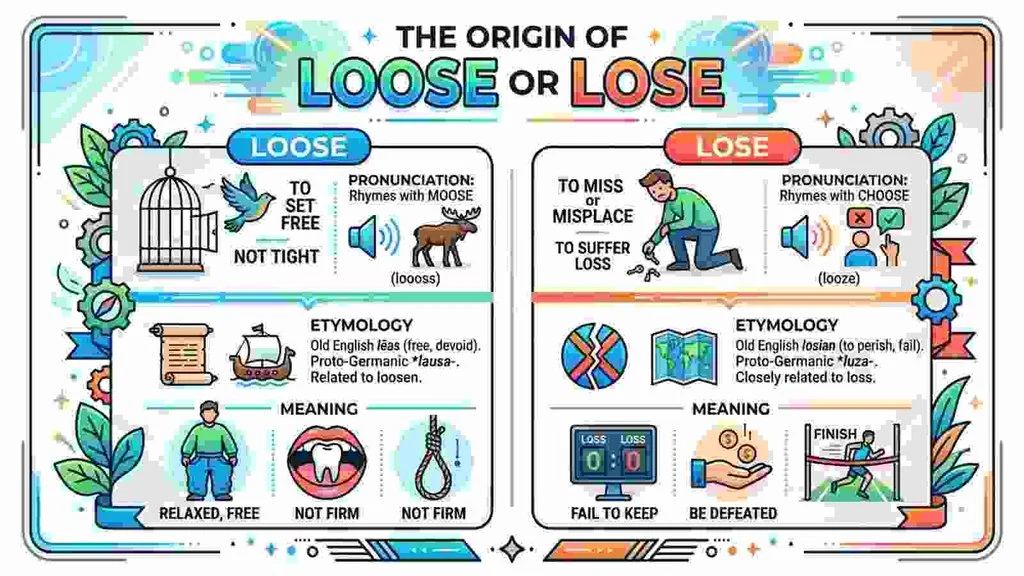
The words loose and lose have different roots. Their spellings developed over time, which explains why they look alike but sound different.
Where does loose come from?
The word loose comes from Old Norse lauss. It meant free from bonds or not tied. It entered Middle English and kept its meaning over time.
Today, we use loose to describe things that are not tight, fixed, or held in place.
Oxford Learner’s Dictionaries
Examples:
- A loose rope
- Loose clothes
- A loose tooth
Where does lose come from?
The word lose comes from Old English losian. It meant to perish, be lost, or become separated from something.
Over time, it became the word we use today for losing an item, failing to win, or no longer having something.
Examples:
- Lose a game
- Lose your keys
- Lose hope
Why are the spellings different?
English words often come from different languages. Their spelling and sound can change over time.
Loose ends with an “s” sound. Lose ends with a “z” sound. This is one key difference that helps us tell them apart.
British English vs American English Spelling
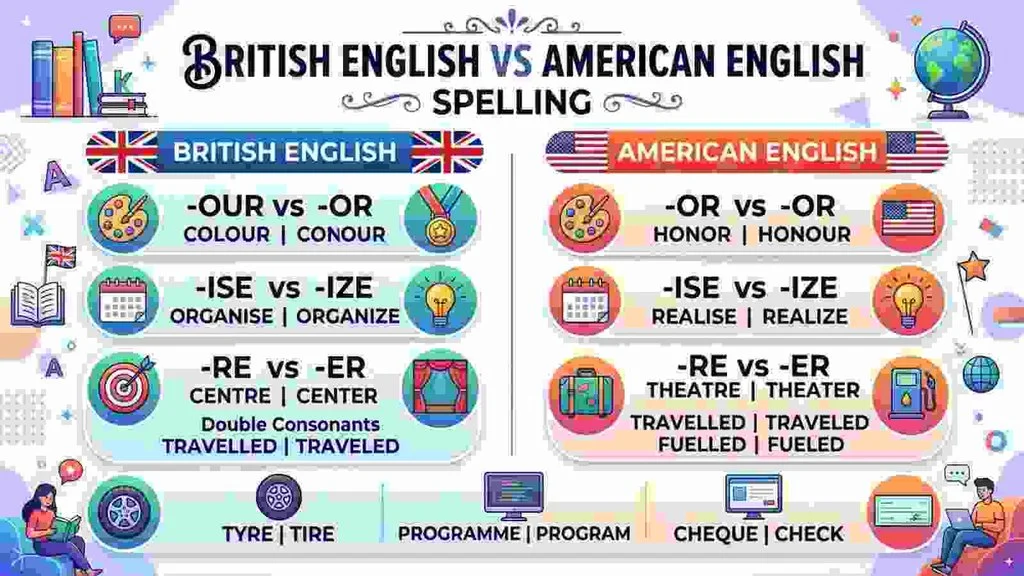
Many English words have different spellings in British and American English. For example, British English uses “colour,” while American English uses “color.”
However, loose and lose follow the same spelling rules in both forms of English.
There is no British or American spelling difference between these two words.
Comparison table
| Feature | British English | American English |
| Loose | Loose | Loose |
| Lose | Lose | Lose |
| Loose meaning | Not tight | Not tight |
| Lose meaning | Misplace or fail | Misplace or fail |
| Loose pronunciation | /luːs/ | /luːs/ |
| Lose pronunciation | /luːz/ | /luːz/ |
| Spelling difference | None | None |
Example sentences
British English:
- I do not want to lose my keys.
- These trousers are too loose.
American English:
- I do not want to lose my keys.
- These pants are too loose.
The words stay the same. Only some other words, such as trousers and pants, may change by region.
Which Spelling Should Use Loose or Lose ?
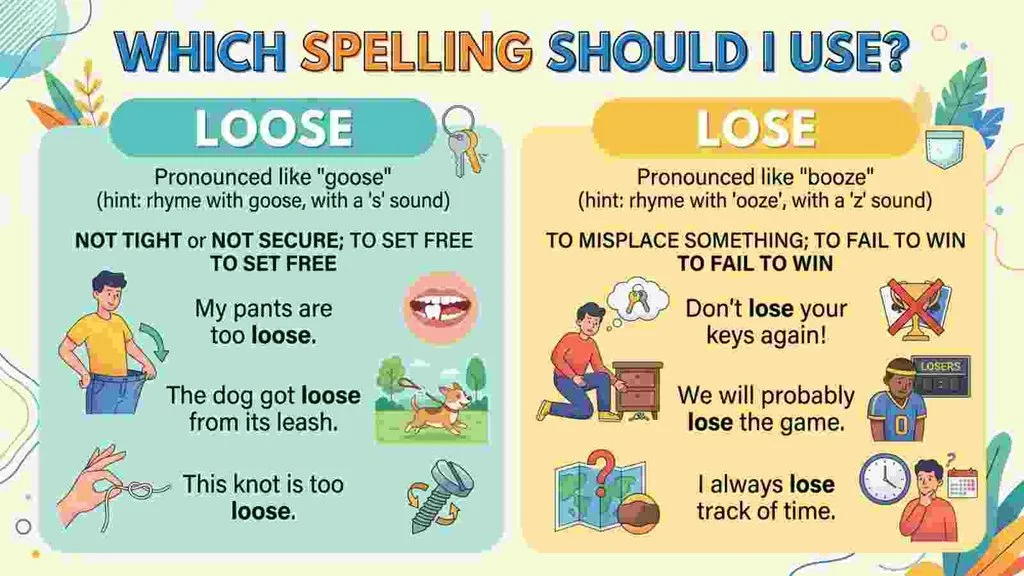
Your choice depends on what you want to say, not where you live.
For US readers
Use loose when something is not tight.
Use lose when talking about loss or failure.
Examples:
- Do not lose your phone.
- This shirt is too loose.
For UK and Commonwealth readers
The same rules apply in British English and Commonwealth countries such as Australia, Canada, and New Zealand.
Examples:
- I do not want to lose the match.
- My shoes feel loose.
For global English
If you write for a global audience, use the same standard spellings.
Both words are understood worldwide. There is no need to change them for different countries.
Professional advice: Always check the meaning of the sentence. Do not choose a spelling based on the country or writing style.
Common Mistakes with Loose or Lose
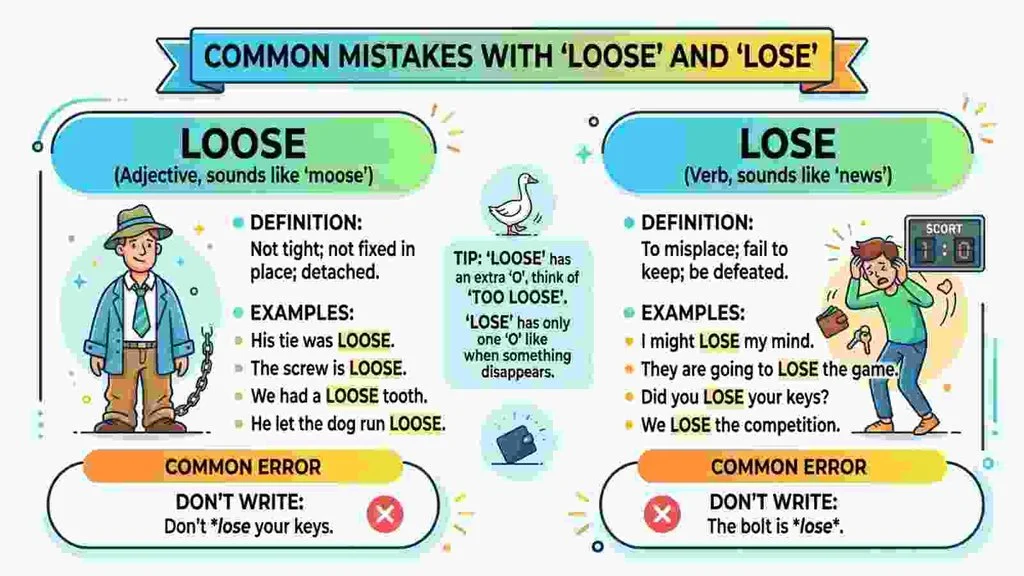
Many writers use these words incorrectly because they look similar.
Here are common mistakes and their corrections.
| Incorrect sentence | Correct sentence |
| I do not want to loose my phone. | I do not want to lose my phone. |
| My shirt is too lose. | My shirt is too loose. |
| We might loose the game. | We might lose the game. |
| Do not loose your keys. | Do not lose your keys. |
| The screw is lose. | The screw is loose. |
| I hope I do not loose money. | I hope I do not lose money. |
Mistake: Using loose instead of lose
Incorrect: I do not want to loose my job.
Correct: I do not want to lose my job.
Why? The sentence talks about losing something. So, lose is correct.
Mistake: Using lose instead of loose
Incorrect: My jeans are too lose.
Correct: My jeans are too loose.
Why? The sentence describes how the jeans fit. So, loose is correct.
Mistake: Forgetting the extra letter
Loose has two “o” letters. Lose has one.
A simple way to remember:
- Loose = not tight.
- Lose = no longer have something.
Mistake: Thinking “loosing” is always correct
The word “loosing” can exist as a verb. It means releasing or setting something free.
Example: The hunter was loosing the arrows.
However, when you mean losing something, use “losing,” not “loosing.”
Loose or Lose in Everyday Examples
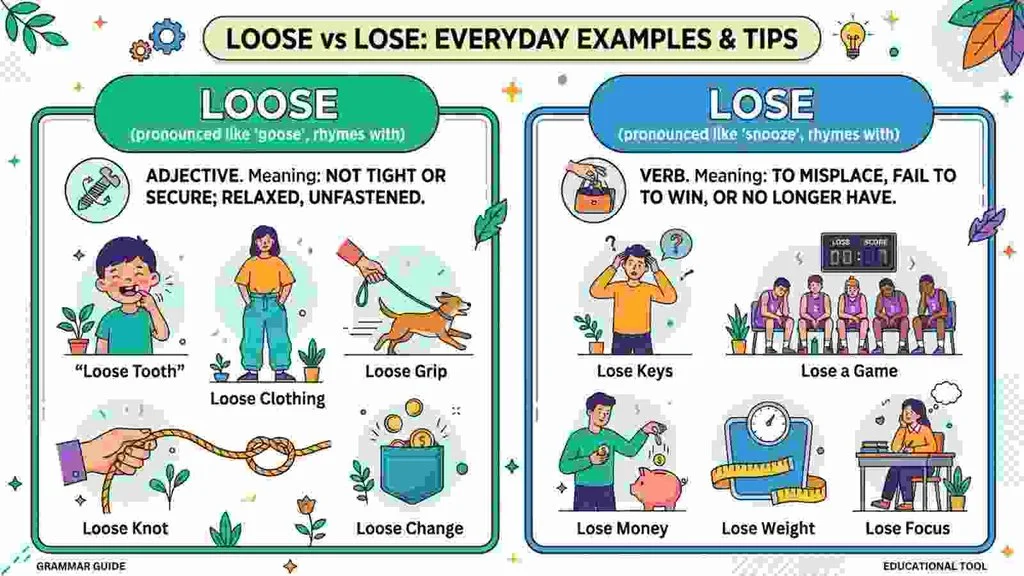
Both words appear in daily life. The right choice depends on the meaning of your sentence.
In emails
Use lose when you talk about missing files, money, or time.
Correct:
“Please save a copy of the file. We do not want to lose any important data.”
Use loose when you describe something that is not tight.
Correct:
“The cable is loose. Please check it before the meeting.”
In news
News reports often use lose when talking about sports, money, or business.
Examples:
- The team could lose the final match.
- The company may lose several customers.
- The country could lose its lead in the race.
Loose can describe objects or rules.
Examples:
- A loose wire caused a delay.
- Police found a loose animal near the road.
On social media
People often write short and quick messages online.
Correct examples:
- I hope I do not lose my phone again!
- These jeans are too loose.
- Never lose hope.
- I love wearing loose clothes.
In formal writing
Correct spelling matters in reports, school work, and business documents.
Examples:
- The company may lose valuable data.
- Loose connections can affect system safety.
- Students should not lose focus during exams.
- The loose cable must be repaired.
Writing tip: Read your sentence aloud. Ask yourself if you mean something is not tight or if something may be lost. This simple check can prevent errors.
Loose or Lose – Google Trends & Usage Data
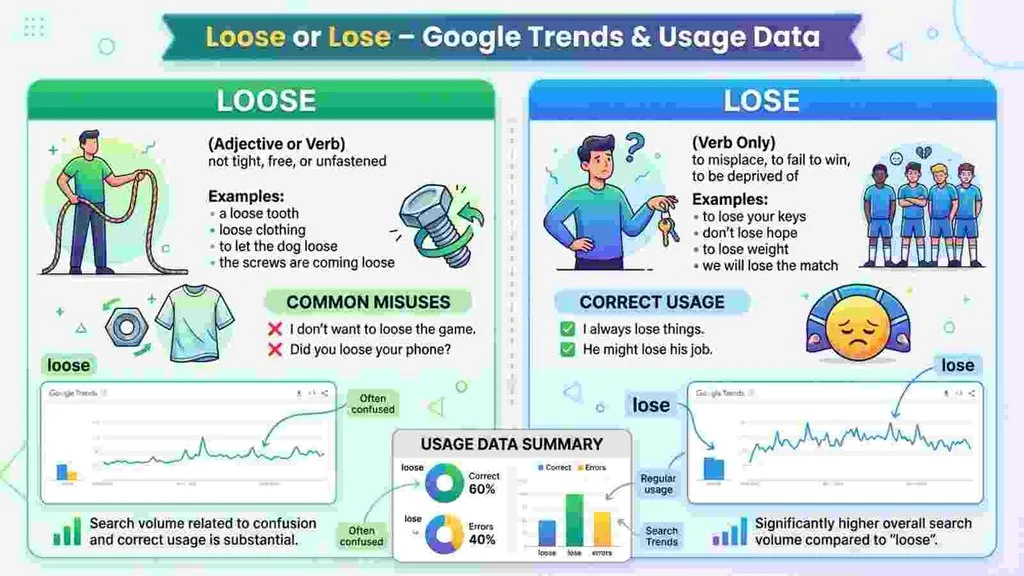
People search for “loose or lose” because these words look similar and are easy to mix up.
Google Trends can help writers study search interest across countries and over time. However, it does not measure how many people make a spelling mistake.
Google also explains that Trends uses a sample of searches and scales results from 0 to 100. These scores show relative interest, not exact search numbers.
Search interest by country
The following table shows useful regional areas to explore when researching this keyword. It is not a ranking of search volume.
| Country or region | Common language context | Search intent |
| United States | American English | Meaning and correct spelling |
| United Kingdom | British English | Grammar and spelling help |
| Canada | Canadian English | Everyday writing and grammar |
| Australia | Australian English | English learning and spelling |
| India | Indian English | School and professional writing |
| Pakistan | English as an additional language for many users | Grammar and writing support |
What do people search for?
Common search phrases include:
- Loose or lose meaning
- Lose or loose difference
- How to spell lose
- Loose vs lose examples
- Is it lose weight or loose weight?
- Do not lose or loose hope?
These searches show that people want a quick answer and clear examples.
How does context affect search interest?
The word lose is used in many everyday situations, such as losing a game, money, time, or an item.
The word loose is common when people talk about clothes, wires, screws, and other things that are not tight.
For accurate country-level data, use the
Google Trends tool
and compare relevant search terms over a selected period. Note that Google Trends may treat spelling variations as separate searches.
Comparison Table: Loose and Lose Side by Side
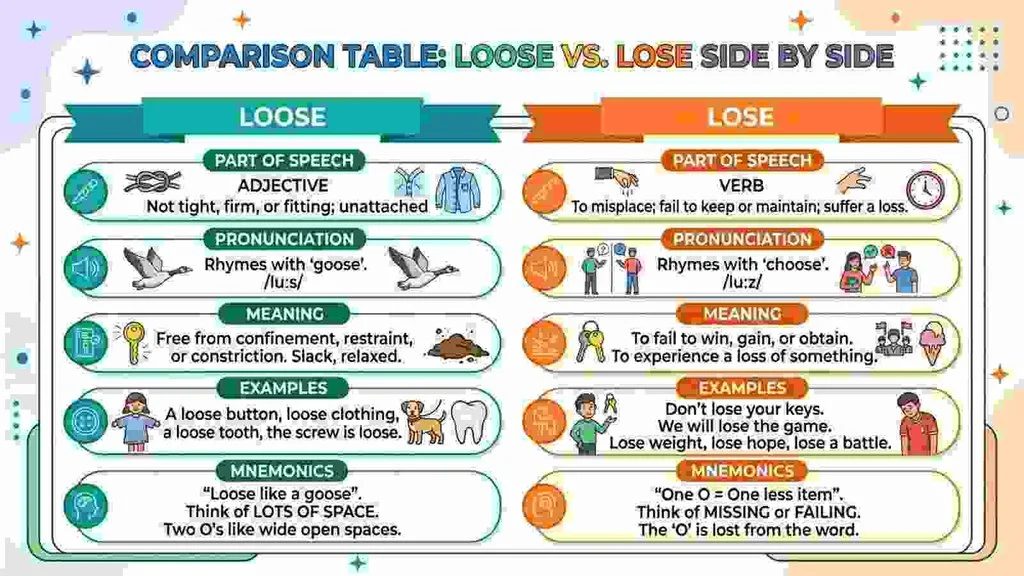
| Feature | Loose | Lose |
| Main meaning | Not tight or fixed | To misplace or fail |
| Part of speech | Usually an adjective | Verb |
| Pronunciation | Looss | Looz |
| Number of O letters | Two | One |
| Ending sound | S sound | Z sound |
| Example | Loose shirt | Lose weight |
| Common use | Clothes, wires, knots | Games, money, items |
| Past tense | Loosened (verb form) | Lost |
| Present participle | Loosening | Losing |
| Opposite | Tight | Find or win (depending on context) |
Quick memory trick
Think of the word “loose” as having extra room. It has an extra “o” because it is not tight.
Think of “lose” as something that is gone.
This simple trick can help you remember the correct spelling.
FAQs About Loose or Lose
1. Is it lose or loose?
Both words are correct, but they have different meanings. Loose means not tight. Lose means to misplace something or fail to win.
Example: My shirt is loose, but I do not want to lose it.
2. Is it lose weight or loose weight?
The correct phrase is lose weight.
Lose is a verb that means to become lighter or have less weight.
Example: I want to lose weight.
3. Is it loose your phone or lose your phone?
The correct phrase is lose your phone.
It means you cannot find your phone or no longer have it.
Example: Be careful not to lose your phone.
4. Why do people confuse loose and lose?
People confuse them because they look almost the same. They also have similar sounds.
However, loose ends with an “s” sound, while lose ends with a “z” sound.
5. Is loose an adjective or a verb?
Loose is usually an adjective.
Example: My shoes are loose.
It can also be a verb meaning to release or set free.
Example: They will loose the birds into the sky.
6. Is losing spelled with one O or two?
Losing is spelled with one O.
Example: Our team is losing the match.
The word losing comes from lose, not loose.
7. Is “loosing” a real word?
Yes, loosing is a real word, but it is rare.
It means releasing or making something loose.
Example: The soldiers were loosing arrows.
For most everyday sentences about loss, use losing.
Conclusion
The difference between loose and lose is simple once you know what each word means. Loose means not tight, not fixed, or free. Lose means to misplace something, fail to win, or no longer have something.
Both words have the same spelling in British and American English. So, you do not need to change them based on your audience or location.
The easiest way to remember the difference is to look at the number of “o” letters. Loose has two “o” letters and means something is not tight. Lose has one “o” and means something is gone or missing.
For example, you can say, “My shirt is loose, but I do not want to lose it.”
Always check the meaning before choosing the spelling. This small habit can improve your emails, school work, social media posts, and professional writing.
Whether you are writing for a local or global audience, using loose and lose correctly will make your English clearer and easier to read.
Continue Reading:
- Muah vs Mwah: Meaning, Spelling, and Usage ( for 2026)
- Complete vs. Completed: Meaning, Difference, and Usage ( for 2026)
- Caliber vs Calibre: Meaning, Spelling, and Usage ( for 2026)

Here’s a concise 2-line author bio suitable for Simifind.com:
James Dashner is an American bestselling author best known for The Maze Runner series and other popular young-adult fiction.
On Simifind.com, he shares clear, engaging insights and helpful content for readers interested in books, writing, and popular literature.





3 thoughts on “Loose vs. Lose: Meaning, Spelling, and Examples ( for 2026)”