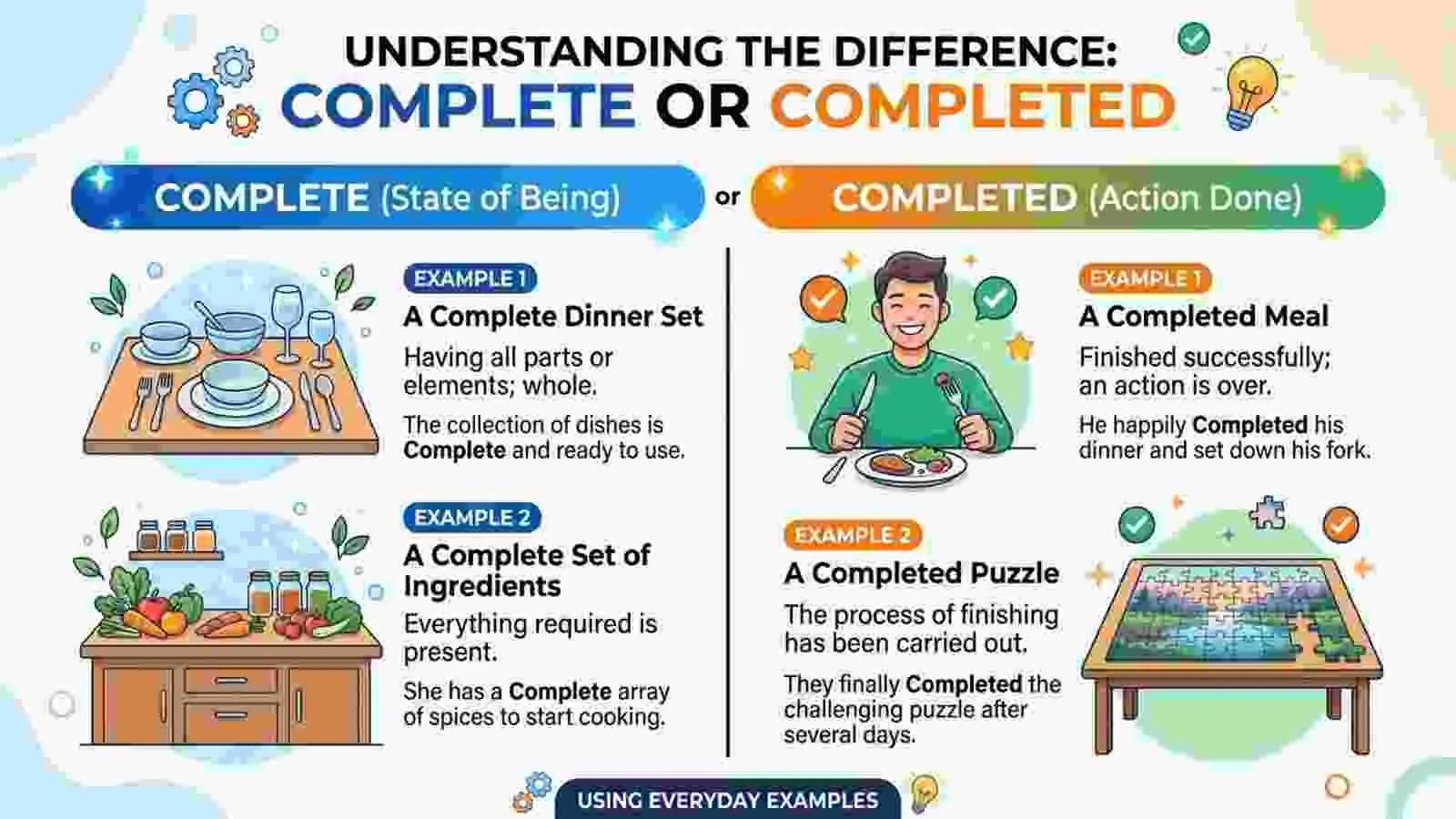
Complete = do it now, or something whole / finished. Completed = already finished. Please complete the form (now). I completed the form yesterday (past).
Have you ever paused while writing and wondered whether “complete or completed” is the right choice? You are not alone.
These two words look closely related, but they do different jobs in a sentence.
Complete can work as a verb, adjective, or noun, while completed is mainly the past form and past participle of the verb complete.
Choosing the right word matters in emails, schoolwork, reports, applications, and everyday English.
For example, you can say, “Please complete the form,” when asking someone to finish something.
But you would say, “I completed the form yesterday,” when the action is already finished. You can also use complete as an adjective: “The project is complete.”
This guide explains complete or completed in simple English. You will learn their meanings, grammar rules, differences, common mistakes, and practical examples.
Whether you use American English, British English, or international English, this article will help you choose the correct form with confidence.
Complete – Quick Answer
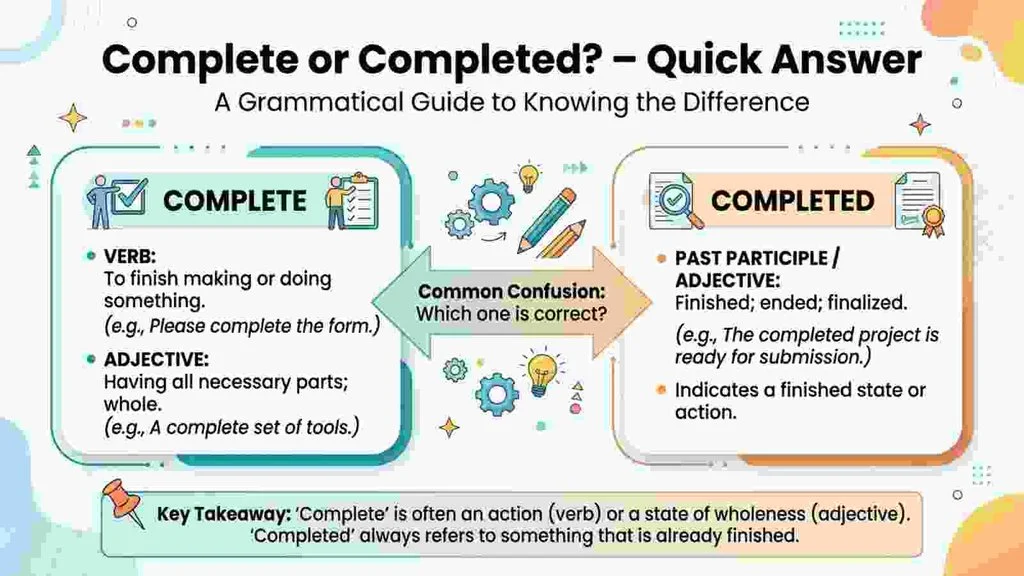
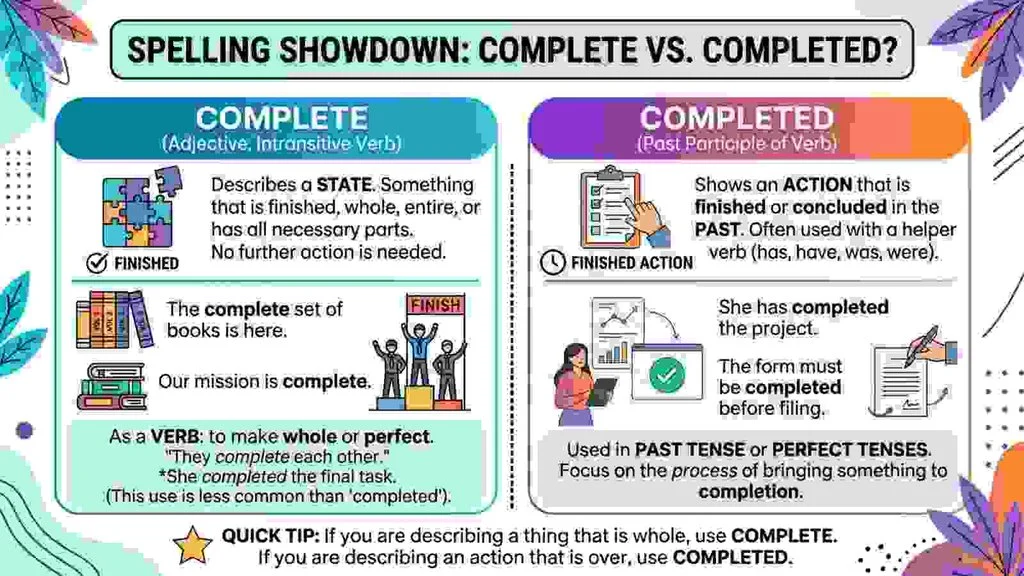
Both complete and completed are correct, but they are used in different situations.
- Complete = to finish something, or something that is whole or finished.
- Completed = something that has already been finished.
Examples
Complete as a verb:
Please complete the application form.
Completed as a past verb:
She completed the application yesterday.
Complete as an adjective:
The report is complete.
Completed as an adjective:
The completed report was sent to the manager.
A simple rule is:
Use “complete” for an action you need to do or as an adjective describing something whole or finished. Use “completed” for an action that has already happened or for something that has been finished.
The Origin of Complete
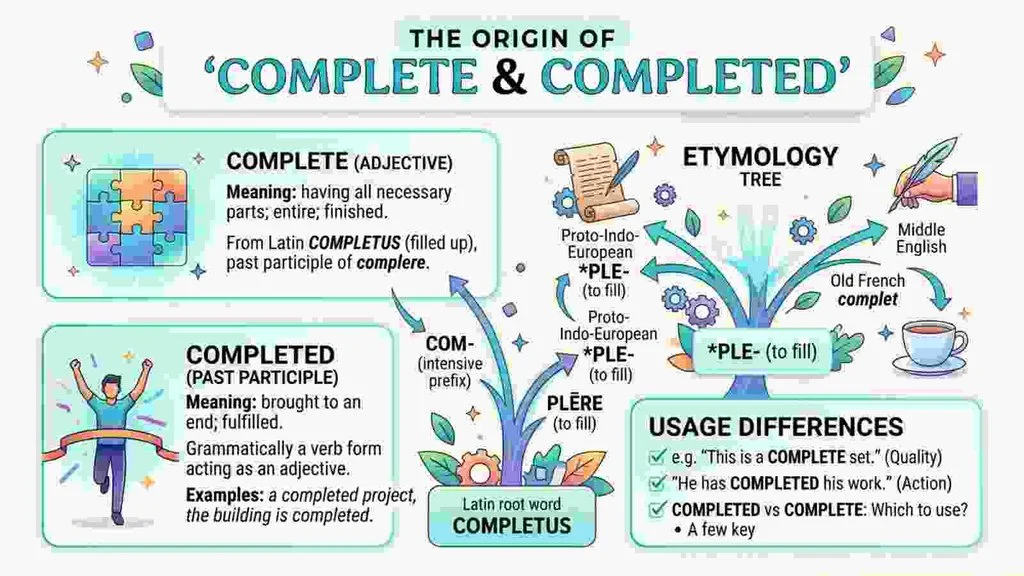
The word complete comes from Latin completus, meaning “filled up” or “finished.” It entered English through Old French and Middle English.
Over time, complete developed several grammatical uses.
Complete as a Verb
As a verb, complete means to finish something.
I need to complete my assignment.
Please complete this form.
Complete as an Adjective
As an adjective, complete means whole, finished, or containing everything needed.
We have a complete set of books.
The work is complete.
Completed as a Verb Form
Completed is the past tense and past participle of complete.
They completed the project last week.
She has completed her training.
The spelling does not change between British and American English. Both varieties normally use complete .
British English vs American English Spelling
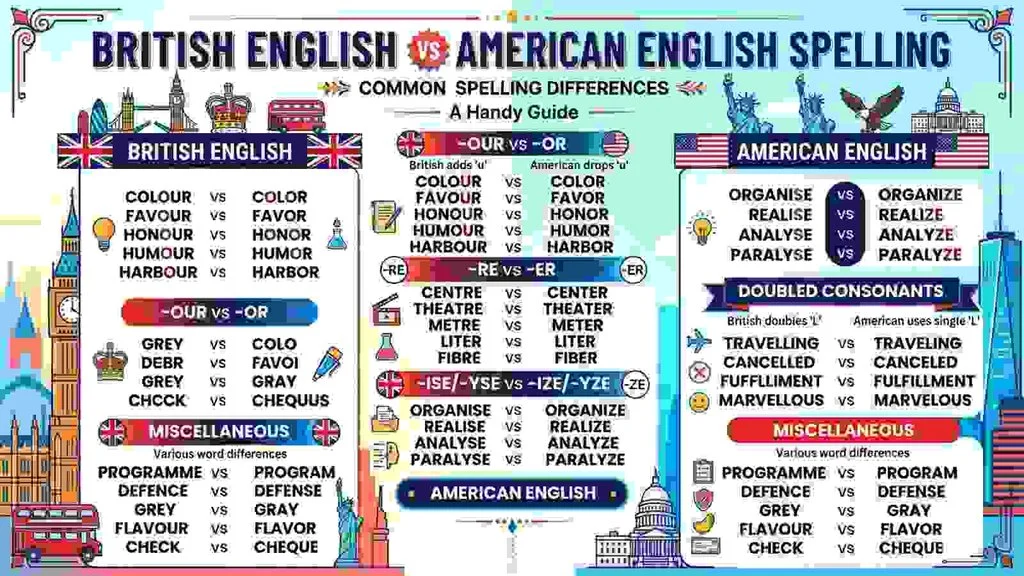
Unlike words such as colour/color or cancelled/canceled, there is no major British-American spelling difference between complete and completed.
| Word | British English | American English | Meaning |
| Complete | Complete | Complete | Finish or whole |
| Completed | Completed | Completed | Finished |
| Completing | Completing | Completing | In the process of finishing |
| Completion | Completion | Completion | The act of finishing |
| Completely | Completely | Completely | Fully |
Examples in Both Varieties
British English:
Please complete the form before Friday.
American English:
Please complete the form before Friday.
The spelling is identical in both versions.
Related Words
You may also see:
- complete
- completed
- completing
- completion
- completely
These forms have different grammatical functions, but their basic meaning is connected to finishing or being whole.
Which Spelling Should Use Complete ?
You do not need to choose between a British and American spelling here. Complete and completed are standard in both forms of English.
The important choice is grammar, not regional spelling.
Use “Complete” When:
You are telling someone to finish something:
Please complete the form.
You are talking about something as whole:
This is a complete guide.
You are describing a finished state:
The work is complete.
Use “Completed” When:
The finishing action happened in the past:
I completed the task yesterday.
The action has happened before now:
She has completed the course.
A noun describes something that has already been finished:
Submit the completed application.
For global audiences, these rules are the same. Focus on the meaning and grammatical role of the word.
Common Mistakes with Complete
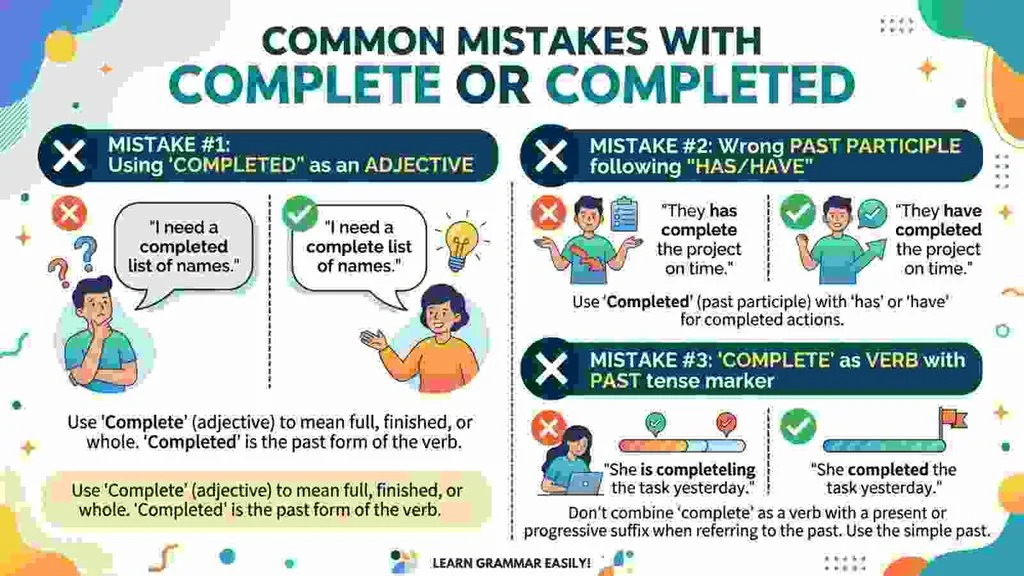
Mistake 1: Using “completed” for an instruction
❌ Please completed the form.
✅ Please complete the form.
After please, use the base verb.
Mistake 2: Using “complete” for a finished past action
❌ I complete the project yesterday.
✅ I completed the project yesterday.
The word yesterday shows that the action happened in the past.
Mistake 3: Confusing “complete” with “completed”
❌ The completed project is not yet finished.
This can sound contradictory because completed normally means finished.
Better:
✅ The complete project contains all the required sections.
Or:
✅ The project has been completed.
Mistake 4: Using “complete” after “has”
❌ She has complete the assignment.
✅ She has completed the assignment.
After has/have/had, use the past participle completed.
Mistake 5: Using “completed” after “to”
❌ I need to completed the form.
✅ I need to complete the form.
After to, use the base form of the verb.
Complete or Completed in Everyday Examples
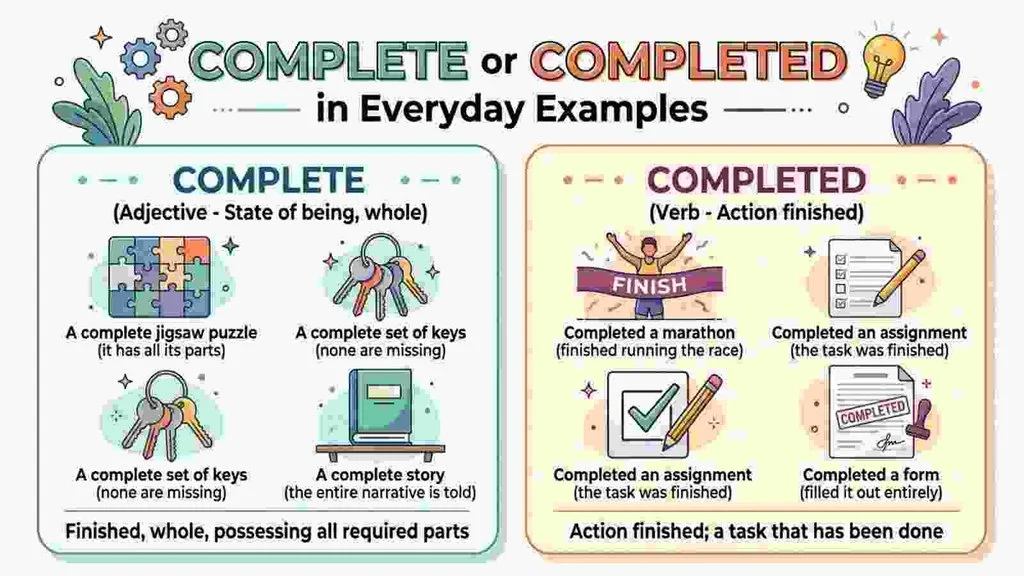
Knowing the difference becomes easier when you see the words in real situations.
In Emails
Please complete the attached form and return it by Friday.
I have completed the requested document.
In News Writing
The company will complete the construction next year.
The company completed construction in June.
In Social Media
Finally completed my first marathon!
I need to complete this project before the weekend.
In Formal Writing
All applicants must complete the required documentation.
The research team completed the study in 2026.
In School or University
Students must complete the assignment by Monday.
She completed her degree last year.
In Workplace Communication
Please complete your training today.
All employees have completed the training.
Complete or Completed: Comparison Table
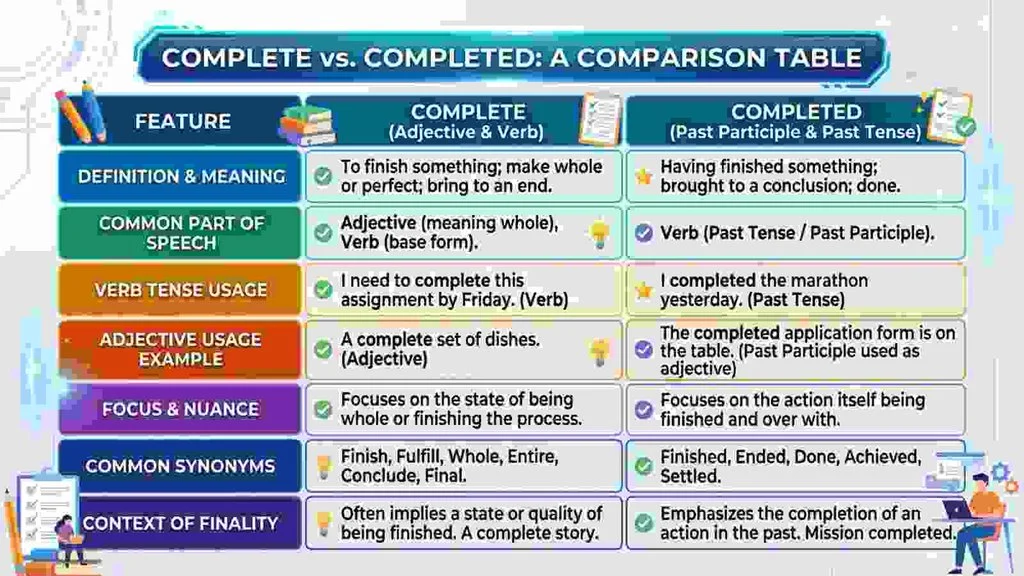
| Form | Grammar | Main Use | Example |
| Complete | Verb | Present/base action | Please complete the task. |
| Complete | Adjective | Whole or finished | The report is complete. |
| Completed | Verb | Past action | She completed the task. |
| Completed | Past participle | Perfect/passive structures | They have completed the work. |
| Completing | Present participle | Ongoing action | He is completing the form. |
| Completion | Noun | Act of finishing | Completion is required. |
| Completely | Adverb | Fully | The work is completely finished. |
Complete – Google Trends & Usage Data
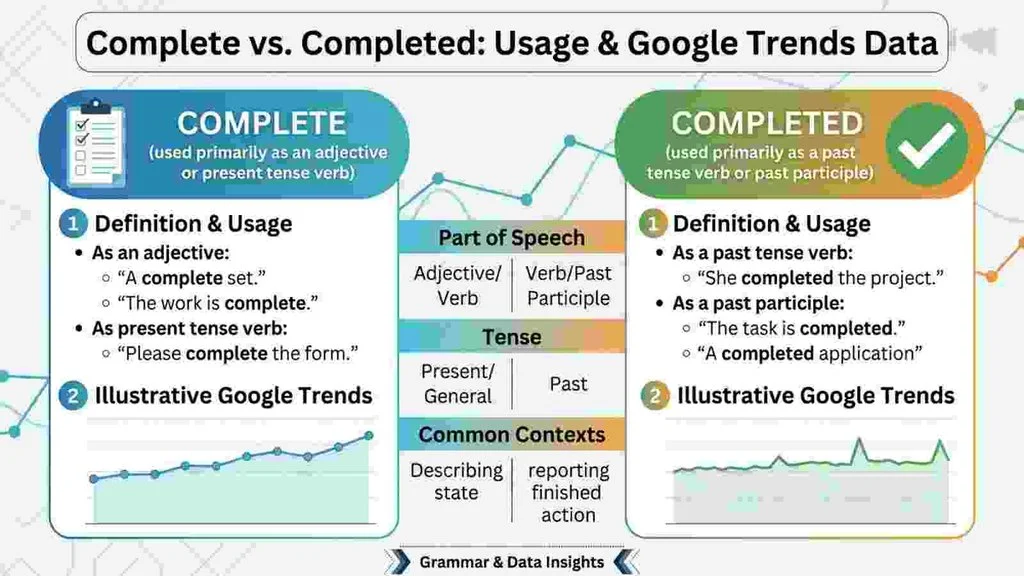
Search interest for complete and completed can vary because they serve different grammatical purposes.
Complete has a wider range of uses. People search it as a verb, adjective, and part of phrases such as:
- complete meaning
- complete definition
- complete the form
- complete sentence
- complete list
Completed is more strongly connected with finished actions and phrases such as:
- completed meaning
- completed form
- completed project
- completed application
- completed work
Search behavior can also vary by country, industry, and context. For example, education and employment searches may frequently use completed, while instructions and forms often use complete.
Because search volume changes over time, current Google Trends data should be checked for the specific countries and date range being studied rather than treating one fixed popularity ranking as permanent.
FAQs About Complete
1. Is it correct to say “complete” or “completed”?
Yes. Both words are correct, but their grammatical uses are different. Complete can be a verb or adjective, while completed is the past form of the verb and can also act as an adjective.
2. Should I say “complete the form” or “completed the form”?
Use complete the form for an instruction or present/base verb.
Please complete the form.
Use completed the form for a past action.
I completed the form yesterday.
3. Is “completed” the past tense of “complete”?
Yes. Completed is both the simple past tense and past participle of the regular verb complete.
She completed the assignment.
4. Should I say “has complete” or “has completed”?
Use has completed.
She has completed the course.
The auxiliary verb has requires the past participle completed.
5. Is “complete” an adjective?
Yes. Complete can be an adjective meaning whole, finished, or containing everything needed.
We received the complete report.
6. Is “completed” an adjective?
Yes. Completed can describe something that has been finished.
Please submit the completed application.
7. Are complete and completed spelled differently in British and American English?
No. Both British and American English use complete and completed with the same spelling.
8. What does complete mean?
Complete means to finish something, or to describe something whole and finished.
9. What does completed mean?
Completed means something has already been finished.
10. What is the difference between complete and completed?
Complete is used for an action happening now or something whole, while completed is used for an action already finished in the past.
Conclusion
The difference between complete or completed is mainly about grammar and time.
Complete is the base form of the verb and can also work as an adjective.
Use it when giving an instruction, talking about an action that needs to happen, or describing something as whole or finished.
Completed is the past tense and past participle of complete, so it normally refers to an action that has already happened.
For example, say “Please complete the form” when giving an instruction. Say “I completed the form” when describing a past action.
With perfect forms, use completed, as in “She has completed the course.”
There is no important British-American spelling difference here. Both varieties use the same forms. The key is to understand the grammatical role of each word and the time of the action.
Once you remember this simple distinction, choosing between complete and completed becomes much easier in emails, schoolwork, professional documents, applications, and everyday English.
Continue Reading:
- Muah vs Mwah: Meaning, Spelling, and Usage ( for 2026)
- I’m or I Am: Examples, Rules, and Common Mistakes ( for 2026)
- Cuter or Cutier: Correct Spelling, Meaning, and Usage ( for 2026)
- Selfs or Selves: Meaning, Grammar, and Examples (for 2026)
- Shoutout or Shout Out: Meaning, Spelling, and Usage (for 2026)

Mary Roach is an American science writer and bestselling author known for making unusual and complex scientific topics engaging, accessible, and humorous. Her books include Stiff, Packing for Mars, Gulp, and Fuzz.
Author at Simifind.com, sharing clear, informative content designed to help readers understand interesting topics and everyday questions.








3 thoughts on “Complete vs. Completed: Meaning, Difference, and Usage ( for 2026)”