English learners often stop at a simple question: Should I write “I’m” or “I am”?
Both forms are correct, but they do not always fit the same situation. The choice depends on tone, emphasis, sentence position, and the type of writing you are doing.
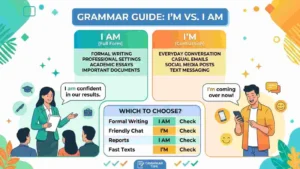
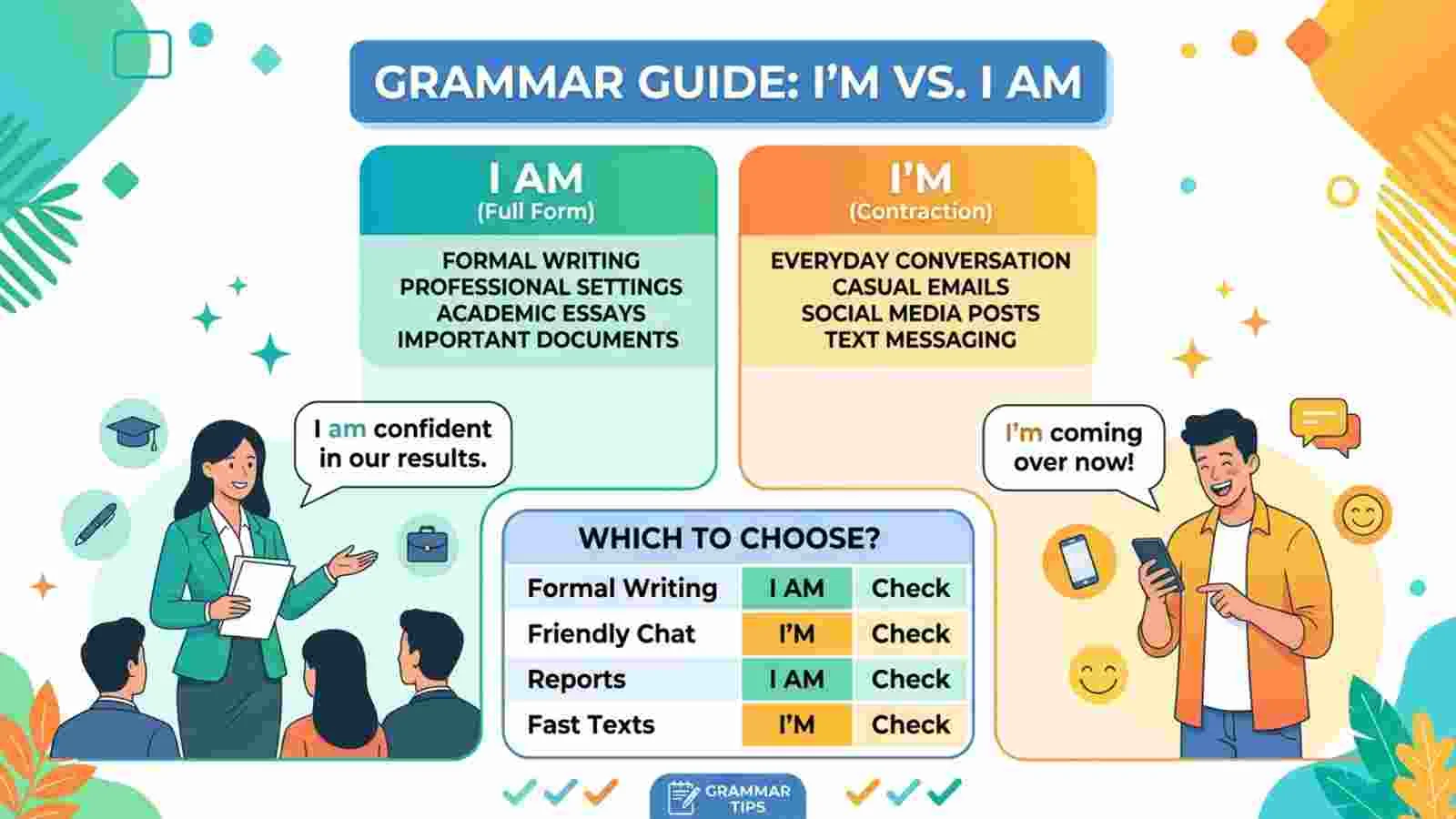
“I’m” is the contraction of “I am.” It is common in everyday speech, conversations, messages, and informal writing. “I am” is the full form.
It is often preferred in formal writing and can add emphasis when you want to stress the word “am.”
For example, you can say, “I’m ready.” You can also say, “I am ready.” The basic meaning is the same. However, the second sentence can sound more deliberate or emphatic.
People search for “I’m or I am” because they want to know which form is grammatically correct and when each form should be used.
The good news is simple: both are correct. The context decides which one is better. Cambridge Dictionary also defines “I’m” as the short form or contraction of “I am.”
I’m or I Am – Quick Answer
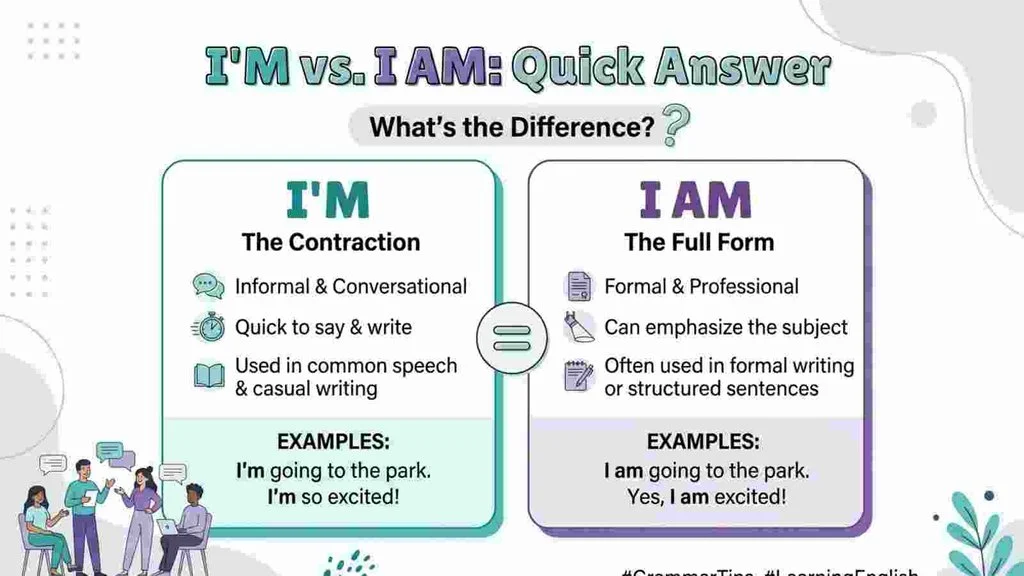
I’m and I am have the same basic meaning.Simply the contracted form of I am.
| Form | Type | Example |
| I’m | Contraction | I’m ready for work. |
| I am | Full form | I am ready for work. |
Use “I’m” when:
- You are speaking naturally.
- You are writing a text message.
- You are chatting online.
- You are writing an informal email.
- You want a relaxed, conversational tone.
Examples:
- I’m tired.
- I’m happy to help.
- I’m learning English.
- I’m going home.
- I’m sorry for being late.
Use “I am” when:
- You are writing formally.
- You want to emphasize your statement.
- You are answering a question with a short answer.
- You want a more deliberate or serious tone.
Examples:
- I am writing to request further information.
- I am pleased to accept your offer.
- Yes, I am.
- I am certain about my decision.
The key point is that “I’m” is not incorrect or less grammatical. It is a standard English contraction.
The Origin of I’m or I Am
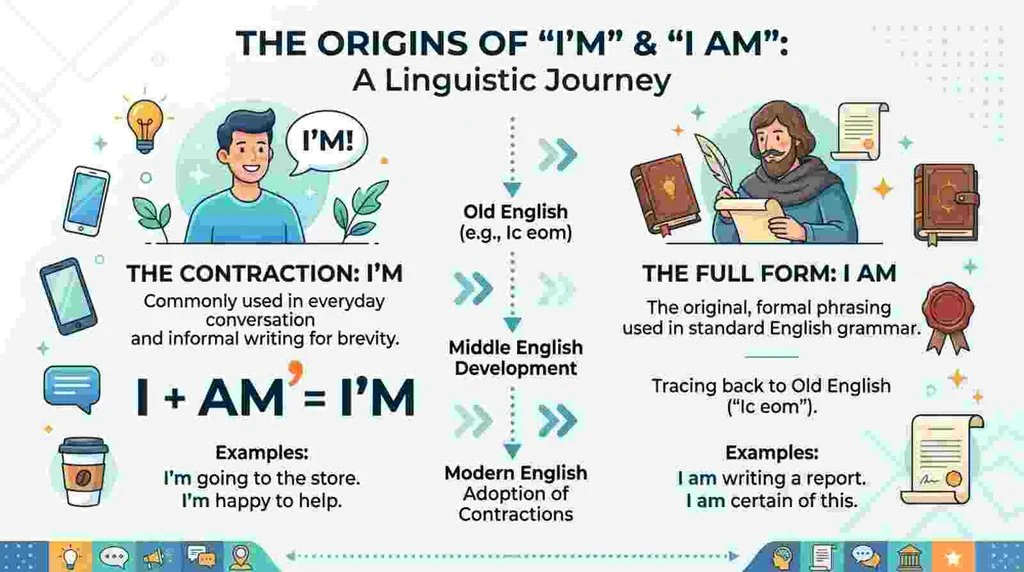
I am comes from the present-tense form of the verb “to be.” The word “I’m” developed as a contraction of these two words.
A contraction combines words and removes some letters. An apostrophe shows where the missing letters were removed:
I am → I’m
The apostrophe marks the missing a in “am.” This same pattern appears in many English contractions:
- I am → I’m
- You are → you’re
- We are → we’re
- They are → they’re
- He is → he’s
- She is → she’s
The contraction I’m is therefore not a different verb. It represents the same grammatical construction in a shorter form. Cambridge lists “I’m” as the short form of “I am.”
Historical dictionaries also record “I’m” as a contraction of “I am.”
Contractions became an important part of natural English because speakers often combine words in normal conversation. Over time, many of these shortened forms became standard written forms.
British English vs American English Spelling
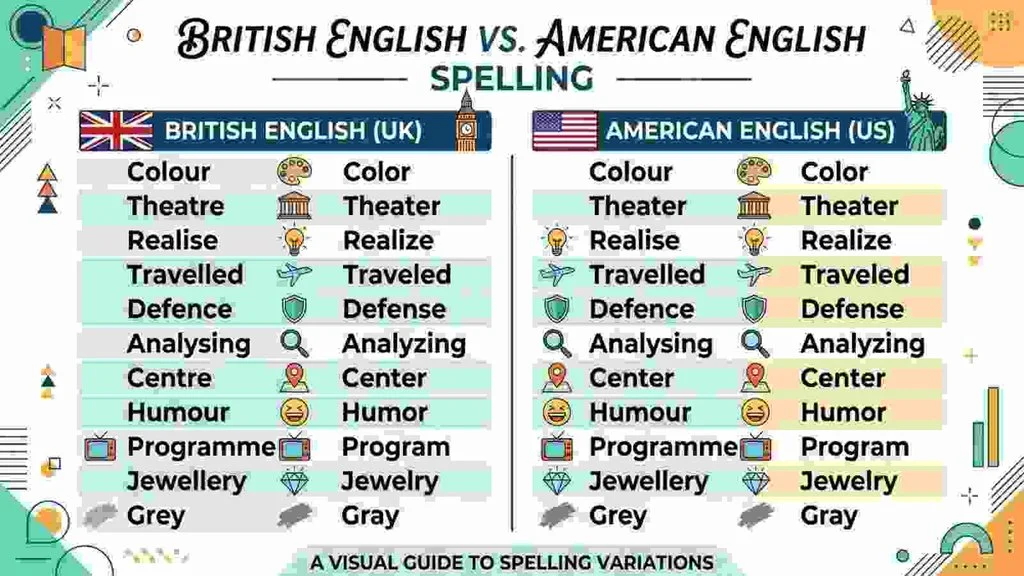
There is no major British-versus-American spelling difference between “I’m” and “I am.” Both forms are standard in British English and American English.
The main difference is usually style and context, not national spelling.
| Feature | British English | American English |
| Contraction | I’m | I’m |
| Full form | I am | I am |
| Informal speech | I’m ready. | I’m ready. |
| Formal writing | I am pleased. | I am pleased. |
| Apostrophe | Required in “I’m” | Required in “I’m” |
| Meaning | Same | Same |
Australian, Canadian, and other varieties of English also commonly use I’m and I am.
For example:
British English:
I’m going to the office.
American English:
I’m going to the office.
The spelling remains the same.
What can change is the level of contraction used in particular styles or varieties of English. Contractions are especially common in spoken and informal English.
Which Spelling Should Use I’m or I Am ?
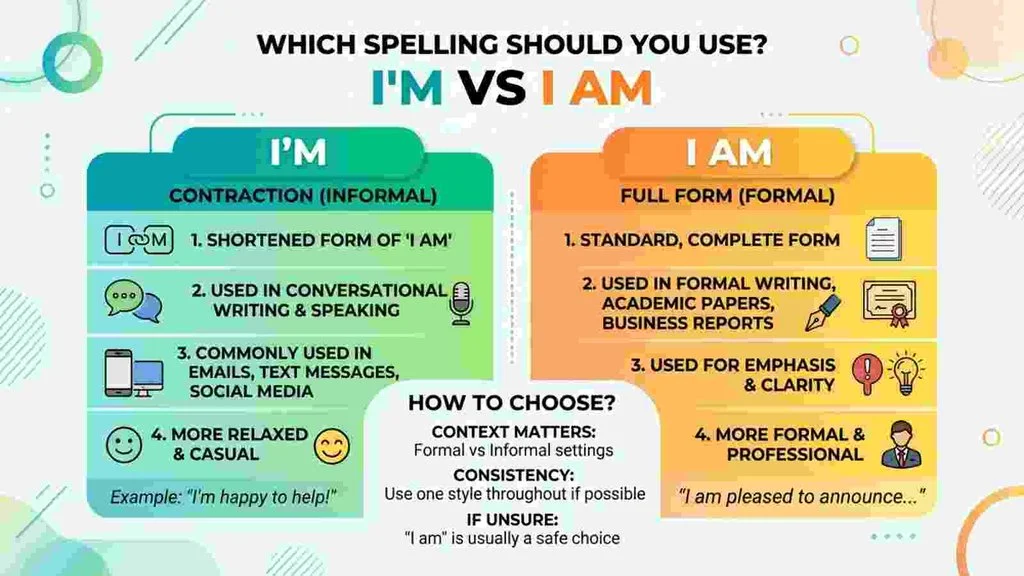
The choice depends more on audience and tone than on country.
For everyday conversation
Use I’m.
I’m hungry ,tired.
I’m ready.
This sounds natural and conversational.
For text messages and social media
I’m is usually the natural choice.
I’m on my way.
So excited!
I’m not sure.
For formal emails
Both forms are grammatically correct, but I am can create a more formal tone.
I am writing to ask about the position.
Instead of:
I’m writing to ask about the position.
The second sentence is not wrong. It is simply more conversational.
For academic writing
Follow your institution’s style guide. In formal academic prose, writers often avoid contractions and use the full form:
I am convinced that further research is needed.
However, a direct quotation may contain I’m, and some academic styles allow contractions depending on the discipline and context.
For emphasis
Use I am.
Compare:
I’m telling you the truth.
with:
I am telling you the truth.
The second version gives extra emphasis to the speaker’s statement.
Common Mistakes with I’m or I Am
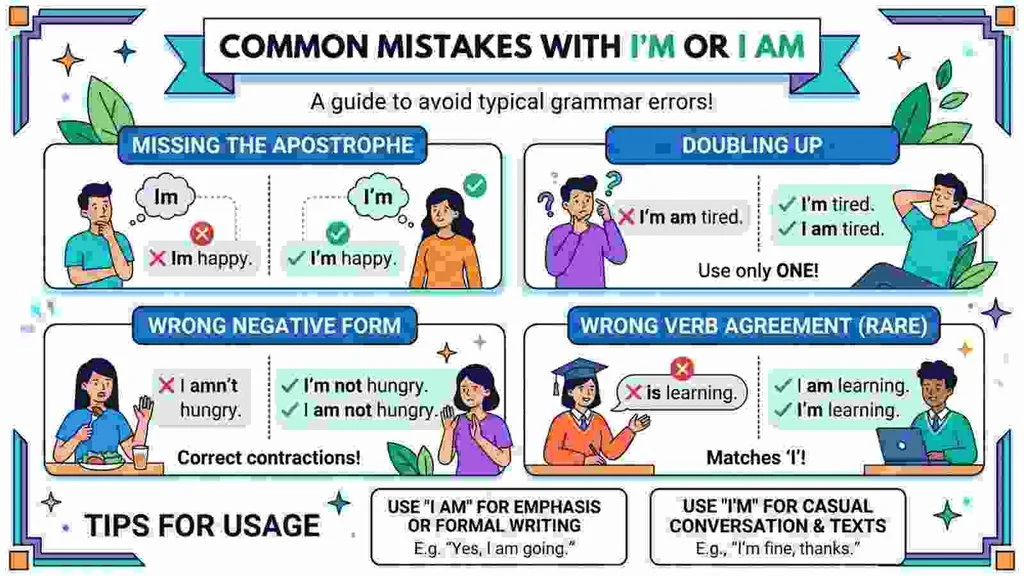
1. Writing “Im”
Incorrect:
Im ready.
Correct:
I’m ready.
The apostrophe is necessary because it represents the missing letter.
2. Writing “I’am”
Incorrect:
I’am happy.
Correct:
I’m happy.
I am happy.
Do not put the apostrophe between I and am.
3. Writing “I m”
Incorrect:
I m tired.
Correct:
I’m tired.
There is no space inside the contraction.
4. Using “I’m” as a complete short answer
Consider:
Are you ready?
The natural answer is:
Yes, I am.
Not:
Yes, I’m.
The full form is used because the verb remains at the end of the answer.
5. Thinking “I’m” is informal English only
“I’m” is a standard English contraction. It is widely used, especially in speech and informal writing. The issue is usually register, not grammatical correctness.
6. Confusing “I’m” with “im”
I’m is the standard contraction of I am.
I’m happy.
Lowercase im without an apostrophe is not the standard form.
I’m or I Am in Everyday Examples
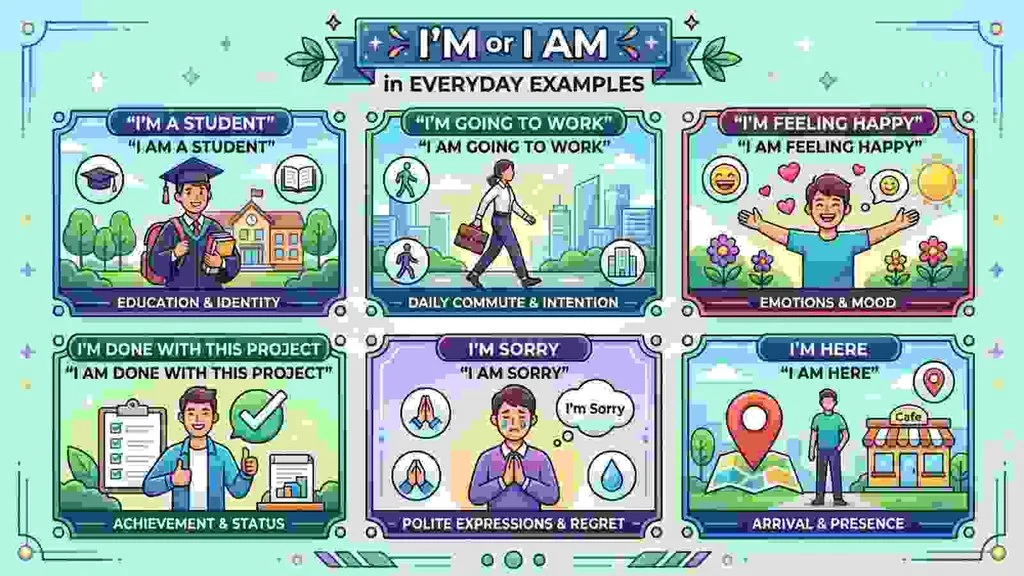
In emails
Informal email:
Hi Sarah,
I’m available for the meeting tomorrow.
Thanks.
Formal email:
Dear Mr. Khan,
I am writing to confirm my attendance at the meeting.
Both sentences are correct. The second uses the full form for a more formal tone.
In news writing
News and formal reports often favor a more neutral style.
I am pleased to announce the new policy.
However, news reports may use I’m when directly quoting someone’s words:
“I’m pleased with the result,” the manager said.
On social media
The contraction is very natural:
I’m so excited about this project!
Finally learning how to cook.
I’m ready for the weekend.
In formal writing
The full form can sound more professional:
I am writing to express my interest in the position.
I am confident that the proposal meets the requirements.
In conversation
I’m is extremely natural:
Busy right now.
Coming with you.
I’m not sure.
For emphasis
The full form can make the statement stronger:
I am responsible for this project.
I am certain this is the correct answer.
I’m or I Am – Google Trends & Usage Data
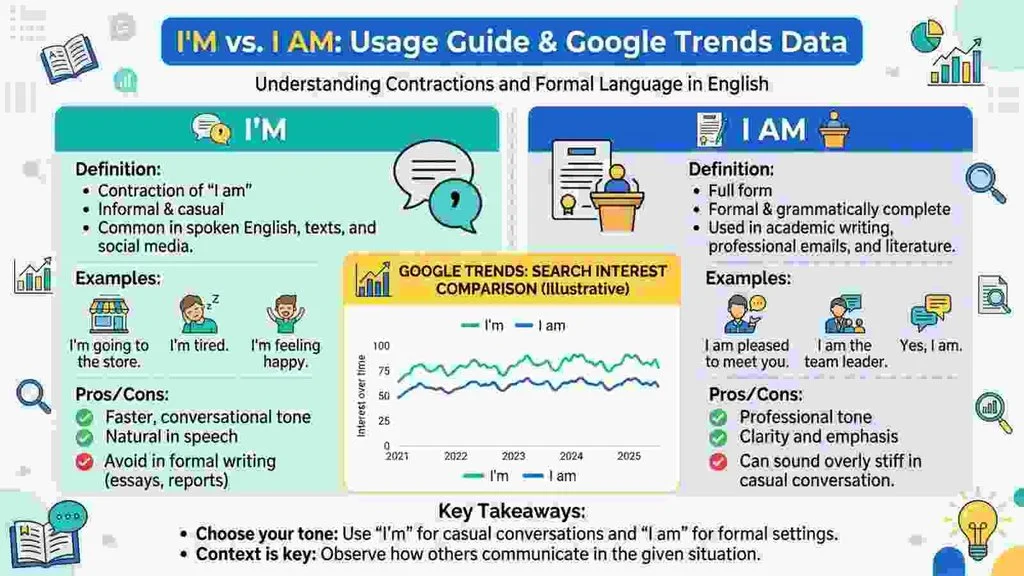
Search interest for “I’m or I am” reflects a common English-learning question: people want to understand the difference between a contraction and its full form.
However, Google Trends should be handled carefully. Trends data shows relative search interest, not the total number of searches. It can also change by country, language, time range, and search wording.
There is no fixed rule that says one form is always more popular in every English-speaking country. Search behavior also depends heavily on the phrase being searched. For example, users may search:
- I’m or I am
- when to use I’m
- is I’m correct
- I am vs I’m
- I’m meaning
- I’m grammar
- can I use contractions in formal writing
Corpus evidence also shows that contractions are very common in natural conversation. One study of spoken English found that forms of be with subject pronouns were contracted very frequently in conversational data.
A frequency resource based on the FrequencyWords corpus ranks “I’m” among frequently occurring English headwords, illustrating that the contraction is a well-established and commonly encountered form.
What the usage evidence tells us
The practical pattern is clear:
Conversation and informal writing → “I’m” is very common.
Formal or emphatic writing → “I am” is often preferred.
This is a style difference, not a British-versus-American spelling rule.
I’m vs I Am: Comparison Table
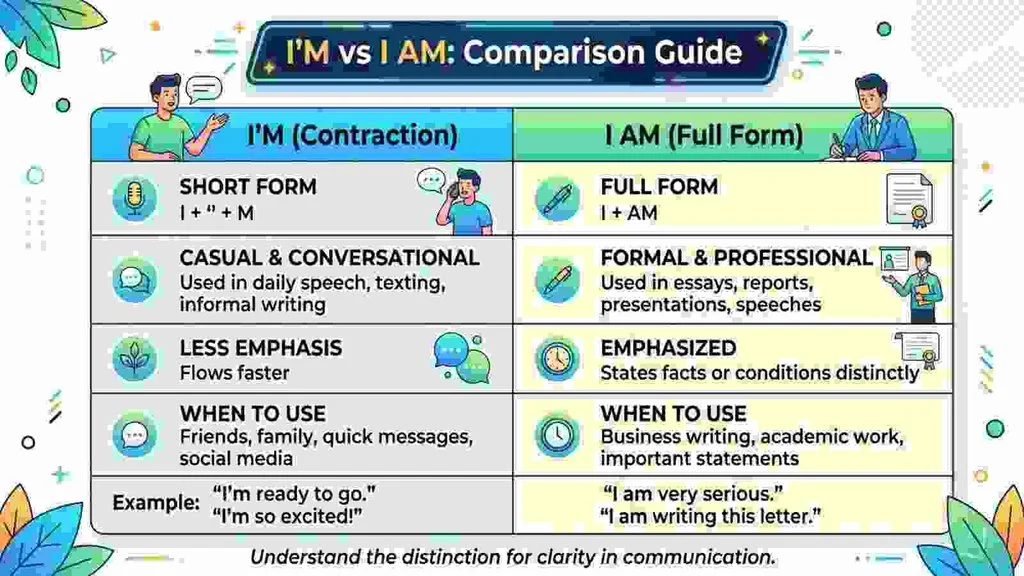
| Point | I’m | I am |
| Meaning | Same | Same |
| Grammar | Correct | Correct |
| Form | Contraction | Full form |
| Apostrophe | Yes | No |
| Speech | Very common | Common |
| Informal writing | Very common | Common |
| Formal writing | Sometimes used | Often preferred |
| Emphasis | Less direct | Stronger emphasis |
| Short answer | Usually not used alone | Yes |
| British English | Correct | Correct |
| American English | Correct | Correct |
| Canadian English | Correct | Correct |
| Australian English | Correct | Correct |
FAQs About I’m or I Am
1. Is “I’m” grammatically correct?
Yes. I’m is the standard contraction of I am and is grammatically correct.
2. Is “I am” better than “I’m”?
Neither is always better. I’m is natural for conversation and informal writing, while I am can suit formal writing or emphasis.
3. Can I use “I’m” in an email?
Yes. I’m is perfectly normal in friendly and many everyday professional emails. For highly formal communication, I am may be a better stylistic choice.
4. Can I use “I’m” in academic writing?
It depends on the style guide, institution, and type of academic writing. Many formal academic texts prefer full forms, but contractions are not automatically grammatically wrong.
5. Is “Im” correct?
No. The standard contraction is I’m, with an apostrophe.
6. Is “I’am” correct?
No. The correct forms are I am and I’m.
7. Can “I’m” end a sentence?
Normally, you should use I am when the verb “am” is left at the end of a short answer.
Question: Are you ready?
Answer: Yes, I am.
You would not normally write “Yes, I’m.”
8. Do British and American English use different forms?
No. Both British and American English use I’m and I am. The difference is mainly about style, context, and emphasis.
Conclusion
The choice between I’m or I am is simple once you understand the difference between a contraction and a full form.
I’m is the contracted form of I am, and both forms are grammatically correct. The apostrophe in I’m shows that part of am has been removed.
For everyday speech, conversations, text messages, social media, and informal emails, I’m is usually the natural choice.
It is short, smooth, and common in spoken English. For formal writing, professional documents, academic work, or situations where you want stronger emphasis, I am may be more suitable.
Remember a few important rules. Write I’m, not Im or I’am. Do not put a space inside the contraction. When am stands alone at the end of a short answer, use the full form: “Yes, I am.”
Most importantly, “I’m” and “I am” do not represent different meanings. The main difference is style, emphasis, and context. Once you know your audience and purpose, choosing the right form becomes easy.

Mary Roach is an American science writer and bestselling author known for making unusual and complex scientific topics engaging, accessible, and humorous. Her books include Stiff, Packing for Mars, Gulp, and Fuzz.
Author at Simifind.com, sharing clear, informative content designed to help readers understand interesting topics and everyday questions.