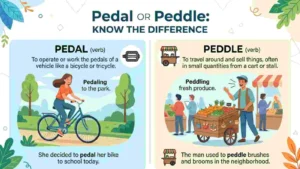
Have you ever stopped while writing and wondered whether the correct word is pedal or peddle?
These two words look and sound very similar, but they have completely different meanings. This small spelling difference can change the meaning of an entire sentence.
People often search for “pedal or peddle” because both words are pronounced almost the same in standard English.
The confusion becomes common when writing about bicycles, selling products, spreading ideas, or describing actions. For example, you pedal a bicycle, but you peddle goods.
The good news is that the difference is simple once you connect each word with its main meaning.
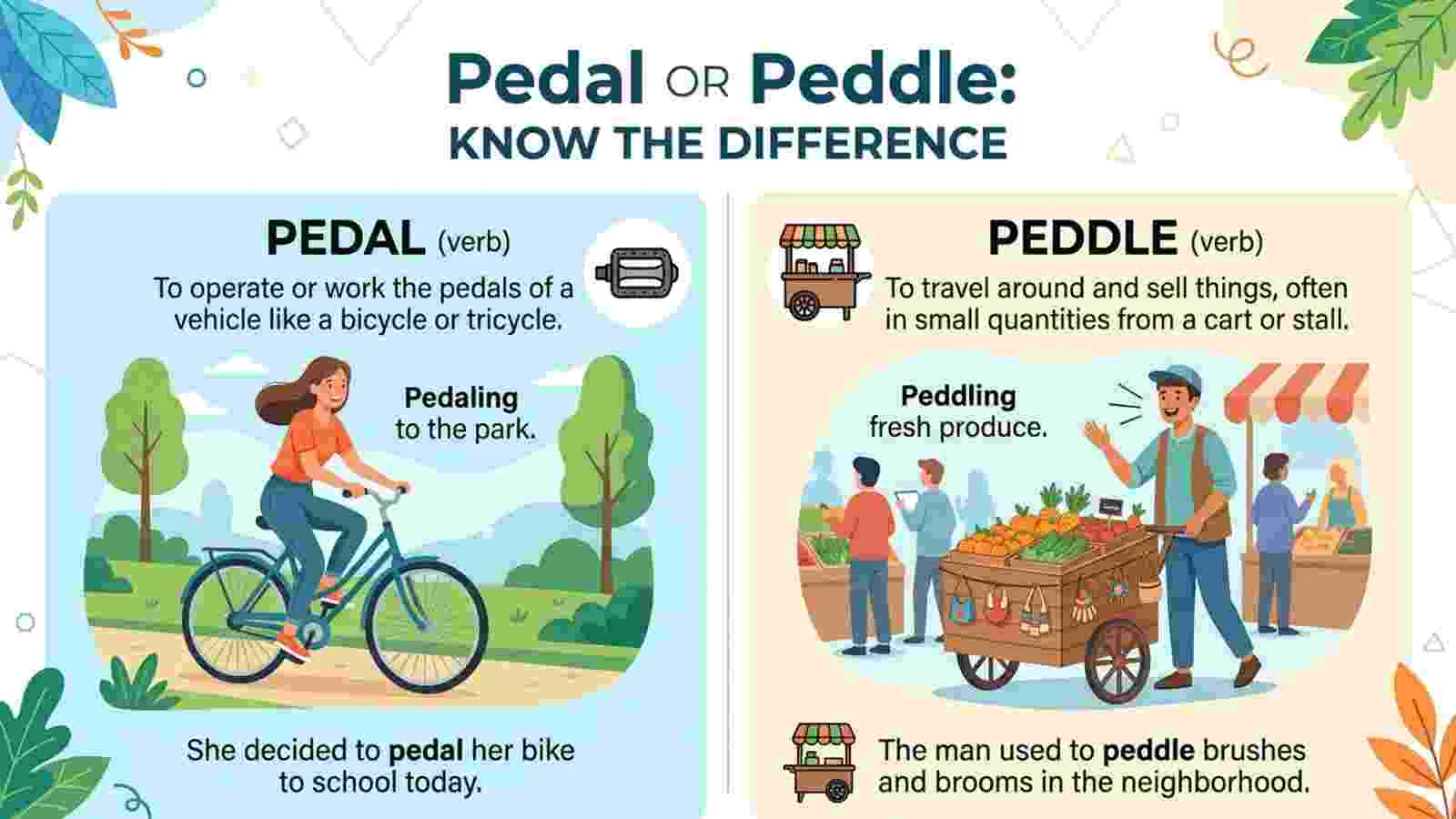
Pedal relates to a foot-operated part or the action of using pedals. Peddle means to sell something, often by going from place to place.
It can also mean to promote or spread an idea, story, or claim.
This guide explains the difference between pedal and peddle, their origins, spelling, usage, common mistakes, examples, and practical rules for choosing the right word.
Pedal or Peddle – Quick Answer
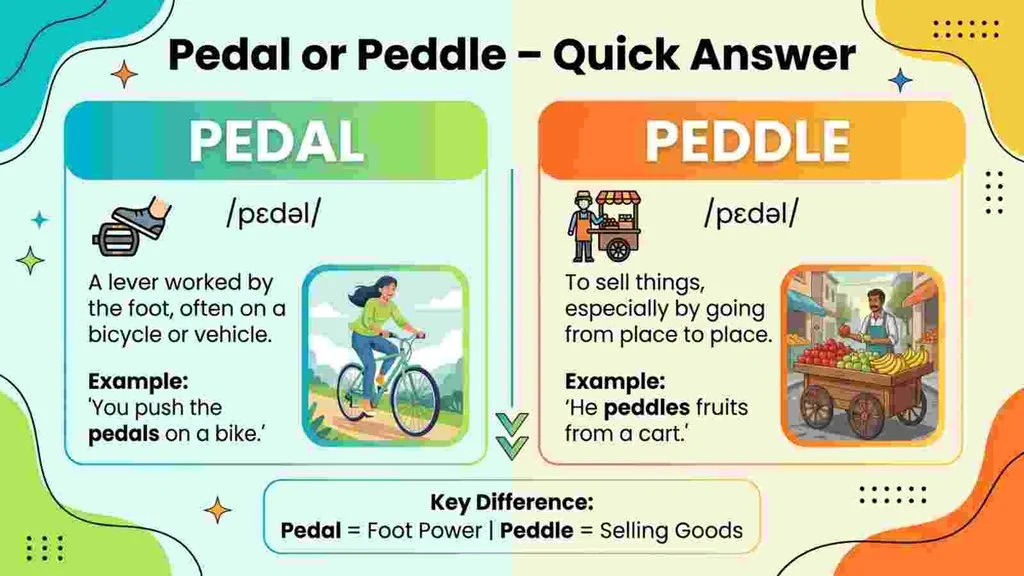
Pedal and peddle are both correct English words, but they have different meanings.
- Pedal = a part operated by the foot, or the action of using pedals.
- Peddle = to sell something, especially by going from place to place; it can also mean to promote or spread something.
Examples of Pedal
- I need to repair my bicycle pedal.
- She learned to pedal without training wheels.
- Press the brake pedal slowly.
- He pedaled his bike up the hill.
Cambridge defines pedal as a part of a machine or object that is pushed with the foot. As a verb, it means to push bicycle pedals with your feet.
Examples of Peddle
- They peddle handmade goods at the market.
- He peddles fruit from door to door.
- Some websites peddle false information.
- The company was accused of peddling an unproven product.
Peddle means to sell things, especially by taking them to different places. It can also describe spreading stories, information, or claims.
Easy Memory Trick
Think:
Pedal = feet, bike, machine
Peddle = sell, promote, spread
If your sentence involves a bicycle, car, piano, or foot-operated mechanism, choose pedal.
If it involves selling or promoting something, choose peddle.
The Origin of Pedal or Peddle
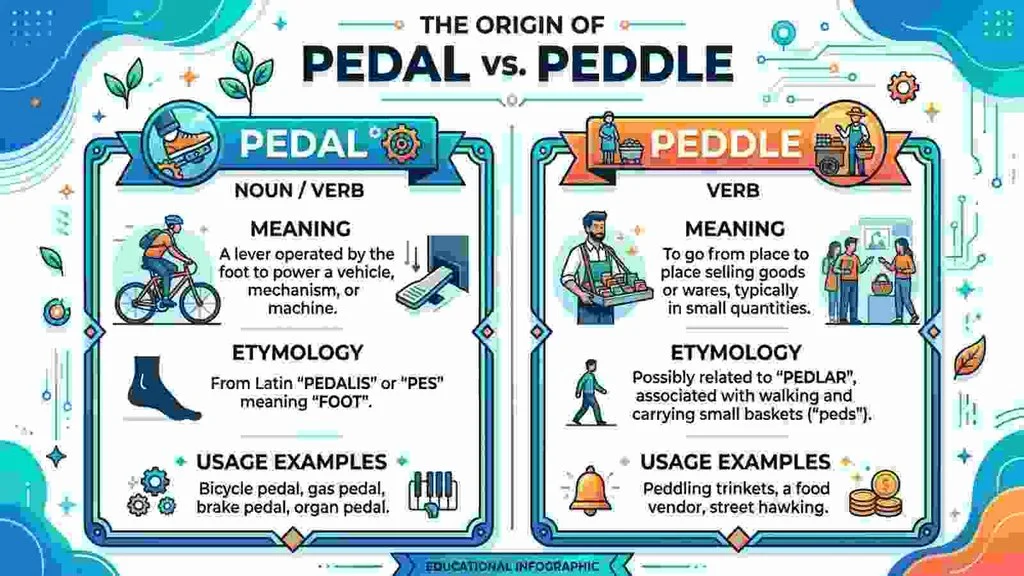
Although pedal and peddle look similar, they developed from different word histories.
Origin of Pedal
The word pedal is connected with the Latin word pedalis, meaning “of the foot.” It entered English through French pédale and Italian pedale. The history is connected with the Latin word for “foot.”
This history makes sense because a pedal is operated by the foot.
Today, pedal can be a noun, verb, or adjective.
For example:
- Noun: The bicycle has two pedals.
- Verb: I pedal every morning.
- Adjective: The machine has a pedal control.
Origin of Peddle
Peddle developed as a verb associated with traveling around to sell goods. Modern English uses it mainly for selling products or, in a broader figurative sense, promoting ideas or information.
For example:
Street vendors peddle food to tourists.
The word can also have a negative or critical tone when used with things such as rumors, myths, or misleading claims.
For example:
The website was accused of peddling false information.
Cambridge lists both selling and the figurative spreading of stories or information as meanings of peddle.
Why Are They So Easy to Confuse?
The main reason is pronunciation.
In standard English, pedal and peddle are pronounced very similarly, and they are commonly treated as homophones. Their spellings are different because their histories and meanings are different.
So, hearing the word alone may not tell you which spelling to use. You need to look at the meaning of the sentence.
British English vs American English Spelling
Unlike pairs such as colour/color or centre/center, pedal and peddle are not mainly a British-versus-American spelling difference.
Both pedal and peddle are standard spellings in both British and American English.
The important difference appears in some verb forms of pedal.
| Word | British English | American English | Meaning |
| pedal | pedal | pedal | Use a foot-operated control |
| pedaled | less common in British writing | common | Past tense of pedal |
| pedalled | common | less common | Past tense of pedal |
| peddle | peddle | peddle | Sell or promote |
| peddled | peddled | peddled | Past tense of peddle |
| peddling | peddling | peddling | Present participle of peddle |
Cambridge notes that British English commonly uses pedalling, while American English usually uses pedaling.
Pedalling vs Pedaling
This is where British and American spelling rules matter.
British English:
- pedal → pedalled
- pedal → pedalling
American English:
- pedal → pedaled
- pedal → pedaling
Examples:
British English:
She was pedalling quickly down the road.
American English:
She was pedaling quickly down the road.
The basic word remains pedal in both varieties.
Peddled and Peddling
The word peddle keeps its double d in its common inflected forms:
- peddle
- peddled
- peddling
- peddler
For example:
The salesman was peddling goods in the market.
Cambridge identifies peddling as the present participle of peddle.
Which Spelling Should Use Peddle ?
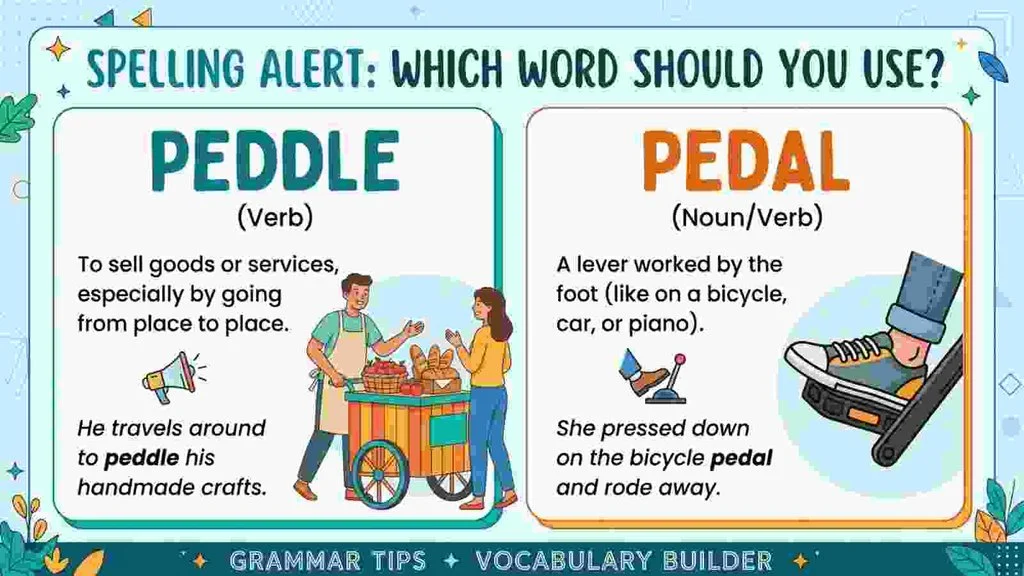
Your choice depends on what you mean, not simply where you live.
Use Pedal for Bikes
Use pedal when talking about riding a bicycle.
He learned to pedal at the age of five.
Her foot slipped from the pedal.
Use Pedal for Cars
Use pedal for foot-operated controls in vehicles.
Press the brake pedal.
The accelerator pedal feels stiff.
Use Pedal for Musical Instruments
The word is also used for piano and organ controls.
She pressed the piano pedal.
Use Peddle for Selling
Use peddle when someone sells products, often by moving from place to place.
Vendors peddle snacks near the station.
Use Peddle for Ideas or Claims
Use peddle when someone spreads or promotes an idea, story, claim, or belief.
The website continues to peddle the same claim.
A Simple Rule
Ask yourself:
“Is this about a foot-operated object or movement?”
If yes, use pedal.
“Is this about selling or spreading something?”
If yes, use peddle.
Common Mistakes with Pedal or Peddle
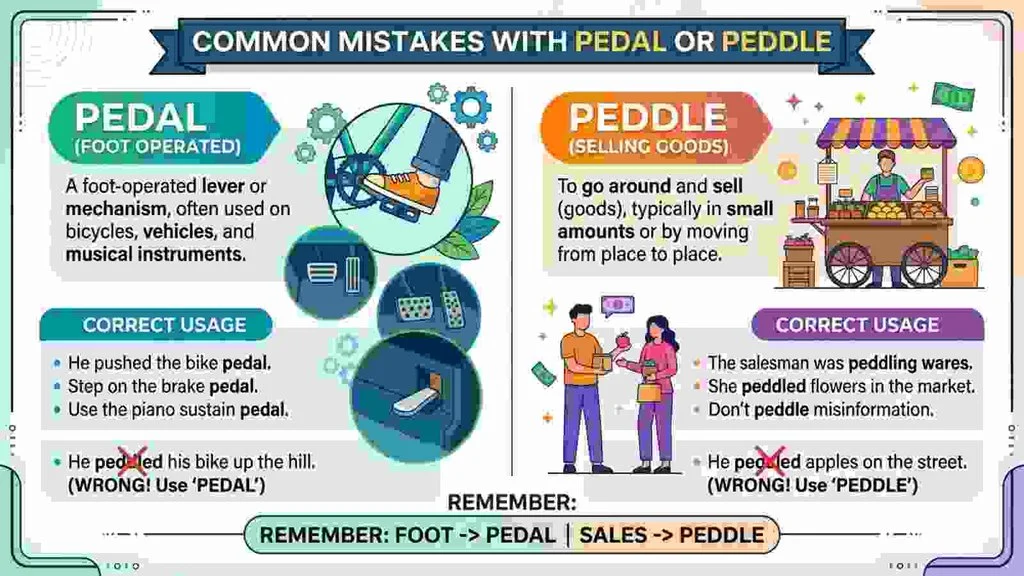
Because the words sound alike, spelling mistakes are common.
Mistake 1: Peddling a Bicycle
❌ He was peddling his bicycle.
If you mean riding a bicycle, the correct form is:
✅ He was pedaling his bicycle.
In British English, you may write:
✅ He was pedalling his bicycle.
Mistake 2: Pedaling Products
❌ The vendor was pedaling products.
Correct:
✅ The vendor was peddling products.
The action is selling, so peddling is required.
Mistake 3: Peddle the Brake
❌ Press the brake peddle.
Correct:
✅ Press the brake pedal.
A brake pedal is a foot-operated part.
Mistake 4: Pedal False Information
❌ The company was pedaling false claims.
Correct:
✅ The company was peddling false claims.
Here, peddling means promoting or spreading claims.
Mistake 5: Confusing Peddler and Pedaler
These nouns also have different meanings.
- Pedaler/pedaller = a person who pedals.
- Peddler = a person who sells goods, especially by traveling from place to place.
For example:
The pedaler rode across the country.
The peddler sold handmade products.
Pedal or Peddle in Everyday Examples
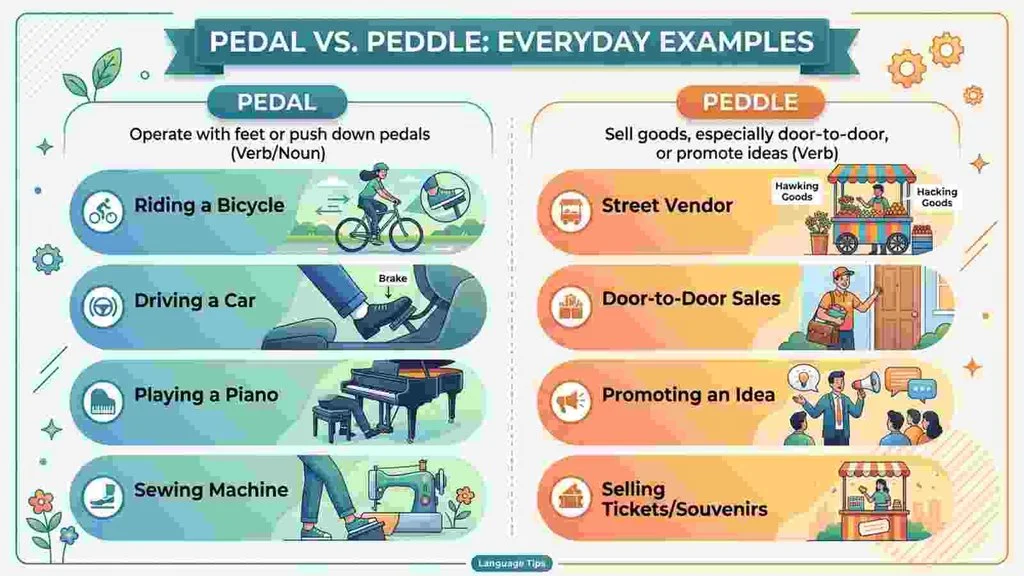
Understanding these words becomes easier when you see them in normal writing.
In Emails
Pedal:
Please check the bicycle pedal before our weekend trip.
Peddle:
The company should not peddle products without clear information about their contents.
In News Writing
Pedal:
The cyclist continued to pedal despite the strong wind.
Peddle:
Authorities warned consumers about websites peddling counterfeit products.
On Social Media
Pedal:
Finally learned how to pedal without training wheels!
Peddle:
Be careful of accounts that peddle misleading health claims.
In Formal Writing
Pedal:
The vehicle’s brake pedal should be inspected regularly.
Peddle:
Consumers should be cautious of businesses that peddle unsupported claims.
In Everyday Conversation
Pedal:
I forgot how hard it is to pedal uphill.
Peddle:
Some vendors peddle snacks near the beach.
These examples show why context matters more than pronunciation.
Pedal or Peddle – Google Trends & Usage Data
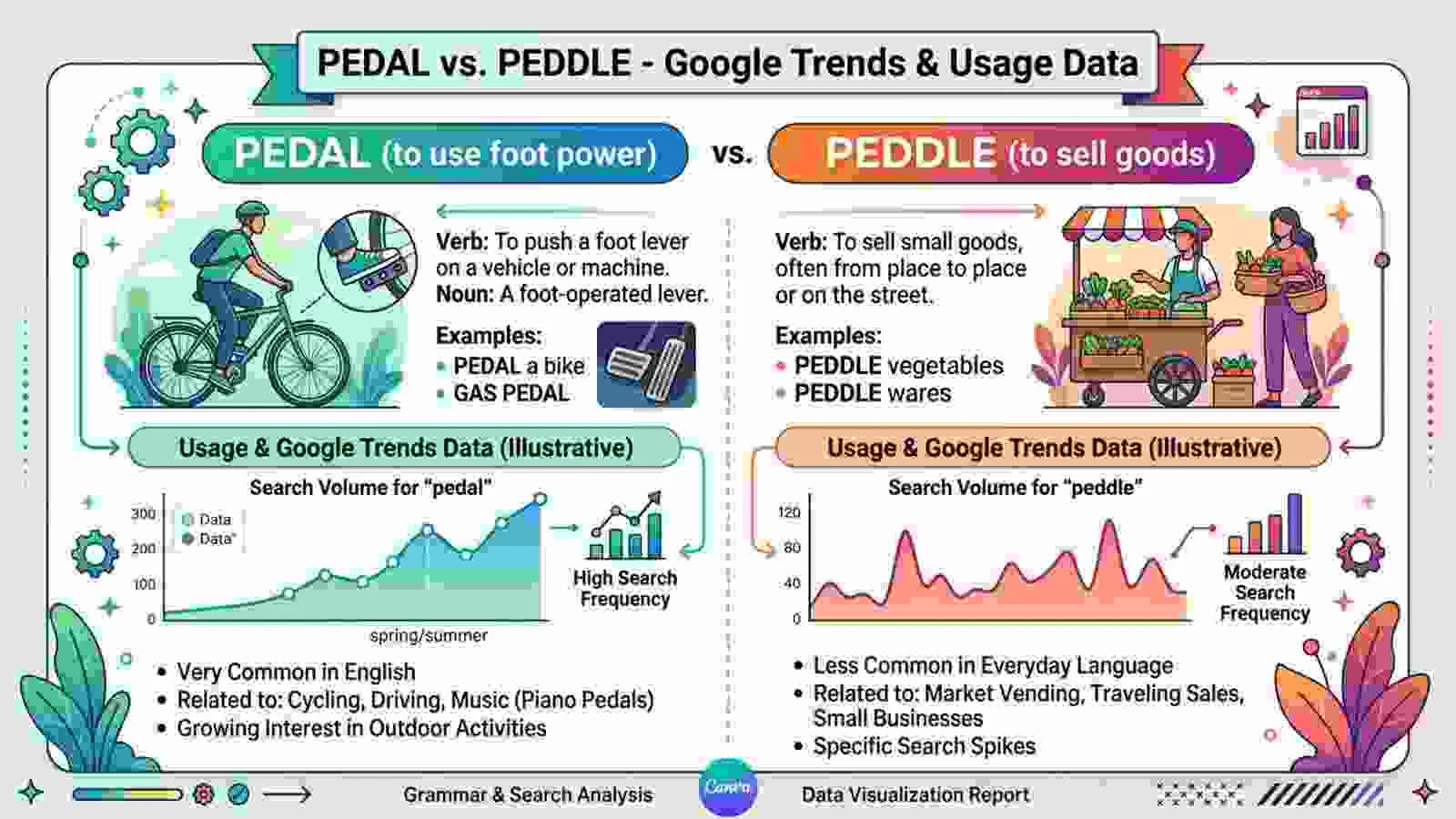
Search interest for pedal and peddle is influenced strongly by meaning and context.
A direct Google Trends comparison should be treated as relative search interest, not as exact search volume. Google Trends values are normalized for the selected time period, location, and search type. Therefore, a Trends graph can change when you change the country or date range.
Why Pedal Often Has Broader Search Contexts
Pedal is used in several everyday areas:
- bicycles
- cycling
- cars
- driving
- musical instruments
- machines
- fitness
- mechanical equipment
For example, people may search for phrases such as:
- bike pedal
- bicycle pedal
- pedal bike
- brake pedal
- accelerator pedal
- pedal meaning
- pedal exercise
Cambridge also lists bicycle, machine, vehicle, piano, and organ uses for pedal, showing how many different contexts the word covers.
Why Peddle Has a Narrower Context
Peddle is more strongly connected with:
- selling goods
- street selling
- door-to-door selling
- promoting products
- spreading claims
- spreading stories or information
Common contexts include:
- peddle products
- peddle goods
- peddle ideas
- peddle rumors
- peddle misinformation
- peddling claims
Cambridge specifically records both commercial selling and the figurative spreading of stories or information.
Country and Regional Searches
The meanings of the two words remain broadly consistent across major English-speaking varieties, including the United States, United Kingdom, Canada, and Australia.
The more noticeable regional difference is not pedal vs peddle itself. It is the spelling of forms such as:
- pedaling — commonly American
- pedalling — commonly British
For SEO research, it is better to compare specific search phrases and set a clear country and date range rather than assume that one spelling has the same search behavior everywhere.
Pedal vs Peddle – Side-by-Side Comparison
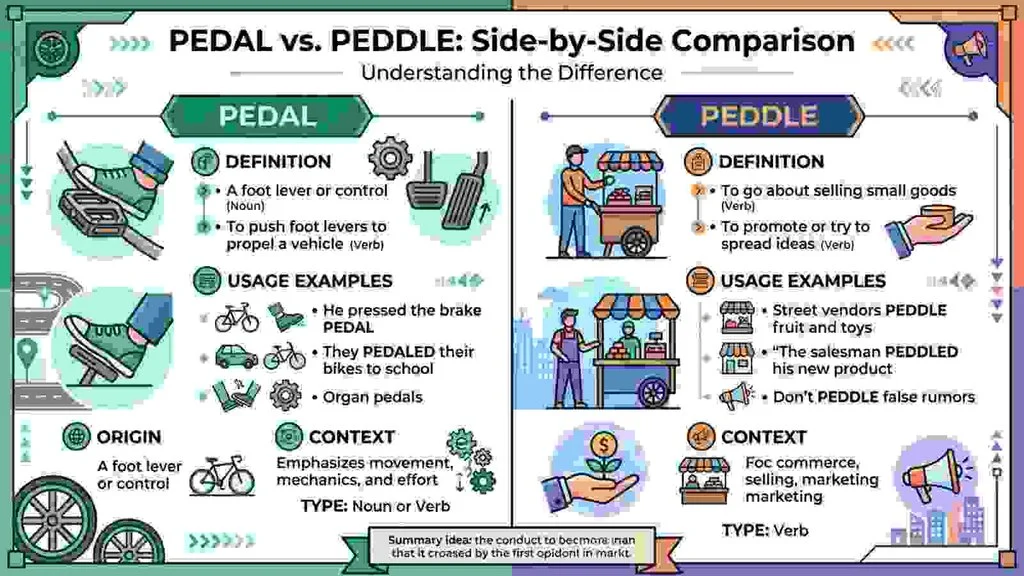
| Feature | Pedal | Peddle |
| Main meaning | Foot-operated part or action | Sell or promote |
| Word type | Noun, verb, adjective | Mainly verb |
| Bicycle use | Yes | No |
| Car use | Yes | No |
| Piano/organ use | Yes | No |
| Selling goods | No | Yes |
| Spreading claims | No | Yes |
| Example | Pedal the bicycle | Peddle products |
| Past tense | Pedaled/pedalled | Peddled |
| Present participle | Pedaling/pedalling | Peddling |
| Common noun | Pedal | Peddler |
Quick Comparison
Pedal:
She pedaled her bicycle to school.
Peddle:
The vendor peddled handmade toys at the market.
The first sentence describes movement using a bicycle. The second describes selling.
FAQs About Pedal or Peddle
1. Is it pedal or peddle a bike?
The correct word is pedal.
I learned to pedal a bike when I was young.
You pedal a bicycle because you use its pedals with your feet.
2. Is it peddle or pedal products?
The correct word is peddle.
The company peddles handmade products online.
Peddle means to sell or promote something.
3. Is pedal and peddle pronounced the same?
In standard English, they are generally pronounced the same or very similarly. This makes them easy to confuse when heard rather than seen in writing.
4. What does peddle mean?
Peddle means to sell something, especially by taking it from place to place. It can also mean to promote or spread information, stories, or claims.
5. What does pedal mean?
Pedal can mean a foot-operated part of a machine, bicycle, vehicle, or musical instrument. As a verb, it means to operate or push pedals with your feet.
6. Is it pedaling or peddling?
Both words are correct, but they have different meanings.
Pedaling/pedalling = riding or operating something with pedals.
Peddling = selling or promoting something.
For example:
He is pedaling his bike.
He is peddling products.
7. Is “peddle” always about selling?
No. It can also be used figuratively for spreading or promoting stories, ideas, claims, or information.
For example:
They were accused of peddling a false story.
This figurative meaning is recorded by Cambridge.
8. Is “pedalled” British English?
Pedalled is a common British English spelling of the past tense of pedal. American English commonly uses pedaled.
Similarly:
- British: pedalling
- American: pedaling
Cambridge records both forms and notes the regional preference.
Conclusion
The difference between pedal and peddle is simple once you focus on meaning. Pedal is connected with feet, bicycles, machines, vehicles, and musical instruments. You can pedal a bike, press a brake pedal, or use a piano pedal. Peddle, on the other hand, means to sell something or, in a broader sense, to promote or spread an idea, story, or claim.
The words sound alike, which explains much of the confusion. However, they are not interchangeable. Remember the easy rule: pedal = foot or movement; peddle = selling or spreading.
There is also a small British-American spelling difference in the forms of pedal. British English commonly uses pedalled and pedalling, while American English usually uses pedaled and pedaling. The spelling of peddle does not change in the same way.
For professional writing, always choose the word based on meaning first. Once you connect each spelling with its function, choosing between pedal or peddle becomes much easier.

Mary Roach is an American science writer and bestselling author known for making unusual and complex scientific topics engaging, accessible, and humorous. Her books include Stiff, Packing for Mars, Gulp, and Fuzz.
Author at Simifind.com, sharing clear, informative content designed to help readers understand interesting topics and everyday questions.