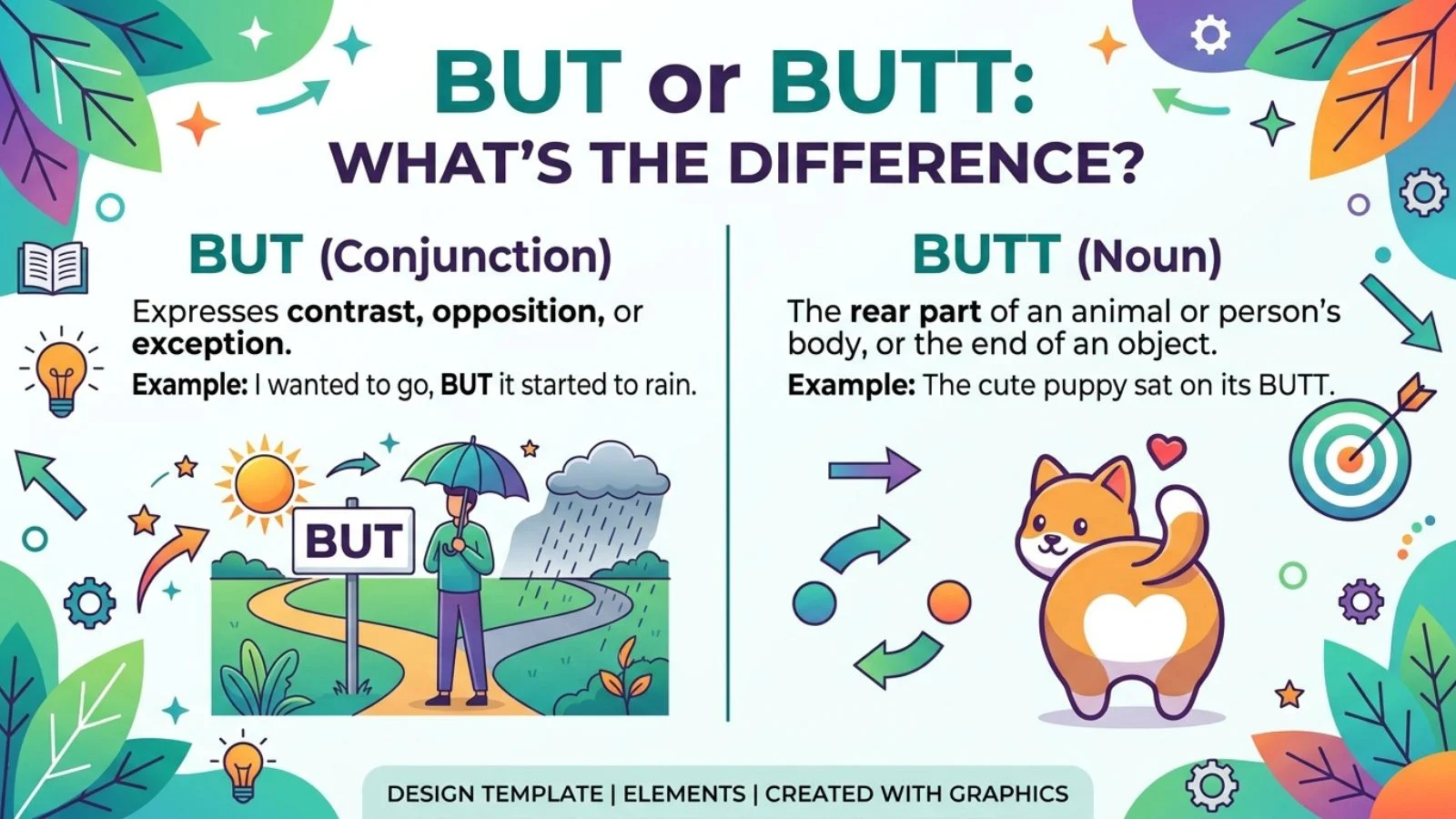
Have you ever typed “but” and wondered if “butt” was the word you needed?
These two words look almost the same, but they have very different meanings and uses.
This is why people often search for “but or butt” when checking spelling, grammar, or sentence meaning.
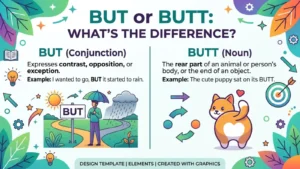
But is a common English conjunction and preposition used to show contrast or exception.
Butt is usually a noun that refers to the rear part of the body, the thick end of something, or the person who is the target of a joke. The extra t changes the word completely.
Learning the difference is simple. But is mainly a grammar word, while butt is a noun or, less often, a verb.
This guide explains their meanings, origins, spelling, common mistakes, regional usage, and everyday examples.
By the end, you will know exactly when to use but and when butt is correct.
But – Quick Answer
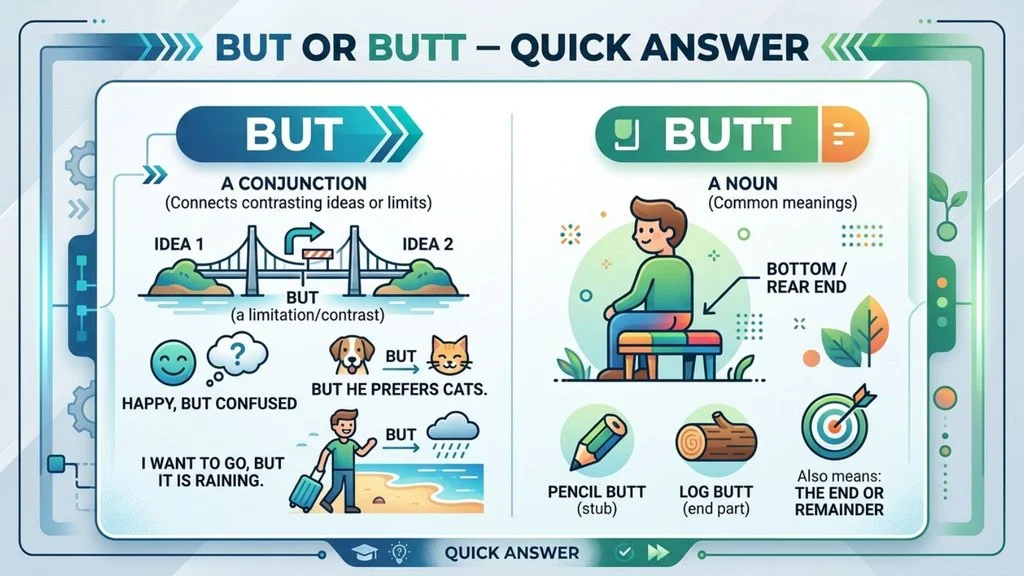
But and both correct English words, but they have different meanings.
| Word | Meaning | Example |
| But | Shows contrast or exception | I wanted to go, but I was busy. |
| Butt | Rear part of the body | He sat on his butt. |
| Butt | Thick or lower end of something | Hold the butt of the tool firmly. |
| Butt | Target of a joke or criticism | He became the butt of the joke. |
When to Use But
Use but when you want to connect ideas that contrast.
- I was tired, but I finished my work.
- She is young but very wise.
- I wanted coffee, but there was none.
When to Use Butt
Use butt when referring to a physical rear part, the end of an object, or someone who is the target of humor.
- He fell on his butt.
- The butt of the rifle rested against his shoulder.
- He was the butt of everyone’s jokes.
The Origin of But
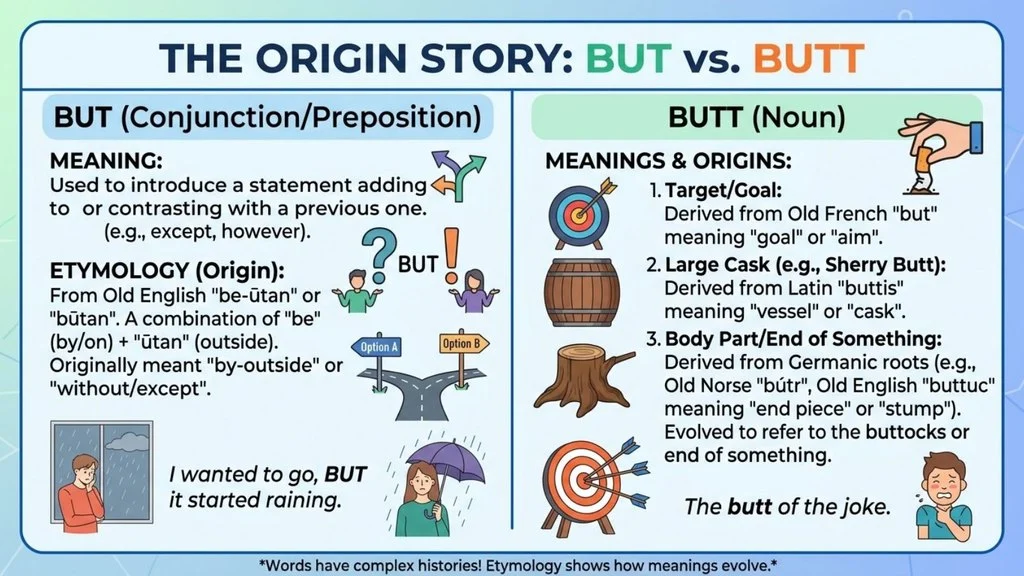
The words but and butt have different histories, even though they look and sound similar.
Origin of But
But comes from Old English būtan, which had meanings related to “outside,” “except,” or “unless.” Over time, its spelling and grammatical role changed.
The word became an important part of English grammar and developed into the modern but used to express contrast.
For example:
I like the house, but it is too expensive.
Here, but connects two ideas that do not fully agree.
Origin of Butt
Butt has a different history. It developed from words associated with a thick end, stump, or remaining part of something. It later gained meanings related to the rear end of a person or animal.
The verb butt can also mean to strike or push with the head.
For example:
- The goat butted the gate.
- He butted into the conversation.
Therefore, the extra t is not simply a spelling variation. But and butt are separate words with separate meanings.
British English vs American English Spelling
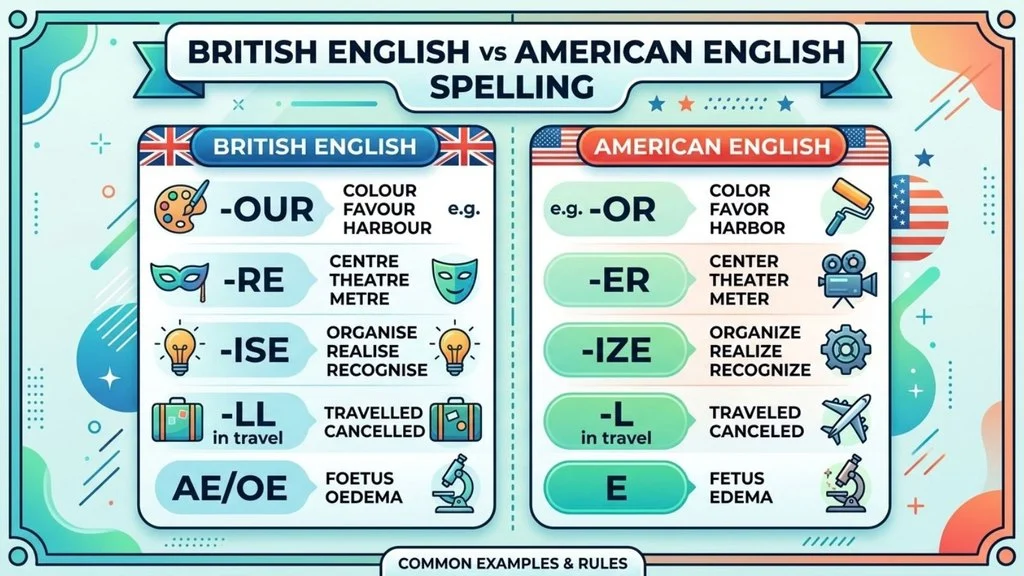
Unlike words such as color/colour or center/centre, but and butt are not British-versus-American spelling variants.
Both British English and American English use but and butt with essentially the same spellings and meanings.
| Word | British English | American English | Main Use |
| but | but | but | Contrast or exception |
| butt | butt | butt | Rear part, end, or target of humor |
| butted | butted | butted | Past tense of butt |
| butting | butting | butting | Present participle of butt |
Examples in Both Varieties
British English:
I wanted to help, but I was too late.
American English:
I wanted to help, but I was too late.
The spelling does not change.
For butt:
He fell on his butt.
This spelling is also used in both major varieties of English.
Which Spelling Should Use but ?
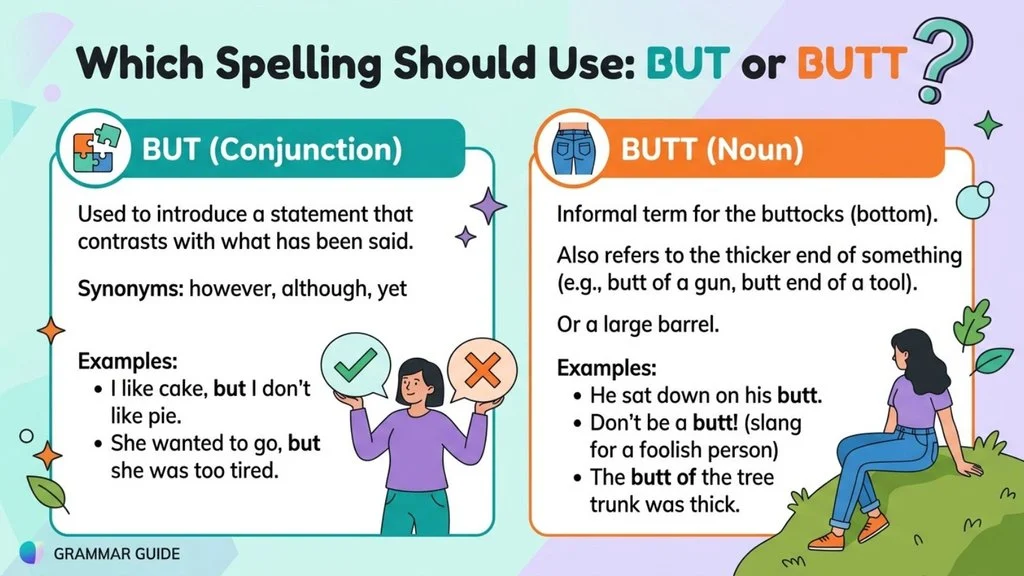
Your choice depends on what you mean, not where your reader lives.
Use But for Contrast
Choose but when connecting contrasting ideas.
- I studied hard, but I failed the test.
- She wanted to leave, but it was raining.
- The task was difficult, but we completed it.
Use Butt for the Noun
Choose butt when talking about the rear part of the body.
- He landed on his butt.
- The chair hurt my butt.
Butt can also describe the end of an object:
- the butt of a cigarette
- the butt of a tool
- the butt of a rifle
For Global Writing
For websites, academic writing, business communication, and professional documents, use the word that matches the intended meaning.
If you mean contrast, write but.
If you mean rear part, end, or target, write butt.
Common Mistakes with But
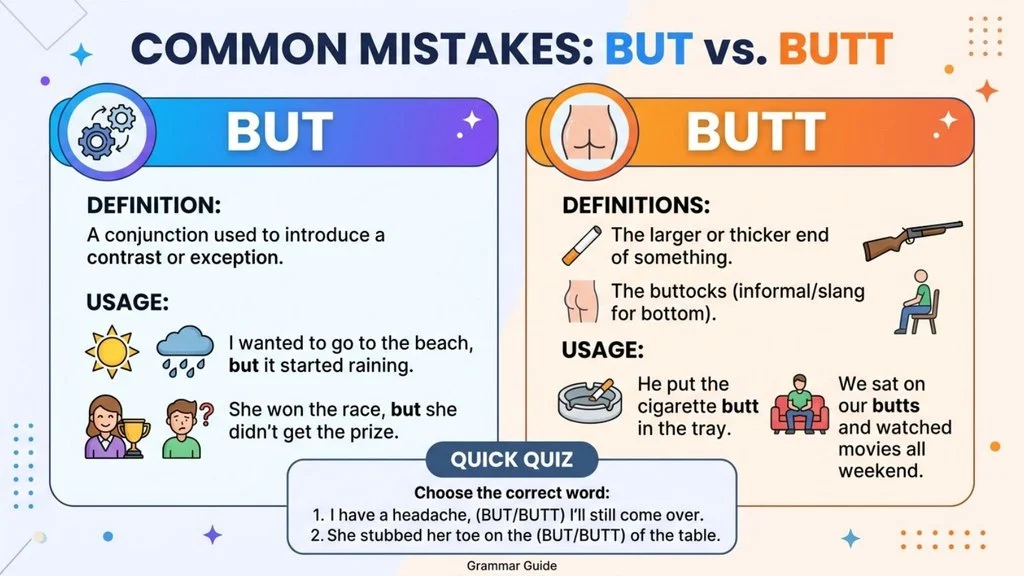
Because the words differ by only one letter, spelling mistakes are common.
Mistake 1: Using “Butt” for Contrast
❌ I wanted to go butt I was sick.
✅ I wanted to go but I was sick.
Mistake 2: Using “But” for the Body Part
❌ He fell on his but.
✅ He fell on his butt.
Mistake 3: Thinking “Butt” Is a British Spelling
Butt is not an alternative British spelling of but.
Both words exist in British and American English.
Mistake 4: Confusing “Butt” With “But”
A useful memory trick is:
But = contrast
Butt = body part or end
The second t helps distinguish the two words.
But in Everyday Examples
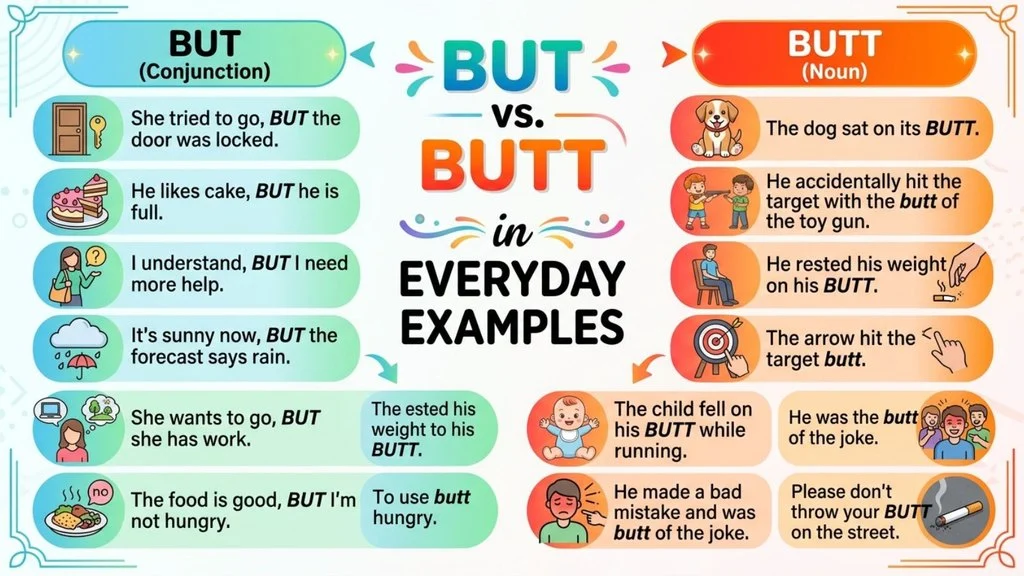
Understanding real examples makes the difference easier to remember.
In Emails
But:
I would like to attend the meeting, but I have another appointment.
This is appropriate for professional communication.
The chair is uncomfortable on my butt.
This is grammatically correct but informal and would usually be unsuitable in a formal business email.
In News Writing
But:
The team played well, but it lost the final match.
News writing commonly uses but to connect contrasting facts.
On Social Media
But:
I wanted to sleep early, but here I am watching another episode.
I fell right on my butt!
The second example uses in a casual way.
In Formal Writing
But is widely used in formal English.
The policy appears simple, but its effects are complex.
Butt can also be correct in formal writing when its literal meaning is needed.
The butt of the instrument was damaged during transportation.
But – Google Trends & Usage Data
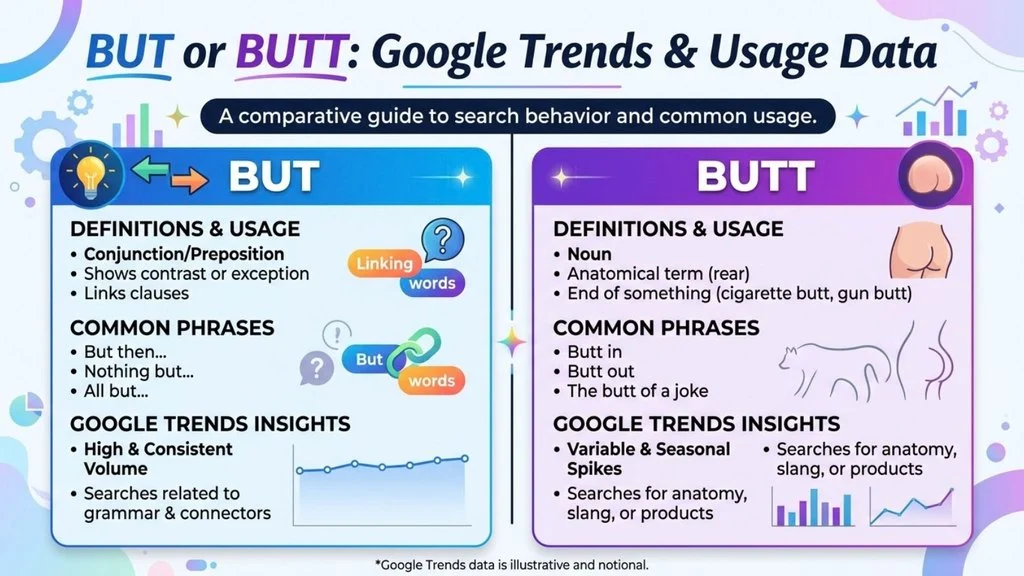
Search interest for but is naturally much higher than for butt because but is one of the most common grammatical words in English.
Searches for butt are usually connected with:
- body-part vocabulary
- slang and informal English
- fitness
- anatomy
- humor
- phrases and idioms
- word meanings
Searches for but are much broader because the word appears in everyday sentences, grammar questions, writing, and language-learning searches.
Google Trends can also show differences in search interest by country and time. However, search volume does not mean that one spelling is “more correct.” The words have different meanings, so popularity should not be used to choose between them.
But : Comparison Table
| Feature | But | Butt |
| Word type | Conjunction, preposition, adverb | Noun, verb |
| Main meaning | Contrast or exception | Rear part or end |
| Extra letter | No | Double t |
| British spelling | but | butt |
| American spelling | but | butt |
| Example | I tried, but I failed. | He fell on his butt. |
| Formal use | Very common | Depends on meaning |
| Common mistake | Writing “butt” for contrast | Writing “but” for the body part |
FAQs About But
1. Is it “but” or “butt”?
Both are correct words. Use but for contrast and butt for meanings such as the rear part of the body or the end of something.
2. Is “butt” a British spelling of “but”?
No. Butt is not a British spelling of but. They are different words in both British and American English.
3. What does “but” mean?
But usually introduces a contrast or exception.
I like it, but it is expensive.
4. What does “butt” mean?
Butt can mean the rear part of the body, the thick end of an object, or the target of a joke.
5. Can “butt” be a verb?
Yes. Butt can mean to hit or push with the head.
The goat butted the fence.
6. Is “butt” informal?
When butt refers to the human body, it is generally informal or conversational. More neutral terms may be preferred in formal contexts.
7. How can I remember the difference between but?
Remember:
But = contrast.
Butt = body part or end.
The extra t gives butt a completely different meaning.
Conclusion
The difference between but and butt is simple once you focus on meaning. But is mainly a grammar word used to show contrast, opposition, or an exception.
For example, “I wanted to go, but I was busy.” Butt, on the other hand, is a noun or verb with different meanings.
It can refer to the rear part of the body, the end of an object, or the target of a joke. It can also mean to hit something with the head.
Neither spelling is a British or American variation of the other. Both but and are standard words in both varieties of English.
When writing, always choose the word based on the meaning you want to express. If you are showing contrast, use but.
If you mean a rear part, end, or related sense, use but. Remembering this simple rule will help you avoid one of the easiest one-letter spelling mistakes in English.

Mary Roach is an American science writer and bestselling author known for making unusual and complex scientific topics engaging, accessible, and humorous. Her books include Stiff, Packing for Mars, Gulp, and Fuzz.
Author at Simifind.com, sharing clear, informative content designed to help readers understand interesting topics and everyday questions.

1 thought on “But vs Butt: Meaning, Spelling, and Examples ( for 2026)”