Have you ever typed “responce” and wondered if it is correct? You are not alone.
This spelling mistake is common because “response” sounds very close to how people may spell it. When writing quickly, it is easy to replace the “s” with “c.”
The correct spelling is response. The word means an answer, reply, or reaction to something. Responce is not a standard English spelling and should be avoided in formal and professional writing.
This guide explains the difference between responce and response, where the correct word comes from, and how to use it naturally.
You will also see examples from emails, news, social media, and formal writing. A comparison table and common mistakes will make the spelling easier to remember.
Whether you use American English, British English, or another major form of English, the correct spelling remains response.
There is no British-versus-American spelling difference for this word.
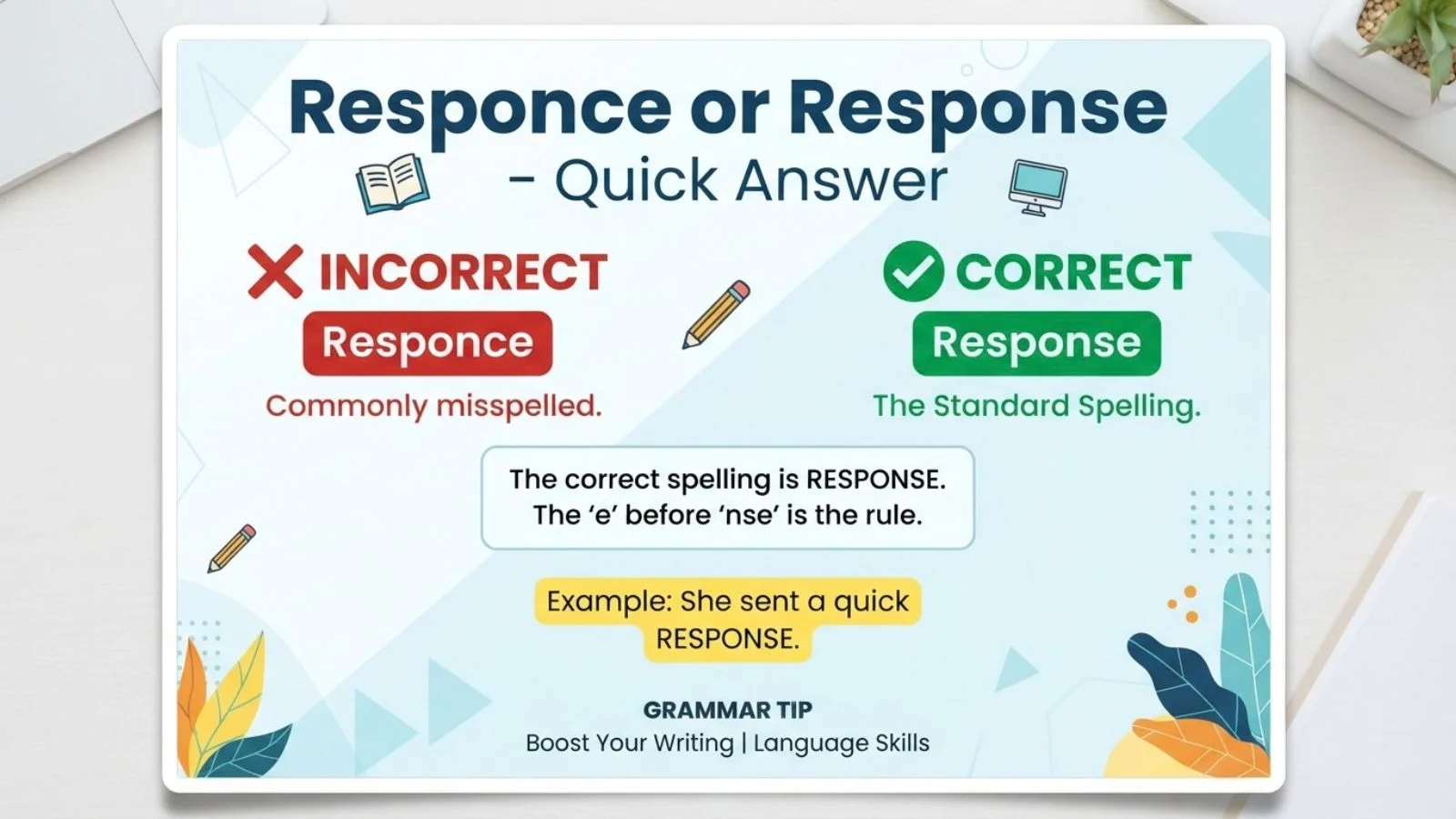
Responce or Response – Quick Answer
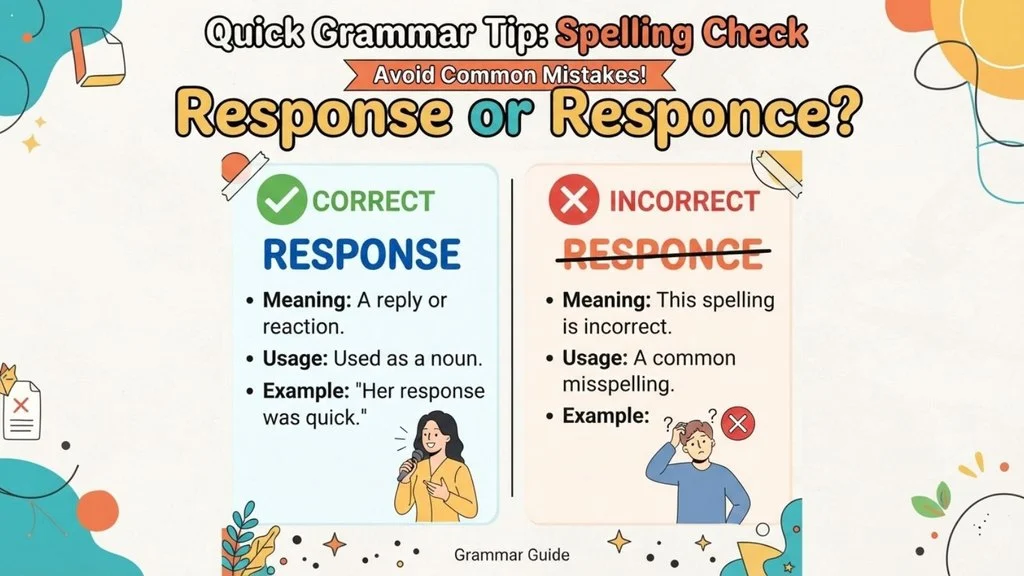
Response is the correct spelling.
❌ Responce — Incorrect
✅ Response — Correct
Response is a noun that means an answer, reply, or reaction.
Examples
- I am waiting for your response.
- She gave a quick response to the question.
- His response was polite and clear.
- We received a positive response from customers.
The easiest way to remember the spelling is:
response = respond + se
The word respond contains an s, and response keeps that spelling pattern.
The Origin of Response
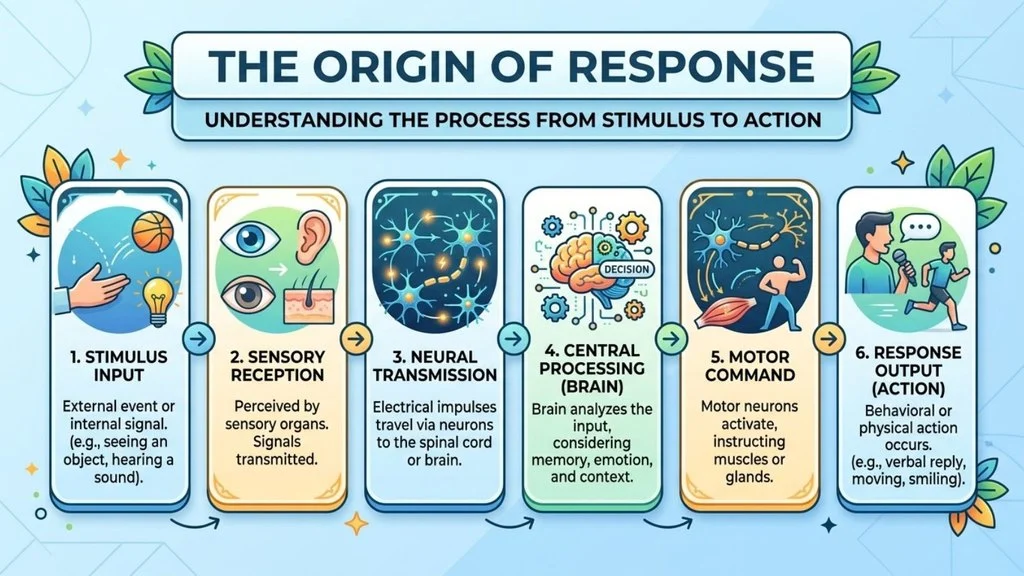
The word response has a long history in English. It comes from the Latin word respondere, meaning “to answer” or “to reply.”
It entered English through Old French and developed into the modern English word response.
The related verb is respond.
- respond = to answer or react
- response = an answer or reaction
For example:
She responded to my email.
I received her response.
The spelling responce probably appears because the c can sometimes represent an /s/ sound in English words. For example, words such as place and notice contain the letter c with an /s/ sound.
However, English spelling is not always predictable. In response, the correct spelling uses s, not c.
British English vs American English Spelling
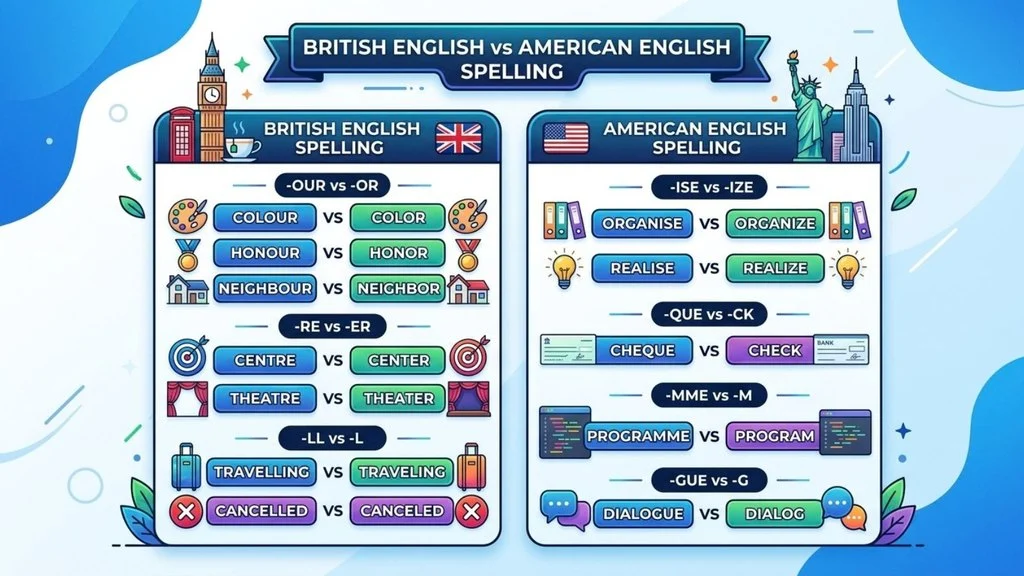
There is no spelling difference between British and American English for this word.
| English Variety | Correct Spelling | Incorrect Spelling |
| American English | response | responce |
| British English | response | responce |
| Canadian English | response | responce |
| Australian English | response | responce |
| Global English | response | responce |
So, whether you are writing for readers in the United States, United Kingdom, Canada, Australia, or Pakistan, use response.
Response in American English
- Please send your response by Friday.
- The company issued a response to the complaint.
Response in British English
- We are awaiting your response.
- Her response was very helpful.
The spelling stays the same in both varieties.
Which Spelling Should Use Responce or Response ?
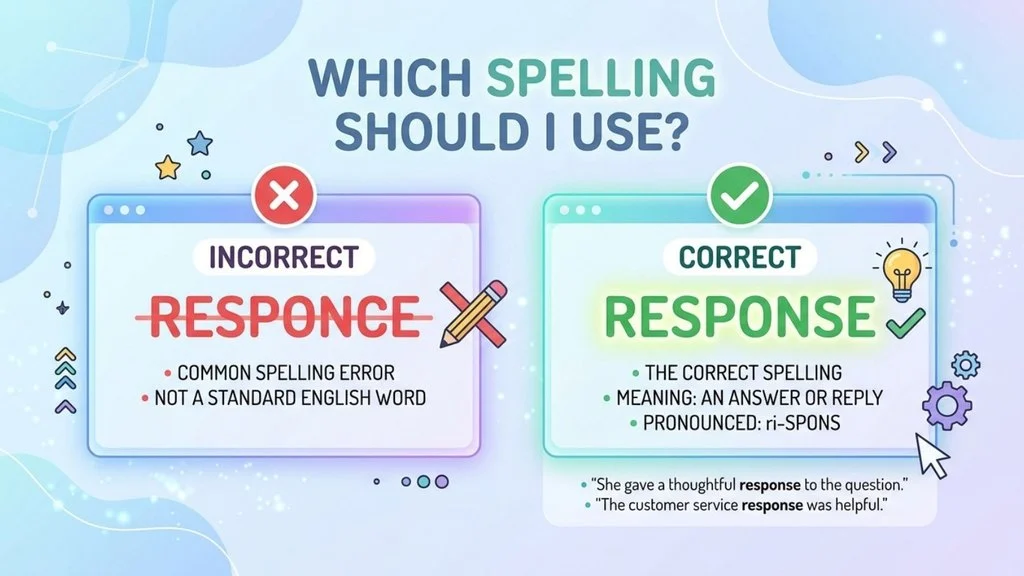
Use response in all standard English writing.
For American English
Use response in:
- Emails
- Essays
- Reports
- Business documents
- Websites
- Academic writing
For British or Commonwealth English
Use response in the same way.
This applies to countries such as:
- United Kingdom
- Pakistan
- India
- Australia
- New Zealand
- Canada
For Global English
If you write for an international audience, response is the safest and standard spelling.
There is no need to change the spelling based on your audience.
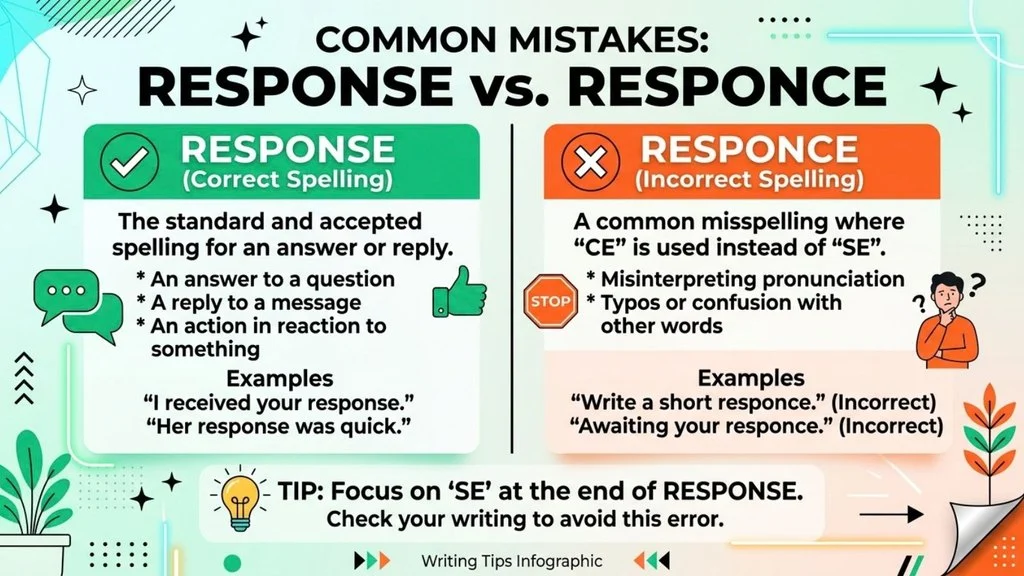
Common Mistakes with Responce or Response
1. Writing “responce”
❌ Thank you for your responce.
✅ Thank you for your response.
2. Confusing “response” with “respond”
Respond is a verb.
Response is a noun.
❌ Thank you for your respond.
✅ Thank you for your response.
But:
✅ Please respond to my email.
3. Using “response” as a verb
Response is normally a noun.
❌ She will response tomorrow.
✅ She will respond tomorrow.
4. Confusing “response” and “reply”
These words are often similar, but response can have a wider meaning. It can describe an answer, reaction, or action caused by something.
For example:
His response to the criticism was calm.
Responce or Response in Everyday Examples
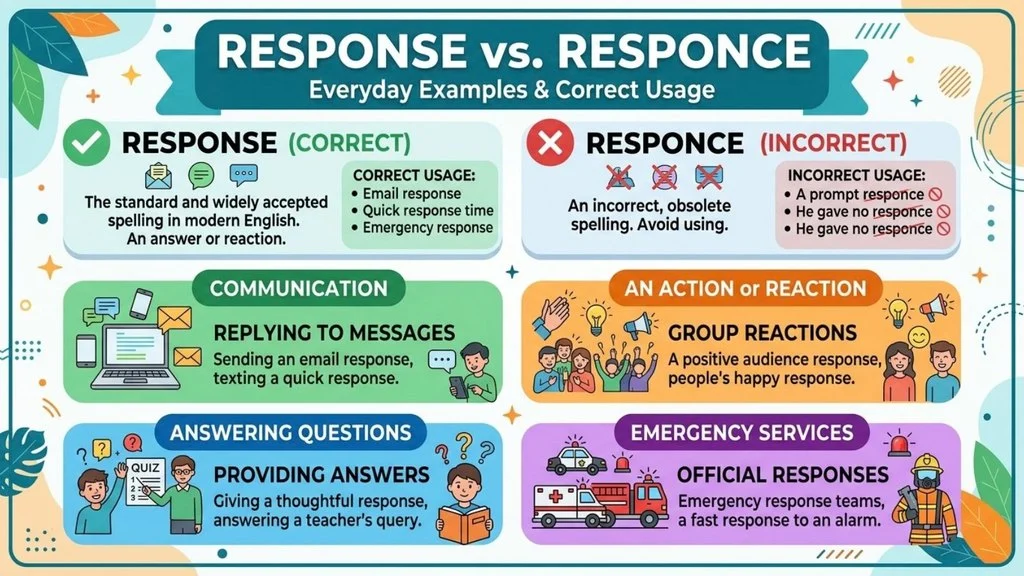
The correct word response appears in many types of writing.
In Emails
I look forward to your response.
Thank you for your quick response.
We appreciate your response to our request.
In News
The government issued a response to the report.
The company released a public response.
In Social Media
Her post received a strong response from followers.
The video received a positive response online.
In Formal Writing
The study examined the public response to the new policy.
The patient’s response to the treatment was recorded.
In Everyday Conversation
What was his response?
I did not expect that response.
Her response made me laugh.
Response – Google Trends & Usage Data
Searches for “responce or response” usually come from people checking the correct spelling of the word. The search reflects a common spelling confusion rather than two accepted variants.
Response is the standard spelling across major English-speaking regions. Responce may appear online because of typing mistakes, user-generated content, or spelling errors, but it is not an accepted standard spelling.
When comparing the two forms, the useful distinction is:
| Variation | Status | Recommended? |
| response | Standard English | ✅ Yes |
| responce | Common spelling error | ❌ No |
| respond | Related verb | ✅ Yes |
| responded | Past tense of respond | ✅ Yes |
| responding | Present participle | ✅ Yes |
Search interest can also vary by country because English learners and writers frequently search for spelling comparisons such as “responce or response.” However, the correct spelling does not change by country.
Response vs Responce: Comparison Table
| Feature | Response | Responce |
| Correct spelling | ✅ Yes | ❌ No |
| Standard English | Yes | No |
| Meaning | Answer, reply, or reaction | — |
| British English | Correct | Incorrect |
| American English | Correct | Incorrect |
| Formal writing | Recommended | Avoid |
| Academic writing | Recommended | Avoid |
| Business writing | Recommended | Avoid |
FAQs About Responce or Response
1. Is “responce” a correct word?
No. Responce is a common spelling mistake. The correct spelling is response.
2. What is the correct spelling: responce or response?
The correct spelling is response, with an s before the final e.
3. Is “response” British or American?
Response is used in both British and American English. The spelling is the same.
4. What does response mean?
Response means an answer, reply, or reaction to something.
5. What is the verb form of response?
The related verb is respond.
Example:
Please respond to my message.
6. Why do people spell response as responce?
The mistake may happen because the s in response has an /s/ sound, and English spelling can make this sound easy to associate with c in other words.
7. How can I remember the spelling of response?
Remember the related verb respond. Both respond and response use s, not c.
Conclusion
The difference between responce and response is simple: response is the correct spelling, while responce is a spelling error. The correct word means an answer, reply, or reaction to something.
The spelling response is used in both American and British English. It does not change based on country or writing style. You should use it in emails, academic papers, business documents, news writing, social media, and everyday communication.
A useful way to remember it is to connect response with the verb respond. Both words contain s, which can help prevent the common mistake of writing responce.
If you are unsure when writing a professional message, choose response. It is the standard form and works naturally across different varieties of English. Once you connect response with respond, the spelling becomes much easier to remember and use correctly.

Here’s a concise 2-line author bio suitable for Simifind.com:
James Dashner is an American bestselling author best known for The Maze Runner series and other popular young-adult fiction.
On Simifind.com, he shares clear, engaging insights and helpful content for readers interested in books, writing, and popular literature.