The spelling wellcome or welcome is a common search because the word can look like a combination of “well” + “come.” This makes the double-l spelling seem logical at first.
However, modern standard English has a simple answer: welcome is the correct spelling when you mean a greeting, friendly reception, or something gladly accepted.
Wellcome is not the standard spelling of the everyday English word.
It can still appear in historical texts or as part of a proper name, so you may sometimes see it in a different context.
This small spelling difference matters in emails, school assignments, websites, social media posts, invitations, and professional documents. A single extra letter can make otherwise clear writing look like a typo.
In this guide, you will learn the difference between wellcome and welcome, their history, British and American usage, common mistakes, everyday examples, and practical rules for choosing the correct spelling.
Wellcome or Welcome – Quick Answer
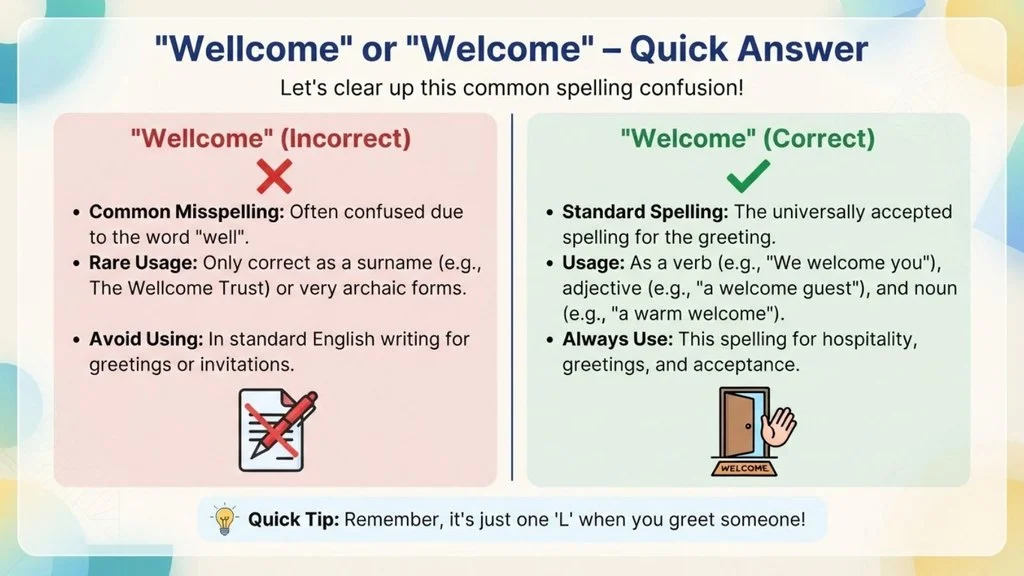
Welcome is the correct spelling for the ordinary modern English word.
- ✅ Welcome — correct
- ❌ Wellcome — incorrect in ordinary modern English
Examples
Correct:
Welcome to our website.
Incorrect:
Wellcome to our website.
Correct:
You are always welcome here.
Incorrect:
You are always wellcome here.
Correct:
Welcome back to our channel!
Incorrect:
Wellcome back to our channel!
The word welcome can work as a noun, verb, adjective, and interjection. Dictionaries define it in connection with greeting people, receiving people warmly, or accepting something gladly.
There is one important exception: Wellcome can occur in proper names or historical writing. Therefore, it is not accurate to say that the sequence of letters “Wellcome” can never appear anywhere. The key point is that it is not the standard spelling of the everyday word.
The Origin of Wellcome or Welcome
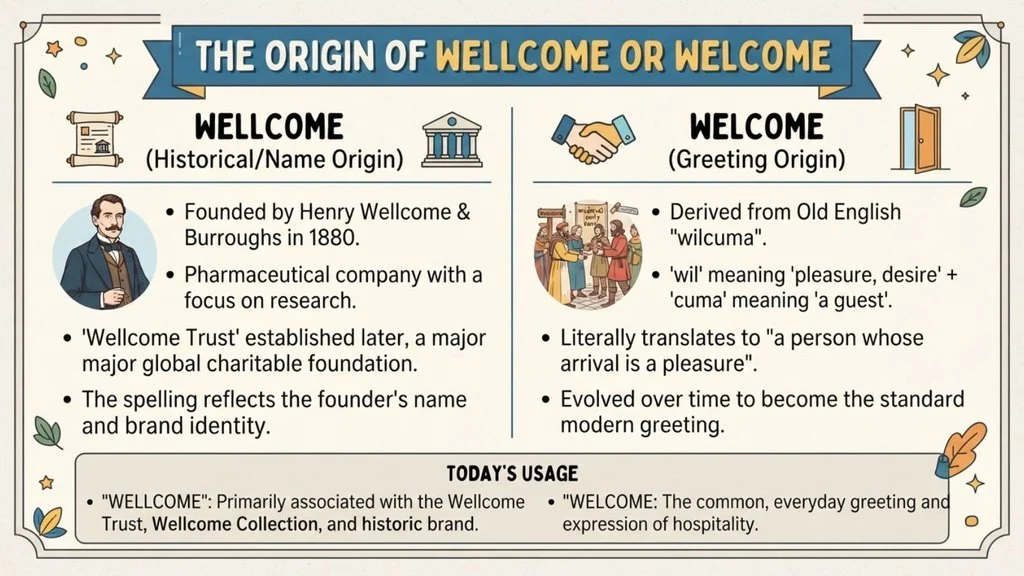
The history of welcome explains why its spelling does not simply follow the modern words well and come.
The word goes back to Old English wilcuma, which referred to a welcome or desired guest. It was related to the idea of a person whose arrival was pleasing or desired. The Old English verb wilcumian meant to welcome or greet gladly.
Over time, the spelling changed. The first part was influenced by wel/well, while the second part became associated with come. Middle English forms included spellings such as welcume, wilcume, and wolcome. Eventually, the modern spelling welcome became established.
This history also explains why people may naturally think that well + come = wellcome. The modern word looks as if it could be built from those two words. But its historical development is more complicated.
So, although wellcome may look logical, modern English uses:
welcome ✅
not:
wellcome ❌
Why Does “Wellcome” Look Correct?
The mistake is easy to understand.
People may mentally divide the word like this:
well + come = wellcome
But the standard English spelling is a single established word:
welcome
English contains many words whose spelling cannot be predicted simply by joining two modern words. That is why learning the standard form is safer than trying to rebuild it from its apparent parts.
British English vs American English Spelling
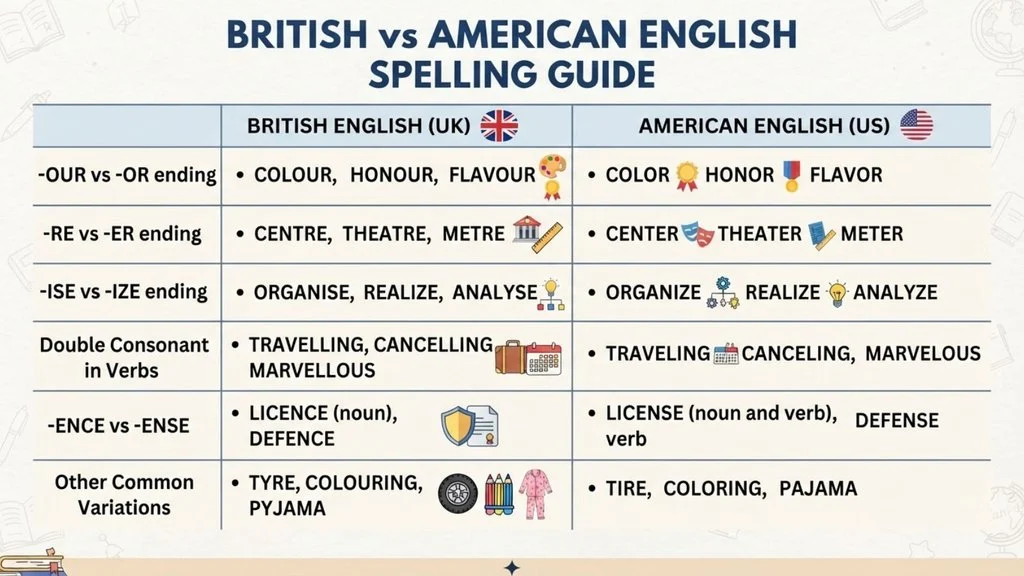
There is no British-American spelling difference for this word.
Both British English and American English use:
welcome
This is different from words such as colour/color, centre/center, or travelling/traveling, where regional spelling differences can exist.
Comparison Table
| Feature | British English | American English |
| Correct spelling | welcome | welcome |
| Incorrect everyday form | wellcome | wellcome |
| Greeting | Welcome! | Welcome! |
| Verb | We welcome guests. | We welcome guests. |
| Noun | a warm welcome | a warm welcome |
| Adjective | You are welcome. | You are welcome. |
| Regional spelling difference | No | No |
So, whether you are writing for readers in the United Kingdom, United States, Canada, Australia, Pakistan, India, or another English-speaking region, the normal spelling is welcome.
Oxford and other major dictionary sources list welcome as the standard English form and provide examples of its use as a noun, adjective, verb, and greeting.
Which Spelling Should Use Wellcome or Welcome ?
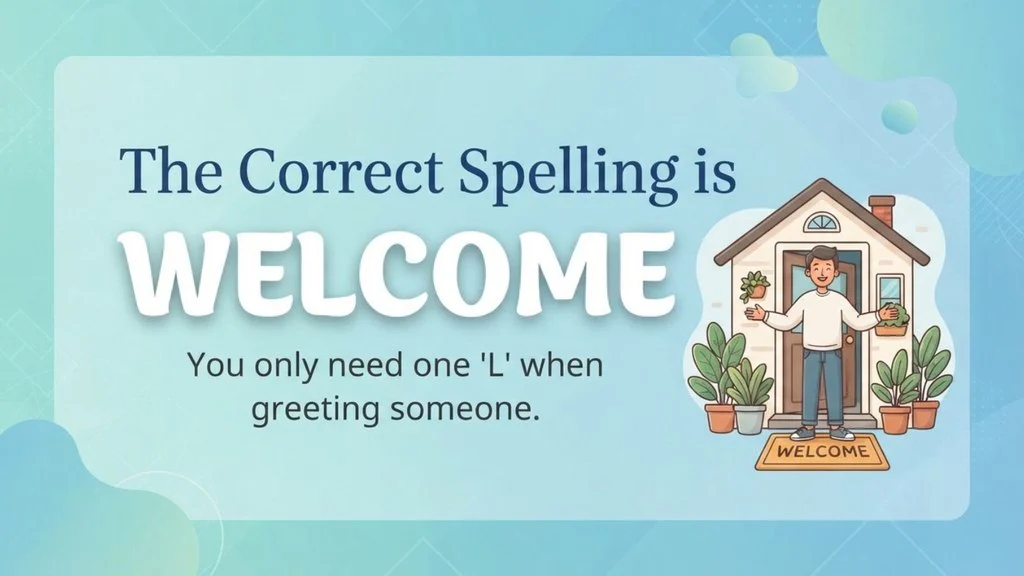
The simple rule is:
For US English
Use welcome.
Welcome to our office.
For British English
Use welcome.
Welcome to our school.
For Canadian English
Use welcome.
Welcome to Canada.
For Australian English
Use welcome.
Welcome to our community.
For Global English
Use welcome.
It is widely understood and does not create a regional spelling problem.
What About “Wellcome”?
Avoid wellcome when writing the ordinary English word.
There are two situations where you may see it:
- Historical spelling — older English texts may contain forms related to wellcome.
- Proper names — a company, organization, surname, or other name may officially use Wellcome.
For example, if Wellcome is part of an official name, keep the spelling because proper names should not be silently changed.
The practical rule is therefore:
Ordinary English word = welcome
Specific proper name or historical quotation = preserve the original spelling
Common Mistakes with Wellcome or Welcome
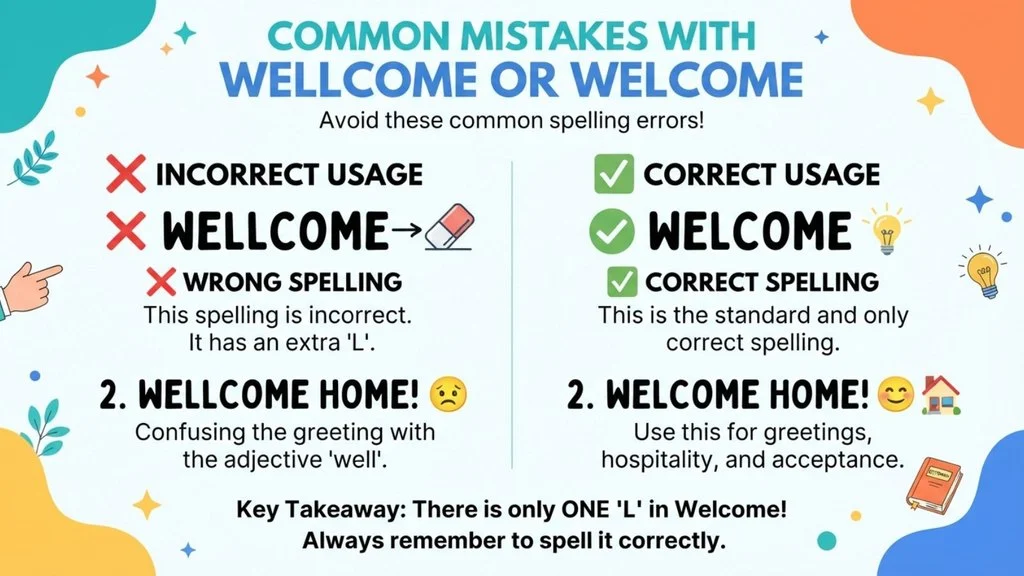
1. Adding an extra “l”
❌ Wellcome to our school.
✅ Welcome to our school.
2. Writing “wellcome back”
❌ Wellcome back!
✅ Welcome back!
3. Writing “you are wellcome”
❌ You are wellcome here.
✅ You are welcome here.
4. Using “wellcome” in an email
❌ We wellcome you to our company.
✅ We welcome you to our company.
5. Assuming “well + come” controls the spelling
❌ well + come = wellcome
✅ The standard word is welcome.
6. Using “wellcome” in formal documents
Formal writing requires the standard spelling:
We welcome your application.
Not:
We wellcome your application.
Common Correction Table
| Incorrect | Correct |
| Wellcome home | Welcome home |
| Wellcome back | Welcome back |
| Wellcome everyone | Welcome everyone |
| You are wellcome | You are welcome |
| Wellcome to our website | Welcome to our website |
| We wellcome new members | We welcome new members |
| A warm wellcome | A warm welcome |
Wellcome or Welcome in Everyday Examples
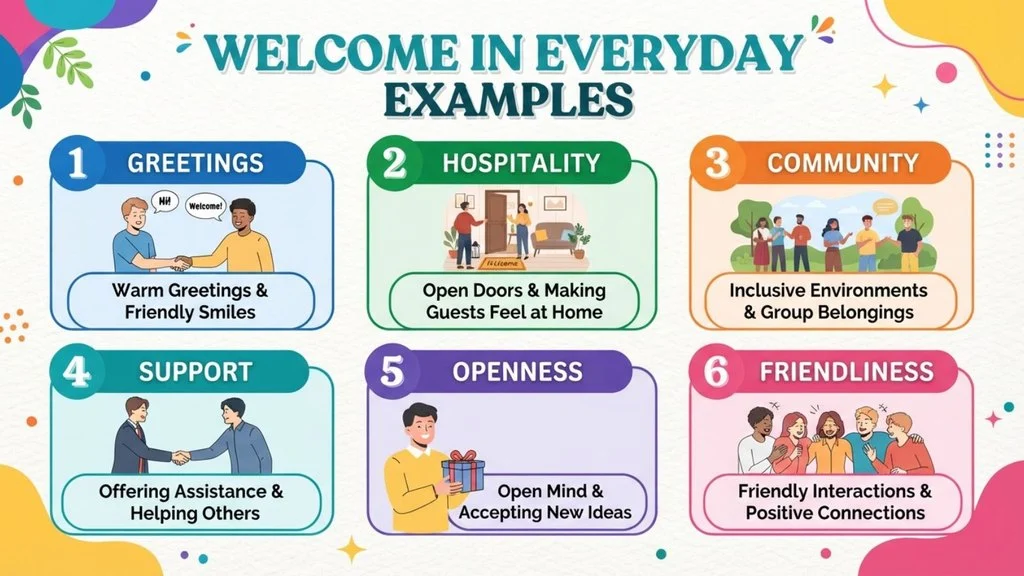
The word welcome appears in many types of communication.
In Emails
Welcome to our team, Sarah. We are happy to have you with us.
Another example:
We welcome your questions and suggestions.
In News Writing
The city welcomed hundreds of visitors during the festival.
Here, welcomed is the past tense of welcome.
In Social Media
Welcome back, everyone! We have a new video for you today.
Or:
Welcome to our new page!
In Formal Writing
We warmly welcome all participants to the annual conference.
In Invitations
You are welcome to join us for dinner.
In Conversation
“Thanks for helping me.”
“You’re welcome.”
The expression “you’re welcome” is a standard polite response to thanks.
As a Noun
The visitors received a warm welcome.
As a Verb
The teacher welcomed the new students.
As an Adjective
Your advice is always welcome.
As an Interjection
Welcome!
These examples show that welcome is a flexible English word with several grammatical uses.
Wellcome or Welcome – Google Trends & Usage Data
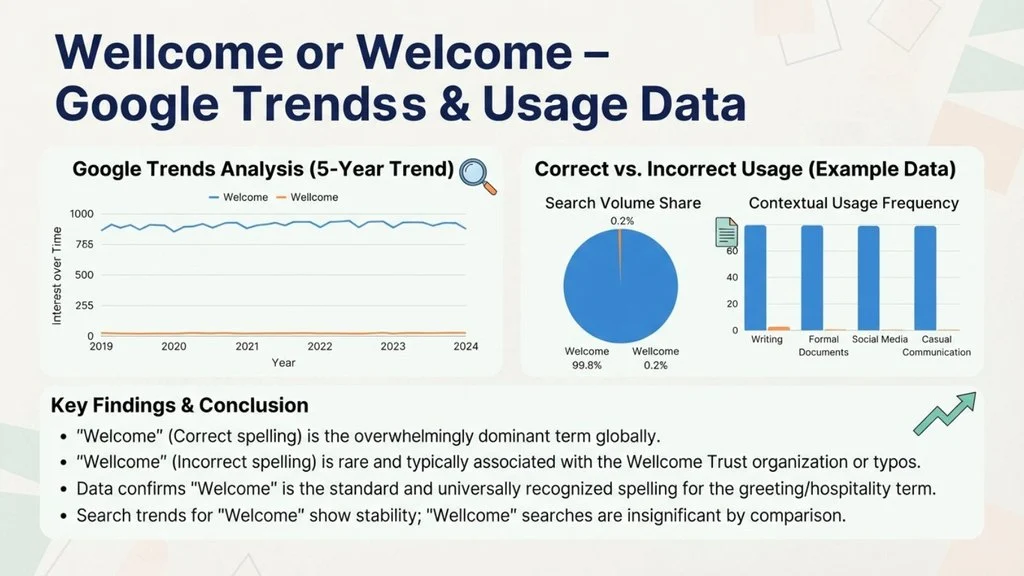
Search behavior can help explain why people ask about wellcome or welcome. The standard word welcome has a broad everyday meaning, so searches for it can relate to greetings, travel, websites, businesses, events, education, customer service, and many other subjects.
By contrast, searches for wellcome can be driven by spelling questions, historical references, surnames, or proper names.
Current web discussions about this spelling pair consistently identify welcome as the standard modern spelling and describe wellcome as a common spelling error or a form found in special contexts.
Search Context Comparison
| Search term | Typical search intent |
| welcome | Greeting, meaning, phrase, usage, general information |
| wellcome or welcome | Spelling comparison |
| wellcome | Spelling mistake, proper name, historical reference |
| welcome meaning | Definition |
| welcome back | Phrase usage |
| you’re welcome | Response to thanks |
| welcome spelling | Correct spelling |
Search interest can also vary by context and country. A search for welcome is much broader than a search for the spelling comparison wellcome or welcome, so raw search volume should not be treated as a direct measure of spelling correctness.
For SEO content, the comparison keyword “wellcome or welcome” has clear informational intent: users usually want a quick spelling answer and examples. The strongest answer should therefore put the correction early and explain why the extra l is tempting.
Wellcome or Welcome – Comparison Table
| Word or Variation | Status | Meaning/Use | Example |
| welcome | ✅ Correct | Standard English word | Welcome to our website. |
| wellcome | ❌ Not standard for ordinary use | Usually a spelling error | Wellcome to our website. |
| Welcome! | ✅ Correct | Greeting | Welcome! Please come in. |
| Welcome back | ✅ Correct | Greeting someone who returned | Welcome back to class. |
| You’re welcome | ✅ Correct | Response to thanks | “Thank you.” “You’re welcome.” |
| welcomed | ✅ Correct | Past tense | She welcomed the guests. |
| welcoming | ✅ Correct | Present participle/adjective | They were very welcoming. |
| Wellcome | ⚠️ Special case | Proper name or historical form | Depends on the official name/context |
FAQs About Wellcome or Welcome
1. Is “wellcome” or “welcome” correct?
Welcome is the correct spelling for the ordinary modern English word. Wellcome is not the standard everyday spelling.
2. Is “wellcome” a real English word?
Historical sources contain forms such as well-come and other older spellings, but welcome is the standard modern English form. Wellcome may also appear in proper names.
3. Why do people spell welcome as wellcome?
The mistake probably feels natural because welcome looks like it could come from well + come. However, the historical development of the word is more complex, beginning with Old English wilcuma.
4. Is welcome spelled differently in British and American English?
No. Both British and American English use welcome.
5. Should I write “Welcome back”?
Yes. Welcome back is the correct expression.
Welcome back to our channel!
6. Is “You’re welcome” correct?
Yes. You’re welcome is the standard polite response when someone thanks you.
7. Can “welcome” be a verb?
Yes. For example:
We welcome all new members.
The verb means to greet, receive, or accept someone or something gladly.
8. Can “welcome” be a noun?
Yes.
The guests received a warm welcome.
9. Can “welcome” be an adjective?
Yes.
Your help is always welcome.
10. Is “Wellcome” ever correct?
It can be correct when it is part of a specific proper name or when an older historical spelling is being reproduced. It is not the normal spelling of the modern English word.
Conclusion
The difference between wellcome or welcome is simple once you know the standard form. Welcome is the correct spelling for the ordinary modern English word. Use it when greeting someone, describing a friendly reception, accepting someone, or saying that something is gladly received.
For example, write “Welcome to our website,” “Welcome back,” “You are welcome,” and “We welcome your suggestions.” Do not add a second l simply because the word may look like well + come.
There is also no British-American spelling difference here. British English and American English both use welcome. This makes the word easy to use for global audiences.
You may occasionally see Wellcome in historical material or as part of a proper name. In those cases, keep the original spelling when it is required. But for normal emails, articles, assignments, websites, social media posts, and professional writing, remember one simple rule:
Welcome has one “l.”
That rule will help you avoid one of the most common spelling mistakes connected with this word.

Mary Roach is an American science writer and bestselling author known for making unusual and complex scientific topics engaging, accessible, and humorous. Her books include Stiff, Packing for Mars, Gulp, and Fuzz.
Author at Simifind.com, sharing clear, informative content designed to help readers understand interesting topics and everyday questions.