These two forms look and sound very similar, but they are used in different ways.
The confusion often appears when people write the spoken form of Mrs., especially in informal messages, social media posts, or casual writing.
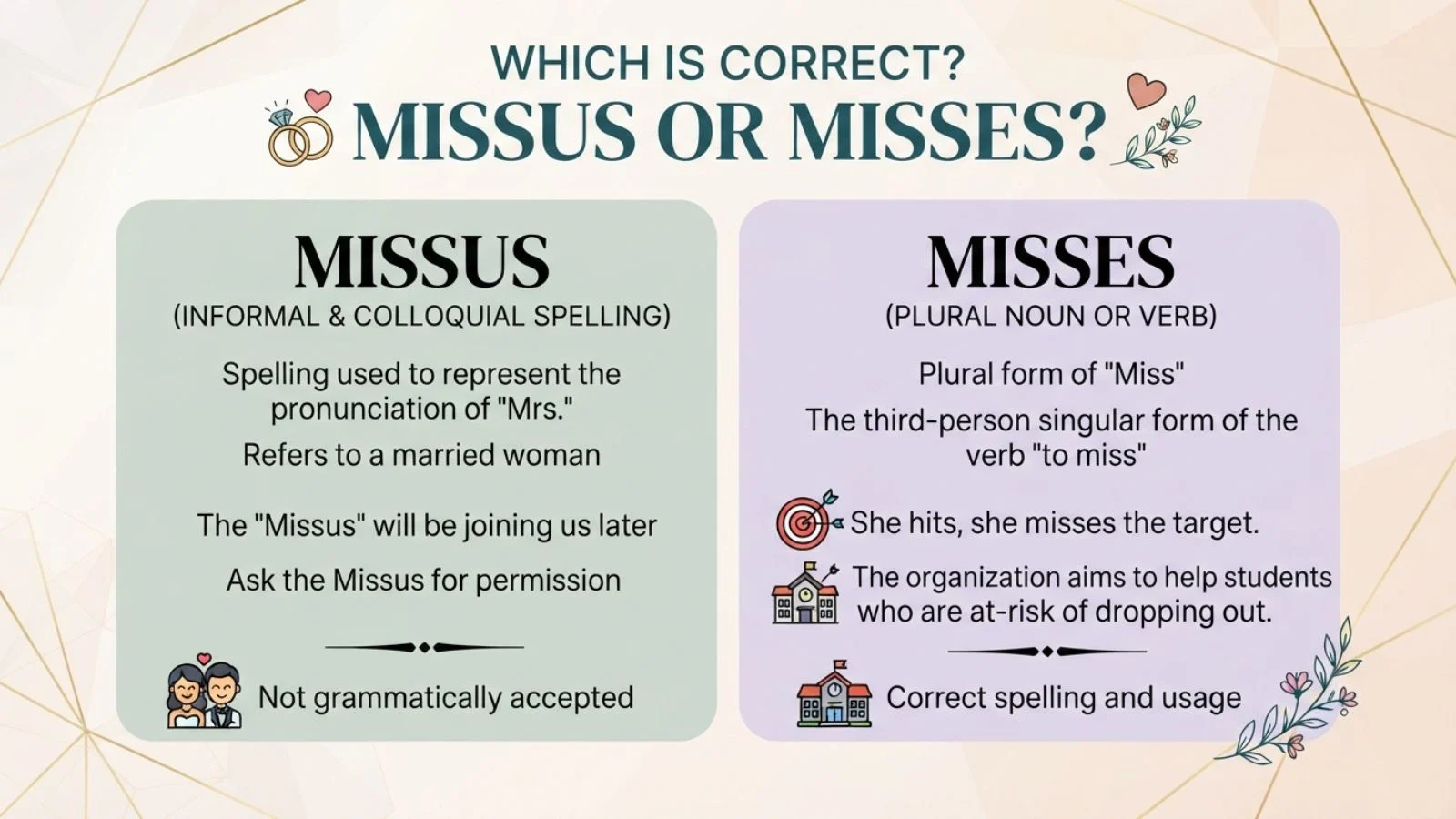
The word missus is an informal spelling used to represent the pronunciation of Mrs., the title traditionally used for a married woman.
Misses, however, is a standard English word with several meanings. It can be the third-person singular form of miss, as in “She misses her family,” or the plural form of Miss, as in “The two Misses arrived together.”
Understanding this difference helps you choose the right word in emails, articles, conversations, and formal writing. In this guide, we will explain missus or misses, their origins, pronunciation, spelling, regional usage, common mistakes, and everyday examples.
Missus or Misses – Quick Answer
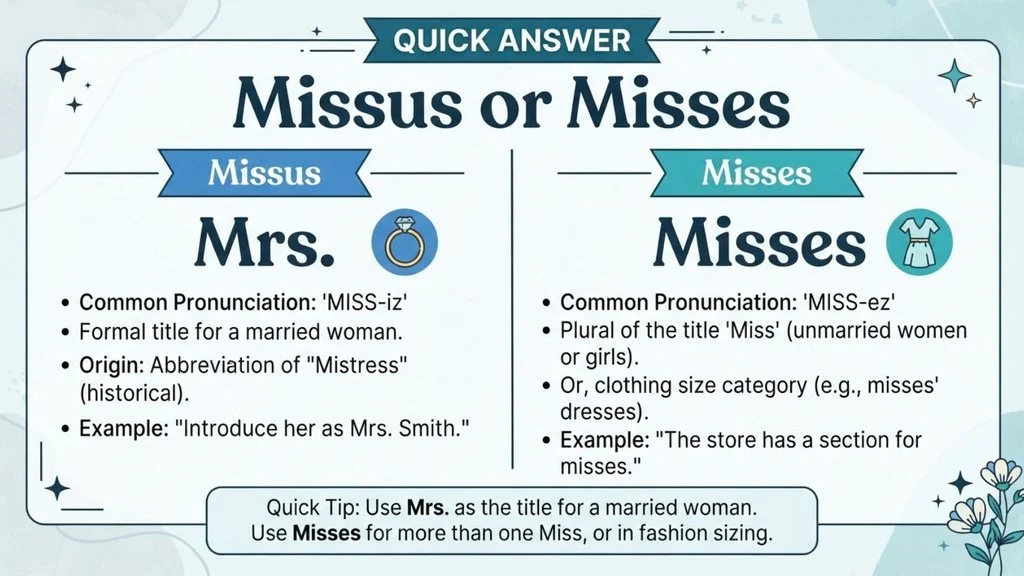
Missus and misses are both correct words, but they do not normally have the same meaning.
- Missus = an informal way to write the spoken word Mrs.
- Misses = a form of the verb miss or the plural of Miss
Examples
Missus:
“The missus is waiting at home.”
Here, missus means a wife or married woman, usually in informal speech.
Misses:
“She misses her children.”
Here, misses means “feels the absence of.”
Another example:
“The two Misses Smith attended the event.”
Here, Misses is the plural form of Miss.
Quick comparison
| Word | Meaning | Example |
| Missus | Informal term for Mrs. or wife | “The missus is at work.” |
| Misses | Verb form of miss | “She misses her friends.” |
| Misses | Plural of Miss | “The Misses Brown arrived.” |
| Mrs. | Formal title for a married woman | “Mrs. Brown teaches English.” |
So, if you mean the informal pronunciation of Mrs., use missus. If you mean the verb miss or more than one Miss, use misses.
The Origin of Missus

The word missus comes from the spoken form of Mrs.
The title Mrs. developed from mistress, which was historically a respectful form of address for a woman. Over time, mistress developed different meanings, while Mrs. became associated mainly with married women.
In everyday speech, people began pronouncing Mrs. in a way that sounded like “missus.” The informal spelling missus was later used to represent this pronunciation.
The word missus has been used in English for centuries, particularly in informal speech. It can mean a man’s wife or simply refer informally to a married woman.
Why do “missus” and “misses” sound similar?
The pronunciation of missus is usually close to:
MISS-us
The word misses is commonly pronounced:
MISS-iz
Because both begin with the sound miss, they can be confused when heard rather than seen.
The spelling helps show their different functions.
British English vs American English Spelling
The basic distinction between missus and misses is similar in both British and American English.
However, missus is informal in both varieties and is much less suitable for formal writing than Mrs.
| Form | British English | American English | Typical Use |
| Mrs. | Common | Common | Formal title |
| Missus | Informal | Informal | Speech or casual writing |
| Misses | Standard | Standard | Verb or plural noun |
| Miss | Standard | Standard | Unmarried woman/title |
British English
In British English, Mrs is commonly written without a full stop:
Mrs Smith
Missus may appear in informal conversation or writing:
“The missus wants to know when you’ll be home.”
American English
American English commonly uses Mrs. with a period:
Mrs. Smith
The informal word missus is also understood:
“I need to ask the missus first.”
The main difference is therefore not usually the spelling of missus, but the punctuation used with the abbreviation Mrs.
Which Spelling Should Use Missus or Misses ?
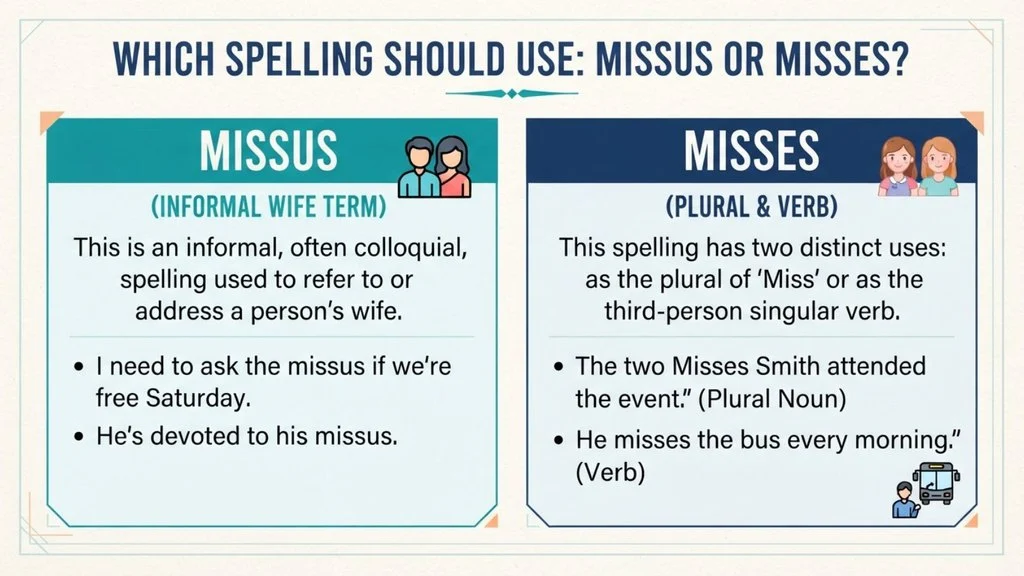
Your choice depends on what you mean and how formal your writing is.
Use “Mrs.” in formal writing
Choose Mrs. when addressing or referring to a married woman in professional or formal contexts.
Example:
Dear Mrs. Wilson,
Use “missus” in informal writing
Use missus when you intentionally want a casual, conversational tone.
Example:
“I’m taking the missus out for dinner tonight.”
It can sound friendly, humorous, old-fashioned, or conversational depending on context.
Use “misses” when it is a verb
Use misses when the subject is he, she, or it and the verb is miss.
Example:
She misses her family.
Use “Misses” as a plural title
Misses can also be used as the plural of Miss in certain formal naming contexts.
Example:
The Misses Johnson attended the ceremony.
For most modern writing, however, this plural form is relatively uncommon.
Common Mistakes with Missus or Misses
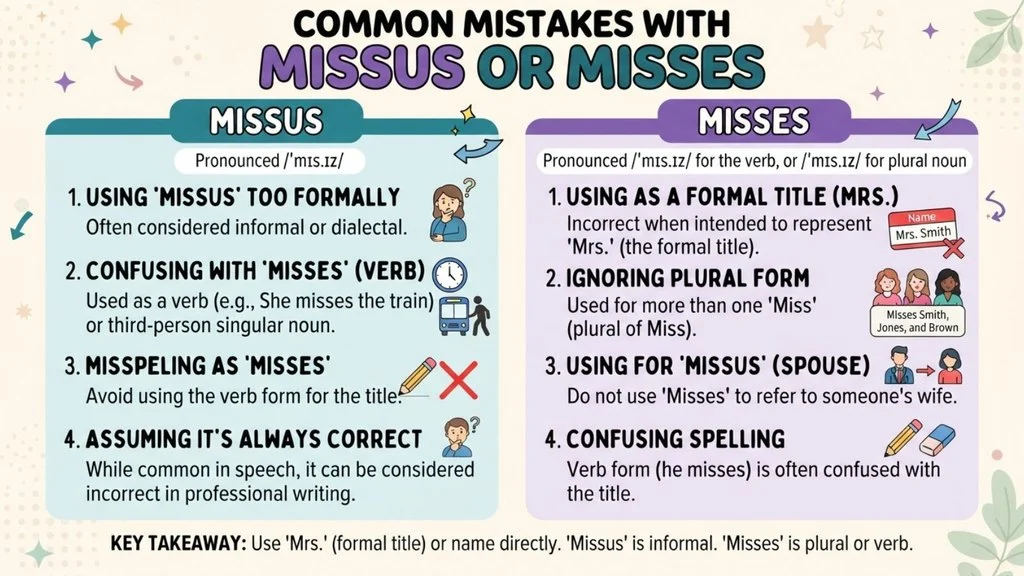
Because the words sound similar, several mistakes are common.
Mistake 1: Using “misses” for a wife
Incorrect:
“The misses is coming home.”
If you mean wife, the informal word is missus.
Correct:
“The missus is coming home.”
Mistake 2: Using “missus” as a verb
Incorrect:
“She missus her family.”
Correct:
“She misses her family.”
Misses is the correct third-person singular form of miss.
Mistake 3: Using “missus” in formal titles
Informal:
“The missus Smith will attend.”
Formal:
“Mrs. Smith will attend.”
Missus is not a replacement for the formal title Mrs.
Mistake 4: Confusing Mrs. with misses
The abbreviation Mrs. represents a title. The word misses usually has a completely different grammatical function.
Compare:
Mrs. Taylor is a doctor.
She misses her family.
The first identifies a person by title. The second describes an action or feeling.
Missus or Misses in Everyday Examples
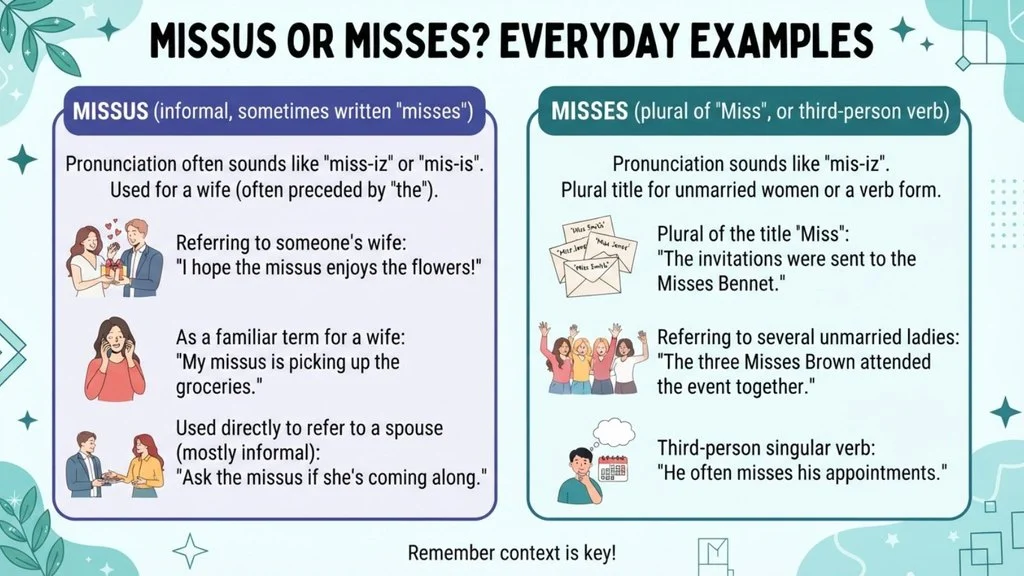
In emails
Formal:
Dear Mrs. Carter,
Thank you for your message.
Informal:
I will ask the missus before making a decision.
For business emails, Mrs. is generally the better choice when a title is needed.
In news writing
News articles normally use formal titles according to their publication style.
Mrs. Johnson spoke at the meeting.
Missus would usually appear only when quoting informal speech or discussing the word itself.
On social media
Informal social media writing may use missus:
“The missus and I are heading out tonight.”
This gives the sentence a conversational tone.
In formal writing
Use Mrs. when referring to a married woman by title:
Mrs. Anderson addressed the committee.
Avoid replacing the title with missus unless the context specifically calls for informal language.
In ordinary conversation
You may hear:
“I need to check with the missus.”
This is a casual way of saying:
“I need to check with my wife.”
Missus or Misses – Google Trends & Usage Data
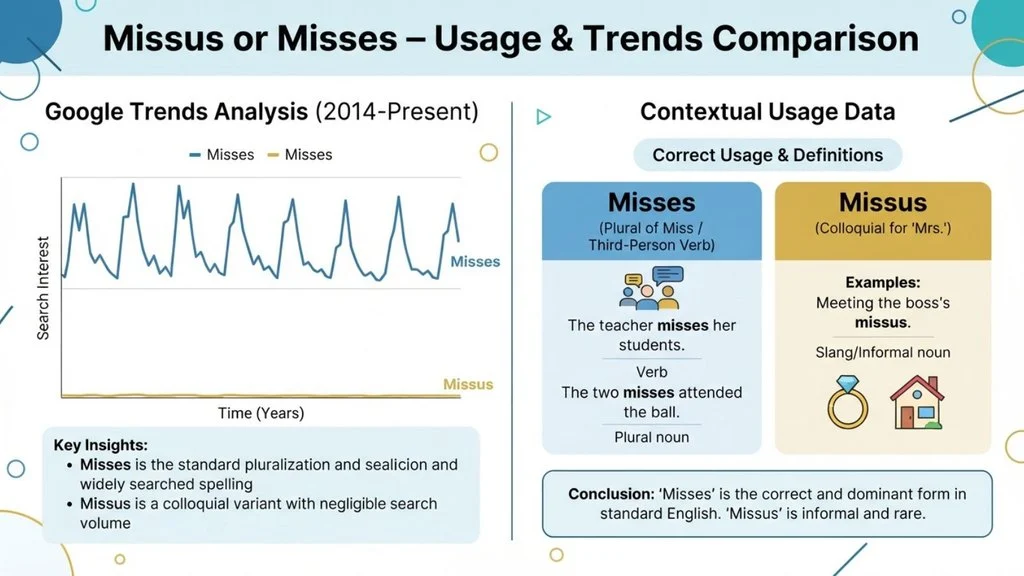
Search interest for missus or misses can vary because the two words serve different purposes.
People searching for missus often want to know:
- How to spell the spoken form of Mrs.
- Whether missus is a real word
- Whether missus means wife
- How Mrs. is pronounced
- Whether missus is formal or informal
Searches for misses are broader because misses has several grammatical uses.
For example:
She misses her parents.
He misses the bus.
The Misses Brown attended the event.
This means raw search popularity for misses does not necessarily show greater interest in the title-related meaning.
Usage also varies by country and context. Mrs. remains the normal formal title in English-speaking countries, while missus is mainly informal. In modern professional writing, the abbreviated title is much more common than the informal spelling.
For current country-by-country search interest, Google Trends can be checked using the exact terms missus, misses, and Mrs., because their search intent is different.
Missus vs Misses: Side-by-Side Comparison
| Feature | Missus | Misses |
| Main meaning | Informal Mrs. or wife | Form of “miss” or plural Miss |
| Part of speech | Noun | Verb or noun |
| Formality | Informal | Standard |
| Pronunciation | MISS-us | MISS-iz |
| Formal title? | No | No |
| Related formal form | Mrs. | Miss |
| Example | “The missus is home.” | “She misses home.” |
| Common in formal writing? | Rare | Yes, depending on meaning |
FAQs About Missus or Misses
1. Is “missus” a correct word?
Yes. Missus is a recognized informal word representing the spoken form of Mrs. It can also mean a man’s wife in informal language.
2. Is “missus” the same as “Mrs.”?
They are closely related but not identical in usage. Mrs. is the standard title, while missus is an informal spelling of the spoken form.
3. Is “misses” the plural of “Mrs.”?
No. Misses is not normally the plural of Mrs. The title Mrs. has a different abbreviation convention.
4. What does “the missus” mean?
The missus is an informal expression meaning one’s wife.
“I’ll ask the missus.”
This means:
“I’ll ask my wife.”
5. Is “missus” formal English?
No. Missus is generally informal. Use Mrs. when a formal title is appropriate.
6. Why does Mrs. sound like “missus”?
Mrs. developed from mistress, and its spoken form became shortened over time. The pronunciation eventually came to resemble “missus.”
7. Which is correct: “missus” or “misses”?
Both can be correct, but they have different meanings. Use missus for the informal term related to Mrs. Use misses for the verb form of miss or certain plural uses of Miss.
Conclusion
The difference between missus or misses becomes simple once you focus on meaning.
Missus is an informal word that represents the spoken form of Mrs. It can also refer casually to a wife.
Misses, on the other hand, is normally the third-person singular form of the verb miss, as in “She misses her family.” It can also be a plural form of Miss in certain naming contexts.
For formal and professional writing, Mrs. is usually the appropriate title when referring to a married woman.
Missus works better in casual speech, dialogue, social media, and informal writing.
Misses should be used when the grammar and meaning call for the verb misses or the relevant plural noun.
Remember the simple rule: missus = informal Mrs.; misses = a form of miss or plural Miss.
Knowing this distinction will help you avoid spelling and grammar errors while choosing the right word for your audience and context.

Here’s a concise 2-line author bio suitable for Simifind.com:
James Dashner is an American bestselling author best known for The Maze Runner series and other popular young-adult fiction.
On Simifind.com, he shares clear, engaging insights and helpful content for readers interested in books, writing, and popular literature.