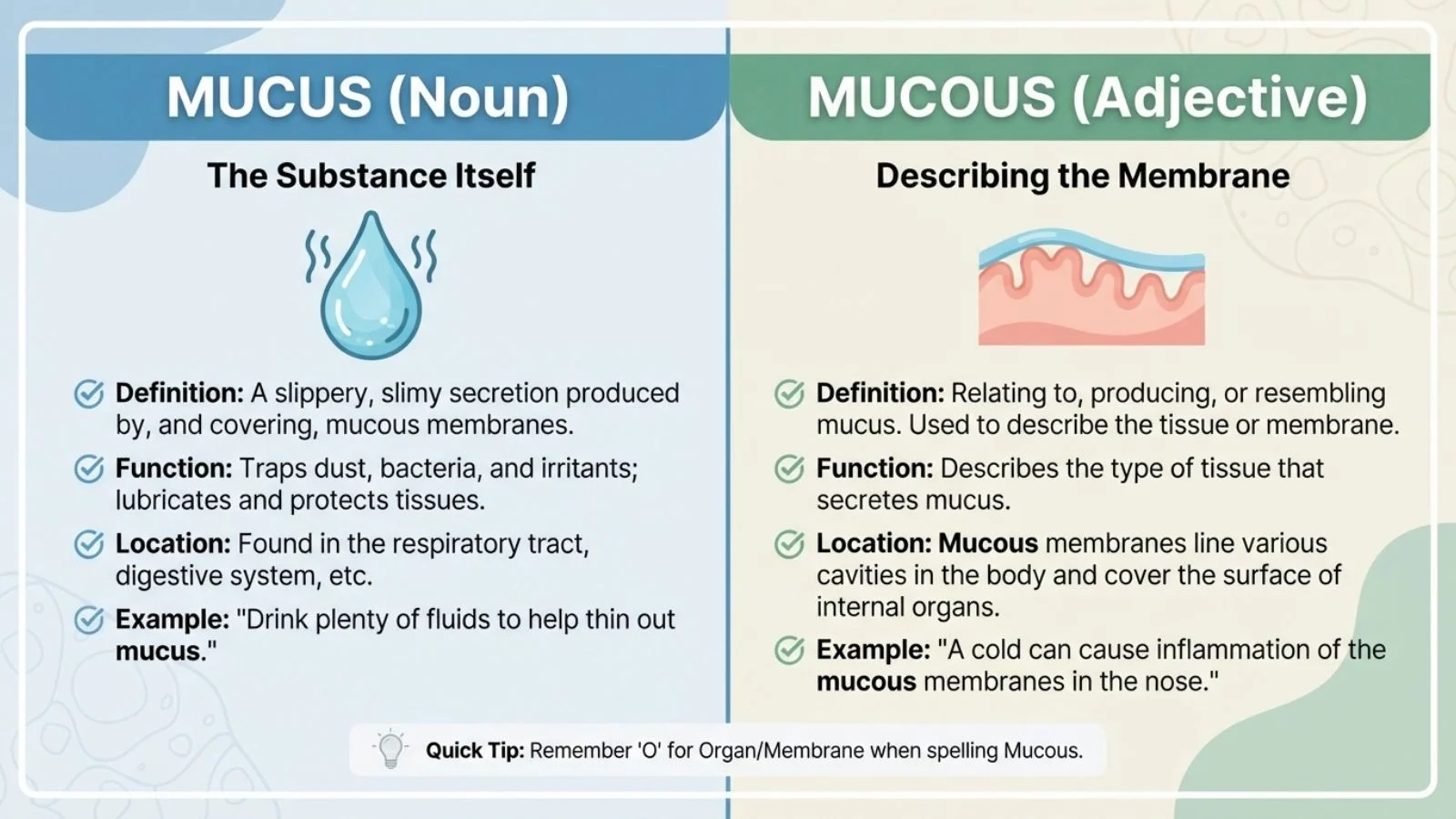
Have you ever written “mucus” and wondered if “mucous” is the correct spelling? You are not alone.
These two words look almost identical, sound similar, and both relate to the body. Yet, they have different grammatical roles and meanings.
The confusion often appears when people write about the nose, throat, lungs, or other parts of the body.
One small letter can change the function of the word in a sentence. Mucus is a noun, while mucous is an adjective.
Knowing this simple difference can help you write medical, educational, workplace, and everyday English more accurately.
This guide explains mucus or mucous, including their meanings, origins, spelling, common mistakes, and practical examples.
You will also see how each word works in British and American English. By the end, you should know exactly when to use mucus and when to use mucous.
Mucus or Mucous – Quick Answer
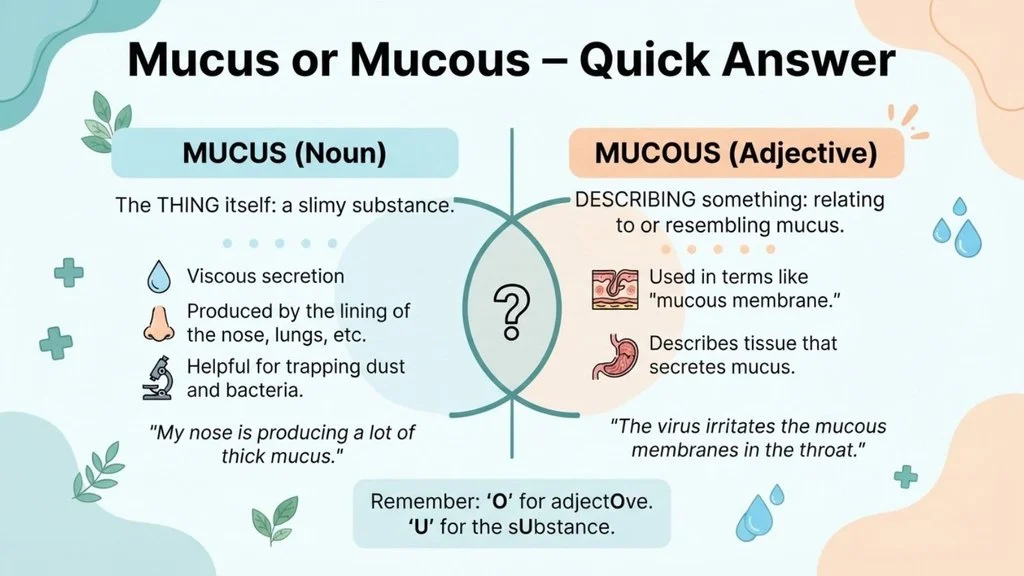
The quick answer is:
- Mucus = a noun meaning the slippery substance produced by membranes in the body.
- Mucous = an adjective describing something related to, containing, or producing mucus.
Examples
Mucus:
- There was a lot of mucus in his nose.
- The body produces mucus to protect tissues.
- She noticed thick mucus in her throat.
Mucous:
- The mucous membrane protects the inside of the nose.
- The doctor examined the mucous lining.
- Some infections can affect the mucous membranes.
A simple rule can help:
Mucus = substance
Mucous = describes something related to that substance
So, if you can replace the word with the name of a substance, mucus is usually correct. If the word describes a membrane, gland, lining, or tissue, mucous is usually correct.
The Origin of Mucus or Mucous
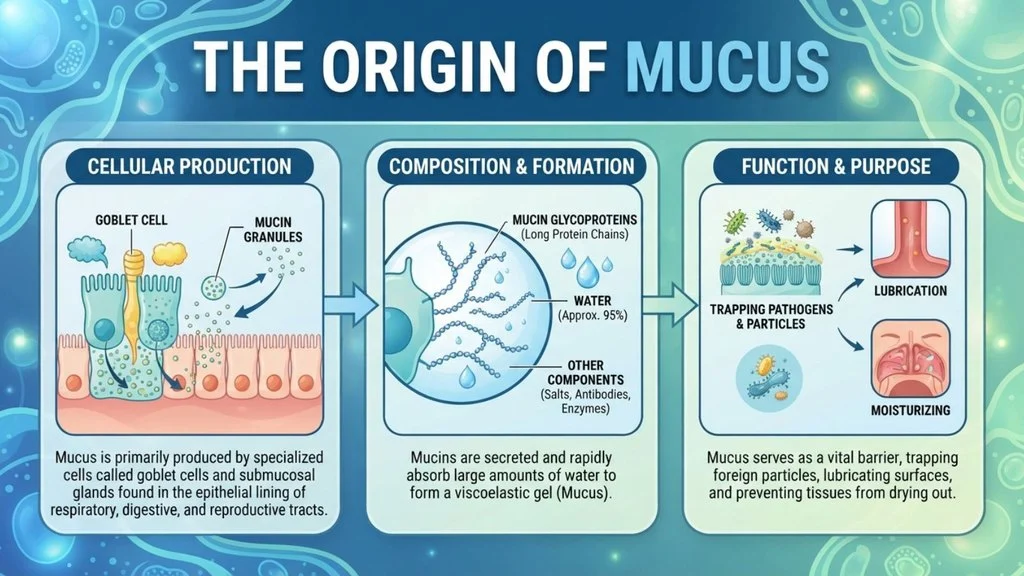
Both mucus and mucous come from the same Latin root.
The Latin word mūcus referred to mucus or a slimy substance. English later adopted mucus as a noun. The related adjective mucous developed to describe things connected with mucus.
This shared origin explains why the two words look so similar.
Mucus as a Noun
Mucus names the actual substance produced by the body.
For example:
- nasal mucus
- thick mucus
- excess mucus
- mucus production
Mucous as an Adjective
Mucous modifies another noun.
For example:
- mucous membrane
- mucous gland
- mucous secretion
- mucous lining
The spelling difference is therefore not mainly about American versus British English. It is primarily about word function.
This is an important point because many writers assume that one spelling is American and the other is British. That is not the main distinction.
British English vs American English Spelling

Unlike many common spelling differences, mucus and mucous do not represent a standard US-versus-UK spelling change.
Both forms are used in American English and British English. The choice depends mainly on grammar and meaning.
| Word | Part of Speech | Meaning | US English | UK English |
| mucus | Noun | A slippery bodily substance | ✓ | ✓ |
| mucous | Adjective | Related to mucus | ✓ | ✓ |
| mucous membrane | Adjective + noun | A membrane that produces or contains mucus | ✓ | ✓ |
| mucus production | Noun + noun | Production of mucus | ✓ | ✓ |
| mucous gland | Adjective + noun | A gland associated with mucus | ✓ | ✓ |
Examples in American English
The patient has excessive mucus production.
The mucous membrane protects the nasal passage.
Examples in British English
The patient has excessive mucus production.
The mucous membrane protects the nasal passage.
The spelling stays the same in both varieties.
Which Spelling Should Use Mucus or Mucous ?
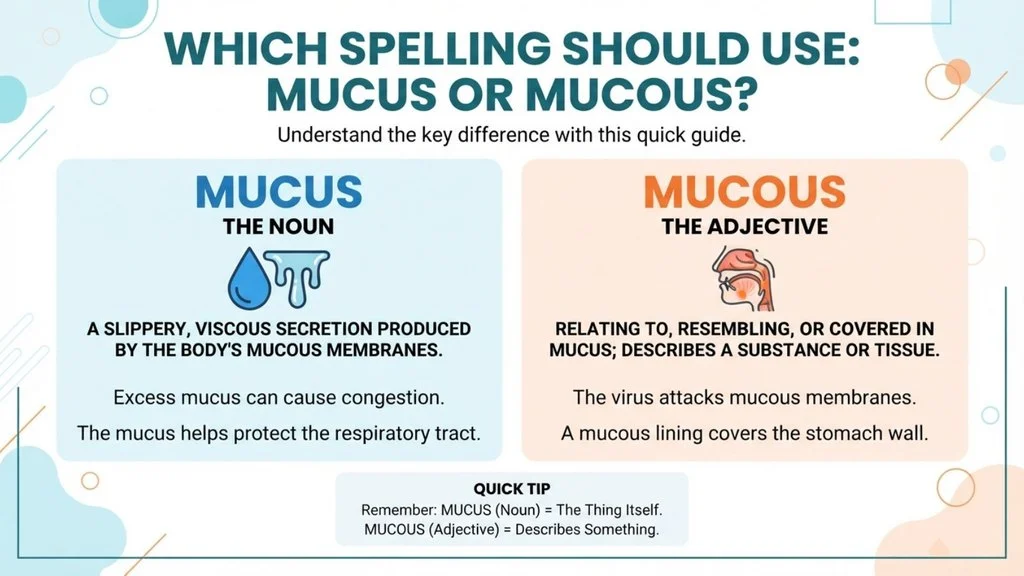
Choose the word based on what you want to say, not simply on where your readers live.
Use “Mucus” When You Mean the Substance
Use mucus when the word functions as a noun.
Correct:
The cold caused excess mucus.
Correct:
The mucus became thicker.
Incorrect:
The cold caused excess mucous.
In the last sentence, mucous is incorrect because the sentence needs a noun.
Use “Mucous” When Describing Something
Use mucous when it describes another word.
Correct:
The mucous membrane helps protect the body.
Correct:
The doctor examined the mucous lining.
Here, mucous tells us what type of membrane or lining is being discussed.
For Global English
The same basic rule works for readers in the United States, United Kingdom, Canada, Australia, and other English-speaking regions.
You do not normally need to change mucus to mucous because of the reader’s country.
Common Mistakes with Mucus or Mucous
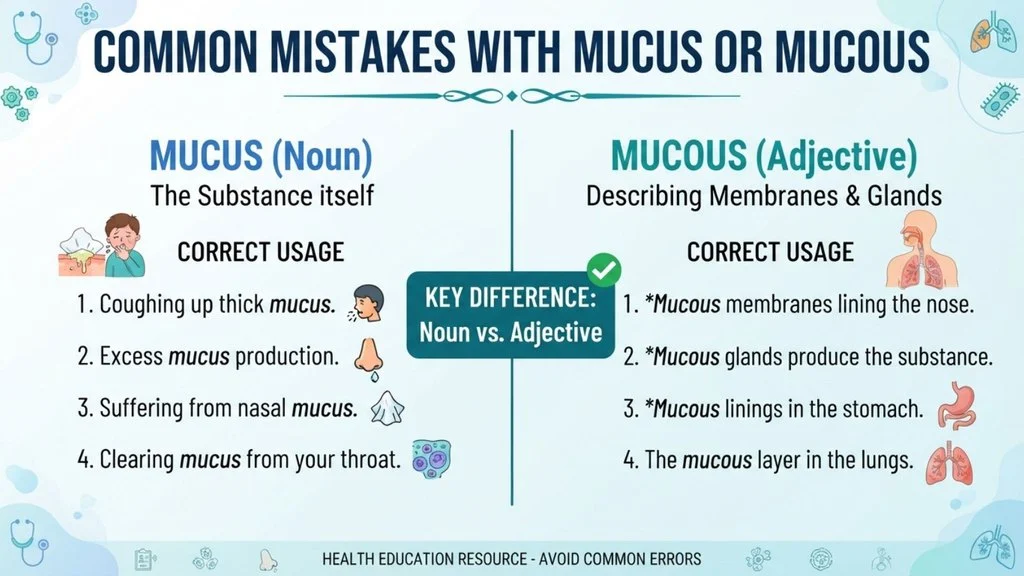
Because these words are so similar, several mistakes are common.
Mistake 1: Using “Mucous” as the Substance
Incorrect:
I have a lot of mucous in my throat.
Correct:
I have a lot of mucus in my throat.
Here, the word names a substance, so mucus is correct.
Mistake 2: Using “Mucus” Before “Membrane”
Incorrect:
The mucus membrane protects the tissue.
Correct:
The mucous membrane protects the tissue.
The standard term is mucous membrane.
Mistake 3: Treating Them as Interchangeable
Although the words are closely related, they cannot always replace each other.
Compare:
The body produces mucus.
The mucous membrane produces mucus.
The first sentence names the substance. The second uses an adjective to describe the membrane.
Mistake 4: Assuming One Is British
It is also incorrect to think that mucus is American and mucous is British.
Both words are standard in both major varieties of English.
Mucus or Mucous in Everyday Examples
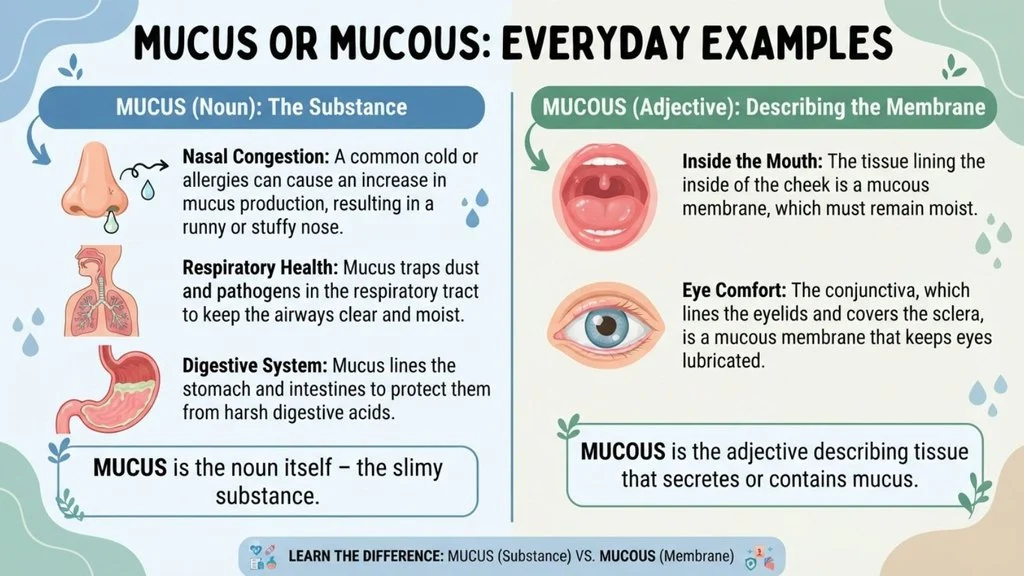
Understanding these words becomes easier when you see them in real sentences.
In Emails
The doctor advised me to monitor the amount of mucus I produce.
In News Writing
Researchers studied how mucus helps protect the respiratory system.
In Social Media
This cold has caused so much mucus!
In Formal Writing
Mucus plays an important role in protecting certain tissues from harmful particles.
In Medical Writing
The mucous membrane helps form a protective barrier.
In School Writing
Mucus helps trap dust and other particles that enter the respiratory tract.
In Everyday Conversation
I have a lot of mucus because of this cold.
These examples show the key pattern: mucus names the substance, while mucous describes something associated with it.
Mucus or Mucous – Google Trends & Usage Data

Search interest for “mucus or mucous” usually comes from people who are unsure which spelling belongs in a particular sentence. The query is therefore more about word choice and grammar than about regional spelling.
Search behavior can also vary by context. Medical searches may use terms such as:
- mucus in throat
- excess mucus
- mucus in nose
- mucus production
- mucous membrane
- mucous glands
The noun mucus appears frequently in everyday health-related language because people use it to describe a bodily substance. Mucous appears more often in technical, medical, and scientific phrases.
Country and Context
There is no simple rule saying that one country prefers mucus while another prefers mucous. Both forms are established in standard English.
For current search-volume numbers, Google Trends results can change over time and depend on the selected country, date range, and search category. Therefore, a specific trend result should always be checked for the exact region and period being studied.
Mucus vs Mucous: Comparison Table
| Feature | Mucus | Mucous |
| Part of speech | Noun | Adjective |
| Refers to | A bodily substance | Something related to mucus |
| Common phrase | excess mucus | mucous membrane |
| Example | I have thick mucus. | The mucous membrane is sensitive. |
| US spelling | Mucus | Mucous |
| UK spelling | Mucus | Mucous |
| Main function | Names something | Describes something |
Easy Memory Trick
Think of the “-ous” ending as a clue that the word is describing something.
- Mucus → the substance
- Mucous → related to the substance
This is not a universal spelling rule for every English word, but it works well for remembering this pair.
FAQs About Mucus or Mucous
1. Is it mucus or mucous?
Both are correct words, but they have different uses. Mucus is a noun, while mucous is an adjective.
2. Is “mucous” the British spelling of “mucus”?
No. Mucous is not simply the British version of mucus. Both words are used in British and American English.
3. What is the plural of mucus?
Mucus is generally treated as a mass noun, so it normally does not need a plural form in everyday English.
4. Is it mucous membrane or mucus membrane?
The standard term is mucous membrane.
5. Is “mucus” a noun or adjective?
Mucus is a noun. It refers to the slippery substance produced by certain tissues in the body.
6. Is “mucous” a noun?
In standard modern English, mucous is primarily used as an adjective. It describes something connected with mucus.
7. How can I remember the difference?
Remember:
Mucus = substance.
Mucous = describes something related to the substance.
Conclusion
The difference between mucus and mucous is simple once you understand their grammatical roles.
Mucus is a noun. It names the slippery substance produced by certain parts of the body. For example, you can have mucus in your nose or throat.
Mucous is an adjective. It describes something connected with mucus, such as a mucous membrane, mucous gland, or mucous lining.
The distinction is not mainly a British-versus-American spelling issue. Both words are standard in American and British English.
The best way to choose the correct word is to look at the sentence. If you are naming the substance, use mucus. If you are describing something related to that substance, use mucous.
Once you remember this simple noun-versus-adjective rule, choosing between these two similar words becomes much easier.

Mary Roach is an American science writer and bestselling author known for making unusual and complex scientific topics engaging, accessible, and humorous. Her books include Stiff, Packing for Mars, Gulp, and Fuzz.
Author at Simifind.com, sharing clear, informative content designed to help readers understand interesting topics and everyday questions.