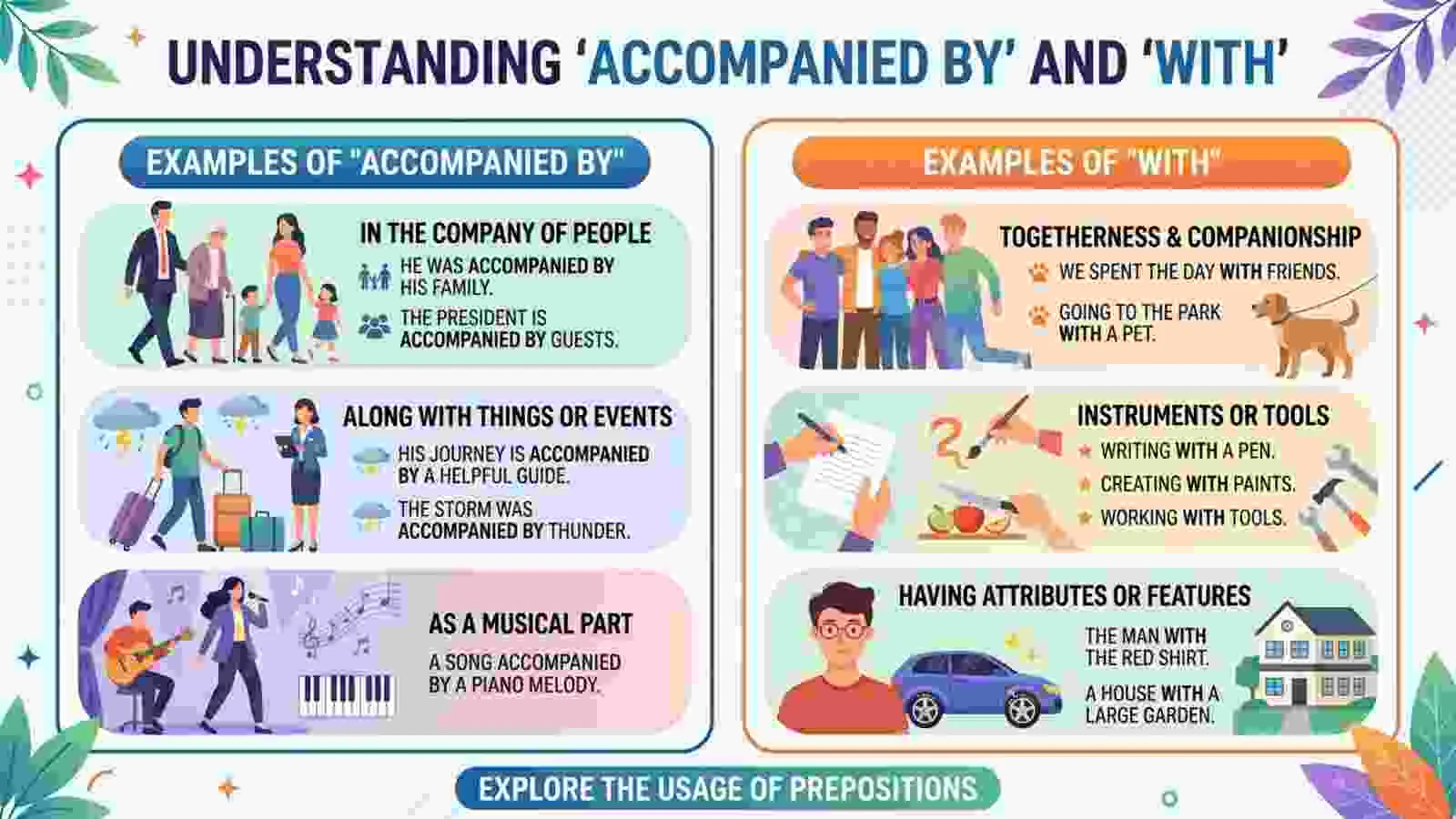
Both ‘accompanied by’ and ‘accompanied with’ are used, but ‘accompanied by’ is the standard and more common form — use ‘accompanied by’ for a person (accompanied by her friend) and for things that come with something. ‘Accompanied with’ is less common and often sounds wrong.
Have you ever wondered whether to write “accompanied by” or “with”?
Both phrases may sound right, but they are not always used in the same way. Choosing the right phrase can make your writing clear and natural.
People often search for “accompanied by or with” when writing emails, school work, reports, or formal documents.
They want to know which phrase is correct and whether both can be used in English.
The good news is that both phrases can be correct in some cases.
However, “accompanied by” is the more common and standard choice when you want to say that someone or something is together with another person or thing.
In this guide, you will learn the difference between these phrases.
We will explain their meanings, grammar rules, and use in British and American English. You will also see simple examples, common mistakes, and helpful tips.
By the end, you will know which phrase to use in daily talks, emails, and formal writing.
Accompanied By or With – Quick Answer
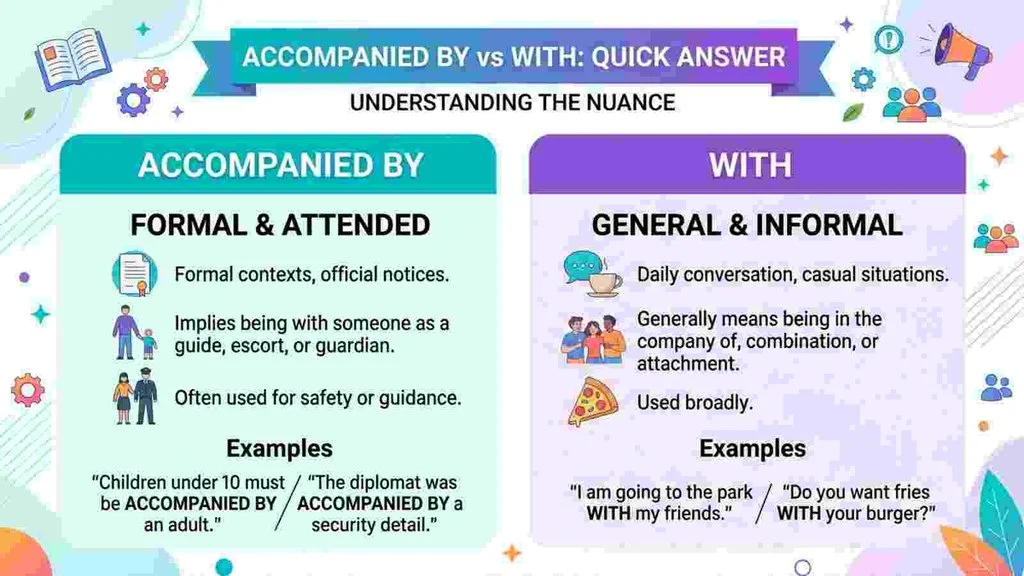
Both phrases can be used, but “accompanied by” is the standard and more natural choice in most cases.
Use “accompanied by” when someone or something is joined by another person or thing.
Examples:
- She was accompanied by her mother.
- The meal was accompanied by fresh juice.
- He arrived accompanied by his friends.
“Accompanied with” can also appear in English, mainly when talking about something that comes together with another thing.
Example:
The report was accompanied with extra documents.
However, “accompanied by extra documents” is more natural in formal writing.
Quick rule: When you are unsure, use “accompanied by.”
The Origin of Accompanied By or With
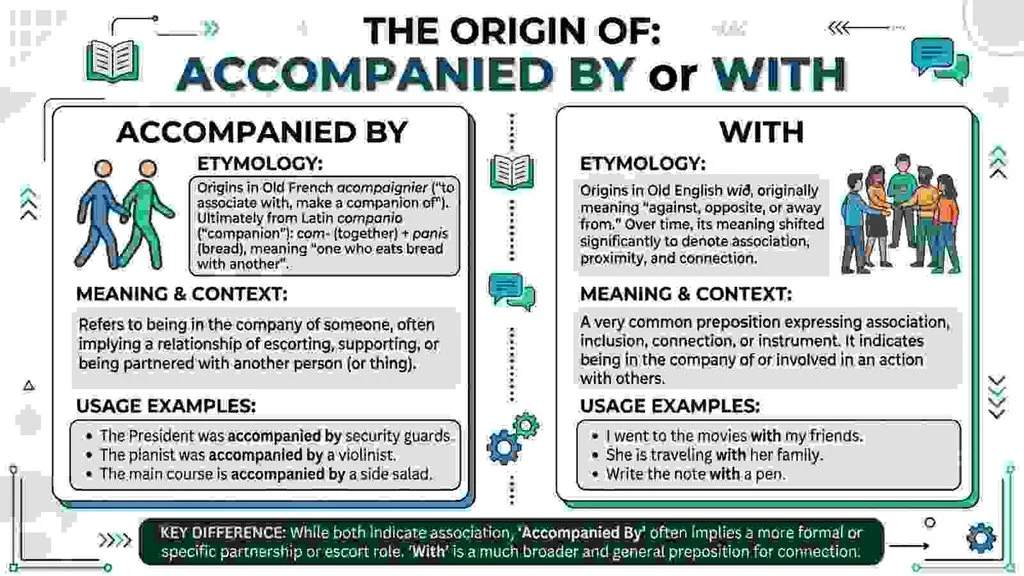
The word “accompany” comes from Old French. It came from the word acompagnier, which meant to take someone as a companion.
The word entered English in the early 15th century. Its meaning was to be with someone or go somewhere together. Later, it also gained a musical meaning. It could describe someone playing music along with another person.
The word “accompanied” is the past form of “accompany.”
For example:
- Present: I accompany my friend.
- Past: I accompanied my friend.
- Passive: I was accompanied by my friend.
Why Do People Confuse By and With?
The confusion comes from the meanings of the two prepositions.
By often shows who or what is present with someone or something.
Example: The singer was accompanied by a pianist.
With often means together or in the company of someone.
Example: The singer performed with a pianist.
Both words can show connection, but they work with different sentence patterns.
The phrase “accompanied by” is the usual choice in modern standard English. “Accompanied with” can appear in some contexts, especially when describing food or added items, but “accompanied by” is often clearer.
Accompanied With or By: Answer
The correct phrase is usually “accompanied by,” which means someone or something is together with another person or thing. “Accompanied with” is less common and is generally used when referring to something provided or included alongside another thing.
Accompanied By vs. Accompanied With: Key Differences
Understand the difference between these two expressions to use them correctly in everyday English and formal writing. Learn their meanings, grammatical patterns, and sentence structures to avoid common mistakes.
When to Use Accompanied By
Use “accompanied by” when describing a person, object, or action that goes together with another person or thing. It is the standard choice in formal writing, professional communication, and everyday English.
When to Use Accompanied With
Use “accompanied with” when referring to something that comes together with, contains, or is provided alongside another item. Although less common, it can be appropriate in certain contexts.
Accompanied By or With: Examples in Sentences
Compare practical examples to understand how both expressions work in context. These examples will help readers recognize natural usage and choose the correct phrase in conversations, emails, and academic writing.
Common Mistakes When Using Accompanied With or By
Many English learners confuse these expressions because both suggest something happening together. Learn the common grammatical errors, incorrect sentence patterns, and simple ways to choose the more natural expression.
Accompanied With: Meaning
The phrase “accompanied with” is sometimes used to describe something that comes together with another thing.
However, “accompanied by” is generally the more natural and grammatically preferred expression when referring to a person or thing that goes along with another.
For example, “She was accompanied by her brother.” In some contexts, “accompanied with” may be used to describe something served or provided alongside another item.
Examples of Accompanied With in Sentences
Understanding the phrase through examples can help you use it more confidently in everyday English.
Although “accompanied with” appears in some contexts, “accompanied by” is usually the better choice when describing an event, person, or condition. Here are some examples:
- The meal was accompanied by fresh juice.
- She arrived accompanied by her parents.
- The report was accompanied by supporting documents.
- The symptoms were accompanied by a high fever.
- The music was accompanied by beautiful singing.
Accompanied With vs. Accompanied By
The main difference between these expressions is their usual grammatical usage. “Accompanied by” is the standard choice when identifying a person or thing that accompanies another.
“Accompanied with” is less common and may occur when emphasizing something included or provided alongside another item. In formal writing, academic work, and professional communication, using “accompanied by” is generally the safest option.
Common Mistakes When Using Accompanied With
One common mistake is using “accompanied with” in every situation without considering the sentence structure.
For example, “He was accompanied with his friend” sounds unnatural in standard English. The preferred sentence is “He was accompanied by his friend.”
Similarly, write “The application was accompanied by the required documents.” Choosing the correct preposition makes your writing clearer, more natural, and grammatically accurate.
British English vs American English Spelling
Is there a difference between “accompanied by” and “accompanied with” in British and American English?
No spelling difference exists. Both phrases use the same words in both forms of English.
The main difference is not spelling. It is how the words fit into a sentence.
British English Examples
- She was accompanied by her sister.
- The meal was accompanied by fresh bread.
- The report was accompanied by a list of facts.
American English Examples
- He was accompanied by his wife.
- The dinner was accompanied by a fresh salad.
- The letter was accompanied by two documents.
Both countries use “accompanied by” in these examples.
British vs American Comparison Table
| Feature | British English | American English |
| Standard phrase | Accompanied by | Accompanied by |
| Alternative phrase | Accompanied with | Accompanied with |
| Spelling | Same | Same |
| Use in formal writing | By is preferred | By is preferred |
| Person example | Accompanied by his mother | Accompanied by his mother |
| Food example | Accompanied by rice | Accompanied by rice |
| Document example | Accompanied by a report | Accompanied by a report |
Important: British and American English do not have separate spelling rules for these phrases. The choice depends on grammar and meaning, not location.
Which Phrase Should You Use: Accompanied By or With?
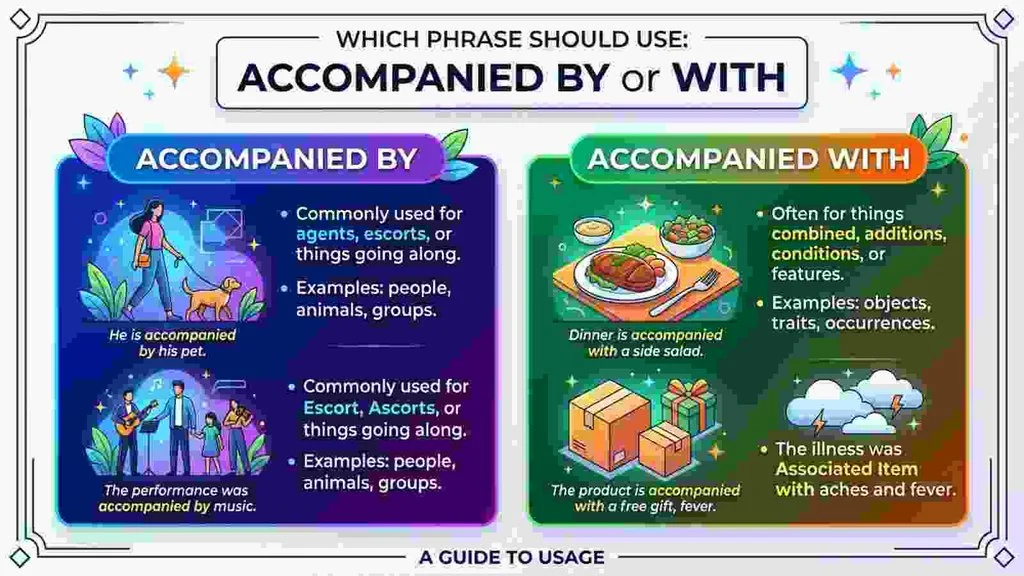
The best phrase depends on your audience and sentence. In most cases, “accompanied by” is the safest choice.
For US Readers
Use “accompanied by” in business writing, school work, reports, and formal emails.
Example:
The manager was accompanied by two team members.
For UK and Commonwealth Readers
Use “accompanied by” in the same way.
Example:
The guest was accompanied by her family.
This phrase is clear and natural in British, Australian, Canadian, and other Commonwealth English settings.
For Global Readers
Choose “accompanied by” when writing for people from different countries.
It is widely understood and works well in both formal and everyday writing.
For Academic and Professional Writing
Use “accompanied by” to make your sentence clear.
Examples:
- The study was accompanied by detailed results.
- The patient was accompanied by a family member.
- The application was accompanied by supporting documents.
If you want to use “with,” you can often change the sentence.
Instead of:
The patient was accompanied with his father.
Write:
The patient came with his father.
Or:
The patient was accompanied by his father.
These forms sound more natural.
Common Mistakes with Accompanied By or With
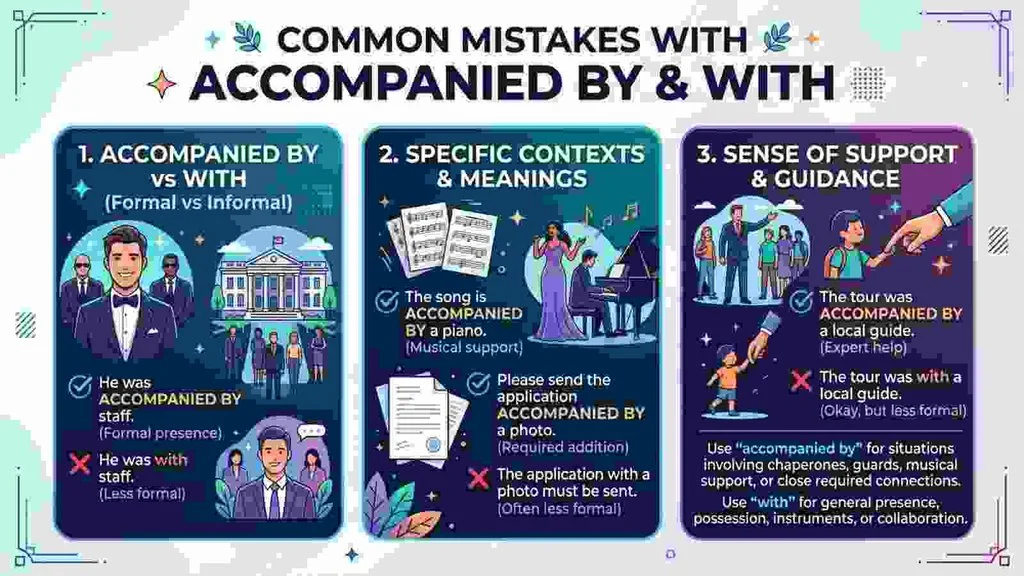
Many English learners mix up these phrases. Here are some common mistakes and their correct forms.
| Incorrect or less natural | Better form | Reason |
| She was accompanied with her mother. | She was accompanied by her mother. | Use “by” for the person who joins someone. |
| The report came accompanied with photos. | The report came accompanied by photos. | “By” is the usual choice. |
| He was accompanied with his friends. | He was accompanied by his friends. | “By” fits the passive form. |
| The speech was accompanied with music. | The speech was accompanied by music. | “By” is more natural. |
| She accompanied by her brother. | She was accompanied by her brother. | Add the verb “was.” |
| He accompanied with his father. | He went with his father. | Use “with” after “went.” |
Mistake 1: Using With After Accompanied
Incorrect: She was accompanied with her friend.
Correct: She was accompanied by her friend.
Mistake 2: Forgetting the Helping Verb
Incorrect: The child accompanied by his mother.
Correct: The child was accompanied by his mother.
Mistake 3: Mixing Two Sentence Patterns
Incorrect: He accompanied by his teacher.
Correct: He was accompanied by his teacher.
Also correct: He went with his teacher.
Mistake 4: Using the Wrong Verb Form
Incorrect: She is accompany by her sister.
Correct: She is accompanied by her sister.
Remember these simple patterns:
- Accompany someone.
- Be accompanied by someone.
- Go with someone.
These patterns will help you avoid most grammar mistakes.
Accompanied By or With in Everyday Examples
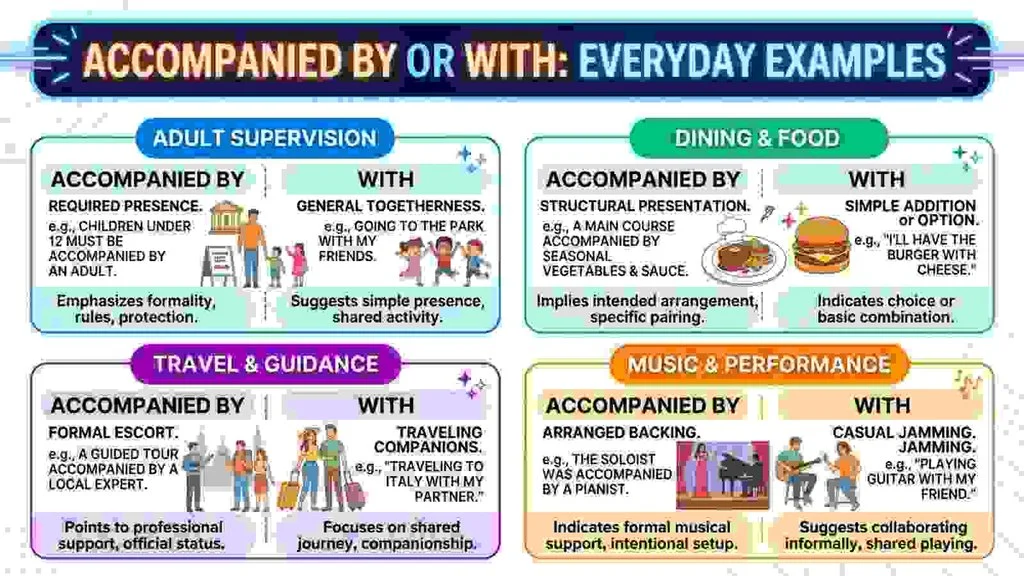
Both phrases may appear in daily communication. However, “accompanied by” is more useful in formal and professional writing.
In Emails
Correct:
Dear Sir,
Please find the application form accompanied by the required documents.
Thank you.
Another example:
Your order will be accompanied by a payment receipt.
In News
News writers often use “accompanied by” to describe people, events, and situations.
Examples:
- The president arrived accompanied by security staff.
- Heavy rain was accompanied by strong winds.
- The announcement was accompanied by loud cheers.
On Social Media
You can use the phrase in captions and posts.
Examples:
- A beautiful evening accompanied by great music.
- Coffee accompanied by a good book.
- A fun trip accompanied by close friends.
In Formal Writing
This phrase works well in reports, letters, and official documents.
Examples:
- The application must be accompanied by a copy of your ID.
- The report was accompanied by supporting evidence.
- The patient was accompanied by a medical assistant.
In Food and Restaurant Writing
You may also see “accompanied with” when talking about food. But “accompanied by” is also natural and often preferred.
Examples:
- The chicken was accompanied by fresh vegetables.
- The soup was served with warm bread.
- The fish came with a side of rice.
Notice that “served with” and “came with” are simple alternatives.
Accompanied By or With – Google Trends & Usage Data
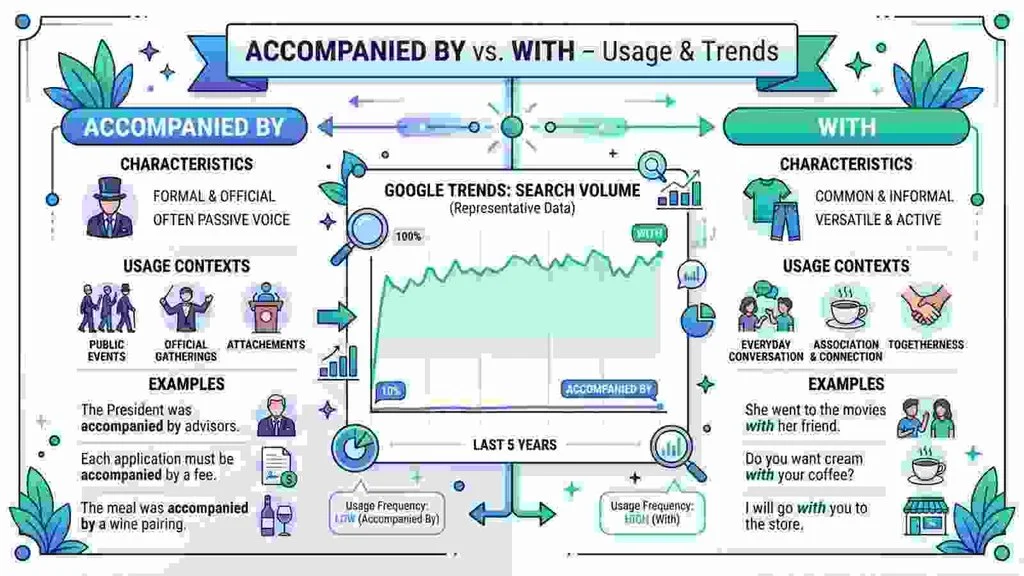
Google Trends helps writers understand what people search for online. It can show interest in grammar questions, word choices, and common language mistakes.
People may search for these phrases:
- Accompanied by or with
- Accompanied meaning
- Accompanied with meaning
- Is accompanied with correct?
- Accompanied with in a sentence
- Which preposition comes after accompanied?
Popularity by Country
English learners and writers in many countries may search for this grammar question.
| Country | Common search context |
| United States | Grammar, school work, and professional writing |
| United Kingdom | English usage and formal writing |
| Pakistan | English learning and grammar rules |
| India | Spoken and written English |
| Canada | Academic and business writing |
| Australia | English grammar and sentence structure |
These are possible search contexts, not verified search rankings.
Which Phrase Is More Popular?
“Accompanied by” is the more common phrase in standard English.
It is widely used in dictionaries and everyday writing. Cambridge Dictionary also gives examples such as “accompanied by a photo” and “accompanied by his bodyguards.”
Google Trends can compare search interest over time. However, it does not provide exact search numbers. Its data uses a score from 0 to 100, based on relative interest.
You should not treat search popularity as a grammar rule. A phrase may receive searches because people are unsure about it.
SEO tip: Articles targeting “accompanied by or with” should answer the question early. Readers want a quick answer before they read the full grammar explanation.
Accompanied By or With – Comparison Table
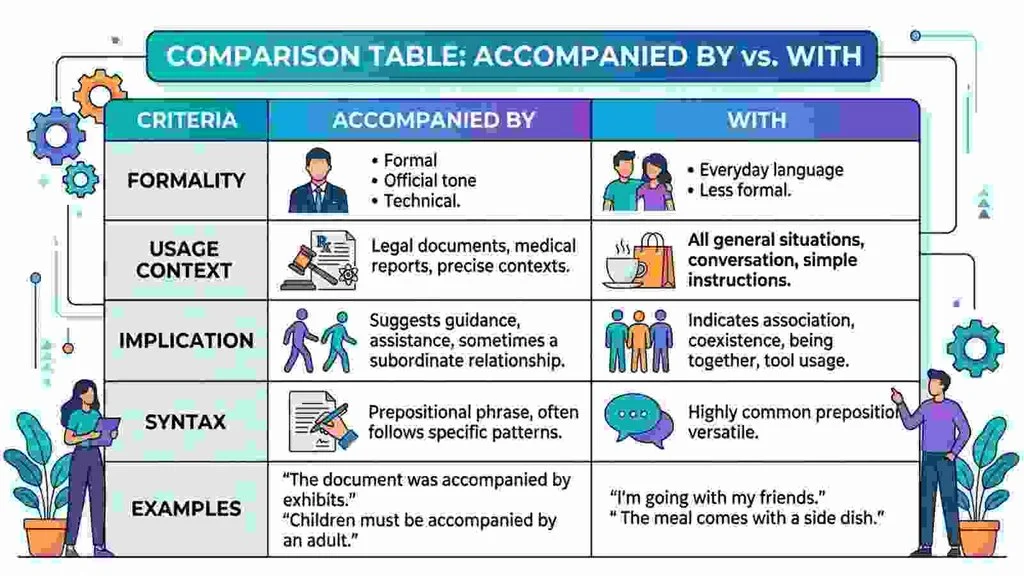
Here is a simple table to help you understand the main phrases and their correct use.
| Phrase | Correct? | Best use |
| Accompanied by | Yes | Standard phrase for people and things |
| Accompanied with | Possible, but less common | Some contexts involving added items |
| Accompany with | Usually avoid | Use “accompany someone” instead |
| Accompany by | Incorrect | Use “be accompanied by” |
| Came with | Yes | Simple, everyday English |
| Went with | Yes | Describes going together |
| Was accompanied by | Yes | Formal or passive sentence |
| Is accompanied by | Yes | Present passive sentence |
| Will be accompanied by | Yes | Future passive sentence |
| Accompanied along with | Often unnecessary | Use “accompanied by” |
Frequently Asked Questions (FAQs)
1. Is it accompanied by or accompanied with?
“Accompanied by” is the standard choice in most sentences. It is used for people, things, and events that happen together.
Example: She was accompanied by her friend.
2. Is accompanied with grammatically correct?
It can appear in English, especially in some contexts involving added things. However, “accompanied by” is more common and safer for formal writing.
3. Why do we use by after accompanied?
We use “by” to show the person or thing that joins or comes along with someone or something.
Example: The child was accompanied by his father.
4. Is accompanied by formal English?
Yes. It is common in formal writing, reports, news, academic work, and business emails.
Example: The application was accompanied by supporting documents.
5. Can I use accompanied with in an essay?
It is better to use “accompanied by” in an essay. It is the more standard phrase and helps keep your writing clear.
6. Is there a difference between British and American English?
No major difference exists. Both British and American English use “accompanied by” as the standard phrase.
7. What is another word for accompanied by?
You can use phrases such as:
- Along with
- Together with
- In the company of
- Joined by
Example: She arrived along with her brother.
8. What is the correct sentence: He was accompanied by his father or with his father?
The correct and natural sentence is:
“He was accompanied by his father.”
You can also write:
“He came with his father.”
9. Can accompanied by be used for food?
Yes. It is often used to describe food served with another item.
Example: The fish was accompanied by fresh vegetables.
You can also say, “The fish was served with fresh vegetables.”
10. What does accompanied by mean?
Accompanied by means together with someone or something — for example, “She was accompanied by her mother.”
11. What is the difference between accompanied by and accompanied with?
The difference is usage: accompanied by is the standard form for people and things that come together; accompanied with is less common and is used mainly for added or provided items.
12. What are some examples of accompanied by in a sentence?
For example, “The patient was accompanied by a nurse.”
Conclusion
The choice between “accompanied by” and “accompanied with” can be confusing, but the rule is simple. “Accompanied by” is the standard and preferred phrase in modern English. It works well when talking about people, food, documents, music, and events.
“Accompanied with” may appear in some forms of English, mainly when describing things that come together. However, it is less common and may sound awkward in formal writing. So, when you are unsure, choose “accompanied by.”
There is no spelling difference between British and American English in these phrases. Both use the same words and follow the same basic grammar rules.
For school work, emails, reports, and business writing, use “accompanied by” to keep your sentences clear and professional. You can also use simple phrases like “came with” or “went with” in everyday English.
Remember one easy rule: write “was accompanied by,” not “was accompanied with,” when you want the safest standard form. This small change can make your English sound more natural and correct.
Continue Reading:
- Caliber vs Calibre: Meaning, Spelling, and Usage ( for 2026)
- Address vs Adress: Meaning, Spelling, and Usage ( for 2026)
- Loose vs. Lose: Meaning, Spelling, and Examples ( for 2026)
- Cuter or Cutier: Correct Spelling, Meaning, and Usage ( for 2026)
- Selfs or Selves: Meaning, Grammar, and Examples (for 2026)

Mary Roach is an American science writer and bestselling author known for making unusual and complex scientific topics engaging, accessible, and humorous. Her books include Stiff, Packing for Mars, Gulp, and Fuzz.
Author at Simifind.com, sharing clear, informative content designed to help readers understand interesting topics and everyday questions.








3 thoughts on “Accompanied By or With: Difference, Rules, and Examples ( for 2026)”