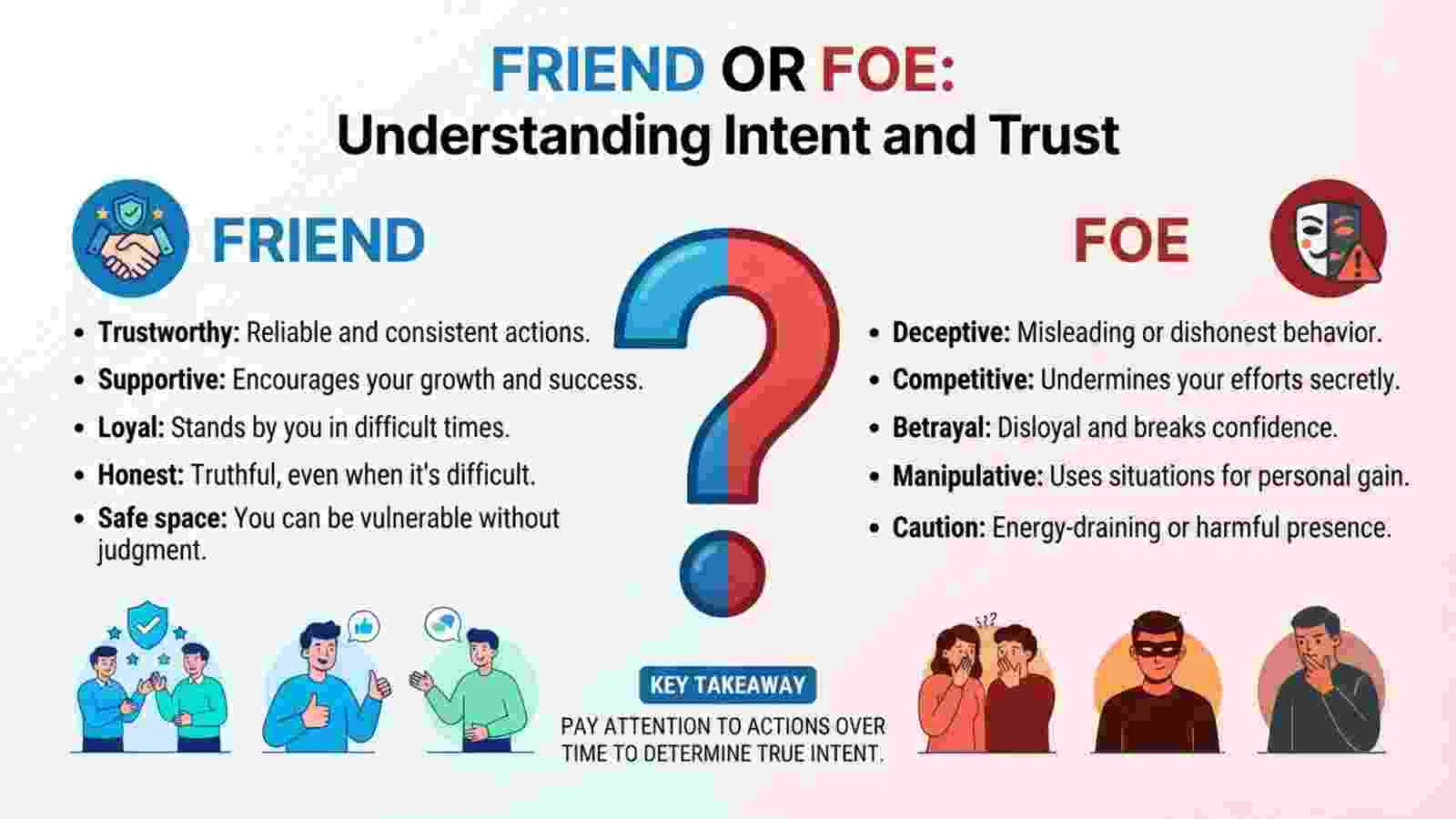
Friend = someone you trust and like. Foe = an enemy or opponent. ‘Friend or foe’ asks whether someone is on your side or against you.
Have you ever heard someone ask, “Is he a friend or a foe?”
This phrase may sound simple, but it has a strong meaning. It helps us understand whether a person is on our side or against us.
People often search for friend or foe meaning because they see it in books, movies, news stories, or daily talks and want to know how to use it.
The phrase is common in English. It can describe people, groups, or even countries. A friend is someone who supports you, while a foe is someone who acts against you. The phrase asks us to think about trust, loyalty, and possible danger.
You may also see it in social media posts, business talks, and stories about conflict. In each case, the main idea stays the same: is someone helping you, or are they working against you?
In this guide, you will learn the meaning of friend or foe, its origin, common uses, and examples. You will also discover how to use the phrase in everyday English and avoid common mistakes.
Friend or Foe Meaning – Quick Answer
Friend or foe means someone who is a friend or an enemy. It is a phrase used to ask whether a person, group, or nation is friendly or hostile.
- Friend: A person who supports, helps, or cares about you.
- Foe: An enemy or someone who opposes you.
- Friend or foe: A question about whether someone is an ally or an enemy.
Examples:
- “We need to know if the stranger is friend or foe.”
- “The two nations must decide whether they are friends or foes.”
- “In business, it can be hard to tell friend from foe.”
The phrase can be used in both serious and casual situations. It does not always mean physical danger. Sometimes, it refers to competition, disagreement, or a lack of trust.
The Origin of Friend or Foe
The words friend and foe have roots in Old English and other early Germanic languages.
The word friend comes from the Old English word frēond. It is linked to the idea of loving or caring for someone. Over time, it came to mean a person who offers friendship, trust, and support.
The word foe comes from Old English fāh, which referred to an enemy or an opponent. Its meaning developed into the modern word used for someone who is against another person or group.
The phrase friend or foe brings these two opposite ideas together. It asks people to identify someone’s position or intentions.
The phrase has been used in stories, military settings, politics, and everyday conversation. In older conflicts, people needed to know whether a stranger belonged to their own group or an opposing force. Today, the phrase can also describe social relationships, workplace competition, and public debates.
Unlike some English expressions, friend or foe does not have separate British and American spellings. The words are spelled the same in both forms of English.
British English vs American English Spelling
British and American English use the same spelling for friend or foe. There is no standard spelling difference between the two countries.
However, the phrase may appear in different contexts depending on the audience, writing style, and subject.
| Feature | British English | American English |
| Correct phrase | Friend or foe | Friend or foe |
| Word for an ally | Friend | Friend |
| Word for an enemy | Foe | Foe |
| Common alternative | Friend or enemy | Friend or enemy |
| Formal usage | Politics, history, news | Politics, history, news |
| Informal usage | Daily conversation | Daily conversation |
British English examples:
- “We must learn whether the new group is friend or foe.”
- “The report examines the country’s friends and foes.”
American English examples:
- “The team needs to know if the stranger is friend or foe.”
- “The article asks whether the rival company is a friend or foe.”
Both versions are correct. You do not need to change the spelling when writing for British, American, Canadian, or Australian readers.
Which Spelling Should You Use?
Since friend or foe has the same spelling in British and American English, your choice is simple: use this standard form everywhere.
Your main concern should be the meaning and tone of the phrase.
For American readers: Use friend or foe in news articles, stories, business writing, and everyday conversation. It is easy to understand.
For British and Commonwealth readers: The same phrase works well. You can also use friend or enemy when you want a more direct meaning.
For a global audience: Use friend or foe when you want a short, memorable expression. If your readers are beginners, explain that foe means enemy.
For formal writing: The phrase can work in essays and reports, but ally or opponent or friend or enemy may be clearer in some situations.
For SEO content, use the exact keyword in the title, introduction, and a suitable heading. Add related phrases naturally, such as friend or foe definition, friend or foe examples, and friend or foe synonym. Avoid repeating the same keyword too often.
Common Mistakes with Friend or Foe
Writers sometimes misuse the phrase because they do not know the meaning of foe or the difference between a friend and an opponent.
1. Thinking Foe Means Stranger
A foe is not simply a person you do not know. A stranger may be friendly, neutral, or hostile.
Incorrect idea: Every stranger is a foe.
Correct idea: A stranger’s intentions may be unknown, so you may need to find out whether they are friendly or hostile.
2. Using the Phrase as a Spelling Choice
Some readers think friend or foe has British and American spelling versions. It does not. The phrase is spelled the same in both forms of English.
3. Confusing Foe with Competitor
A competitor is someone who tries to win against you. A foe is an enemy or opponent. A competitor may still treat you with respect and may not be your enemy.
Example: “The two companies compete for customers, but they are not necessarily foes.”
4. Writing Friends or Foes Incorrectly
Both friends and foes are correct plural forms.
- Singular: “Is he a friend or a foe?”
- Plural: “Are they friends or foes?”
5. Ignoring the Context
The phrase can be serious, humorous, or symbolic. In a military story, it may refer to an enemy. In a workplace discussion, it may refer to someone whose goals conflict with yours.
Always consider the surrounding sentence before deciding what the phrase means.
Friend or Foe in Everyday Examples
The phrase is useful in daily conversation, business, news, social media, and formal writing.
In Everyday Conversation
- “I cannot tell if he is a friend or foe.”
- “Time will show whether they are friends or foes.”
- “She wants to know if the new neighbor is a friend or a foe.”
These examples show uncertainty about another person’s intentions.
In Emails
Example:
“Before we share our plans with the other team, we should understand whether they are allies or rivals.”
In professional emails, friend or foe can sound dramatic. Use it when the tone fits the message.
In News Reports
- “The report examines whether the two nations are friends or foes.”
- “Leaders must decide if the group is a partner or a foe.”
News writers may use the phrase to discuss politics, conflict, and international relations.
On Social Media
People often use the phrase as a short question or a catchy caption.
Examples:
- “Friend or foe? Trust your judgment.”
- “Is technology a friend or foe to students?”
- “Social media: friend or foe?”
These examples show that the phrase can describe ideas and tools, not just people.
In Formal Writing
- “The study explores whether artificial intelligence is a friend or foe to workers.”
- “The essay examines the role of competition in deciding friend from foe.”
- “History shows that today’s allies may become tomorrow’s foes.”
In formal writing, the phrase can make an argument more engaging. For a neutral academic tone, consider using benefit or threat, ally or adversary, or supporter or opponent.
Friend or Foe – Google Trends and Usage Data

The phrase friend or foe appears in English-language writing, entertainment, politics, technology, and everyday speech. It is a familiar expression because it presents two opposing choices in a short form.
However, search popularity can change by country, time, and topic. Without current Google Trends data, it would not be accurate to claim that the phrase is searched most often in a particular country or to provide exact search volumes.
You can explore its popularity by comparing the search terms friend or foe, friend or enemy, and friend or foe meaning in Google Trends.
Consider these factors when studying its usage:
- United States: The phrase may appear in political commentary, entertainment, and technology discussions.
- United Kingdom: It can be used in news, literature, and everyday English.
- Canada and Australia: The phrase is understood and follows the same spelling.
- Global English learners: Searches may focus on the definition, synonyms, and example sentences.
For SEO, focus on answering the searcher’s question quickly. Explain the meaning near the beginning, give clear examples, and include related questions. Use Google Trends and a keyword research tool to verify current interest before making claims about search volume or regional popularity.
Comparison Table: Friend or Foe and Related Phrases
| Phrase | Meaning | Example |
| Friend or foe | Friend or enemy | Is the stranger friend or foe? |
| Friend or enemy | Someone who supports or opposes you | Are they a friend or an enemy? |
| Friend or rival | Someone who supports you or competes with you | Is that team a friend or a rival? |
| Ally or adversary | Supporter or opponent | The leader must identify each ally or adversary. |
| Friend from foe | A way to distinguish allies from enemies | It is hard to tell friend from foe. |
| Friends or foes | More than one friend or enemy | The groups may be friends or foes. |
These phrases are related, but they are not always interchangeable. Rival often refers to competition, while enemy and foe can suggest stronger opposition. Ally is common in politics, military matters, and formal discussions.
Frequently Asked Questions
1. What does friend or foe mean?
Friend or foe means a friend or an enemy. It is used to ask whether someone is supportive or hostile.
2. Is friend or foe an idiom?
Yes. It is a common expression that contrasts friendship with opposition. It is often used when someone’s intentions are unclear.
3. Is foe the same as enemy?
Yes, in many contexts. Both words refer to an enemy or opponent. However, foe can sound more literary or dramatic than enemy.
4. Is friend or foe British or American English?
It is used in both British and American English. The spelling and basic meaning are the same.
5. What is another way to say friend or foe?
You can say friend or enemy, ally or adversary, or supporter or opponent. Choose the phrase that best fits your context.
6. Can friend or foe describe an idea?
Yes. The phrase can describe a tool, trend, or idea that may help or harm people.
Example: “Is artificial intelligence a friend or foe to education?”
7. What is the plural of friend or foe?
The plural forms are friends and foes. For example, “The two groups may become friends or foes.”
8. What is the difference between friend and foe?
A friend is someone who supports, helps, or cares about you, while a foe is an enemy or opponent who works against you.
9. What does foe mean?
Foe means an enemy or opponent — someone who is against you, not on your side.
10. Where does the phrase friend or foe come from?
The words come from Old English — friend from frēond, foe from fāh — and the phrase brings the two opposites together to ask whether someone is an ally or an enemy.
Conclusion
The phrase friend or foe means a friend or an enemy. It helps us describe relationships, conflicts, and situations where a person’s intentions are not clear.
The word friend suggests care and support, while foe means an enemy or opponent.
The expression is useful in everyday conversation, business, news, literature, and social media. It can also describe ideas and technology when people want to know whether something helps or harms them.
There is no difference between British and American spelling. Both use friend or foe, so you can use the phrase confidently for readers in the United States, the United Kingdom, Canada, Australia, and other English-speaking regions.
Remember that a stranger is not always a foe, and a competitor is not always an enemy. Context helps you understand the intended meaning. If you are writing an article or learning English, explain the phrase with simple examples and choose related words carefully.
In short, friend or foe is a clear and memorable expression for asking an important question: is someone on your side, or are they against you?
Continue Reading:
- Sink or Swim Meaning: Definition, Origin, and Examples (for 2026)
- Rhyme or Reason Meaning: Definition, Origin, and Examples (for 2026)
- Victory or Death: Is It a Motto, Slogan, or Battle Cry (for 2026)
- Cuter or Cutier: Correct Spelling, Meaning, and Usage ( for 2026)
- Selfs or Selves: Meaning, Grammar, and Examples (for 2026)

Here’s a concise 2-line author bio suitable for Simifind.com:
James Dashner is an American bestselling author best known for The Maze Runner series and other popular young-adult fiction.
On Simifind.com, he shares clear, engaging insights and helpful content for readers interested in books, writing, and popular literature.








4 thoughts on “Friend or Foe Meaning: Definition, Origin, and Examples (for 2026)”