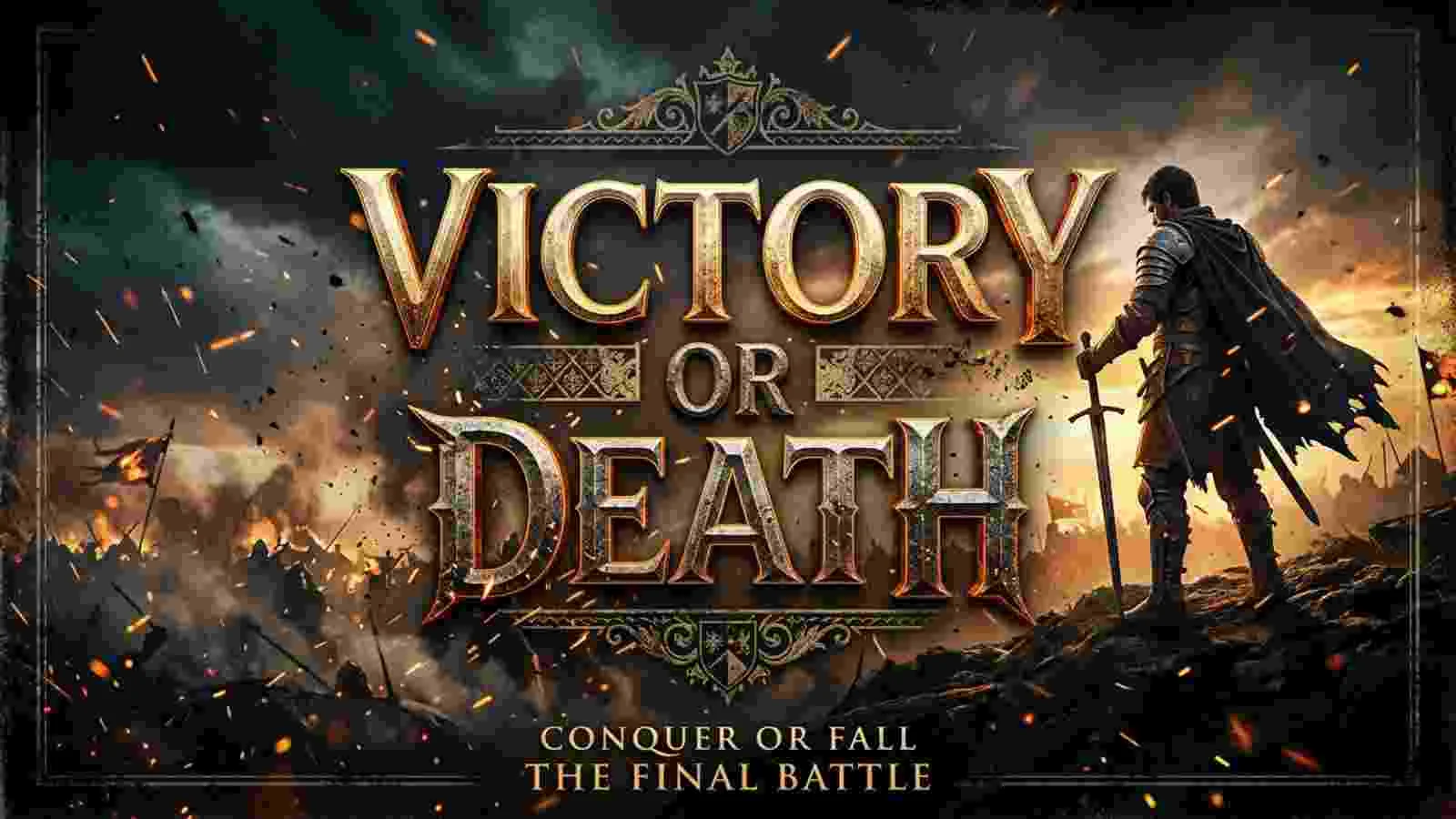
‘Victory or death’ is a famous battle cry meaning ‘we will win or die trying’ — there is no surrender. It is associated with the Texas Revolution (William B. Travis at the Alamo, 1836) and with other historic last-stand speeches. Use it only in a historical or dramatic sense, not as a literal threat.
Have you ever heard someone say “victory or death” and wondered what it really means?
This strong phrase often appears in history books, war stories, films, speeches, and social media posts.
It shows a firm choice between winning and facing death. It can also express deep courage, strong will, and a refusal to give up.
People search for “victory or death” to learn its meaning, history, correct usage, and role in famous events.
Some want to use it in an essay or speech. Others want to understand its message in a book, movie, or online post.
The phrase is simple, but its meaning can change with the situation. In a historical setting, it may show a person’s willingness to die for freedom or a cause.
In daily life, it can be a dramatic way to show strong effort and firm goals.
This guide explains the meaning of “victory or death,” its history, common uses, and mistakes to avoid. You will also learn how to use it in formal writing, everyday speech, and online content.
Victory or Death – Quick Answer
“Victory or death” means that a person or group is ready to win or die trying. It shows a strong choice between success and death, with no easy path to giving up.
The phrase often relates to war, freedom, courage, and great sacrifice. It can also be used in a figurative way to show deep commitment to a goal.
Examples
- History: The soldiers adopted a “victory or death” motto before the battle.
- Sports: The team entered the final match with a “victory or death” attitude.
- Daily life: She joked, “Victory or death! I must finish this project tonight.”
- A speech: The leader used the phrase to inspire courage and unity.
The phrase is not a spelling choice between two words. It is a fixed expression made up of three words: victory, or, and death. Its meaning depends on the context.
The Origin of Victory or Death
The words in “victory or death” have old roots. Victory comes from Latin victoria, which means winning or overcoming an opponent. Death comes through Old English dēaþ, which refers to the end of life.
The word or connects two choices. Together, these words create a forceful statement: win, or face death.
The phrase has appeared in military and political settings where people believed that defeat could bring death, loss of freedom, or the end of their cause. It became a powerful way to express courage, loyalty, and a willingness to make sacrifices.
One famous historical example is the phrase “Victory or Death” associated with the Texas Revolution. At the Battle of the Alamo in 1836, defenders faced Mexican forces during a major struggle for independence. The wording is closely linked to the history and memory of that conflict.
Today, people also use the phrase outside war. A student may use it to describe a hard exam, or a sports fan may use it before a big game. These modern uses are often dramatic or humorous rather than literal.
The phrase has no British or American spelling difference. Both varieties of English use the same words and spelling.
British English vs American English Spelling
British and American English differ in the spelling of some words. For example, British English often uses colour, while American English uses color. However, “victory or death” is spelled the same way in both varieties.
| Feature | British English | American English |
| Correct phrase | Victory or death | Victory or death |
| Word for success | Victory | Victory |
| Connecting word | Or | Or |
| Word for the end of life | Death | Death |
| Capitalization in a title | Victory or Death | Victory or Death |
| Common usage | History, speeches, literature | History, speeches, literature |
Does the phrase change across regions?
No. There is no standard British form such as “victoury or death” or American form such as “victory or deth.” These are incorrect spellings.
The main difference is how the phrase may be used in a sentence or title. A writer in either country can use lowercase letters in a sentence or title case in a heading.
Example in British English: The slogan “victory or death” appears in the historical account.
Example in American English: The speaker used “victory or death” to describe the group’s resolve.
Both examples are correct.
Which Spelling Should You Use?
Since the phrase has one standard spelling, you do not need to choose between British and American forms. Instead, focus on the audience, tone, and purpose of your writing.
For American readers
Use “victory or death” in school essays, news articles, speeches, and historical writing. Explain the background if the phrase refers to a particular battle or political movement.
For British and Commonwealth readers
Use the same spelling. In countries such as the United Kingdom, Australia, Canada, and Pakistan, the phrase is understood in much the same way.
For a global audience
Choose clear language and explain whether the phrase is literal or figurative. It may refer to a real threat of death in a historical account, or it may be a dramatic way to describe a difficult challenge.
For professional writing
Use the phrase with care. It can sound forceful, emotional, or aggressive. In a formal report, alternatives such as “determined to succeed,” “committed to victory,” or “prepared to make sacrifices” may fit better.
For a history essay, keep the phrase in quotation marks when discussing it as a slogan or direct quotation. Do not claim that a specific person said it unless a reliable source supports that claim.
Common Mistakes with Victory or Death
Writers sometimes misuse this phrase because it sounds simple and powerful. These are the main mistakes to avoid.
1. Changing the spelling
Incorrect: Victoury or death.
Correct: Victory or death.
The standard spelling of victory is the same in British and American English.
2. Using the phrase in the wrong context
The phrase can sound too serious for a small problem if used without humor or context.
Awkward: “Victory or death! I need to buy some bread.”
Better: “Victory or death! I must finish this difficult game.”
The second example makes the dramatic tone sound playful.
3. Treating it as a normal spelling variation
“Victory or death” is not like “color” and “colour.” There is no regional spelling choice to make.
4. Using unnecessary punctuation
Incorrect: “Victory, or, death!”
Better: “Victory or death!”
Use commas only when the sentence structure calls for them.
5. Confusing literal and figurative meaning
In a war story, the phrase may refer to real danger. In a sports post, it usually means that winning matters greatly to the speaker.
Always consider the setting before interpreting the phrase.
Victory or Death in Everyday Examples
The phrase appears in many types of writing. The meaning and tone depend on the situation.
In emails
A person may use the phrase informally when talking to a close friend or teammate.
Example: “The deadline is tomorrow. Victory or death—we need to finish the draft tonight!”
For a professional email, a calmer phrase may be better:
“We are committed to completing the project on time.”
In news reports
News writers may use the phrase when reporting on a historical slogan, military conflict, or political speech.
Example: “The documentary explores how the words ‘victory or death’ became a symbol of resistance.”
A news report should give the source and historical context rather than present the slogan as an unexplained fact.
On social media
People often use the phrase to express excitement, pressure, or determination.
Example: “Final exam tomorrow. Victory or death! 📚”
This is a figurative use. The writer means that they want to succeed, not that failure will cause death.
In formal writing
The phrase can help explain the mindset of a group during a conflict.
Example: “The slogan ‘victory or death’ reflected the defenders’ belief that defeat could mean the loss of their cause.”
In formal writing, explain what the phrase means instead of relying on its emotional power alone.
Victory or Death – Google Trends & Usage Data
People may search for “victory or death” for several reasons. They may want to understand a historical event, find a quotation, study a political slogan, or use the phrase in a speech or social media post.
Search interest can vary by country and time. It may rise when a historical film, documentary, political discussion, or major sporting event brings the phrase into public attention.
However, exact search volume and country rankings should not be guessed. Google Trends shows relative search interest, not the total number of searches. Its figures are usually indexed from 0 to 100 for the selected place and time range.
You can check the phrase directly on Google Trends. Select a country, choose a time range, and compare related search terms.
| Search factor | What it may show |
| Country or region | Where relative interest is higher |
| Time range | When interest rises or falls |
| Related topics | Events or subjects linked to the phrase |
| Search type | Interest in web, news, image, or other searches |
| Related queries | Other terms people search for alongside it |
Do not assume that the phrase is more popular in the United States or the United Kingdom without checking current data. Search interest changes over time, and historical meaning may be more important than spelling for this keyword.
Comparison Table: Victory or Death and Similar Phrases
The following expressions share a theme of courage or determination, but their meanings are not exactly the same.
| Phrase | Meaning | Best use |
| Victory or death | Win or face death | Historical, military, dramatic contexts |
| Do or die | A situation where success feels essential | Sports, deadlines, difficult challenges |
| Fight to the end | Continue resisting or trying | Speeches, stories, personal goals |
| Never give up | Keep trying despite problems | Everyday encouragement |
| Win at all costs | Seek success regardless of the cost | Critical or negative contexts |
| Triumph over adversity | Succeed despite hardship | Essays, biographies, inspirational writing |
Choose the phrase that matches your intended meaning. “Never give up” is usually more suitable for everyday encouragement, while “victory or death” carries a much more serious tone.
FAQs About Victory or Death
1. What does “victory or death” mean?
It means being determined to win, even if the struggle could lead to death. It can also express strong commitment in a figurative or dramatic way.
2. Is “victory or death” grammatically correct?
Yes. It is a correct English phrase. It connects two possible outcomes using the word or.
3. Is there a British or American spelling difference?
No. British and American English both use “victory or death.” There is no standard regional spelling variation.
4. Is “victory or death” a famous historical slogan?
Yes. It is associated with several historical and revolutionary contexts, including the Texas Revolution and the Battle of the Alamo. The precise source and wording should be checked when making a specific historical claim.
5. Can I use “victory or death” in an essay?
Yes. It can be useful in an essay about history, conflict, resistance, courage, or political movements. Explain its context and cite a reliable source when discussing a historical use.
6. Is “victory or death” the same as “do or die”?
They are similar, but not identical. “Victory or death” directly mentions death, while “do or die” often describes a crucial moment when success seems essential.
7. Can I use “victory or death” as a social media caption?
Yes. People often use it as a dramatic or humorous caption about exams, sports, games, or personal challenges. Make sure the tone fits the audience.
8. Who said ‘victory or death’?
No single person invented the phrase — it is a battle cry used in many conflicts. Its most famous use is in William B. Travis’s letter from the Alamo during the Texas Revolution in 1836, which ends with the words ‘Victory or Death.’
9. What is the origin of ‘victory or death’?
The phrase is a battle cry with roots in military history. Its words come from Latin victoria (winning) and Old English dēaþ (death). It became famous through the Texas Revolution, when William B. Travis’s February 24, 1836 letter from the Alamo ended with ‘Victory or Death.’
10. What is the ‘victory or death’ letter from the Alamo?
It is the letter William B. Travis wrote on February 24, 1836, from the Alamo during the Texas Revolution, calling for help. It ends with the words ‘Victory or Death’ and is one of the most famous letters in American history.
Conclusion
The phrase “victory or death” expresses a strong will to win, even when the cost may be severe.
It has a serious tone and is often linked to war, resistance, courage, and sacrifice. In modern speech, it can also be used in a playful or figurative way to describe a difficult goal.
The spelling is simple. Both British and American English use the same form: “victory or death.” There is no need to choose between regional spellings, and forms such as “victoury or death” are incorrect.
When using the phrase, think about your audience and purpose. It can work well in a history essay, a speech, a story, or a social media caption. In professional communication, a softer expression such as “determined to succeed” may be more suitable.
If you are writing about a real historical event, check the original source before attributing the phrase to a person or group.
For search and SEO purposes, explain the meaning early, include clear examples, and distinguish literal danger from figurative determination.
This will help readers understand both the words and the message behind them.
Continue Reading:
- Holiday This or That: Complete Meaning, Rules, and Usage ( for 2026)
- Niacinamide Morning or Night: When Should You Use It? (for 2026)
- More or Less Worksheets: Free Printable Math Activities for Kids (for 2026)
- Cuter or Cutier: Correct Spelling, Meaning, and Usage ( for 2026)
- Selfs or Selves: Meaning, Grammar, and Examples (for 2026)

Mary Roach is an American science writer and bestselling author known for making unusual and complex scientific topics engaging, accessible, and humorous. Her books include Stiff, Packing for Mars, Gulp, and Fuzz.
Author at Simifind.com, sharing clear, informative content designed to help readers understand interesting topics and everyday questions.




2 thoughts on “Victory or Death: Is It a Motto, Slogan, or Battle Cry (for 2026)”