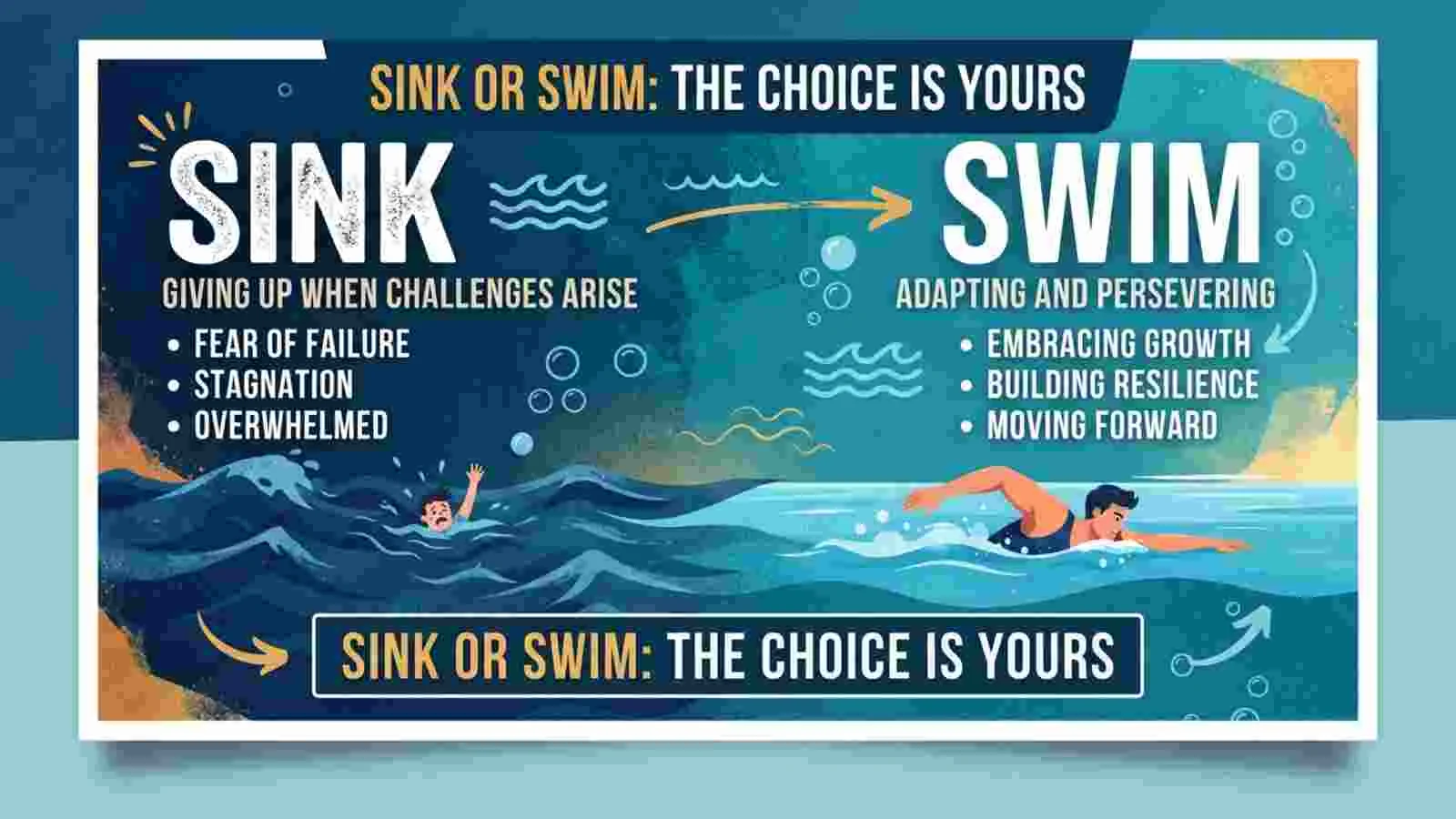
“Sink or swim” means you must succeed on your own or face failure — you have to deal with a hard task with little or no help. The idiom comes from the literal idea of swimming to stay safe in water instead of sinking; today people use it for work, school, business and everyday life.
Have you ever faced a hard task with no help and had to find a way to succeed?
You may have heard someone say, “It is sink or swim.” But what does this phrase mean, and when should you use it?
“Sink or swim” is a popular idiom because people want to understand what it means in daily talks, books, movies, and work settings.
It may sound like it refers to water, but people often use it to talk about life, work, school, or other hard times.
“Sink or swim” means you must succeed on your own or face failure. It describes a time when you have to deal with a hard task without much help. You must learn, act, and find a way to move forward.
For example, a new worker may have to learn a job with little training. A student may need to prepare for a hard test alone. In both cases, the person is in a sink-or-swim situation.
This guide explains the meaning, origin, correct use, common mistakes, and real-life examples of “sink or swim.” It also answers common questions to help you use this phrase with confidence.
Sink or Swim Meaning – Quick Answer
Sink or swim means to succeed or fail when you must face a challenge, often without help.
The phrase comes from the idea of being in water. If you can swim, you stay safe. If you cannot, you may sink. In daily English, it describes situations where people must manage a task on their own.
Examples:
- At work: “My first week was sink or swim because no one trained me.”
- At school: “The teacher gave us a hard project and told us to sink or swim.”
- In life: “Moving to a new city alone was a sink-or-swim experience.”
- In business: “The small company had to sink or swim during its first year.”
The phrase can describe both positive and negative situations. It may show courage, independence, or a lack of support.
The Origin of “Sink or Swim”
The expression “sink or swim” comes from the literal actions of sinking and swimming in water. These actions show two different results: failure or survival.
The phrase became a way to describe situations in which a person must face a challenge and deal with the result. It reflects the idea that someone must learn a skill or solve a problem to succeed.
Over time, people began using it in many areas of life. It no longer refers only to swimming. Today, it can describe a new job, a difficult exam, a business challenge, or a major life change.
For example:
“She joined the team with no training. It was sink or swim.”
This means she had to learn the job quickly and manage the challenge herself.
The phrase is used in both British and American English. Its meaning stays the same in both forms. The main point is the challenge, not the country or spelling.
British English vs American English Spelling
“Sink or swim” has the same spelling in British English and American English. Unlike words such as “colour” and “color,” this phrase does not change between the two forms of English.
However, the phrase may appear with or without hyphens, based on how it is used in a sentence.
| Form | Correct use | Example |
| Sink or swim | Standard phrase | You must sink or swim. |
| Sink-or-swim | Before a noun | It was a sink-or-swim test. |
| Sink or Swim | Title capitalization | Sink or Swim: A New Challenge |
| Sink and swim | Usually not the intended idiom | Use “sink or swim” for this meaning. |
Why Does the Hyphen Matter?
Use sink or swim when the phrase stands alone in a sentence.
Example: “The new staff must sink or swim.”
You can use sink-or-swim before a noun when it acts as a compound modifier.
Example: “The company has a sink-or-swim culture.”
Style guides may vary on hyphenation, so follow the rules used by your school, workplace, or publication.
Which Form Should You Use?
You can use “sink or swim” in the United States, the United Kingdom, Canada, Australia, and other English-speaking countries. The phrase is widely understood.
- For American readers: Use “sink or swim” in everyday speech, emails, and articles.
- For British readers: Use the same phrase. No spelling change is needed.
- For Canadian and Australian readers: The same wording is correct.
- For global readers: Explain the phrase if your audience is learning English.
In formal writing, choose your words with care. “Sink or swim” is common and clear, but it can sound harsh when it describes a lack of support.
For example, instead of writing, “New workers must sink or swim,” you could write, “New workers must learn quickly and work with limited support.”
Both sentences describe a similar situation, but the second sounds more neutral and professional.
Common Mistakes with “Sink or Swim”
English learners and native speakers may make a few mistakes when using this phrase.
1. Changing “or” to “and”
Incorrect: “The new student must sink and swim.”
Correct: “The new student must sink or swim.”
The word or shows two possible results: success or failure.
2. Using the Phrase Only for Water
The phrase can describe real swimming, but it is also an idiom.
Example: “Starting my own business was sink or swim.”
This means the person had to work hard to make the business succeed.
3. Adding Unneeded Words
Incorrect: “He had to either sink or to swim.”
Better: “He had to sink or swim.”
The shorter form is more natural and widely used.
4. Using Hyphens Everywhere
Incorrect: “I had to sink-or-swim during my first day.”
Better: “I had to sink or swim during my first day.”
Use hyphens mainly when the phrase comes before a noun as a modifier, depending on your chosen style guide.
5. Thinking It Always Means Failure
The phrase does not mean that failure is certain. It means a person must face a challenge where success and failure are both possible.
Example: “The new manager faced a sink-or-swim situation and did very well.”
“Sink or Swim” in Everyday Examples
This phrase fits many situations. Here is how you can use it in different forms of communication.
In Emails
“The new team members will need support during their first week so they do not feel they must sink or swim.”
This use is suitable for a workplace email. It shows concern about training and support.
In News Writing
“The small business faced a sink-or-swim moment after its main supplier closed.”
This means the business had to act quickly to survive.
On Social Media
“First day at college, new people, new rules. It is sink or swim!”
This informal example shows the challenge of adapting to a new place.
In Formal Writing
“Without proper training, new employees may face a sink-or-swim environment.”
This sentence can work in a report about staff training or workplace management.
In Everyday Conversation
“My parents let me cook dinner on my own. It was sink or swim!”
This means the speaker had to try without much help.
Sink or Swim – Google Trends and Usage Data

“Sink or swim” is an established English idiom. People may search for it when they read it in a book, hear it in a film, or see it in a work or school setting.
Search interest can vary by country and over time. However, exact rankings and search volumes should be checked in current keyword tools rather than guessed.
Here are common contexts in which people may look up the phrase:
| Context | Likely search intent |
| Education | Understanding a hard learning experience |
| Work | Describing a job with little training |
| Business | Facing a risk or major decision |
| Personal growth | Learning to manage life alone |
| English learning | Understanding an idiom and its examples |
To compare interest in the United States, United Kingdom, Canada, and Australia, use Google Trends and search for “sink or swim.” Select the countries and a time range, then compare interest over time.
Remember that Google Trends shows relative search interest, not exact monthly search volume. For keyword planning, you can also check Google Keyword Planner or another SEO keyword tool.
FAQs About Sink or Swim Meaning
1. What does “sink or swim” mean in simple words?
It means you must try to succeed or risk failing, often without much help.
2. Is “sink or swim” an idiom?
Yes. It is an idiom because its common meaning goes beyond the literal actions of sinking and swimming in water.
3. Is “sink or swim” positive or negative?
It can be either. It may show courage and independence, but it can also describe a situation where a person receives too little help.
4. What is an example of “sink or swim”?
“On my first day at work, I had to sink or swim because my manager was away.”
This means the speaker had to manage the work without much guidance.
5. Is “sink-or-swim” hyphenated?
It is often hyphenated when it comes before a noun, as in “a sink-or-swim approach.” When used as a phrase on its own, write “sink or swim.”
6. Is “sink or swim” used in British and American English?
Yes. Both British and American English use the same phrase with the same meaning.
7. What is another way to say “sink or swim”?
Similar expressions include “make it or fail,” “manage on your own,” and “learn the hard way.” The best choice depends on the sentence and tone.
8. Where does “sink or swim” come from?
The expression comes from the literal actions of sinking and swimming in water: if you can swim, you stay safe; if you cannot, you sink. Over time it became a way to describe any challenge where a person must succeed on their own or fail.
9. What does “sink or swim” mean in business?
In business, it describes a new employee, team or company that must manage on its own — for example, a small business that has to win customers or close, or a new hire who must learn the job fast with little training.
10. Can “sink or swim” be used in formal writing?
Yes, but use it with care. It is common and clear, but it can sound harsh when it describes a lack of support. In formal writing, you can write “New workers must learn quickly and work with limited support” instead.
Conclusion
The phrase “sink or swim” means that a person must face a challenge and try to succeed, often with little help.
It comes from the idea of staying safe in water by swimming instead of sinking. Today, people use it to describe challenges at work, school, in business, and in daily life.
The phrase has the same spelling and meaning in British and American English. Write “sink or swim” when it stands alone. Use “sink-or-swim” before a noun when your chosen style guide calls for a hyphen, as in “a sink-or-swim situation.”
Remember that this expression can have both positive and negative meanings. It can show courage and independence, but it can also suggest that someone has not received enough support.
Choose it when you want to describe a situation where success depends on how well a person responds to a challenge.
Once you understand its meaning and use, you can add “sink or swim” to your everyday English, emails, articles, and conversations with confidence.
Continue Reading:
- Rhyme or Reason Meaning: Definition, Origin, and Examples (for 2026)
- Victory or Death: Is It a Motto, Slogan, or Battle Cry (for 2026)
- Holiday This or That: Complete Meaning, Rules, and Usage ( for 2026)

Mary Roach is an American science writer and bestselling author known for making unusual and complex scientific topics engaging, accessible, and humorous. Her books include Stiff, Packing for Mars, Gulp, and Fuzz.
Author at Simifind.com, sharing clear, informative content designed to help readers understand interesting topics and everyday questions.








3 thoughts on “Sink or Swim Meaning: Definition, Origin, and Examples (for 2026)”