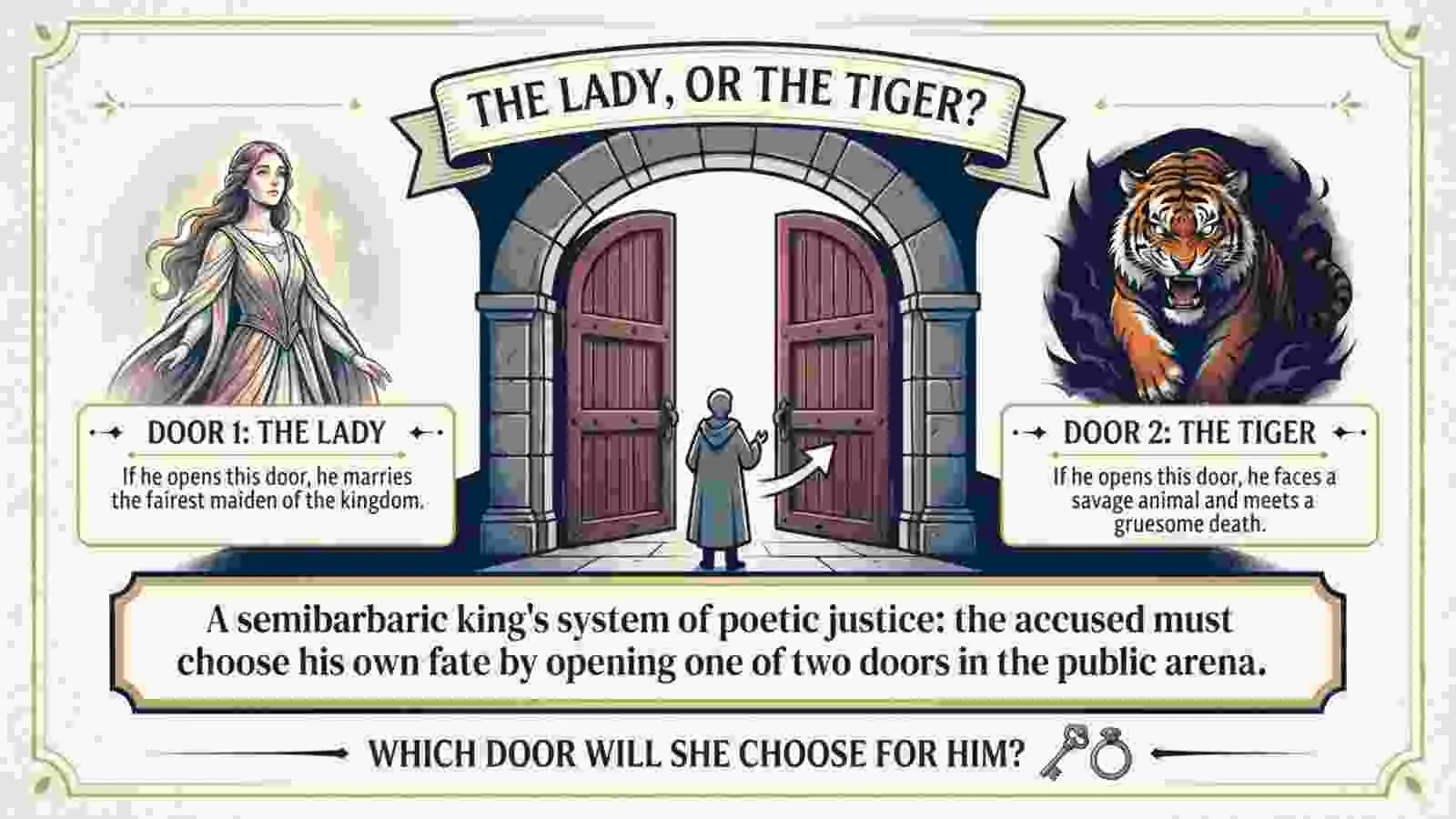
“The Lady, or the Tiger?” is a short story by Frank R. Stockton, first published in 1882. A princess must choose which of two doors her lover will open: behind one is a beautiful lady, behind the other a hungry tiger. The story ends without telling us which door she chooses — the ending is deliberately left open.
Have you ever faced a choice where both options seem hard?
The phrase “The Lady or the Tiger” brings this kind of choice to mind. People often search for “lady or the tiger” to learn its meaning, find the correct title, or understand the story behind these words.
The Lady, or the Tiger? is a famous short story by Frank R. Stockton, first published in 1882. It tells the story of a princess who must make a painful choice.
Her lover stands before two doors. One door hides a beautiful woman, while the other hides a hungry tiger. The choice will decide his future.
Many readers also search for this phrase because they want to know its message, ending, and use in daily speech. It is not a spelling choice like “color” and “colour.”
Instead, it is the title of a classic story and a phrase used to describe a difficult choice with an unknown result.
This guide explains the meaning, origin, correct spelling, common mistakes, and everyday use of “The Lady, or the Tiger?” It also answers common questions for students, readers, and English learners.
Lady or the Tiger – Quick Answer
“The Lady, or the Tiger?” is the correct title of a short story by Frank R. Stockton. It was first published in 1882.
The story asks a difficult question: Will the princess send her lover to another woman, or will she send him to a deadly tiger?
The phrase can also describe a choice between two very different outcomes when the result is unknown.
Examples:
- “I feel like I am facing the lady or the tiger.” This means the speaker faces a risky choice.
- “The ending of The Lady, or the Tiger? is still debated.” This refers to the story’s open ending.
- “Should he trust his friend or walk away? It is a lady-or-the-tiger moment.” This describes a choice with serious consequences.
Remember that “lady” and “tiger” are not alternative spellings. They name the two possible outcomes in the story.
The Origin of Lady or the Tiger
The phrase comes from Frank R. Stockton’s short story The Lady, or the Tiger? The story appeared in 1882 and became famous for its unusual ending.
The story takes place in a kingdom ruled by a king who uses a public test to decide a person’s fate. A person accused of a crime must choose between two doors. Behind one door is a lady. Behind the other is a tiger.
The king’s daughter falls in love with a young man. When the king learns about their relationship, the young man faces this test. The princess learns what lies behind each door, but she must decide which door to direct her lover toward.
The story ends without telling readers which door the princess chooses. This makes readers think about love, jealousy, fairness, and human nature.
The words themselves have different histories. “Lady” comes from an Old English word linked to a woman of high rank. “Tiger” came into English through older European language forms, ultimately from a word of Iranian origin.
The word “or” shows a choice between two options. In the story, the comma in the title adds a pause before the question’s final choice.
British English vs American English Spelling
There is no British or American spelling difference in “The Lady, or the Tiger?” The title uses the same words in both forms of English.
British and American writers may follow slightly different punctuation or style-guide rules. However, these differences do not change the spelling or meaning of the title.
| Feature | British English | American English |
| Correct title | The Lady, or the Tiger? | The Lady, or the Tiger? |
| Word “lady” | Lady | Lady |
| Word “tiger” | Tiger | Tiger |
| Word “or” | Or | Or |
| Story author | Frank R. Stockton | Frank R. Stockton |
| First publication | 1882 | 1882 |
| Main meaning | A story about a difficult choice | A story about a difficult choice |
Correct Title and Capitalization
When writing the story’s title, capitalize the main words:
- Correct: The Lady, or the Tiger?
- Incorrect: the lady or the tiger when used as a formal title
- Incorrect: The Lady, Or The Tiger — the original title uses a lowercase “or”
In ordinary sentences, you do not need to capitalize every word. For example, “She faced a lady-or-the-tiger choice” uses the phrase descriptively, not as the formal title.
Which Spelling Should You Use?
Since the words are spelled the same in British and American English, you do not need to choose between regional forms.
For American Readers
Use The Lady, or the Tiger? when discussing the story in school essays, book reviews, or literary articles. Keep the title’s punctuation when you can.
For British and Commonwealth Readers
Use the same title. The words “lady”, “tiger” and “or” do not change between British and American English.
For Global Readers
Use the full title on the first mention. You can write “Stockton’s story” or “the story” later to avoid repetition.
If you use “lady or the tiger” as a general expression, explain its meaning the first time. Some readers may not know the original story.
Common Mistakes with Lady or the Tiger
Readers and writers often make these mistakes when discussing the phrase.
1. Treating It as a Spelling Comparison
The phrase is not like “theater or theatre.” “lady” and “tiger” have different meanings and refer to the two possible outcomes in the story.
Correction: Explain the story or the difficult choice instead of comparing spellings.
2. Leaving Out the Word “The”
The original title begins with “The.”
Correct: The Lady, or the Tiger?
Incorrect: Lady or Tiger? when giving the exact title.
3. Forgetting the Question Mark
The original title ends with a question mark because it raises an unresolved question.
Correction: Use the full title when referring to Stockton’s story.
4. Giving a Definite Ending
The story does not reveal which door the princess chooses. Readers must decide what they think happened.
Correction: Describe the ending as open or ambiguous rather than claiming that the author confirms one outcome.
5. Using the Phrase Without Context
Some readers may not understand “a lady-or-the-tiger choice.”
Correction: Add a short explanation, such as “a choice between two uncertain outcomes.”
Lady or the Tiger in Everyday Examples
The phrase is mainly used in literature, education, and discussions about difficult decisions. It can also work as a comparison in everyday writing.
In Emails
“I read The Lady, or the Tiger? for class, and I would like to discuss its open ending.”
This is suitable for an email to a teacher or classmate.
In News and Articles
“The election presents a lady-or-the-tiger moment for voters, with two very different possible outcomes.”
This is a figurative use. It does not refer to the original story directly, but it uses the story’s idea of a difficult choice.
On Social Media
“Finished ‘The Lady, or the Tiger?’ What do you think the princess chose?”
This invites readers to share their views about the story.
In Formal Writing
“Frank R. Stockton’s The Lady, or the Tiger? explores jealousy, love, and the uncertainty of human decisions.”
This sentence works well in a school essay or literary review.
In Everyday Conversation
“My job offer feels like the lady or the tiger. One option is safe, but the other could change my life.”
This uses the phrase to describe a choice with uncertain results.
Lady or the Tiger – Google Trends & Usage Data
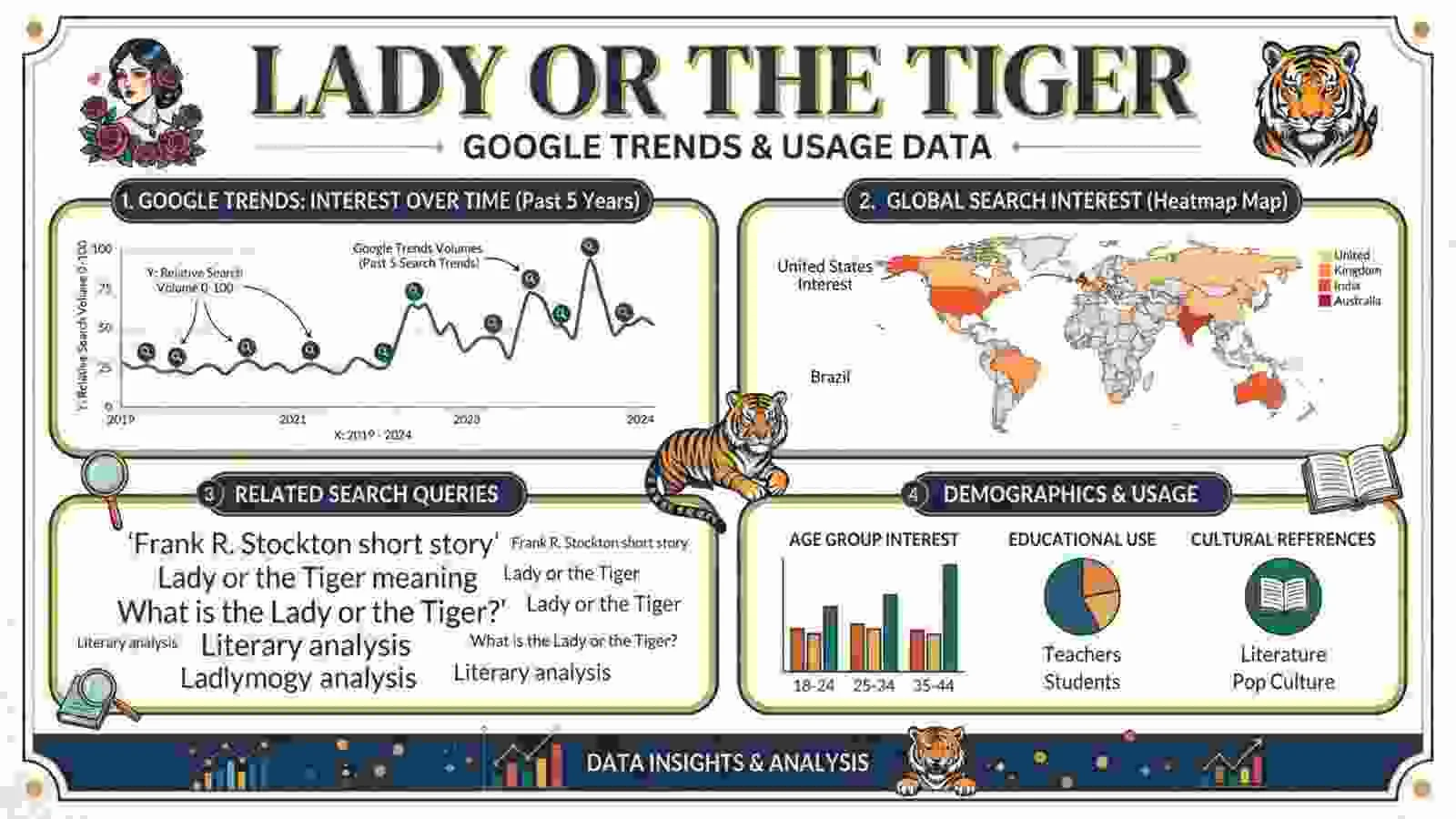
People may search for “lady or the tiger” for several reasons:
- Schoolwork: Students look for summaries, themes, character analysis, and the story’s ending.
- Literature: Readers want to learn about Frank R. Stockton and his famous short story.
- Meaning: English learners want to understand the phrase and its use in conversation.
- Essay writing: Writers search for ways to explain the story’s themes of choice, jealousy, and uncertainty.
- Quotations and discussion: Readers want to explore the ending and decide what the princess might have done.
The phrase is closely linked to English-language literature and school reading lists. Searches may come from the United States, the United Kingdom, Canada, Australia, and other English-speaking regions. However, these are likely audience groups, not verified rankings.
Google Trends data changes over time and by location. Without a current Trends report, it would be misleading to give exact search volumes or claim that one country ranks first.
For SEO, related terms include “The Lady or the Tiger summary,” “The Lady or the Tiger ending explained,” “Frank R. Stockton story,” “The theme,” and “The Lady or the Tiger meaning.”
Comparison Table: Phrase Variations
| Phrase | Correct? | Meaning or Use |
| The Lady, or the Tiger? | Yes | The original story title |
| The Lady or the Tiger | Yes, in general references | A shortened form without the original punctuation |
| Lady or tiger | Sometimes | An informal shortened phrase |
| The Lady and the Tiger | Not the original title | Changes “or” to “and” |
| Lady-or-the-tiger choice | Yes, as a figurative expression | A choice between uncertain outcomes |
| The Lady, Or The Tiger? | Not the original capitalization | Uses unnecessary capitalization for “or” in the original title |
FAQs About Lady or the Tiger
1. What does “The Lady or the Tiger” mean?
It refers to a short story about a person who must choose between two doors. One hides a lady, and the other hides a tiger. The phrase can also describe a difficult choice with an uncertain result.
2. Who wrote The Lady, or the Tiger?
Frank R. Stockton wrote the story. It was first published in 1882.
3. Is there a spelling difference?
No. “Lady” and “tiger” are different words, not alternative spellings. The phrase refers to the story or a choice between two possible outcomes.
4. Is the story’s ending clear?
No. The story ends without revealing which door the princess chooses. This open ending encourages readers to form their own conclusions.
5. Is the title different in British and American English?
No. The title is written the same way in both forms of English: The Lady, or the Tiger?
6. What are the main themes of the story?
The main themes include love, jealousy, choice, fairness, human nature, and uncertainty. The story also asks readers to think about how emotions affect decisions.
7. Can I use “lady or the tiger” in everyday writing?
Yes. You can use it as a figurative expression for a difficult choice with uncertain results. Give readers enough context so they understand the comparison.
8. What is a summary of ‘The Lady or the Tiger’?
In a semi-barbaric kingdom, a king puts accused people on trial in an arena with two doors: behind one is a beautiful lady, behind the other a hungry tiger. When the princess falls in love with a young man of low rank, the king has him tried in the arena. The princess knows what is behind each door and must point her lover to one of them — but the story ends without telling us which door she chooses.
9. Who are the characters in ‘The Lady or the Tiger’?
The main characters are the semi-barbaric king, his daughter the princess, her lover (a young man of low rank), and the beautiful lady behind one of the doors.
Conclusion
The phrase “lady or the tiger” refers to a famous short story by Frank R. Stockton, first published in 1882. Its correct title is The Lady, or the Tiger?
The story follows a young man who must choose between two doors, one hiding a lady and the other hiding a tiger. The princess knows what is behind each door, but readers never learn which one she chooses.
The phrase is not a British-versus-American spelling issue. Both forms of English use the same words and spelling. The main points to remember are the original title, its question mark, and its meaning.
When writing about the story, use the full title in essays, reviews, and school assignments. When using the phrase in daily speech, explain that it describes a choice between two uncertain outcomes. This helps readers understand the comparison.
For SEO content, focus on search intent by answering questions about the story’s meaning, author, themes, and ending.
Avoid claiming exact Google Trends rankings without current data. Clear wording, accurate facts, and helpful examples make the article useful to both students and general readers.
Continue Reading:
- Friend or Foe Meaning: Definition, Origin, and Examples (for 2026)
- Sink or Swim Meaning: Definition, Origin, and Examples (for 2026)
- Rhyme or Reason Meaning: Definition, Origin, and Examples (for 2026)

Mary Roach is an American science writer and bestselling author known for making unusual and complex scientific topics engaging, accessible, and humorous. Her books include Stiff, Packing for Mars, Gulp, and Fuzz.
Author at Simifind.com, sharing clear, informative content designed to help readers understand interesting topics and everyday questions.








3 thoughts on “The Lady or the Tiger: Meaning, Story, and Ending Explained (for 2026)”