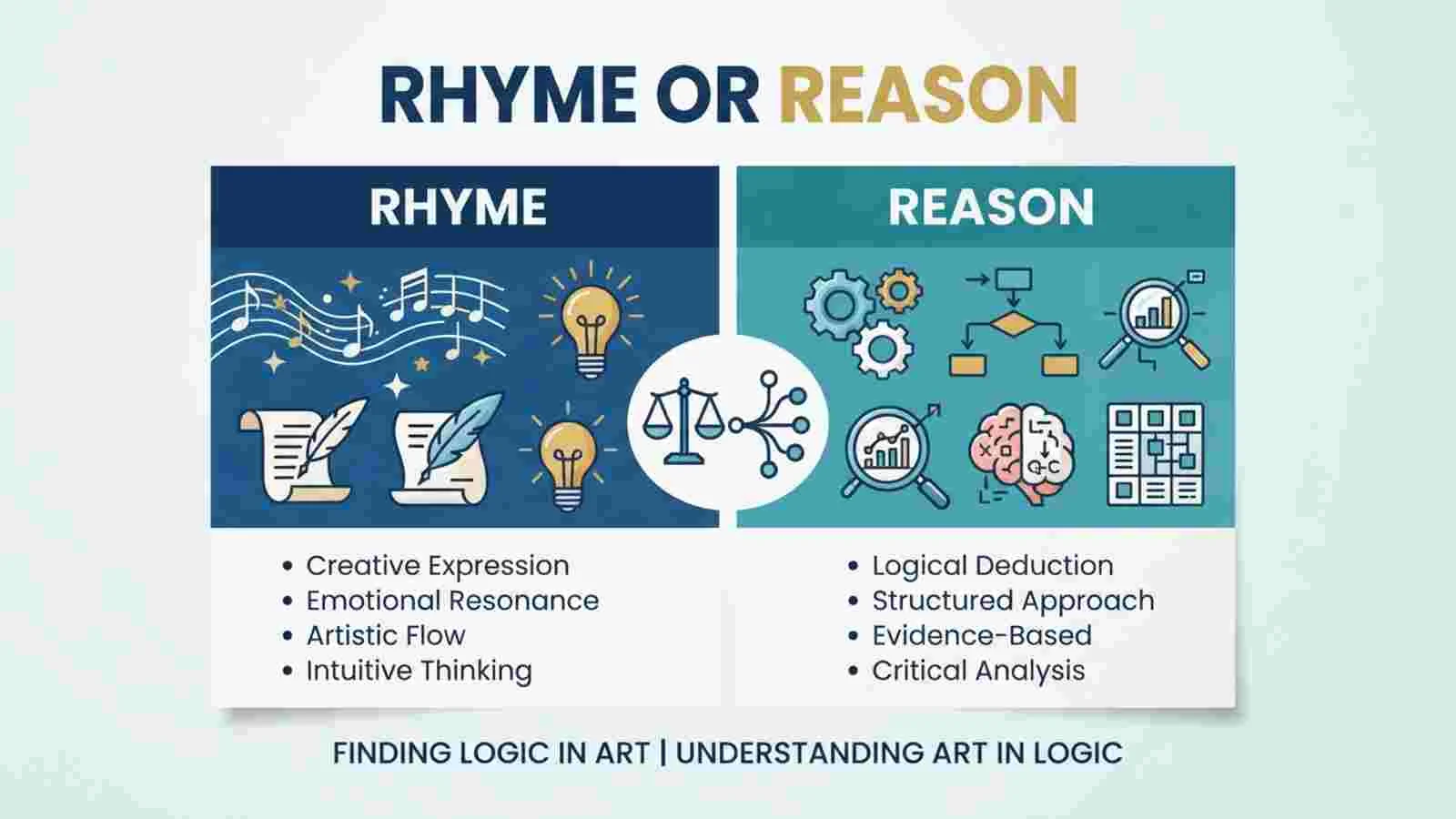
“Rhyme or reason” means the logic, sense or clear explanation behind something. The phrase is most often used in the negative form — “no rhyme or reason” — to say that something has no clear logic or pattern and seems random: “There is no rhyme or reason to these rules.”
Have you ever heard someone say, “There is no rhyme or reason for this,” and wondered what they meant?
This phrase is common in everyday English. People use it when something seems random, confusing, or hard to explain.
If you are learning English, you may wonder whether “rhyme or reason” has a special meaning or refers to poetry and logic.
The phrase “rhyme or reason” means a clear sense, logic, or explanation behind something.
When people say there is “no rhyme or reason,” they mean that something seems to have no clear purpose, order, or logical explanation.
People search for this phrase to understand its definition, learn how to use it in sentences, and avoid common mistakes.
It often appears in conversations, books, news stories, emails, and social media posts.
In this guide, you will learn the meaning of “rhyme or reason,” its historical background, its use in British and American English, and examples from everyday life.
You will also discover common errors and answers to frequently asked questions. By the end, you will know how to use this useful English expression with confidence.
Rhyme or Reason Meaning – Quick Answer
“Rhyme or reason” means logic, sense, or a clear explanation behind something. The phrase is most often used in the expression “no rhyme or reason.”
When someone says there is no rhyme or reason for something, they mean it seems random or does not follow a clear pattern.
Simple Examples
- There is no rhyme or reason to his choices. His choices seem random.
- I cannot find any rhyme or reason for these changes. I cannot understand why the changes happened.
- The teacher arranged the books with rhyme or reason. The arrangement had a clear order or purpose.
- There seems to be no rhyme or reason behind the decision. The decision appears to lack logic.
The phrase is an idiom. Its meaning is not simply the meaning of the two words placed together.
The Origin of Rhyme or Reason
The expression “rhyme or reason” has a long history in English. The word rhyme refers to words that have similar ending sounds, while reason refers to logic, sense, or a cause.
The phrase connects two ideas: a pattern and a logical explanation. Together, they suggest that something should have a clear order or make sense.
The expression became established in English centuries ago. It is often associated with the older phrase “neither rhyme nor reason,” which describes something that lacks sense, order, or a clear plan.
Over time, people began using the phrase in many situations. It can describe a confusing decision, an unusual event, a messy room, or a set of actions that seem random.
Why Does the Phrase Have Two Words?
The two words work together to express a broader idea.
- Rhyme: A pattern in sound or language.
- Reason: A logical explanation or purpose.
For example, imagine someone puts books, shoes, and kitchen tools in one box without any plan. You might say, “There is no rhyme or reason to this arrangement.”
The phrase does not refer only to poetry or music. It is an idiom used to describe a lack of order or logic.
British English vs American English Spelling
There is no spelling difference between British and American English for the phrase “rhyme or reason.” Both varieties use the same words and spelling.
The phrase also keeps the same basic meaning in both countries. Differences may appear in the surrounding vocabulary or sentence style, but the idiom itself remains unchanged.
Comparison Table
| Feature | British English | American English |
| Correct phrase | Rhyme or reason | Rhyme or reason |
| Common expression | No rhyme or reason | No rhyme or reason |
| Meaning | No clear logic or pattern | No clear logic or pattern |
| Rhyme spelling | R-h-y-m-e | R-h-y-m-e |
| Reason spelling | R-e-a-s-o-n | R-e-a-s-o-n |
| Common context | Conversation and writing | Conversation and writing |
Examples in Both Varieties
British English: “There is no rhyme or reason to the way these files are arranged.”
American English: “There is no rhyme or reason to the way these files are arranged.”
Both sentences are correct. Neither country uses a different spelling for this expression.
Which Spelling Should You Use?
You should always write “rhyme or reason.” The phrase has no alternative British or American spelling.
Your choice should depend on the meaning and context of the sentence, not your location.
For American Readers
Use “rhyme or reason” in schoolwork, emails, articles, and everyday conversations.
Example: “There is no rhyme or reason behind the sudden price changes.”
For British and Commonwealth Readers
The same expression works in British English and other English-speaking countries, including Australia, Canada, and New Zealand.
Example: “There appears to be no rhyme or reason for the delay.”
For Global Readers
If you write for an international audience, choose simple sentences that make the idiom clear.
Example: “The rules seem random, with no rhyme or reason behind them.”
If your readers are learning English, explain the phrase the first time you use it. You can write, “There is no rhyme or reason to the decision — there is no clear logic behind it.”
Common Mistakes with Rhyme or Reason
Although this expression is simple, English learners sometimes misunderstand or misuse it.
1. Using “Rime” Instead of “Rhyme”
Incorrect: There is no rime or reason for this.
Correct: There is no rhyme or reason for this.
“Rhyme” is the standard spelling used in the idiom.
2. Thinking It Only Refers to Poetry
The word “rhyme” can relate to poetry, but the full phrase has a wider meaning.
Incorrect idea: The phrase only describes poems that do not make sense.
Correct understanding: It describes something that seems to lack logic, order, or a clear explanation.
3. Using the Phrase Without Understanding Its Meaning
Unclear: The room has rhyme or reason.
Clear: The room has no rhyme or reason; everything is scattered around.
You can use the phrase in a positive sense, but the negative form is much more common.
4. Writing “Rhyme and Reason” When You Mean the Idiom
“Rhyme and reason” can appear in ordinary writing, but the familiar expression is often “no rhyme or reason” or “neither rhyme nor reason.”
Example: “I cannot see any rhyme or reason behind the changes.”
5. Treating the Phrase as a Literal Question
The phrase does not usually ask whether something rhymes or has a reason. It is an idiom that describes logic, order, or the lack of them.
Rhyme or Reason in Everyday Examples
This expression works in many everyday situations. Here are examples of how people use it.
In Emails
“Could you explain the changes to the schedule? I cannot see any rhyme or reason behind them.”
This is useful when you need a clear explanation for a confusing decision.
In News Writing
“The new policy appeared to have no rhyme or reason, leaving residents unsure about what would happen next.”
News writers may use the expression to describe rules, decisions, or events that seem inconsistent.
On Social Media
“Why does this app keep changing its settings? There is no rhyme or reason!”
This casual use shows frustration with something that seems random.
In Formal Writing
“The committee’s decisions appeared to follow no consistent principle, with no clear rhyme or reason behind the changes.”
In formal writing, you may choose a more direct phrase such as “lacked a clear rationale” or “showed no consistent pattern.”
In Daily Conversation
“My brother buys things without any rhyme or reason.”
This means his buying choices seem random or lack a clear plan.
Comparison Table: Similar Expressions
| Expression | Meaning | Example |
| No rhyme or reason | No clear logic or pattern | There is no rhyme or reason to the rules. |
| No logical explanation | No clear reason | There is no logical explanation for the delay. |
| Random | Without a clear plan or pattern | The results seem random. |
| Make no sense | Be hard to understand | His answer makes no sense. |
| Without a purpose | With no clear goal | The meeting seemed to have no purpose. |
Rhyme or Reason – Google Trends & Usage Data

“Rhyme or reason” is an established English idiom used in conversation, literature, news, and online writing. However, its exact popularity can change by country, time, and search context.
Without current Google Trends data, it would not be accurate to claim that a particular country searches for the phrase the most or to provide exact search-volume figures.
What Influences Search Interest?
People may search for “rhyme or reason meaning” when they encounter the phrase in a book, film, article, conversation, or English lesson.
Search interest may come from several types of users:
- English learners: People who want to understand idioms.
- Students: People studying vocabulary and figurative language.
- Writers: People looking for correct usage and examples.
- General readers: People who encounter the expression online or in conversation.
How to Check Its Popularity
You can use Google Trends to compare interest in “rhyme or reason,” “no rhyme or reason,” and “rhyme or reason meaning.”
Choose a time range, such as the past 12 months or five years, and compare countries such as the United States, the United Kingdom, Canada, and Australia.
Remember that Google Trends reports relative search interest, not exact monthly search volumes. A Trends score of 100 represents the highest relative interest within the selected comparison, not 100 searches.
For readers, the most useful parts are the definition, sentence examples, origin, synonyms, and correct usage. These topics explain the idiom clearly, without relying on unsupported popularity claims.
Frequently Asked Questions
1. What does “rhyme or reason” mean?
“Rhyme or reason” refers to logic, sense, order, or a clear explanation. The expression is commonly used in the negative phrase “no rhyme or reason.”
2. What does “no rhyme or reason” mean?
It means that something seems random, confusing, or without a clear explanation.
Example: “There is no rhyme or reason to these sudden changes.”
3. Is “rhyme or reason” an idiom?
Yes. It is an English idiom whose meaning goes beyond the literal meanings of the words “rhyme” and “reason.”
4. Is there a difference between British and American English?
No. British and American English use the same spelling and meaning: “rhyme or reason.”
5. Can I use “rhyme or reason” in formal writing?
Yes, but consider your audience. For academic or technical writing, phrases such as “no logical explanation” or “no consistent pattern” may be more precise.
6. What is another way to say “no rhyme or reason”?
You can say “no clear logic,” “no apparent explanation,” “no consistent pattern,” or “without a clear purpose.” Choose the expression that best fits your sentence.
7. What is an example of “rhyme or reason” in a sentence?
“There seems to be no rhyme or reason behind the company’s sudden decision to change its plans.”
This means the decision has no clear or understandable explanation.
8. Where does “rhyme or reason” come from?
The expression has a long history in English. It is linked to the older phrase “neither rhyme nor reason,” which describes something that lacks sense, order, or a clear plan.
9. What is the difference between “rhyme or reason” and “neither rhyme nor reason”?
There is no real difference in meaning — both phrases describe a lack of logic or a clear explanation. “Neither rhyme nor reason” is simply the older, more formal form of the phrase.
10. Can “rhyme or reason” be used in a positive sentence?
Yes. You can say, “There is rhyme and reason to her choices,” meaning that her choices follow a clear logic. But the negative form, “no rhyme or reason,” is much more common.
Conclusion
The phrase “rhyme or reason” is a useful English idiom that describes logic, sense, order, or a clear explanation.
It is most often found in expressions such as “no rhyme or reason” and “neither rhyme nor reason.” These phrases describe situations that seem random, confusing, or difficult to explain.
The expression has the same spelling and basic meaning in British and American English. You do not need to choose between regional spelling forms. Instead, focus on using the phrase in the right context.
For example, you might say, “There is no rhyme or reason to these rules,” when the rules seem inconsistent.
In formal writing, you can use alternatives such as “no logical explanation” when you want a more direct tone.
If you are learning English, remember that the phrase is not limited to poems or sounds. It is about whether something makes sense or follows a clear pattern.
Learning this idiom will help you understand conversations, read English more confidently, and express your ideas in a natural way.
Continue Reading:
- Victory or Death: Is It a Motto, Slogan, or Battle Cry (for 2026)
- Holiday This or That: Complete Meaning, Rules, and Usage ( for 2026)
- Niacinamide Morning or Night: When Should You Use It? (for 2026)

Here’s a concise 2-line author bio suitable for Simifind.com:
James Dashner is an American bestselling author best known for The Maze Runner series and other popular young-adult fiction.
On Simifind.com, he shares clear, engaging insights and helpful content for readers interested in books, writing, and popular literature.








3 thoughts on “Rhyme or Reason Meaning: Definition, Origin, and Examples (for 2026)”