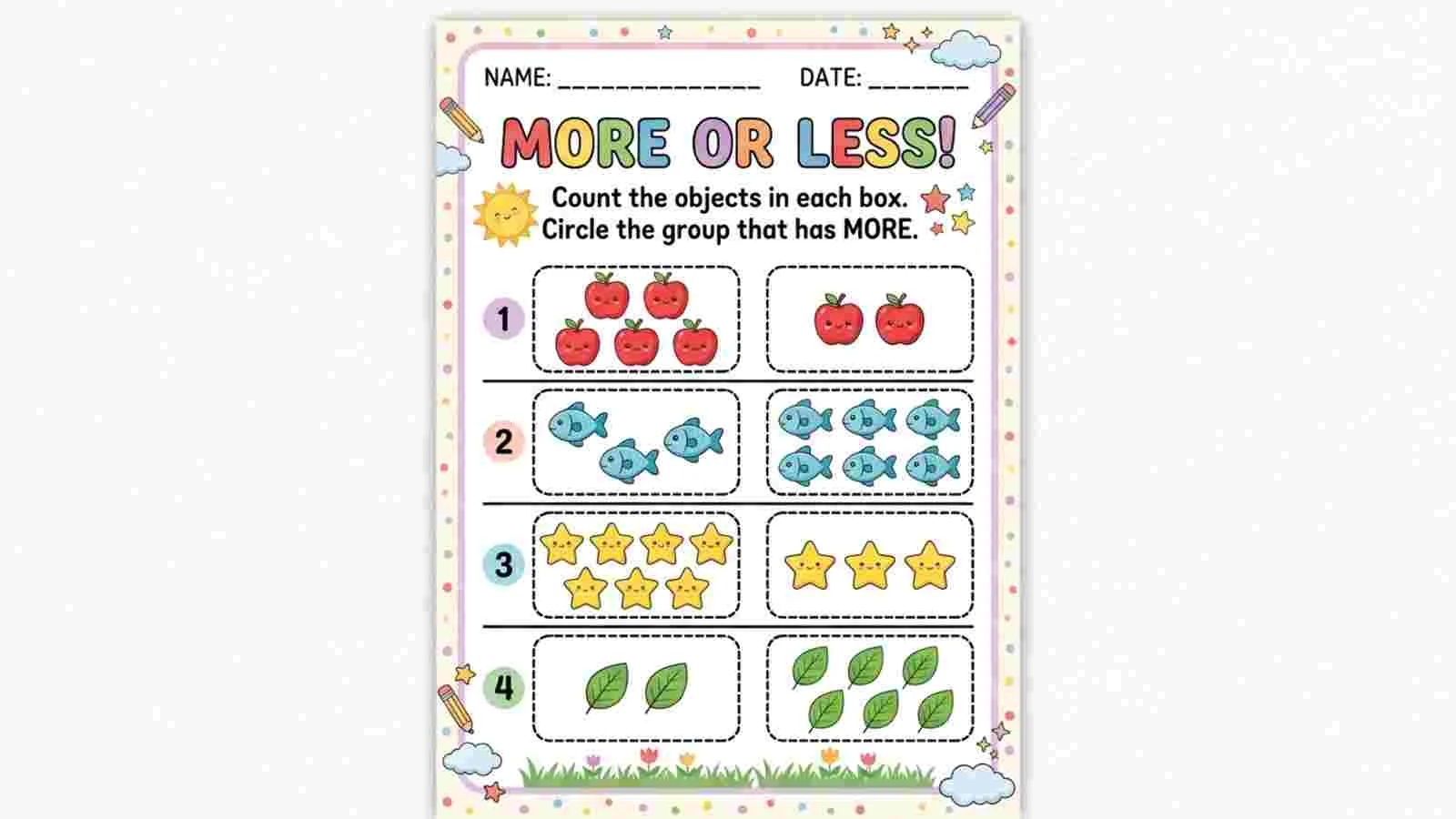
More or less worksheets are math practice pages that teach children to compare numbers and amounts — for example, 8 is more than 5 and 3 is less than 7. They suit preschool, kindergarten, and early elementary children, and use pictures, counting, and simple number exercises.
Learning math can be fun when children use simple and clear worksheets.
More or less worksheets help kids learn how to compare numbers, count objects, and understand which number is bigger or smaller.
These worksheets are useful for preschoolers, kindergarten students, and early elementary learners.
Many parents and teachers search for more or less worksheets to help children build basic math skills.
Some kids can count well but still find it hard to tell which group has more objects or which number is less.
These worksheets make this task easier through pictures, number lines, counting exercises, and simple questions.
Children can practice at home, in the classroom, or during extra study time. Teachers can also use these pages for homework, classroom activities, and quick math tests.
Parents can print them to give their children extra practice without needing special tools.
In this guide, you will learn what more or less worksheets are, how to use them, and how to choose the right activities for your child’s age.
You will also find examples, common mistakes, and helpful tips for making math practice simple and enjoyable.
More or Less Worksheets – Quick Answer
More or less worksheets are math practice pages that teach children to compare amounts and numbers. They help kids understand whether one group has more items, fewer items, or the same number of items as another group.
For example:
- More: 8 is more than 5.
- Less: 3 is less than 7.
- Equal: 4 is equal to 4.
Children may compare pictures, count objects, fill in missing numbers, or choose the correct answer.
Example of a More or Less Worksheet
| Question | Answer |
| Which is more: 6 or 9? | 9 |
| Which is less: 2 or 5? | 2 |
| Fill in the blank: 4 is ___ than 7. | Less |
| Fill in the blank: 8 is ___ than 3. | More |
| Are 5 and 5 equal? | Yes |
These activities help children develop number sense and prepare for addition, subtraction, and other math skills.
The Origin of More or Less Worksheets
The phrase more or less worksheets combines common English words with a term used for learning materials.
The word more refers to a greater amount or number. The word less refers to a smaller amount or degree. Both words have a long history in English.
The word more comes from Old English māra, while less comes from Old English lǣssa. Both words have been used for centuries to compare amounts.
A worksheet is a page or document with tasks for students to complete. Worksheets became a common teaching tool as schools developed printed exercises for classroom learning and independent practice.
Today, more or less worksheets are available in printed books, downloadable PDFs, and online learning platforms. Many include colorful pictures, counting games, number comparisons, and simple exercises.
The phrase does not have different British and American spellings. It describes the same type of educational resource in both varieties of English.
British English vs American English Spelling
The phrase more or less worksheets is spelled the same way in British English and American English. There is no regional spelling difference in the phrase itself.
However, teachers and educational websites may use slightly different words when describing these activities. For example, British materials may use maths, while American materials usually use math.
Comparison Table
| Feature | British English | American English |
| Main phrase | More or less worksheets | More or less worksheets |
| School subject | Maths worksheets | Math worksheets |
| Learning material | Worksheet | Worksheet |
| Number comparison | More or less | More or less |
| Printable resource | Printable worksheets | Printable worksheets |
| Common school level | Reception, Year 1 | Preschool, Kindergarten |
Both versions are correct. The main difference is the vocabulary used to describe the school subject and grade level.
For example:
- British English: Download more or less maths worksheets for Year 1.
- American English: Download more or less math worksheets for first grade.
Both sentences describe similar learning resources.
Which Spelling Should You Use?
Since “more or less worksheets” is spelled the same way in both countries, parents and teachers only need to use the words their child’s school uses — math or maths, and the local grade names.
For a US Audience
In the United States, parents and teachers usually look for “math worksheets,” “kindergarten worksheets,” and “first-grade math practice.” These match common American school terms.
For a UK or Commonwealth Audience
In the United Kingdom and other Commonwealth countries, parents and teachers usually look for “maths worksheets,” “Reception worksheets,” and “Year 1 number activities.” School terms can vary across Commonwealth countries.
For a Global Audience
For readers everywhere, simple phrases work best — for example, “more or less worksheets for kids” and “printable number comparison worksheets.” These terms are easy for parents and teachers to understand.
Both math and maths mean the same subject, so a worksheet labelled either way teaches the same skill. What matters is clear instructions and practice at the right level for the child.
Common Mistakes with More or Less Worksheets
Children may make a few common mistakes when learning to compare numbers. Parents and teachers can use these errors as opportunities for practice.
1. Confusing More with Less
Some children think a smaller number means more because they focus on the number’s shape rather than its value.
Correction: Use objects to show that 8 blocks are more than 4 blocks.
2. Counting Incorrectly
Children may skip objects or count the same object twice.
Correction: Ask them to point to each object while counting.
3. Ignoring the Question
A child may find the bigger number when the task asks for the smaller one.
Correction: Encourage children to read or listen to the full question before answering.
4. Comparing Digits Instead of Numbers
Children may struggle when comparing two-digit numbers, such as 19 and 21.
Correction: Use number lines and explain that 21 comes after 19.
5. Practicing Activities That Are Too Difficult
Long or complex worksheets may frustrate beginners.
Correction: Start with pictures and small numbers. Increase the difficulty as the child improves.
More or Less Worksheets in Everyday Examples
More or less worksheets are useful in many learning situations. They help children connect math to daily life.
At Home
Parents can use worksheets to practice counting toys, fruits, pencils, or buttons.
Example: Mia has 6 apples, and Ben has 4 apples. Who has more apples?
Answer: Mia has more apples.
In the Classroom
Teachers can give students worksheets to complete alone or in pairs. Picture-based activities can help young learners understand number comparisons.
Example: Circle the group with fewer stars.
In Homework
A worksheet can give children extra practice after a lesson. Parents can review the answers and explain any mistakes.
On Educational Websites
Websites can offer free printable worksheets, answer sheets, and interactive number games. These resources let children practice at their own pace.
In Formal Learning
Teachers can use comparison exercises to check whether students understand number order before moving on to addition and subtraction.
More or Less Worksheets – Google Trends and Usage Data
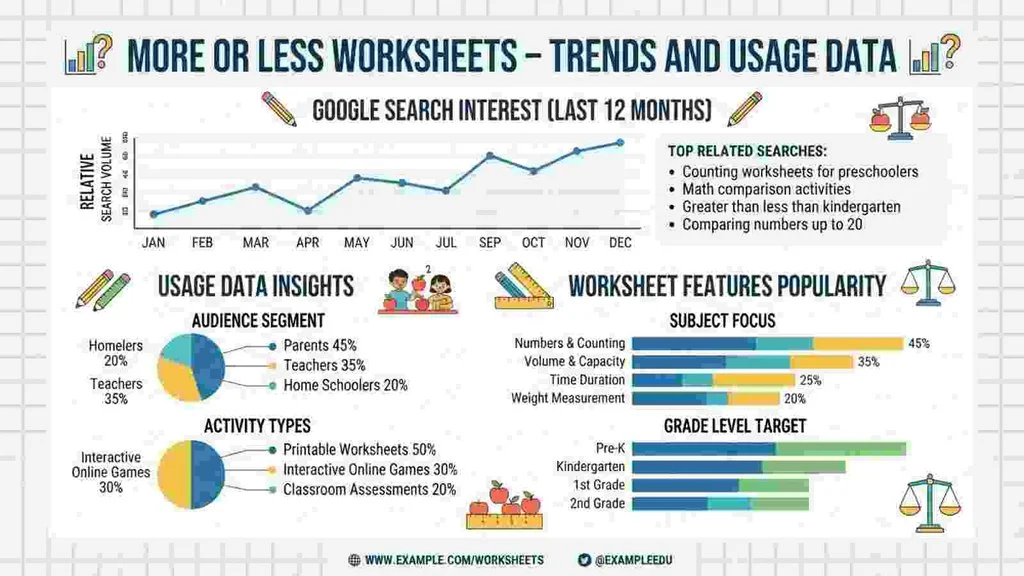
People search for educational worksheets for many reasons, including home learning, classroom teaching, homework, and school preparation. The phrase more or less worksheets fits the wider topic of early math education.
However, exact search popularity can change over time and by country. Without current keyword research or Google Trends results, it would not be accurate to claim a specific search volume or rank countries by popularity.
What Affects Search Interest?
1. School calendars: Parents and teachers may seek worksheets before a new school year or during school breaks.
2. Age and grade level: Searches may include preschool, kindergarten, Year 1, or first grade.
3. Printable learning materials: Some users prefer PDF worksheets that they can download and print.
4. Learning needs: Parents may look for easier exercises when children need extra help with number comparisons.
Related Keywords to Explore
| Keyword | Search Intent |
| More or less worksheets | General worksheet search |
| More or less worksheets for kindergarten | Age-specific learning |
| Free printable more or less worksheets | Free downloads |
| More or less worksheets with pictures | Visual learning |
| Comparing numbers worksheets | Number comparison practice |
| Greater than less than worksheets | Mathematical symbols |
| More or less worksheets with answers | Practice and self-checking |
These related phrases show what parents and teachers commonly look for — free printables, picture-based practice, and worksheets for kindergarten and grade 1.
FAQs About More or Less Worksheets
1. What are more or less worksheets?
More or less worksheets are educational pages that help children compare numbers and groups of objects. They may include pictures, counting tasks, and number comparison questions.
2. What age is best for more or less worksheets?
Many children begin simple comparison activities around preschool or kindergarten age. The best starting point depends on the child’s counting skills and learning needs.
3. Are more or less worksheets free?
Some websites provide free worksheets, while others offer paid activity packs. Check the terms of use before downloading or sharing materials.
4. How do I teach a child more and less?
Start with real objects, such as blocks or pencils. Make two groups and ask the child which group has more and which has less.
5. What is the difference between more or less and greater than or less than?
More or less often describes amounts in everyday language. Greater than and less than are also used in math, often with symbols such as > and <.
6. Can I use more or less worksheets at home?
Yes. Parents can print worksheets or create their own activities with toys, snacks, and other safe objects. Short practice sessions can help children stay focused.
7. How can I make more or less worksheets fun?
Use colorful pictures, number cards, counting games, and small rewards for effort. Let children explain their answers instead of only marking them right or wrong.
8. What grade are more or less worksheets for?
They are mainly for preschool, kindergarten, and first grade (Year 1 in the UK). Start with small numbers and pictures, and make the exercises harder as the child’s skills grow.
9. Are there more or less worksheets with pictures?
Yes — many worksheets use pictures of objects, such as apples, stars, or toys, so children can count and compare groups by sight. Picture-based activities are a good starting point for beginners.
10. Do more or less worksheets come with answers?
Many printable worksheets include an answer key or answer sheet, so parents and teachers can check the child’s work. If a worksheet has no answers, you can check it by counting the objects together.
Conclusion
More or less worksheets are a simple way to help children build strong early math skills.
They teach kids to compare numbers, count objects, and understand which amount is greater or smaller.
These basic skills support later learning in addition, subtraction, and number order.
Parents can use these worksheets at home, while teachers can include them in classroom lessons, homework, and revision activities.
For beginners, picture-based exercises and small numbers are often a good starting point. As children gain confidence, they can move on to larger numbers, number lines, and written comparisons.
Remember that more or less worksheets use the same spelling in British and American English.
The main vocabulary difference is that Americans usually say math, while British speakers usually say maths. Either word works — the worksheets teach the same skill in both countries.
For the best results, combine worksheets with real objects and everyday examples. Encourage children to explain their answers and learn from mistakes.
With regular practice and patient guidance, comparing numbers can become an easy and enjoyable part of learning.
Continue Reading:
- The Lady or the Tiger: Meaning, Story, and Ending Explained (for 2026)
- Friend or Foe Meaning: Definition, Origin, and Examples (for 2026)
- Sink or Swim Meaning: Definition, Origin, and Examples (for 2026)

Here’s a concise 2-line author bio suitable for Simifind.com:
James Dashner is an American bestselling author best known for The Maze Runner series and other popular young-adult fiction.
On Simifind.com, he shares clear, engaging insights and helpful content for readers interested in books, writing, and popular literature.








3 thoughts on “More or Less Worksheets: Free Printable Math Activities for Kids (for 2026)”