One small spelling mistake can completely change the meaning of a word.
Hey, I want to share something that happened to me recently about Wich or Witch.
I was chatting with a friend when I suddenly saw this term pop up, and honestly, I had no clue what it meant at first.
I kept wondering, “Am I missing something?” It was a bit confusing, and I didn’t want to respond the wrong way.
So, I decided to look into Wich or Witch and figure out its meaning and context.
After understanding it, I realized how important it is to know the difference between these two words to avoid awkward situations in conversations.
I handled it by learning the proper spelling, meaning, and usage of Wich or Witch, and now I feel ready whenever I see these words again in chats, messages, or social media.
Wich or Witch – Quick Answer
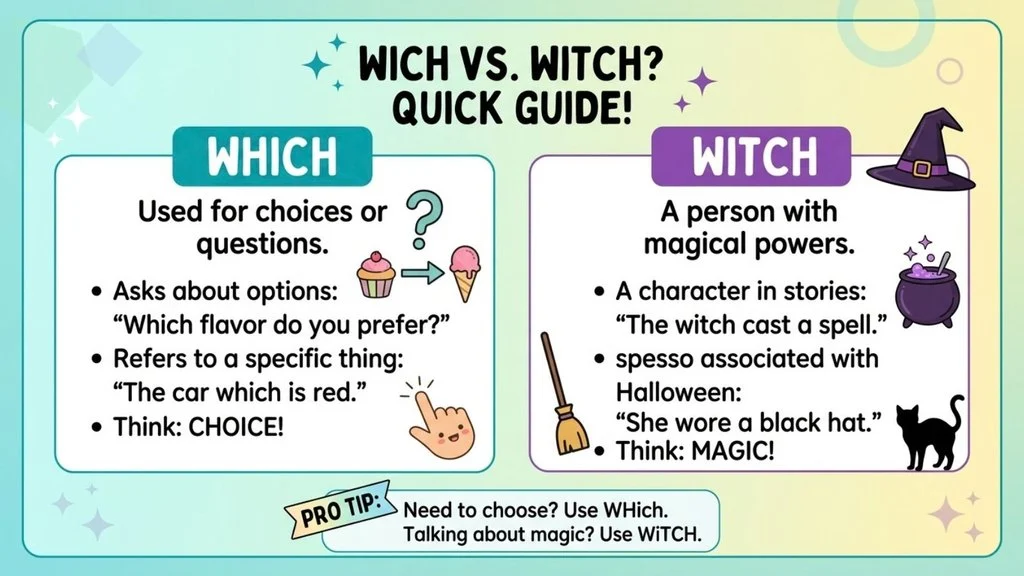
The answer depends on what you mean.
- Which = used for a choice, question, or reference to something.
- Witch = a person associated with magic or witchcraft.
- Wich = generally not the standard spelling you need in ordinary English.
Examples
Which:
Dress do you like?
Road should we take?
I do not know which answer is correct.
Witch:
The witch lived in a dark forest.
The story features a powerful witch.
Wich:
❌ Wich book should I buy?
Correct:
✅ Which book should I buy?
So, if you are asking a question about a choice, use which. If you mean a magical person, use witch.
There are rare dictionary and historical uses of wich, including a dialect noun for a saltworks or salt-producing town, so it is not accurate to say the spelling never exists. It is simply not the normal spelling of which or witch.
The Origin of Wich or Witch
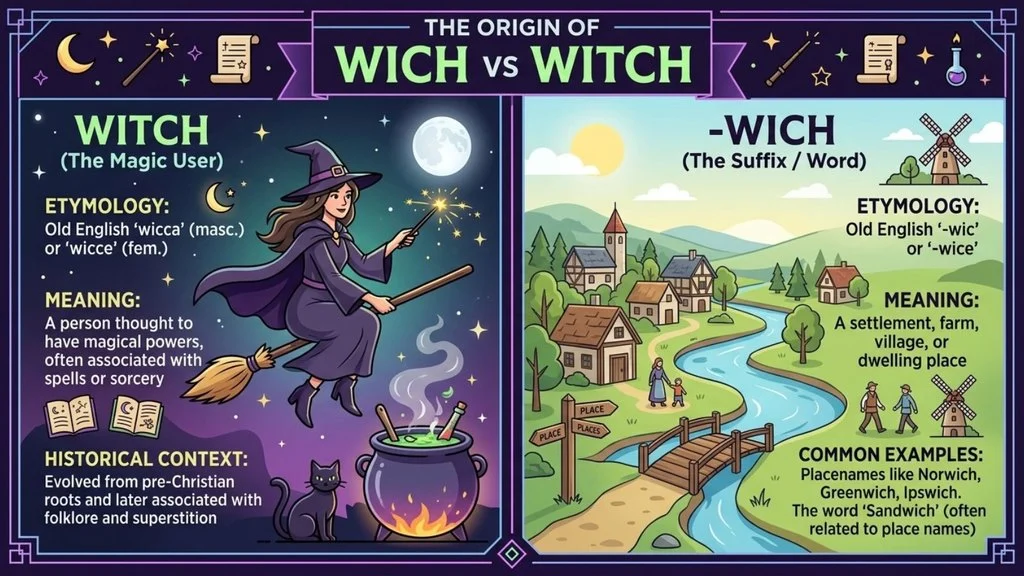
The words which and witch have different histories, even though they sound alike.
Which comes from Old English forms such as hwilc and hwælc. These forms developed from an older Germanic construction connected with the idea of “what kind” or “which one.” Over time, the spelling and pronunciation changed into the modern English which.
Today, which can work as both a determiner and a pronoun.
For example:
Which book do you want?
Here, which comes before the noun book.
Which do you prefer?
Here, which stands on its own.
Origin of Witch
Witch has a very different history. It developed from Middle English wicche and Old English wicce, referring to a female magician or sorceress. The masculine Old English form was wicca. The word was connected with the practice of magic or witchcraft.
Modern dictionaries define a witch as a person, traditionally a woman, believed to have magical powers. The word is also common in folklore, fantasy, literature, and popular culture.
Why Are They So Easy to Confuse?
The main reason is sound.
In standard modern pronunciation, which and witch are pronounced /wɪtʃ/ in both British and American English.
That means you can hear the difference only from the context, not usually from the sound.
British English vs American English Spelling
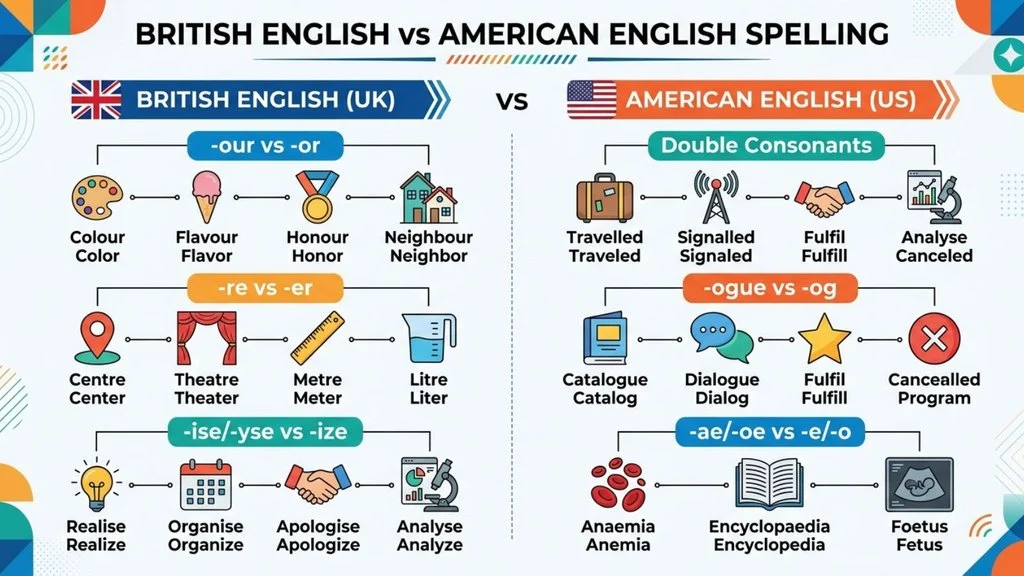
There is no British-versus-American spelling difference between which and witch.
Both varieties use:
- which
- witch
The difference is in meaning, not regional spelling.
| Word | British English | American English | Meaning |
| which | which | which | Choice, identification, or relative pronoun |
| witch | witch | witch | Person associated with witchcraft |
| wich | Rare/dialectal | Not standard for the intended meaning | Usually an error when intended as which or witch |
For example:
British English:
Which film are you watching?
American English:
Which movie are you watching?
The vocabulary can change, but which remains spelled the same.
Likewise:
The witch appeared in the story.
The spelling witch is the same in both major forms of English. Cambridge lists the pronunciation of witch as /wɪtʃ/ in both UK and US English.
Which Spelling Should You Use?
For most writers, the rule is simple.
If You Mean a Choice → Use “Which”
Use which when asking someone to select or identify something.
Phone is yours?
Color do you prefer?
Train goes to London?
If You Mean Magic → Use “Witch”
Use witch when referring to a person associated with witchcraft or magical powers.
The witch cast a spell.
The book tells the story of a young witch.
If You Typed “Wich”
Check the sentence again.
If you meant which, add the h:
❌ Wich option is better?
✅ Which option is better?
If you meant witch, add the t:
❌ The wich flew across the sky.
✅ The witch flew across the sky.
For global English, academic writing, business writing, and formal communication, avoid using wich as a replacement for which or witch.
Common Mistakes with Wich or Witch
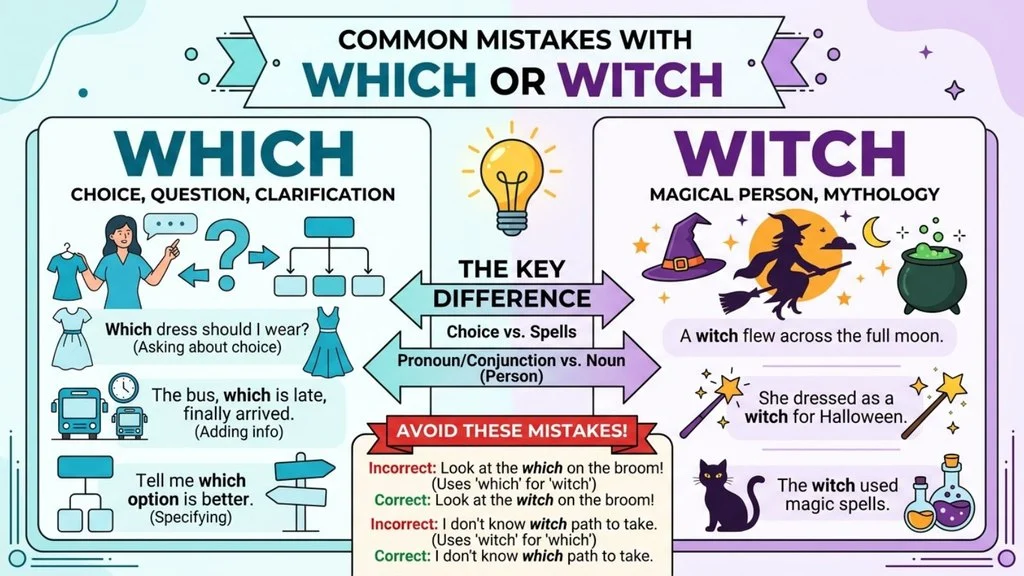
Mistake 1: “Wich one”
Incorrect:
Wich one do you want?
Correct:
Which one do you want?
Which is needed because the sentence asks for a choice.
Mistake 2: “Which” for a Magical Character
Incorrect:
The which cast a spell.
Correct:
The witch cast a spell.
Here, witch is a noun.
Mistake 3: “Wich” in Formal Writing
Incorrect:
Please tell me wich document you need.
Correct:
Please tell me which document you need.
A missing h can make an otherwise professional email look careless.
Mistake 4: Choosing by Sound
Because which and witch sound alike, spelling them from memory can cause errors.
A better method is to think about meaning first:
Choice or identification → which
Magic or witchcraft → witch
Wich or Witch in Everyday Examples
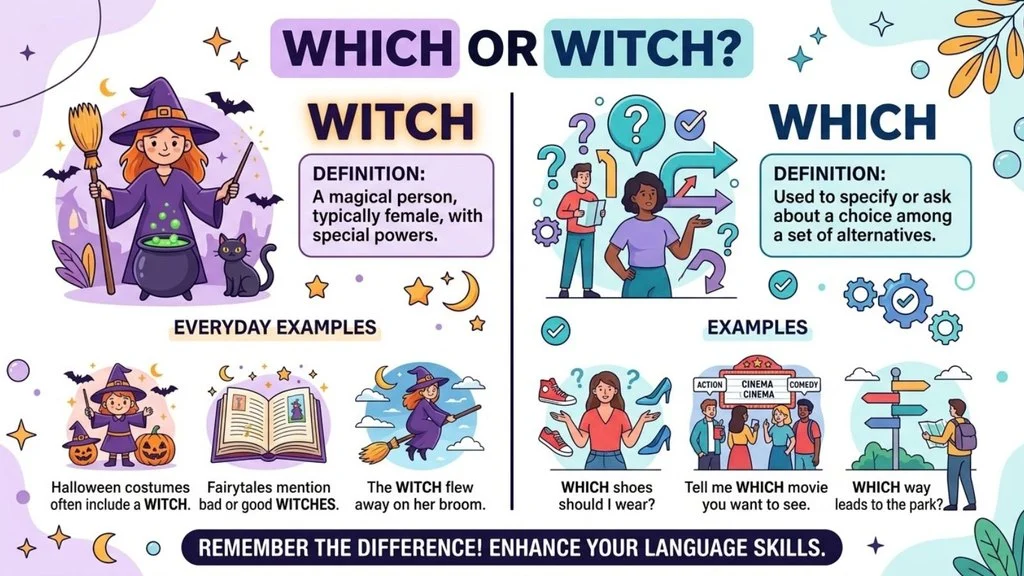
In Emails
Could you please confirm which file I should send?
Which date works best for the meeting?
In professional emails, which is common because it helps identify a specific option.
In News Writing
Officials are reviewing which areas need additional support.
A news article may also use witch when discussing folklore or historical events:
The article examines the history of witch trials in Europe.
On Social Media
Which outfit should I wear tonight?
Halloween is coming, so everyone is sharing witch costumes.
In Formal Writing
The committee must decide which proposal meets the requirements.
Or:
The novel follows a young witch who discovers a hidden power.
In Everyday Conversation
Which one is yours?
Which restaurant should we choose?
Have you seen the movie about the witch?
These examples show why context matters more than pronunciation.
Wich or Witch – Comparison Table
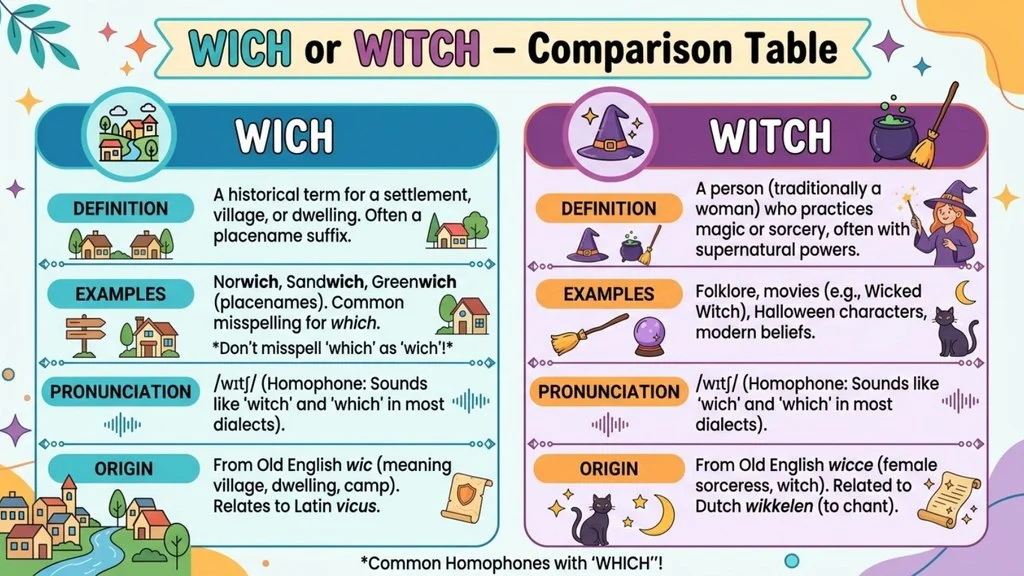
| Word | Correct in Standard English? | Main Function | Example |
| Which | Yes | Choice, identification, relative clauses | Which book is yours? |
| Witch | Yes | Person associated with witchcraft | The witch entered the forest. |
| Wich | Usually no for these meanings | Usually a spelling error; rare dialect/historical uses exist | ❌ Wich book is yours? |
| -wich | Yes in names/compounds | Appears in some place names and words | Norwich, Greenwich, sandwich |
The final row is important. Wich can appear as part of historical names and linguistic forms. Collins, for example, records wich as a British dialect noun meaning a saltworks or salt-producing town.So, do not confuse the standalone spelling error wich with legitimate forms containing -wich.
Wich or Witch – Google Trends & Usage Data
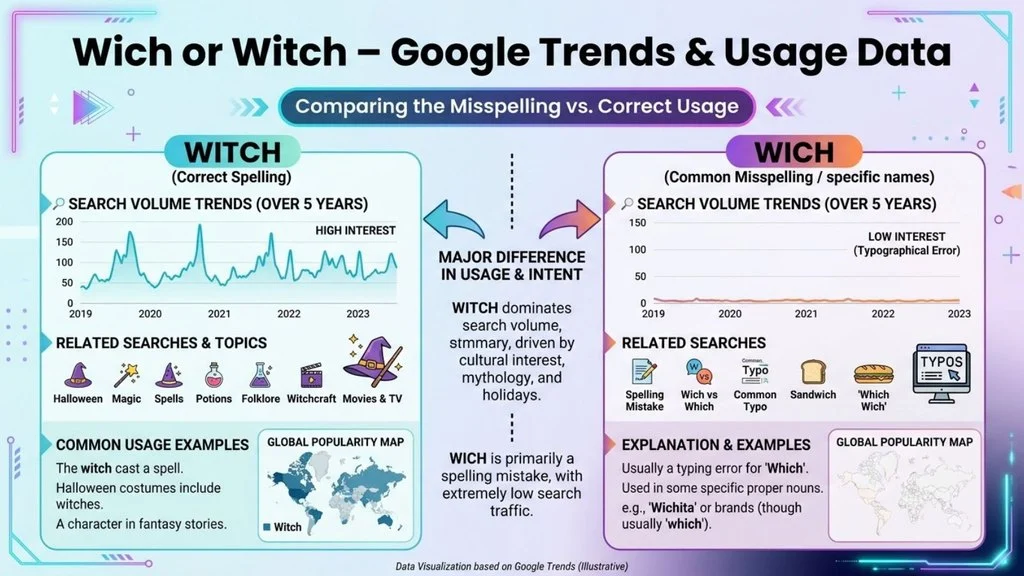
Google Trends measures search interest, rather than dictionary correctness or the total number of times a word appears in writing.
Google describes Trends as a tool for exploring what people search for and provides regional and time-based comparisons.
For the query “wich or witch,” search interest is mainly connected with spelling and word-choice confusion.
People may also search the individual terms because which and witch have different meanings but similar pronunciation.
There is an important limitation: Google Trends does not provide a simple universal number showing how many times a word is searched.
Its results are relative and depend on the selected country, time period, search category, and comparison terms.
Therefore, a precise claim such as “witch is searched X times more than wich” should only be made from a specific Trends comparison with the exact settings recorded.
For SEO content, the most useful search-intent groups include:
- wich or witch
- wich vs witch
- which or witch
- is wich a word
- how to spell witch
- how to spell which
- witch meaning
- which meaning
This makes the topic useful for learners who want a quick spelling answer as well as readers looking for the difference between the two words.
Wich vs Witch vs Which at a Glance
| Feature | Which | Witch | Wich |
| Pronunciation | /wɪtʃ/ | /wɪtʃ/ | Usually pronounced like which or witch when encountered |
| Meaning | Choice or identification | Person associated with witchcraft | Rare dialect/historical uses |
| Part of speech | Determiner/pronoun | Noun | Rare noun or nonstandard spelling |
| Common in modern English? | Yes | Yes | No, for ordinary writing |
| Used in questions? | Yes | No | No |
| Example | Which one? | The witch smiled. | Usually avoid |
FAQs About Wich or Witch
1. Is “wich” the correct spelling?
Usually, no. If you mean the question or choice word, the correct spelling is which. If you mean a person associated with magic, use witch. Rare dialectal and historical uses of wich do exist.
2. What is the difference between which and witch?
Which is used for choices, questions, identification, and certain relative clauses. Witch is a noun referring to a person associated with witchcraft or magical powers.
3. Is “wich” a word?
Yes, in a limited historical or dialectal sense. Collins records wich as a British dialect noun meaning a saltworks or salt-producing town. But it is not the standard spelling of which or witch in everyday English.
4. Are which and witch pronounced the same?
In modern British and American pronunciation, they are both commonly pronounced /wɪtʃ/.
5. How do I remember which spelling to use?
Use this simple memory rule:
Which = choice
Witch = magic
For example:
Which dress should I wear?
The witch lives in the castle.
6. Is “wich” a common spelling mistake?
Yes. People often type wich when they intend which, especially because the words sound alike. In standard writing, replace it with which when the sentence asks about a choice or identifies something.
7. Is “witch” used only for women?
The traditional meaning strongly associates witch with women, but modern usage can be broader. The word is also used in folklore, fiction, cultural discussions, and modern contexts without always being limited to a woman. Cambridge defines it traditionally as a woman believed to have magical powers.
Conclusion
Understanding wich or witch becomes easy when you focus on meaning rather than sound.
Which is the correct word when you are asking about a choice, identifying something, or referring to something in a clause.
For example, “Which book do you want?” uses which because the sentence asks someone to select or identify a book.
Witch, on the other hand, is a noun connected with witchcraft, magic, folklore, and stories. For example, “The witch entered the forest” clearly refers to a person associated with magical powers.
Wich is usually not the spelling you want in normal modern English. However, it does have limited dialectal and historical uses, including references to saltworks or salt-producing towns.
The easiest rule is “which for choice, witch for magic.” If you remember that distinction, you can avoid the most common spelling errors in emails, schoolwork, articles, social media posts, and professional writing.

Here’s a concise 2-line author bio suitable for Simifind.com:
James Dashner is an American bestselling author best known for The Maze Runner series and other popular young-adult fiction.
On Simifind.com, he shares clear, engaging insights and helpful content for readers interested in books, writing, and popular literature.