
Sometimes, one small spelling difference can make you stop and wonder which word is actually correct.
Hey, I want to share something that happened to me recently about Leapt or Leaped.
Chatting with a friend when I suddenly saw this term pop up, and honestly, I had no clue what it meant at first.
I kept wondering, “Am I missing something here?” It was a bit confusing, and I didn’t want to respond the wrong way.
So, I decided to look into Leapt or Leaped and figure out its meaning and context.
After understanding it, I realized how important it is to know these terms to avoid awkward situations in conversations.
I handled it by learning the proper meaning and usage of Leapt or Leaped, and now I feel ready whenever I see these forms again in chats, writing, or social media.
Leapt or Leaped – Quick Answer
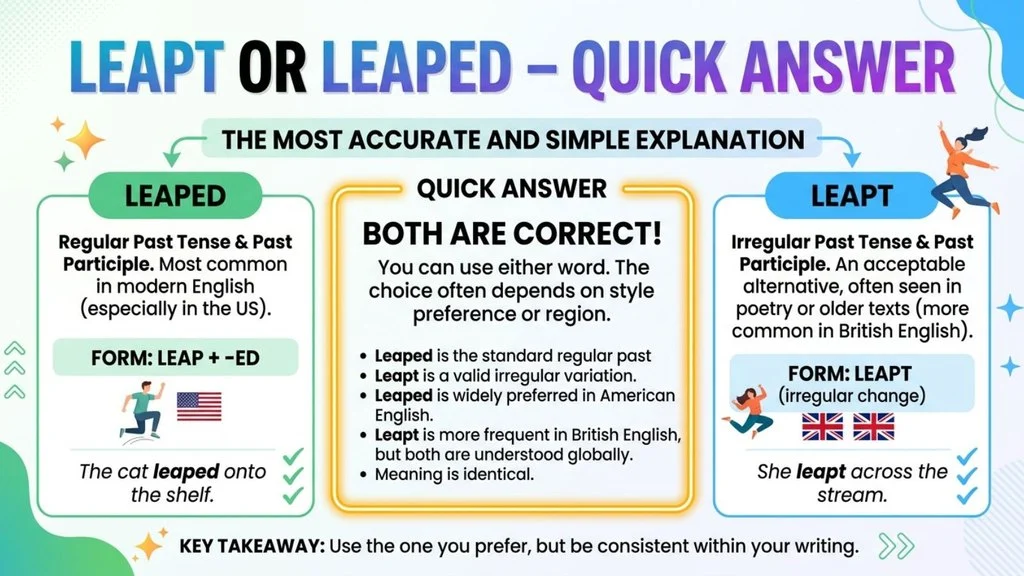
Both leapt and leaped are correct past-tense and past-participle forms of the verb leap.
- Leapt — more common in British English.
- Leaped — especially common in American English.
- Both forms mean that someone or something jumped or moved suddenly into the air.
Examples
- The horse leapt over the fence.
- The horse leaped over the fence.
- She leapt from her chair.
- She leaped from her chair.
- The child leapt into the pool.
- The child leaped into the pool.
There is no grammatical error in choosing either form.
Verb Forms
| Form | Usage |
| Leap | Present/base form |
| Leapt | Past tense/past participle |
| Leaped | Past tense/past participle |
| Leaping | Present participle |
| Leaps | Third-person singular |
For example:
She leaps over the stream every morning. Over the stream yesterday.
She leaped over the stream yesterday.
The Origin of Leapt or Leaped

The verb leap is an old English word. It comes from Old English hlēapan, meaning to jump, run, or spring.
Over time, English developed different ways of forming the past tense of this verb. Leapt developed as an irregular past form, while leaped developed by adding the regular -ed ending.
This gives English two accepted forms:
Leap → leapt
Leap → leaped
English has many verbs with more than one accepted past-tense form.
This can happen because the language changes over time and different English-speaking communities develop different preferences.
The same pattern can be seen with words such as:
- dreamed / dreamt
- learned / learnt
- burned / burnt
- smelled / smelt
In many cases, the -ed form is more common in American English, while the shorter form ending in -t is often associated with British English.
However, these patterns are not absolute.
Both leapt and leaped are used across different English-speaking countries.
British English vs American English Spelling
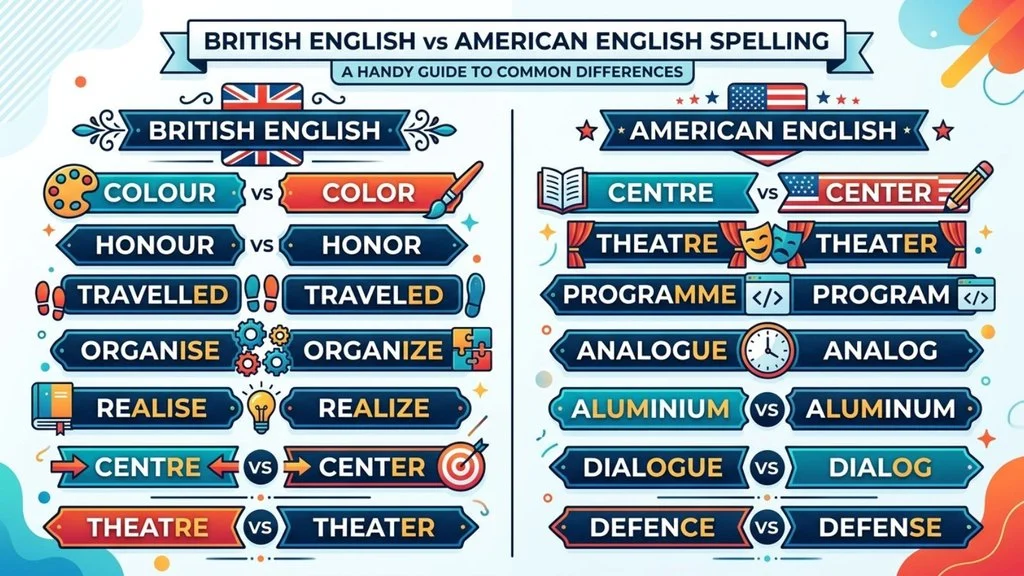
The main difference between leapt and leaped is regional preference rather than grammar.
Leapt is traditionally more frequent in British English. Leaped is widely preferred in American English.
| Feature | Leapt | Leaped |
| Base verb | Leap | Leap |
| Past tense | Leapt | Leaped |
| Past participle | Leapt | Leaped |
| British English | Common | Also accepted |
| American English | Accepted | Very common |
| Commonwealth English | Common | Also used |
| Formal writing | Correct | Correct |
| Meaning | Jumped/sprang | Jumped/sprang |
British English Example
The deer leapt across the road.
American English Example
The deer leaped across the road.
The meaning does not change.
Which Spelling Should Leapt or Leaped Use?

Your choice should mainly depend on your audience and the variety of English you are using.
For American English
Use leaped if you are writing primarily for readers in the United States.
The athlete leaped over the hurdle.
For British English
Leapt is a natural choice in British English.
The athlete leapt over the hurdle.
For Commonwealth English
In countries such as Australia, Canada, and New Zealand, both forms can be found. Local style and personal preference can influence the choice.
For Global Websites
If you write for an international audience, either form is correct. The most important rule is consistency.
If your website generally follows American English, use leaped. If it follows British English, leapt may fit better.
For Academic or Professional Writing
Both are grammatically correct. Follow the style guide used by your school, university, employer, or publication.
Common Mistakes with Leapt or Leaped
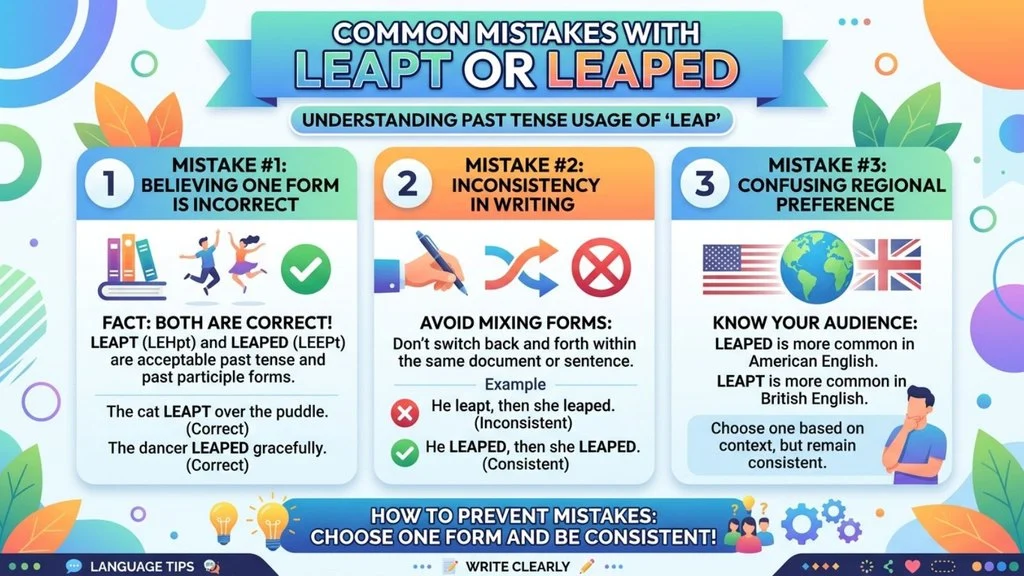
Mistake 1: Thinking One Form Is Incorrect
Some writers believe that leapt or leaped must be wrong.
Incorrect idea:
“Leaped” is always wrong.
Correct understanding:
Both leapt and leaped are accepted forms.
Mistake 2: Using “Leap” for a Past Event
Because leap is the base form, it should not normally be used for a completed past action.
❌ Yesterday, the dog leap over the wall.
✅ Yesterday, the dog leapt over the wall.
✅ Yesterday, the dog leaped over the wall.
Mistake 3: Mixing English Varieties
Switching between British and American spelling can make an article look inconsistent.
For example, if your article consistently uses American spellings such as color, center, and realize, using leapt is not necessarily wrong, but leaped may create greater stylistic consistency.
Mistake 4: Confusing “Leaping” with “Leapt”
Leaping is the present participle.
The frog is leaping across the pond.
Leapt and leaped are past forms.
The frog leapt across the pond.
Leapt or Leaped in Everyday Examples

Both forms work naturally in everyday English.
In Emails
The team leaped at the opportunity to work with the new client.
Or:
The team leapt at the opportunity to work with the new client.
Both are correct.
In News Writing
Shares leaped after the company announced strong results.
British-oriented publications may use:
Shares leapt after the company announced strong results.
In Social Media
My heart leapt when I saw the surprise!
Or:
My heart leaped when I saw the surprise!
In Formal Writing
The researcher leapt to an early conclusion.
Or:
The researcher leaped to an early conclusion.
The choice does not change the basic meaning.
In Creative Writing
Leapt is often seen in literary writing:
The fox leapt through the snow.
Leaped is equally grammatical:
The fox leaped through the snow.
Writers may choose one form based on regional style, rhythm, or personal preference.
Leapt or Leaped – Google Trends & Usage Data

Search interest for “leapt or leaped” usually comes from people checking which past-tense form is correct. The question is especially relevant because both spellings appear in published English.
Usage can vary by region:
- United States: leaped is widely used.
- United Kingdom: leapt is traditionally common.
- Australia and New Zealand: both forms occur.
- Canada: both forms are used.
- International English: either form may be understood.
Google Trends can show search interest for the exact phrase “leapt or leaped,” but search volume should not be treated as a direct measure of correct usage. Search behavior changes by country, time, and user intent.
For reliable writing decisions, published usage, dictionaries, and the style guide for your target audience are more useful than search popularity alone.
Leapt vs Leaped: Comparison Table
| Word | Type | Meaning | Common Usage |
| Leap | Base verb | To jump or spring | Present/general |
| Leapt | Past tense | Jumped | Common in British English |
| Leaped | Past tense | Jumped | Very common in American English |
| Leaping | Present participle | Jumping | Continuous forms |
| Leaps | Present tense | Jumps | He/she/it |
Simple Comparison
Present:
The horse leaps over the fence.
Past with leapt:
The horse leapt over the fence.
Past with leaped:
The horse leaped over the fence.
All three sentences are grammatically correct.
FAQs About Leapt or Leaped
1. Is “leapt” correct English?
Yes. Leapt is a correct past-tense and past-participle form of leap.
2. Is “leaped” correct English?
Yes. Leaped is also a correct past-tense and past-participle form of leap.
3. Is leapt British or American?
Leapt is traditionally more common in British English, although it is also understood and used in American English.
4. Is leaped American English?
Leaped is especially common in American English, but it is not limited to the United States.
5. Which is correct: leapt or leaped?
Both are correct. Choose according to your preferred English variety and maintain consistency.
6. What is the past tense of leap?
Both leapt and leaped can be used as the past tense of leap.
7. Is “leapt” more formal than “leaped”?
Not necessarily. Leapt may sound more literary or traditional to some readers, but both forms are grammatically correct and suitable for formal writing.
Conclusion
The choice between leapt or leaped is not a question of right versus wrong. Both are correct forms of the verb leap, and both mean essentially the same thing when used as the past tense or past participle.
The main difference is usage preference. Leapt is traditionally common in British English and can have a literary or traditional feel. Leaped is especially common in American English and is widely accepted in international writing.
If you are writing for an American audience, leaped is a natural choice. If you are following British English, leapt is often the more familiar option. For global audiences, either form works.
The most important point is to remain consistent with your chosen style of English. Once you understand this regional difference, you can confidently use either leapt or leaped in emails, articles, academic work, news writing, and everyday communication.

Here’s a concise 2-line author bio suitable for Simifind.com:
James Dashner is an American bestselling author best known for The Maze Runner series and other popular young-adult fiction.
On Simifind.com, he shares clear, engaging insights and helpful content for readers interested in books, writing, and popular literature.