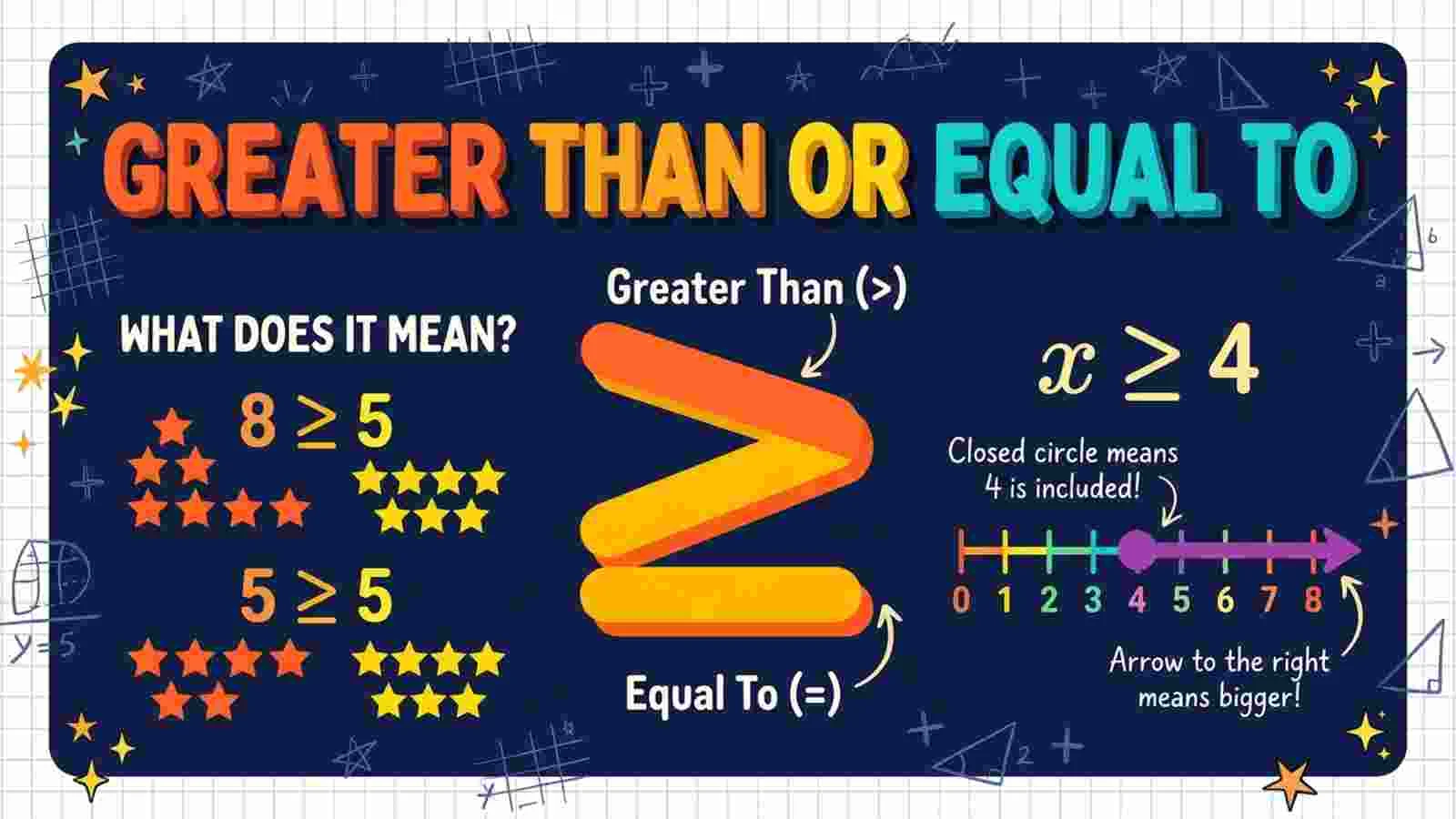
Greater than or equal to (≥) means a value is either larger than or exactly the same as another value. Example: x ≥ 5 means x is 5 or more than 5. It is the opposite of less than or equal to (≤).
Have you ever seen the symbol ≥ in a math problem, school assignment, or computer program and wondered what it means?
The phrase greater than or equal to is common in math, science, coding, and daily life. It helps us compare two numbers and decide whether one number is bigger than or the same as another.
People often search for “greater than or equal to” because they want to understand its meaning, learn its symbol, or know how to use it in equations.
Some people also confuse it with the greater than symbol (>) and the equal to symbol (=). These symbols look similar in purpose, but each has a different meaning.
The good news is that this rule is easy to learn. The symbol ≥ means that the number on the left can be greater than the number on the right or exactly equal to it.
For example, \(8 \geq 5\) is true because 8 is greater than 5. Also, \(5 \geq 5\) is true because both numbers are equal.
In this guide, you will learn the meaning, history, correct usage, common mistakes, and everyday examples of greater than or equal to.
Greater Than or Equal To – Quick Answer
Greater than or equal to (≥) means that one number is either bigger than or equal to another number.
Here are three simple examples:
- \(10 \geq 7\): True, because 10 is greater than 7.
- \(7 \geq 7\): True, because both numbers are equal.
- \(4 \geq 9\): False, because 4 is less than 9.
The symbol has two parts. The open side points toward the larger number, while the line underneath means “or equal to.”
Understand the symbols
≥
Greater than or equal to
Example: 6 ≥ 6
The numbers may be equal or the left number may be larger.
>
Greater than
Example: 8 > 3
The left number must be larger.
=
Equal to
Example: 5 = 5
Both sides must have the same value.
The Origin of Greater Than or Equal To
The phrase “greater than or equal to” comes from the basic language used to compare numbers. The word greater means larger, while equal means having the same value.
The mathematical symbols for comparing numbers became widely used after the development of modern mathematical notation. English mathematician Thomas Harriot used the greater-than (>) and less-than (<) symbols.
| Symbol | Meaning | Example |
|---|---|---|
| ≥ | Greater than or equal to | \(8 \geq 5\) |
| > | Greater than | \(9 > 6\) |
| = | Equal to | \(6 = 6\) |
| < | Less than | \(3 < 8\) |
| ≤ | Less than or equal to | \(5 \leq 5\) |
These symbols help readers compare values quickly. Learning the difference between them can prevent mistakes in maths homework, spreadsheets, and programming.
Which Spelling Should You Use?
You can use “greater than or equal to” in any English-speaking country. There is no need to change the phrase for a British, American, or international audience.
Your choice depends on the type of writing you are doing.
- For US readers: Use “greater than or equal to” in maths assignments, reports, and technical documents. The usual American spelling is “math” when referring to the subject.
- For UK and Commonwealth readers: Use the same phrase and symbol. In general writing, “maths” is the common form in the UK.
- For a global audience: Introduce the phrase with its symbol, such as “greater than or equal to (≥).” This helps readers understand the term even if English is not their first language.
- For coding and technical work: Use the correct operator for the language. Many programming languages use
>=instead of the single mathematical symbol ≥.
For formal writing, explain the symbol the first time it appears. After that, you can use it throughout the document without repeating the definition.
Common Mistakes with Greater Than or Equal To
People often make simple mistakes when learning comparison symbols. Understanding the rules can help you avoid them.
1. Confusing ≥ with >
The greater-than symbol (>) does not allow equality. The greater than or equal to symbol (≥) does.
- Incorrect conclusion: \(5 > 5\) is true.
- Correct conclusion: \(5 > 5\) is false, but \(5 \geq 5\) is true.
2. Reversing the Symbol
The open side of the symbol faces the larger value. For example, \(9 \geq 4\) is true, but \(4 \geq 9\) is false.
Remember that the symbol compares the value on the left with the value on the right.
3. Forgetting the Equal Part
The line underneath ≥ is important. It means the two numbers may have the same value.
For example, if a rule says a person must be at least 18 years old, an 18-year-old meets the rule. The condition can be written as age ≥ 18.
4. Using the Wrong Symbol in Code
In many programming languages, >= means greater than or equal to. Typing only > would remove the equality condition.
For example, age >= 18 accepts an age of 18, while age > 18 does not.
5. Reading the Symbol Backward
The expression \(x \geq 3\) means that x is at least 3. It does not mean x must be smaller than 3.
Greater Than or Equal To in Everyday Examples
The symbol ≥ is not limited to school maths. It is also useful for explaining limits, rules, and minimum requirements.
In Emails
A teacher might write:
“Students must score 60 or more marks to pass the test.”
This condition can be written as:
\[ \text{Marks} \geq 60 \]
A score of 60 or 75 meets the requirement, but a score of 59 does not.
In News and Reports
A report may explain that a region needs rainfall of at least 100 millimetres for a certain target. The condition is:
\[ \text{Rainfall} \geq 100\text{ mm} \]
This means the rainfall must reach 100 millimetres or more.
On Social Media
Someone might post, “You must be 18 or older to enter.”
This is the same as saying:
\[ \text{Age} \geq 18 \]
The condition includes people who are exactly 18 years old.
In Formal Writing
Researchers may use ≥ to describe values that meet a minimum standard. For example:
“Participants with a score greater than or equal to 70 were included in the group.”
The shorter mathematical form is:
\[ \text{Score} \geq 70 \]
This style is common in statistics, science, and academic research.
In Computer Programming
A program may check whether a number meets a required value:
score = 75
if score >= 60:
    print("Pass")
The program prints “Pass” because 75 is greater than 60. A score of exactly 60 would also pass this condition.
Greater Than or Equal To – Google Trends and Usage Data
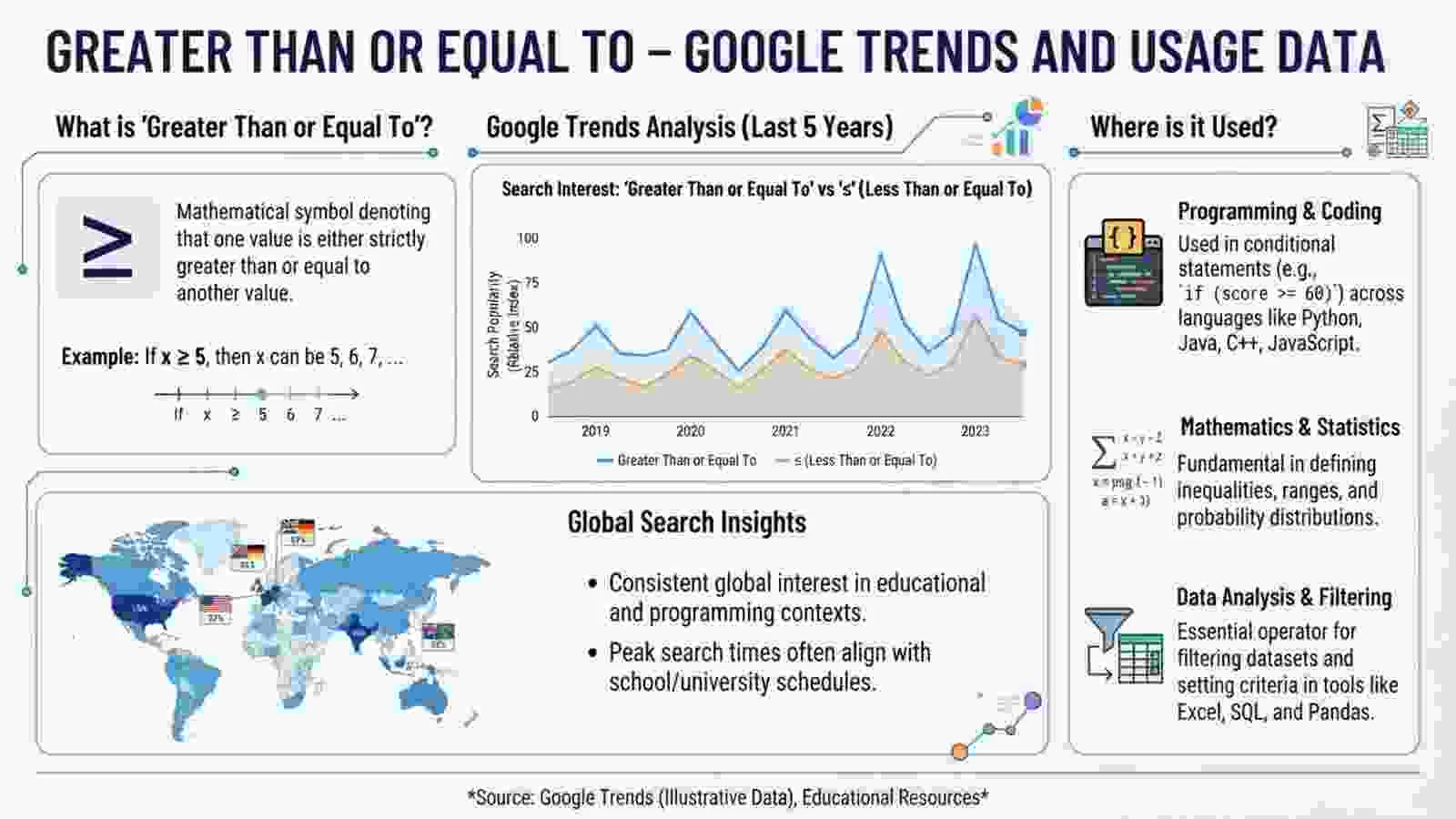
The phrase “greater than or equal to” is a common educational and technical search term. People may search for it while studying mathematics, solving equations, learning coding, or looking for the symbol on a keyboard.
Search interest can vary by country, school calendars, exam periods, and the use of technology. However, exact country rankings and search volumes require current keyword or Google Trends data. Without that data, it would be misleading to claim that one country searches for the phrase more than another.
Here are the main contexts in which people may look for this term:
- Education: Students search for the symbol, definition, and worked examples.
- Programming: Developers look for comparison operators such as
>=. - Science and research: Writers use the symbol to show minimum values and measurement limits.
- Everyday maths: People use it to understand age limits, scores, prices, and other requirements.
For SEO, related keywords include “greater than or equal to symbol,” “greater than or equal to meaning,” “how to type greater than or equal to,” and “greater than vs greater than or equal to.”
These related terms address different user needs and can help create useful supporting sections for an educational article.
FAQs About Greater Than or Equal To
1. What does greater than or equal to mean?
Greater than or equal to means that one number is bigger than another number or has the same value. Its mathematical symbol is ≥.
2. What is the symbol for greater than or equal to?
The symbol is ≥. It combines the greater-than sign (>) with a line underneath to show that equality is also allowed.
3. What is the difference between ≥ and >?
The symbol ≥ includes equal values, while > does not. For example, \(4 \geq 4\) is true, but \(4 > 4\) is false.
4. How do you read ≥ in words?
You read ≥ as “greater than or equal to.” For example, \(x \geq 10\) means “x is greater than or equal to 10.”
5. How do you type the greater than or equal to symbol?
You can copy and paste this symbol: ≥. In many Windows applications, you can also type 2265 and then press Alt + X in Microsoft Word. On many systems, programming uses >= instead.
6. Is greater than or equal to the same in British and American English?
Yes. The phrase and symbol have the same meaning in both varieties of English. The spelling of the mathematical term does not change.
7. What does x ≥ 5 mean?
It means x can be 5 or any number greater than 5. Examples include 5, 6, 10, and 20. The value 4 does not meet the condition.
8. What are some examples of greater than or equal to?
For example, 7 ≥ 5 is true because 7 is greater than 5, and 5 ≥ 5 is true because the numbers are equal.
9. What is the opposite of greater than or equal to?
Less than or equal to (≤) is the opposite. It means a value is either smaller than or exactly the same as another value.
10. Does ≥ mean at least?
Yes. The symbol ≥ means at least — x ≥ 3 means x is at least 3. For example, age ≥ 18 means a person must be at least 18 years old.
Conclusion
The phrase greater than or equal to is an important part of mathematics, science, and computing.
Its symbol, ≥, shows that one value can be larger than another or exactly the same. Once you understand this simple rule, it becomes easier to solve equations, read reports, and understand minimum requirements.
Remember the difference between the main comparison symbols. The greater-than sign (>) means the first value must be larger. The equal sign (=) means both values must match. The greater than or equal to sign (≥) allows either a larger value or an equal one.
There is no spelling difference between British and American English for this phrase. You can use it with the same meaning in schoolwork, emails, formal writing, and technical documents. In programming, remember that many languages use >= to express the same condition.
For the best results, practise with simple examples and always check whether equal values are allowed. This small habit can help you avoid common errors and use comparison symbols with confidence.
Continue Reading:
- Cuter or Cutier: Correct Spelling, Meaning, and Usage ( for 2026)
- Selfs or Selves: Meaning, Grammar, and Examples (for 2026)

Mary Roach is an American science writer and bestselling author known for making unusual and complex scientific topics engaging, accessible, and humorous. Her books include Stiff, Packing for Mars, Gulp, and Fuzz.
Author at Simifind.com, sharing clear, informative content designed to help readers understand interesting topics and everyday questions.