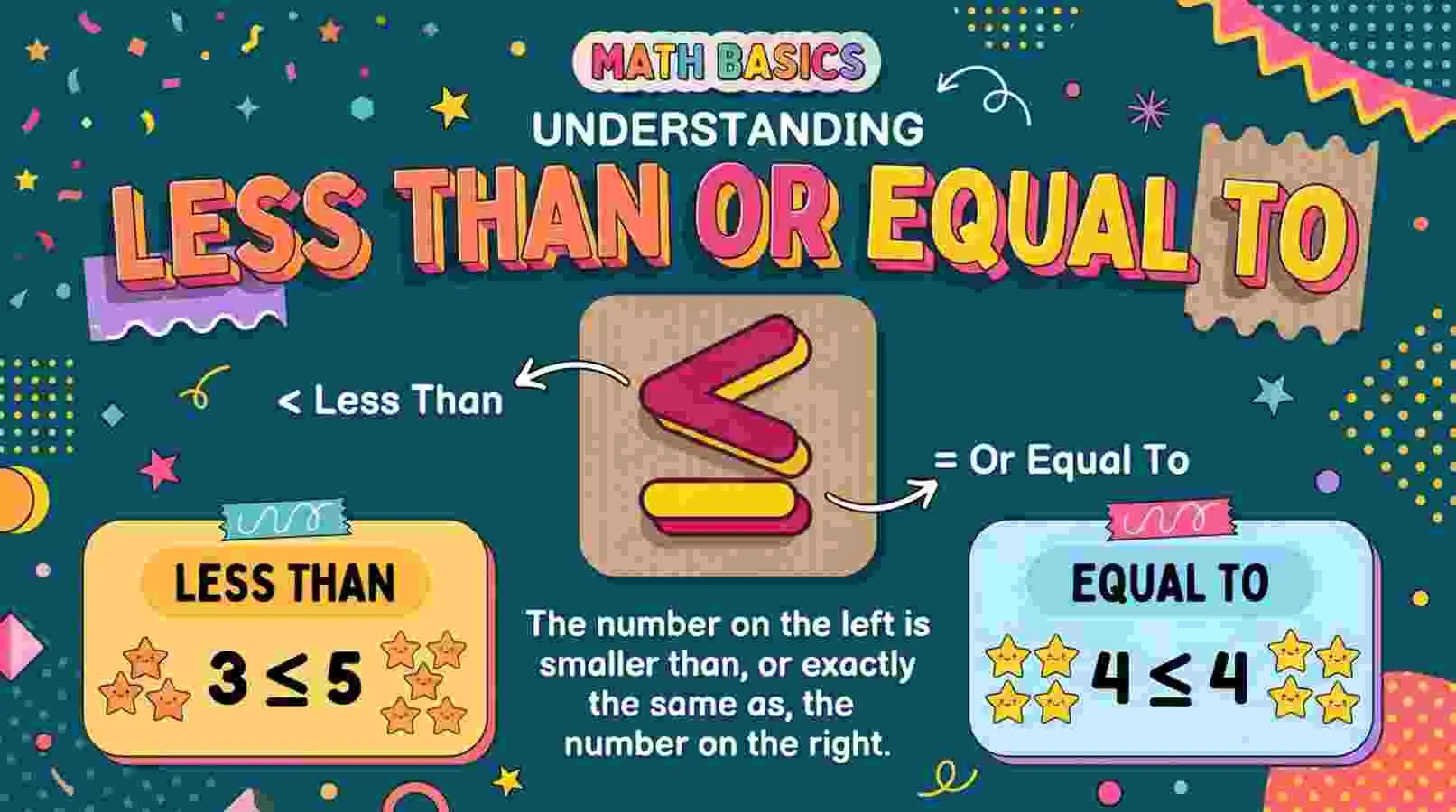
Less than or equal to is written as ≤. It means a number is smaller than, or exactly the same as, another number. For example, x ≤ 5 means x is 5 or less than 5. In code, it is written as <=.
The phrase less than or equal to is common in math, schoolwork, science, and daily life.
It helps us compare two numbers and show that one number can be smaller than another or the same as it.
You may see this phrase in math tests, computer programs, charts, and online lessons. But what does it mean, and how do you use it correctly?
The symbol for less than or equal to is ≤. It means that the number on the left is either smaller than or equal to the number on the right. For example, (x \leq 5) means that (x) can be 5, 4, 3, 2, or any smaller number.
People often search for this term because they want to understand its meaning, find its keyboard shortcut, or learn how it differs from less than and greater than. These terms may look similar, but each has a clear purpose.
In this guide, you will learn the meaning, origin, correct usage, common mistakes, and everyday examples of less than or equal to. You will also see how to type the symbol and use it in math and writing.
Less Than or Equal To – Quick Answer
Less than or equal to means that one value is smaller than another value or exactly the same. Its mathematical symbol is ≤.
For example:
- (3 \leq 5) means 3 is less than 5.
- (5 \leq 5) means both numbers are equal.
- (7 \leq 5) is false because 7 is greater than 5.
The symbol has two parts. The open side points toward the larger number, while the small line underneath means “or equal to.”
You can remember it this way: ≤ means smaller than or equal to.
The Origin of Less Than or Equal To
The words “less than” have been used for a long time to compare amounts, sizes, and values. The mathematical symbol for less than, <, became widely known through the work of English mathematician Thomas Harriot, whose mathematical writings were published in 1631.
The symbol for less than or equal to, ≤, adds a horizontal line beneath the less-than sign. This line shows that equality is also allowed.
This extra line makes the meaning clear. The sign does not only compare smaller values; it also accepts two equal values.
For example, (x \leq 10) allows (x) to be 10 or any value below 10. In contrast, (x < 10) does not allow 10 itself.
The phrase is now used around the world in mathematics, science, engineering, statistics, and computer programming.
British English vs American English Spelling
The phrase less than or equal to is spelled the same way in British English and American English. It is a mathematical term, not a word with different regional spellings.
The main difference is often how people explain or write the concept in different settings. In formal mathematics, the symbol is common in both countries.
| Feature | British English | American English |
| Standard phrase | Less than or equal to | Less than or equal to |
| Mathematical symbol | ≤ | ≤ |
| Short form | Less than or equal to | Less than or equal to |
| Example | (x \leq 10) | (x \leq 10) |
| Common use | Maths, science, exams | Math, science, exams |
Notice that British English often uses “maths,” while American English usually uses “math.” The phrase and symbol remain the same.
Less Than or Equal To vs Other Symbols
| Term | Symbol | Meaning | Example |
| Less than | < | Smaller than | (3 < 5) |
| Less than or equal to | ≤ | Smaller than or equal | (5 \leq 5) |
| Greater than | > | Larger than | (8 > 5) |
| Greater than or equal to | ≥ | Larger than or equal | (5 \geq 5) |
| Equal to | = | The same value | (5 = 5) |
| Not equal to | ≠ | Different values | (5 \neq 7) |
Which Spelling Should You Use?
You can use less than or equal to in any English-speaking country. There is no British or American spelling difference to consider.
Choose your format based on your audience and purpose.
- For schoolwork: Write the phrase or use the symbol ≤, depending on your teacher’s instructions.
- For formal writing: Use “less than or equal to” when explaining the concept in words.
- For mathematics: Use ≤ in equations, inequalities, and calculations.
- For computer programming: Follow the rules of your programming language. Many languages use <= instead of the symbol ≤.
- For global readers: Explain the symbol the first time you use it if your readers may be new to mathematics.
For example, you could write, “The temperature must be less than or equal to 25°C.” In a mathematical formula, you could write (T \leq 25).
Both forms are correct. The best choice depends on clarity and context.
Common Mistakes with Less Than or Equal To
People often confuse this symbol with other comparison signs. Here are some common mistakes and their corrections.
Mistake 1: Using < when equality is allowed
Incorrect: (x < 10), when 10 is also an accepted value.
Correct: (x \leq 10).
The less-than sign alone does not include equality.
Mistake 2: Thinking ≤ means only smaller than
The symbol also allows equal values. For example, (4 \leq 4) is true.
Mistake 3: Reversing the symbol
The expression (3 \leq 7) is true, but (7 \leq 3) is false.
Mistake 4: Confusing ≤ with ≥
The symbol ≤ means less than or equal to. The symbol ≥ means greater than or equal to.
Mistake 5: Using the wrong programming symbol
Many programming languages use <= instead of ≤. Check the rules of the language you are using.
Mistake 6: Forgetting the equal line
The line under < changes its meaning. Without the line, the symbol means only “less than.”
Less Than or Equal To in Everyday Examples
This term is useful in many parts of daily life. It helps people set limits, compare values, and explain rules.
1. In Emails
A teacher may write:
“Please keep your answer to 200 words or fewer.”
In mathematics, this can be shown as:
[
\text{Word count} \leq 200
]
The answer may contain 200 words or fewer.
2. In News Reports
A report may state that a road is open to vehicles weighing 3,000 kg or less.
This can be written as:
[
\text{Vehicle weight} \leq 3000\text{ kg}
]
The limit includes a vehicle weighing exactly 3,000 kg.
3. On Social Media
A user may share a challenge that says, “Spend $20 or less on lunch.”
The rule can be written as:
[
\text{Cost} \leq $20
]
Spending exactly $20 is allowed.
4. In Formal Writing
A policy may state:
“Applicants must be 18 years old or younger.”
This means:
[
\text{Age} \leq 18
]
The rule includes people who are exactly 18 years old.
5. In School Mathematics
If a question says that (x) is less than or equal to 6, you can write:
[
x \leq 6
]
Possible whole-number values include 6, 5, 4, 3, 2, 1, and 0. Negative whole numbers also satisfy the inequality.
Less Than or Equal To – Google Trends & Usage Data
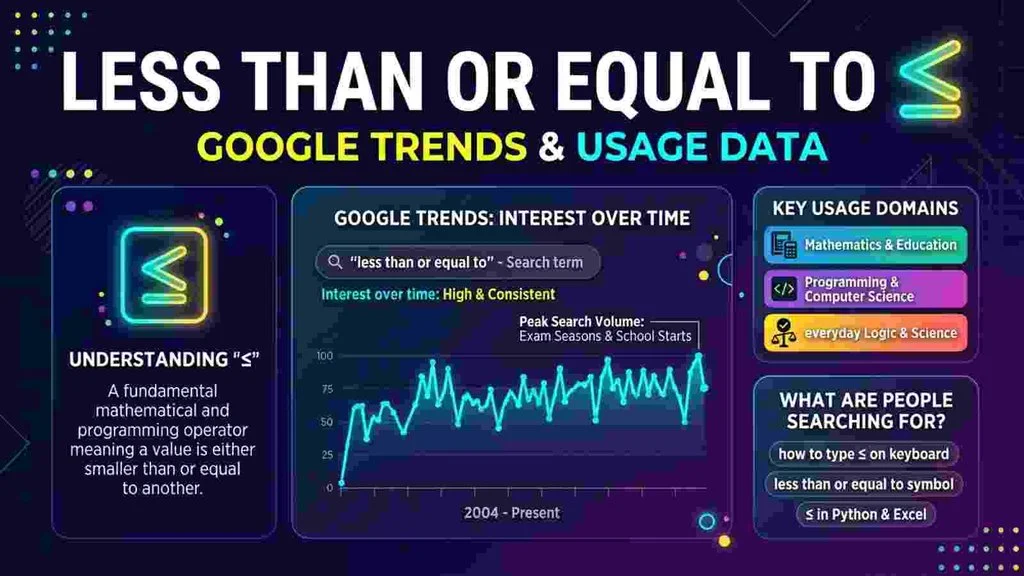
The phrase “less than or equal to” is a common educational search term. People look for it when learning mathematics, solving homework, writing equations, or using comparison symbols in code.
Search interest can vary by country, school calendars, and the type of work people do. Students may search for the meaning during exam periods, while programmers may look for ways to write comparison operators.
The phrase is relevant to searches such as:
- Less than or equal to symbol
- What does ≤ mean?
- Less than or equal to examples
- How to type less than or equal to
- Less than vs less than or equal to
- Less than or equal to in programming
However, exact popularity rankings by country cannot be confirmed without current Google Trends data. Search volume can also change based on the selected date range, region, and related search terms.
Related searches include how to type the ≤ symbol on a keyboard, how to write it in code as <=, and how it compares with greater than or equal to (≥). Those questions are answered in the FAQs below.
FAQs About Less Than or Equal To
1. What does less than or equal to mean?
It means that one value is smaller than or the same as another value. For example, (4 \leq 6) and (6 \leq 6) are both true.
2. What is the symbol for less than or equal to?
The symbol is ≤. It combines the less-than sign with a line underneath to show that equality is allowed.
3. Is less than or equal to the same as less than?
No. The symbol < means strictly smaller than. The symbol ≤ means smaller than or equal to, so it includes equal values.
4. How do you type less than or equal to?
You can copy and paste ≤ into your document. On Windows, hold Alt and type 8804 on the numeric keypad to insert ≤. On a Mac, you can insert it from the Character Viewer. In LaTeX, write \leq. The method depends on your device and software.
5. What does (x \leq 10) mean?
It means that (x) can be 10 or any number smaller than 10. For example, 10, 8, 0, and −3 all satisfy the inequality.
6. How is less than or equal to written in coding?
Many programming languages use <=. For example, if (x <= 10) checks whether the value of x is smaller than or equal to 10.
7. What is the difference between ≤ and ≥?
The symbol ≤ means less than or equal to. The symbol ≥ means greater than or equal to. The direction of the sign changes the comparison.
8. How do you write less than or equal to in Excel and Python?
In both Excel formulas and Python code, write <= (the less-than sign followed by an equals sign). For example, in Excel =A1<=10 returns TRUE when A1 is 10 or smaller, and in Python x <= 10 is True when x is 10 or smaller.
9. What is the opposite of less than or equal to?
The opposite is greater than (>). If x is not less than or equal to 5, then x is greater than 5 (x > 5).
10. Does ≤ include the number itself?
Yes. The small line under the < means the value itself counts: x ≤ 5 includes 5, while x < 5 does not.
Conclusion
The phrase less than or equal to is an important term in mathematics, science, education, and daily life.
Its symbol, ≤, shows that a value can be smaller than another value or exactly the same. Once you understand this simple rule, it becomes easier to read equations, solve inequalities, and understand limits.
Remember that (3 \leq 5) is true because 3 is smaller than 5. The expression (5 \leq 5) is also true because both values are equal. However, (7 \leq 5) is false because 7 is greater than 5.
There is no difference between British and American spelling for this phrase. You can write it in words when explaining an idea or use the symbol in mathematical work. In programming, the common written form is <=.
The most useful tip is to check whether equality is allowed. If it is, use ≤. If the value must be strictly smaller, use < instead.
This small difference can help you avoid errors in exams, reports, calculations, and code.

Here’s a concise 2-line author bio suitable for Simifind.com:
James Dashner is an American bestselling author best known for The Maze Runner series and other popular young-adult fiction.
On Simifind.com, he shares clear, engaging insights and helpful content for readers interested in books, writing, and popular literature.