Have you ever stopped while writing an email because you were unsure whether to use i.e. or e.g.?
You are not alone. These two short terms look alike, but they have different meanings. Using the wrong one can make your writing confusing.
Both terms come from Latin. They are common in schoolwork, business emails, news articles, academic papers, and everyday messages.
However, many people mix them up because they often appear in the same sentence.
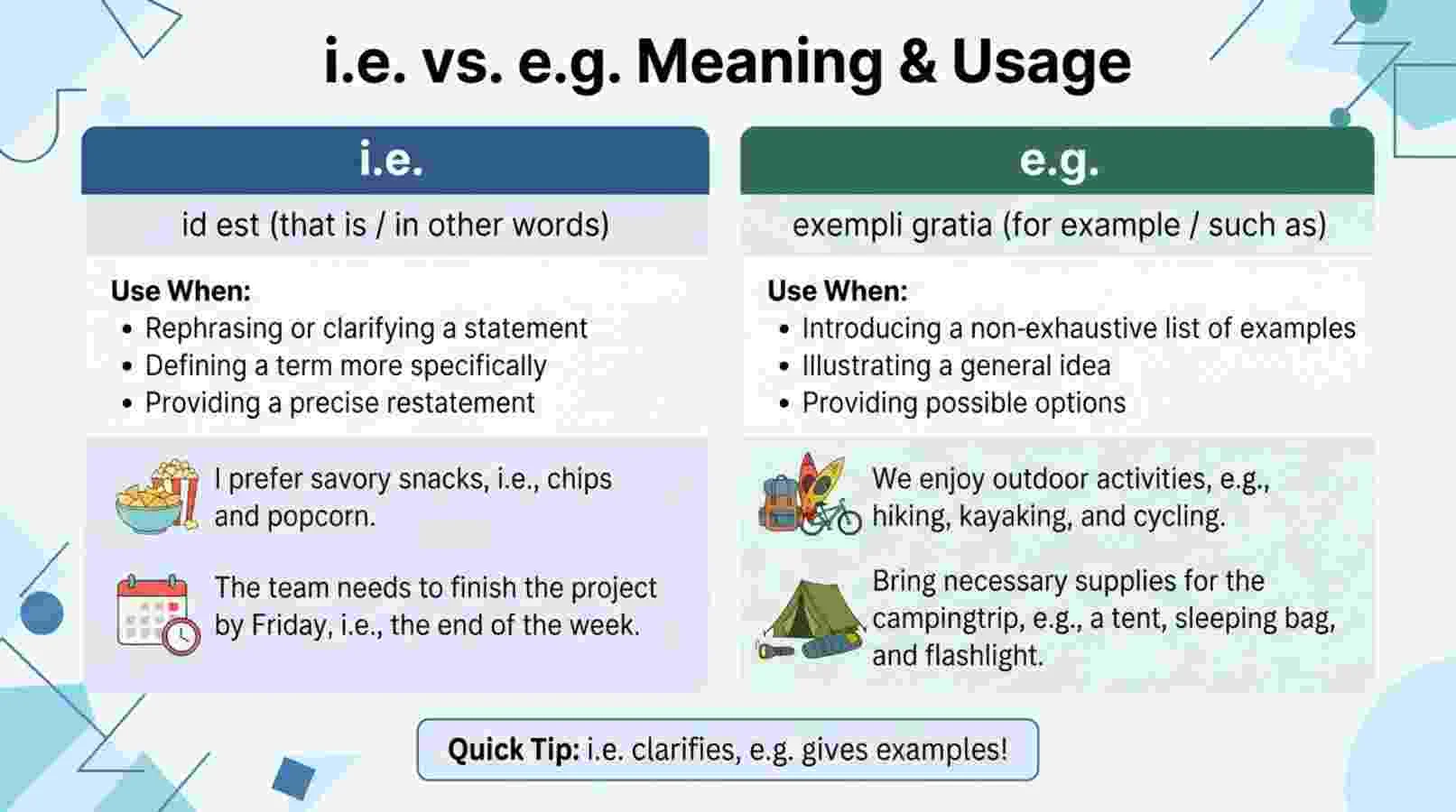
The good news is that the difference is easy to learn. I.e. means “that is,” while e.g. means “for example.”
Use i.e. when you want to explain something more clearly or state exactly what you mean. Use e.g. when you want to give one or more examples of a larger group.
In this guide, you will learn the meaning, origin, spelling, and correct use of i.e. and e.g.
You will also see simple examples, common mistakes, and tips for choosing the right term in American English, British English, and global writing. By the end, you will know how to use both terms with confidence.
i.e. or e.g. – Quick Answer
I.e. means “that is,” while e.g. means “for example.” Both are correct in American and British English, but they serve different purposes.
- i.e. (that is): Use it to explain or clarify a statement.
- e.g. (for example): Use it to give examples of something.
Examples of i.e. and e.g.
Example 1: Using i.e.
I work on weekdays, i.e., Monday through Friday.
Here, i.e. explains which days the writer means.
Example 2: Using e.g.
I enjoy outdoor activities, e.g., hiking, cycling, and swimming.
Here, e.g. gives examples of outdoor activities.
Quick Comparison Table
| Term | Full Latin Form | English Meaning | Main Use |
| i.e. | id est | That is | Clarifying an idea |
| e.g. | exempli gratia | For example | Giving examples |
Easy memory tip: Think of i.e. as “in other words” and e.g. as “example given.”
The Origin of i.e. and e.g.
The terms i.e. and e.g. come from Latin, an ancient language that has shaped English vocabulary for centuries. Both are abbreviations, which means they are shortened forms of longer expressions.
Where Does i.e. Come From?
The abbreviation i.e. comes from the Latin phrase id est. It means “that is” or “in other words.”
Writers use it to explain a statement, make an idea more precise, or define what they mean.
For example:
The meeting is held on the last business day, i.e., the final weekday when the office is open.
The phrase after i.e. explains the meaning of “the last business day.”
Where Does e.g. Come From?
The abbreviation e.g. comes from the Latin phrase exempli gratia. It means “for the sake of example,” which is commonly expressed in English as “for example.”
Writers use it to name one or more items from a larger group.
For example:
You can learn a new language through different tools, e.g., books, apps, and online classes.
The examples show some possible learning tools. They do not list every option.
Why Do Writers Still Use These Latin Terms?
These abbreviations are short and widely recognized. They help writers keep sentences brief, especially in academic, technical, and professional writing.
However, their Latin origins do not mean you must use them in every situation. In simple writing, “that is” and “for example” are often easier to understand.
British English vs American English Spelling
Unlike words such as “color” and “colour,” i.e. and e.g. do not have separate standard American and British spellings. Both forms are used in the United States, the United Kingdom, and other English-speaking regions.
The main differences involve punctuation, style guides, and how formal the writing is.
Comparison of American and British Usage
| Feature | American English | British English |
| i.e. | Standard abbreviation | Standard abbreviation |
| e.g. | Standard abbreviation | Standard abbreviation |
| Meaning of i.e. | That is | That is |
| Meaning of e.g. | For example | For example |
| Periods | Commonly retained | Commonly retained |
| Commas after abbreviations | Often used | Depends on style guide |
| Informal alternatives | “That is,” “for example” | “That is,” “for example” |
American English Examples
American writers commonly use these forms in business and academic writing.
- Bring a valid ID, e.g., a passport or driver’s license.
- The deadline is tomorrow, i.e., October 30.
American style guides often recommend a comma after i.e. and e.g. when they introduce a phrase within a sentence. Exact punctuation can vary by publication.
British English Examples
British writers also use both abbreviations in formal and informal contexts.
- Several subjects, e.g. history and science, are covered in the course.
- The office is closed on public holidays, i.e. official holidays recognized by the relevant authority.
Some British style guides omit the comma immediately after these abbreviations, while others use it. Follow the rules of the publication or organization you are writing for.
Does the Spelling Change by Country?
No. The standard forms remain i.e. and e.g. in both American and British English.
You should focus on their meaning and follow the punctuation rules of your chosen style guide.
Which Spelling Should You Use?
The right choice depends on what you want to say, not on whether your audience uses American or British English.
For American Readers
Use i.e. when explaining a precise meaning and e.g. when providing examples.
For example:
- Please bring one form of identification, e.g., a passport.
- We accept payment on business days, i.e., Monday through Friday.
For professional documents, follow the organization’s preferred style guide.
For British and Commonwealth Readers
The same meanings apply in British, Australian, Canadian, and other varieties of English. Punctuation preferences may differ, so check the rules of your workplace, university, or publisher.
For example:
- Some sports, e.g. tennis and cricket, are played worldwide.
- The event is for beginners, i.e. people with little or no prior experience.
For Global and Online Writing
If you write for an international audience, clarity should come first.
Use “for example” instead of e.g. when you think readers may not know the abbreviation. Use “that is” or “in other words” instead of i.e. when a sentence needs a clear explanation.
For example:
- Clear: You can use digital tools, for example, calendars and note-taking apps.
- More formal: You can use digital tools, e.g., calendars and note-taking apps.
Both versions are correct. The first may be easier for new English learners.
Common Mistakes with i.e. and e.g.
Many writers confuse these terms because both appear before extra information. Learning a few common errors can help you avoid them.
Mistake 1: Using i.e. to Give Examples
Incorrect: I like fruits, i.e., apples, oranges, and bananas.
Correct: I like fruits, e.g., apples, oranges, and bananas.
The second sentence gives examples of fruits. It does not define all fruits.
Mistake 2: Using e.g. to Explain an Exact Meaning
Incorrect: The test covers two subjects, e.g., math and science, and no others.
Correct: The test covers two subjects, i.e., math and science.
The second sentence uses i.e. to identify the exact subjects meant.
Mistake 3: Writing “e.g.,” Without Checking the Style Guide
Some style guides use a comma after e.g., while others omit it. Neither punctuation choice should be treated as a universal rule for every publication.
Tip: Choose one style guide and use its rules consistently.
Mistake 4: Using Both Terms Together
Avoid writing “i.e., for example” or “e.g., that is” when the phrases repeat or conflict with the abbreviation’s meaning.
Choose the term that matches your purpose.
Mistake 5: Using Abbreviations in Simple Writing
Latin abbreviations can make a sentence look formal or technical. They may slow down readers who do not know their meanings.
Instead of writing:
Please bring supplies, e.g., pens and paper.
You can write:
Please bring supplies, such as pens and paper.
The second version is simple and natural.
i.e. and e.g. in Everyday Examples
Both abbreviations appear in many types of writing. Here is how to use them in everyday situations.
In Emails
Use these terms to make instructions more precise.
Using i.e.:
Please send the final report by the end of the week, i.e., Friday afternoon.
Using e.g.:
Please attach supporting files, e.g., receipts, charts, or invoices.
For everyday workplace emails, writing “that is” or “for example” may sound more natural.
In News Articles
News writers may use e.g. to introduce examples or i.e. to explain a term.
- Some cities, e.g., London and New York, attract millions of visitors.
- The policy applies to full-time staff, i.e., employees who meet the stated full-time requirements.
News organizations may prefer to spell out the phrases, depending on their editorial style.
On Social Media
Short abbreviations can save space, but simple language is often easier to read.
- i.e.: I only work weekdays, i.e., Monday to Friday.
- e.g.: I love quiet hobbies, e.g., reading and gardening.
For casual posts, “meaning” and “for example” are often better choices.
In Academic Writing
Academic writers use i.e. to define a concept and e.g. to illustrate it.
Using i.e.:
The study examines bilingual students, i.e., students who use two languages.
Using e.g.:
Several research methods, e.g., surveys and interviews, can collect useful data.
Use the exact definitions and examples that fit your research. Also check the citation and style requirements of your institution.
In Formal Reports
Both abbreviations can help shorten technical explanations.
- The system requires two inputs, i.e., a username and a password.
- The software supports common file types, e.g., PDF, DOCX, and XLSX.
If the report is intended for a broad audience, spelling out the phrases may improve readability.
i.e. or e.g. – Google Trends and Usage Data
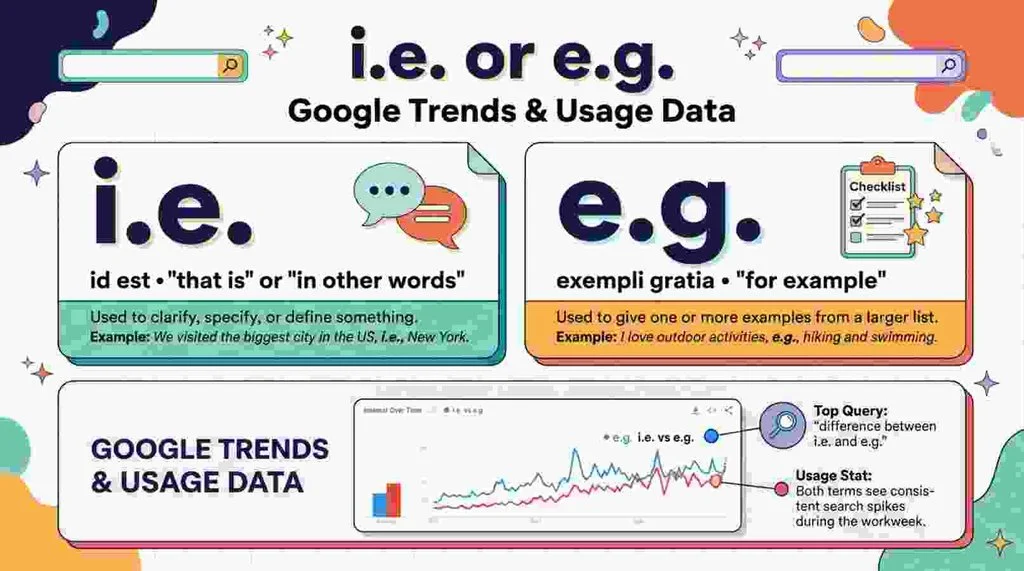
People search for “i.e. or e.g.” because they want a quick way to understand the difference between these abbreviations. The question is common among students, English learners, office workers, editors, and professional writers.
However, it is important to separate general search interest from verified search-volume data.
Which Countries Search for These Terms?
Search interest may come from English-speaking countries such as the United States, the United Kingdom, Canada, and Australia. It may also come from countries where English is widely used in education and business, including Pakistan and India.
These are plausible audiences for the topic, not a verified ranking of countries searching for the keyword.
Why Do People Search for i.e. or e.g.?
Common reasons include:
- Learning the difference between the two abbreviations.
- Checking grammar and punctuation.
- Improving essays, reports, and emails.
- Understanding Latin expressions.
- Preparing academic or professional documents.
What Does Google Trends Tell Us?
Google Trends can help compare relative search interest over time and across regions. Its values are normalized on a scale from 0 to 100; they do not represent exact search counts.
Without a current, verified Trends comparison, it would be misleading to claim that one country or abbreviation has the highest search volume. You can explore the keyword directly through Google Trends and compare “i.e. or e.g.,” “ie vs eg,” and “e.g. meaning.”
For SEO writers, this topic works well as a short grammar guide because it answers a clear question and provides practical examples.
Frequently Asked Questions
1. What is the main difference between i.e. and e.g.?
I.e. means “that is” or “in other words.” E.g. means “for example.” Use i.e. to clarify a point and e.g. to give examples.
2. Is i.e. the same as e.g.?
No. They have different meanings. I.e. explains what you mean, while e.g. introduces examples of something.
3. Should I use i.e. or e.g. in formal writing?
Both are acceptable in formal writing. Use i.e. for clarification and e.g. for examples. Follow the style guide required by your school, workplace, or publisher.
4. Do British and American English use the same abbreviations?
Yes. Both varieties use i.e. and e.g. The main differences relate to punctuation and editorial preferences, not spelling.
5. Should I put a comma after i.e. and e.g.?
It depends on the style guide. Many American style guides use a comma after both abbreviations, while some British guides omit it. Consistency matters most.
6. Can I use i.e. and e.g. in everyday emails?
Yes. They are acceptable in emails, but “that is” and “for example” may be clearer for readers who are unfamiliar with Latin abbreviations.
7. How can I remember the difference between i.e. and e.g.?
Remember this simple rule: i.e. explains; e.g. gives examples. If you are clarifying an idea, use i.e. If you are listing examples, use e.g.
Conclusion
Understanding i.e. or e.g. is simple once you learn what each abbreviation means. Both come from Latin, and both are widely used in American, British, and international English. However, they are not interchangeable.
Use i.e. when you want to explain a point, make a statement more precise, or say “in other words.” Use e.g. when you want to provide examples of a larger group.
For instance, “I enjoy outdoor activities, e.g., hiking and cycling” gives examples, while “I work weekdays, i.e., Monday through Friday” explains the meaning of weekdays in that context.
Remember that neither abbreviation has a separate American or British spelling. Punctuation can vary by style guide, so follow the rules of your school, workplace, or publication.
If your audience includes English learners or general readers, consider using “that is” and “for example” instead. These phrases are clear, natural, and easy to understand.
The most useful rule is simple: i.e. clarifies, and e.g. gives examples. Keep this difference in mind, and you will choose the correct term with confidence.

Mary Roach is an American science writer and bestselling author known for making unusual and complex scientific topics engaging, accessible, and humorous. Her books include Stiff, Packing for Mars, Gulp, and Fuzz.
Author at Simifind.com, sharing clear, informative content designed to help readers understand interesting topics and everyday questions.