Have you ever stopped while writing because you were unsure whether to use affect or effect?
You are not alone. These two words sound almost the same, but they have different meanings and uses. Choosing the wrong one can make your writing unclear.
Many students, teachers, writers, and English learners search for affect or effect because both words are common in daily English.
They often appear in emails, school assignments, business reports, news articles, and social media posts. The good news is that learning the difference is simple.
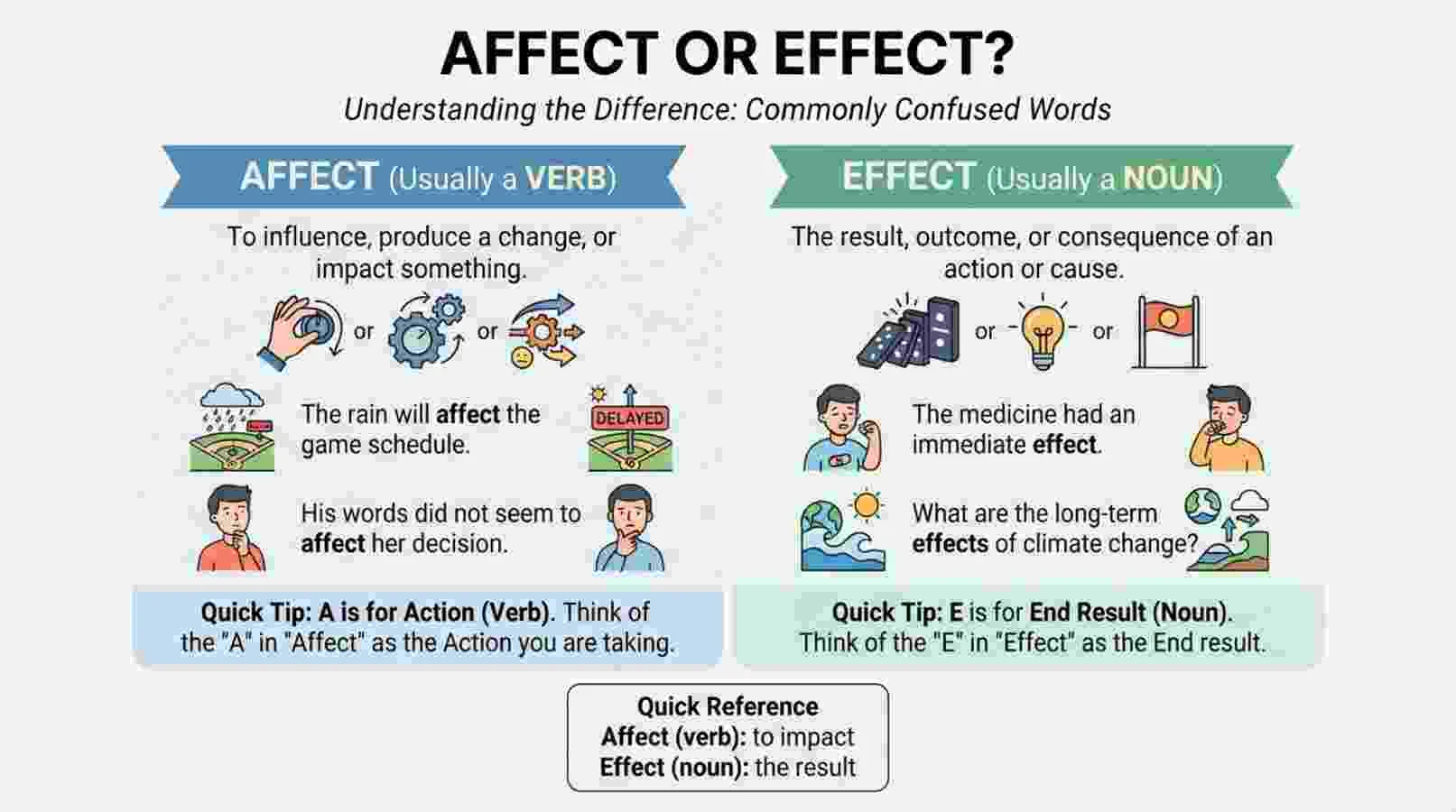
In most cases, affect is a verb, while effect is a noun. Affect means to change or influence something. Effect means a result or outcome. For example, rain can affect your plans, while the effect of rain may be a wet road.
This guide explains their meanings, origins, spelling, and correct usage. You will also find simple examples, common mistakes, and helpful tips to choose the right word every time.
Affect or Effect – Quick Answer
The main difference between affect and effect is their part of speech and meaning.
- Affect: Usually a verb. It means to influence or change something.
- Effect: Usually a noun. It means the result or outcome of an action.
Examples:
- The weather can affect your mood.
- The effect of bad weather was a canceled match.
- Lack of sleep can affect your health.
- One effect of poor sleep is tiredness.
A simple trick can help you remember:
A = Affect = Action
E = Effect = End result
Although these are the most common uses, both words have less common grammatical uses. Affect can be a noun in psychology, while effect can be a verb meaning to bring something about.
The Origin of Affect and Effect
The words affect and effect have Latin roots. They entered English through French and Latin forms. Their histories explain why they look and sound so similar today.
Origin of Affect
The word affect comes from the Latin word afficere, which means to influence, act upon, or have an impact on something.
Over time, it developed into the English verb we use today. It describes how one thing can change or influence another.
For example:
- Stress can affect your sleep.
- Your words may affect someone’s feelings.
- Cold weather can affect plant growth.
Origin of Effect
The word effect comes from the Latin word effectus, meaning accomplishment, result, or outcome.
It developed into a noun that describes what happens because of an action or event.
For example:
- The medicine had a positive effect.
- The new rules had little effect.
- Exercise can have a good effect on health.
Both words share a historical connection, but their modern meanings are different. Their spelling has remained distinct because they developed from different Latin forms.
British English vs American English Spelling
Unlike words such as colour and color or organise and organize, affect and effect have the same spelling in British and American English.
There is no regional spelling difference between these two words. Their meanings and grammatical uses also remain the same in both varieties of English.
| Word | American English | British English | Meaning |
| Affect | Affect | Affect | To influence |
| Effect | Effect | Effect | A result |
| Affected | Affected | Affected | Influenced |
| Effective | Effective | Effective | Producing a result |
| Affecting | Affecting | Affecting | Having an impact |
American English examples:
- The new policy will affect workers.
- The changes had a positive effect.
British English examples:
- The new policy will affect workers.
- The changes had a positive effect.
As you can see, both countries use the same spelling. The difference is not regional; it is based on meaning and grammar.
Which Spelling Should You Use?
You do not need to choose between British and American spelling when using affect or effect. Both words are correct in the United States, the United Kingdom, Canada, Australia, and other English-speaking countries.
However, you must choose the right word for your sentence.
For American English
Use affect when you want to describe an action or influence. Use effect when you want to describe a result.
Example: The new law may affect small businesses. Its effect could be significant.
For British English and Commonwealth Countries
Follow the same rule. Both words have identical spelling and meaning in British English.
Example: The weather affected the event. The effect was clear.
For Global English
If you write for an international audience, use the standard grammatical rules. These words are understood across English-speaking countries.
Professional advice: Do not use affect or effect based on your location. Choose the word that matches the meaning of your sentence.
Common Mistakes with Affect and Effect
Many people confuse these words because they sound alike. However, a few simple rules can help you avoid mistakes.
1. Using Effect Instead of Affect
Incorrect: The rain will effect our plans.
Correct: The rain will affect our plans.
Why? The sentence describes how rain will influence the plans. Therefore, affect is correct.
2. Using Affect Instead of Effect
Incorrect: The effect of exercise can affect your health.
Correct: The effect of exercise can improve your health.
Why? Effect is a noun when it describes a result.
3. Forgetting the Difference in Formal Writing
Incorrect: The new policy had a strong affect on students.
Correct: The new policy had a strong effect on students.
Why? The sentence talks about the result of a policy, so effect is the correct choice.
4. Confusing Affected and Effected
These words have different meanings.
- Affected means influenced or changed.
- Effected means brought about or made happen.
Example: The storm affected the town.
Example: The government effected major changes.
5. Ignoring Their Less Common Meanings
Affect can also be a noun in psychology. It describes the way a person’s emotions appear or are expressed.
Effect can also be a verb. It means to make something happen.
Example: The new leader hopes to effect change.
Learning these exceptions will help you write with greater confidence.
Affect and Effect in Everyday Examples
Both words appear in everyday communication. Understanding their use in different situations can improve your writing and speaking.
1. In Emails
Professional emails often use these words when discussing changes, results, or decisions.
- The new schedule may affect our meeting time.
- The delay had an effect on the project.
2. In News Articles
News writers use affect and effect to explain events and their results.
- Rising prices affect families across the country.
- The policy had a major effect on the economy.
3. On Social Media
People use these words when discussing feelings, experiences, and daily events.
- Music can affect my mood.
- The positive effect of exercise is amazing.
4. In Academic Writing
Students and researchers use these words to explain causes and outcomes.
- Climate change can affect natural habitats.
- The effect of pollution on human health is serious.
5. In Formal and Business Writing
Correct word choice makes professional communication clearer.
- Market changes may affect company profits.
- The new strategy had a positive effect on sales.
Affect or Effect – Google Trends & Usage Data
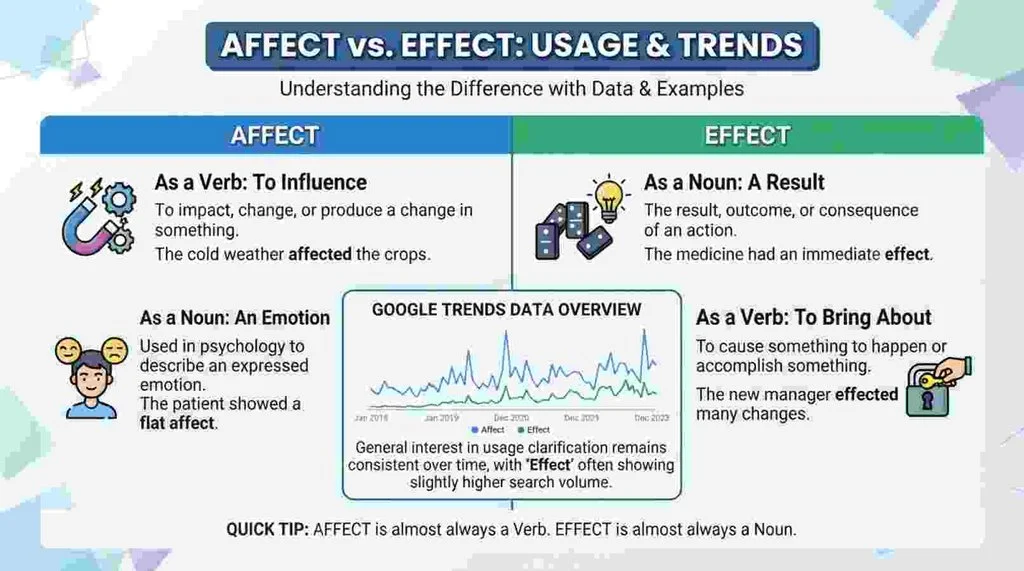
The words affect and effect are both widely used in English-speaking countries. People search for them because they want to understand their meanings, avoid grammar mistakes, and improve their writing.
Search interest is especially relevant in countries where English is widely used, including:
- United States: Students and professionals often search for the difference between affect and effect.
- United Kingdom: English learners and writers look for grammar explanations and examples.
- Canada: Both words appear in academic, business, and everyday writing.
- Australia: People search for their meanings and correct grammatical use.
- India and Pakistan: Students, English learners, and competitive exam candidates often need help understanding the difference.
Which word is more popular?
Both words have frequent uses, but their popularity depends on context. Affect appears in sentences about influence and change. Effect appears in sentences about results and outcomes.
Google Trends measures search interest over time. It does not directly measure the total number of times a word appears in written or spoken English. Therefore, exact popularity rankings should be checked using a selected country and date range rather than assumed.
For SEO writers, a useful approach is to target the combined keyword affect or effect and include related searches such as:
- Affect vs effect meaning
- Difference between affect and effect
- When to use affect or effect
- Affect and effect examples
- Is it affect or effect?
Affect vs Effect: Side-by-Side Comparison Table
This table makes it easy to understand the difference between the two words.
| Feature | Affect | Effect |
| Main use | Verb | Noun |
| Meaning | To influence | A result |
| Purpose | Shows an action | Shows an outcome |
| Example | Noise affects sleep. | Noise has an effect on sleep. |
| Past form | Affected | Effected |
| Common phrase | Affect someone’s mood | Have an effect |
| Memory trick | Action | End result |
Remember: Affect usually describes what happens to something, while effect describes what happens as a result.
Frequently Asked Questions (FAQs)
1. What is the main difference between affect and effect?
Affect is usually a verb meaning to influence or change something. Effect is usually a noun meaning a result or outcome. For example, stress can affect your health, while tiredness can be an effect of stress.
2. Is it affect or effect in a sentence?
It depends on the meaning. Use affect when describing an influence. Use effect when describing a result. For example, rain can affect traffic, but heavy traffic can be an effect of rain.
3. Is affect a verb or a noun?
Affect is mainly used as a verb. It means to influence or change something. However, it can also be a noun in psychology, where it describes the outward expression of emotion.
4. Is effect a verb or a noun?
Effect is mainly a noun. It describes a result or outcome. However, it can also be a verb meaning to bring about or make something happen.
5. Do British and American English spell affect and effect differently?
No. Both British and American English use the same spelling. The words have the same meanings and grammatical rules in both varieties.
6. What is an easy trick to remember affect and effect?
Remember A for Affect and Action. Affect usually describes an action or influence. Remember E for Effect and End result. Effect usually describes what happens afterward.
7. Is it affected or effected?
Affected means influenced or changed by something. Effected means brought about or made something happen. For example, the storm affected the town, while the new law effected major changes.
Conclusion
Understanding the difference between affect and effect can make your English writing clearer and more professional. Although these words look and sound similar, they have different meanings and grammatical roles.
In most everyday sentences, affect is a verb that means to influence or change something. Effect is a noun that means a result or outcome.
For example, lack of sleep can affect your health, and tiredness can be an effect of poor sleep.
Remember that British and American English use the same spelling for both words. You do not need to change their spelling based on your audience or location. Instead, focus on the meaning of your sentence.
The easiest way to remember the difference is to connect affect with action and effect with the end result.
With regular practice and simple examples, you can avoid common mistakes and use both words with confidence in emails, school assignments, business writing, and everyday conversations.

Here’s a concise 2-line author bio suitable for Simifind.com:
James Dashner is an American bestselling author best known for The Maze Runner series and other popular young-adult fiction.
On Simifind.com, he shares clear, engaging insights and helpful content for readers interested in books, writing, and popular literature.