Have you ever stopped while writing because you were unsure whether to use farther or further? You are not alone.
These two words look and sound alike. Both can talk about distance, but they do not always mean the same thing.
Many people search for “farther or further” because they want to know which word is correct in English.
The confusion often comes from their similar meanings and everyday use. For example, should you say, “My house is farther away” or “My house is further away”? Both sentences can be correct.
The main difference is simple. Farther usually refers to physical distance. Further often refers to an extra amount, degree, or progress. However, further can also describe physical distance.
In this guide, you will learn the meaning, origin, spelling, and correct use of both words. You will also find simple examples, common mistakes, and helpful tips for choosing the right word in everyday writing.
Farther or Further – Quick Answer
Both farther and further are correct English words. The main difference is how we use them.
- Farther: Use it when talking about physical distance.
- Further: Use it when talking about extra information, progress, or a greater degree.
Examples of farther:
- My school is farther from home.
- We walked farther than we planned.
- The next town is farther away.
Examples of further:
- I need further information.
- We should discuss this matter further.
- She wants to further her education.
Easy trick: If you can measure the distance, use farther. If you mean more, extra, or additional, use further.
Remember, further can also describe physical distance, so both words may sometimes be correct.
The Origin of Farther and Further
The words farther and further have a long history in the English language. Both are linked to the old word far, which means a long distance away.
The word farther developed as a comparative form of far. It became a common way to describe a greater physical distance.
The word further also developed from older forms of far. Over time, it gained extra meanings. People began using it to describe progress, additional information, and a greater degree.
English spelling and word use changed over many years. This is why the two words now have different common uses, even though their meanings still overlap.
Today, both words are accepted in British and American English. However, modern writing often follows a simple rule:
- Use farther for physical distance.
- Use further for additional ideas or progress.
These rules help writers make their meaning clear.
British English vs American English Spelling
British and American English both use farther and further. There is no major spelling difference between the two varieties.
However, people may show slight differences in preference and everyday use.
American English often follows the traditional rule of using farther for physical distance and further for figurative meaning. British English also follows this distinction, but further is widely used for both physical and figurative distance.
Comparison Table
| Feature | American English | British English |
| Physical distance | Farther | Farther or further |
| Extra information | Further | Further |
| More progress | Further | Further |
| Additional discussion | Further | Further |
| Spelling | Farther / Further | Farther / Further |
Examples in American English
- The park is farther from my house.
- We need further research.
- He walked farther than his brother.
Examples in British English
- The village is farther away.
- We need further information.
- Let’s discuss this matter further.
Both forms are correct in both countries. The main difference is usage preference, not spelling.
Which Spelling Should You Use?
Choosing between farther and further depends on your meaning and audience. Both words are accepted worldwide, but using them correctly makes your writing clearer.
For American Readers
If your audience is in the United States, use farther for measurable physical distance.
Example: The airport is farther from the city than the station.
Use further for extra details, progress, or additional work.
Example: We need further information about the project.
For British and Commonwealth Readers
In the United Kingdom and other Commonwealth countries, both words are common.
Farther can describe physical distance, while further can describe distance and additional meaning.
Example: We walked further along the road.
For Global Readers
If you write for an international audience, follow the simple distinction:
- Physical distance: Farther.
- Extra information: Further.
- More progress: Further.
- Additional discussion: Further.
This approach makes your writing easy to understand for readers around the world.
Common Mistakes with Farther and Further
Many English learners and native speakers mix up these words. Their similar meanings can make choosing the correct word difficult.
Here are some common mistakes and their corrections.
1. Using farther for extra information
Incorrect: I need farther information.
Correct: I need further information.
Why? Further means additional or more in this sentence.
2. Using further for measurable distance
Incorrect: My house is further than yours.
Better: My house is farther than yours.
Why? Farther is the traditional choice for physical distance. Further is also accepted by many speakers.
3. Mixing both words in formal writing
Incorrect: We need farther research before making a decision.
Correct: We need further research before making a decision.
Why? Further means additional research.
4. Thinking one word is always correct
Incorrect: Farther is always better than further.
Correct: Both words are correct, but their meanings can differ.
Why? Each word has its own common uses.
5. Forgetting the meaning of further
Incorrect: We must walk further our education.
Correct: We must further our education.
Why? Further can be a verb meaning to help something progress.
Farther and Further in Everyday Examples
Both words appear in daily conversations, emails, news stories, social media posts, and formal documents. Knowing how to use them makes your English more natural.
1. In Emails
People often use further when asking for more details or explaining the next steps.
Examples:
- Please send further details about the meeting.
- I will contact you for further information.
- We can discuss this matter further next week.
2. In News
News writers use both words to describe distance and developments.
Examples:
- The storm moved farther away from the coast.
- Officials are waiting for further reports.
- The investigation may lead to further action.
3. On Social Media
People use these words in posts, captions, and everyday messages.
Examples:
- We walked farther than we expected today.
- I want to take my skills further.
- Follow me for further updates.
4. In Formal Writing
Academic and professional writing often uses further to explain additional research, information, or progress.
Examples:
- Further research is needed to understand the issue.
- The study explores this topic further.
- The new policy aims to further economic growth.
5. In Daily Conversations
Both words are useful in simple spoken English.
Examples:
- How much farther is the station?
- Can you explain this further?
- We cannot go any farther.
- Let’s take this discussion further.
Farther or Further – Google Trends and Usage Data
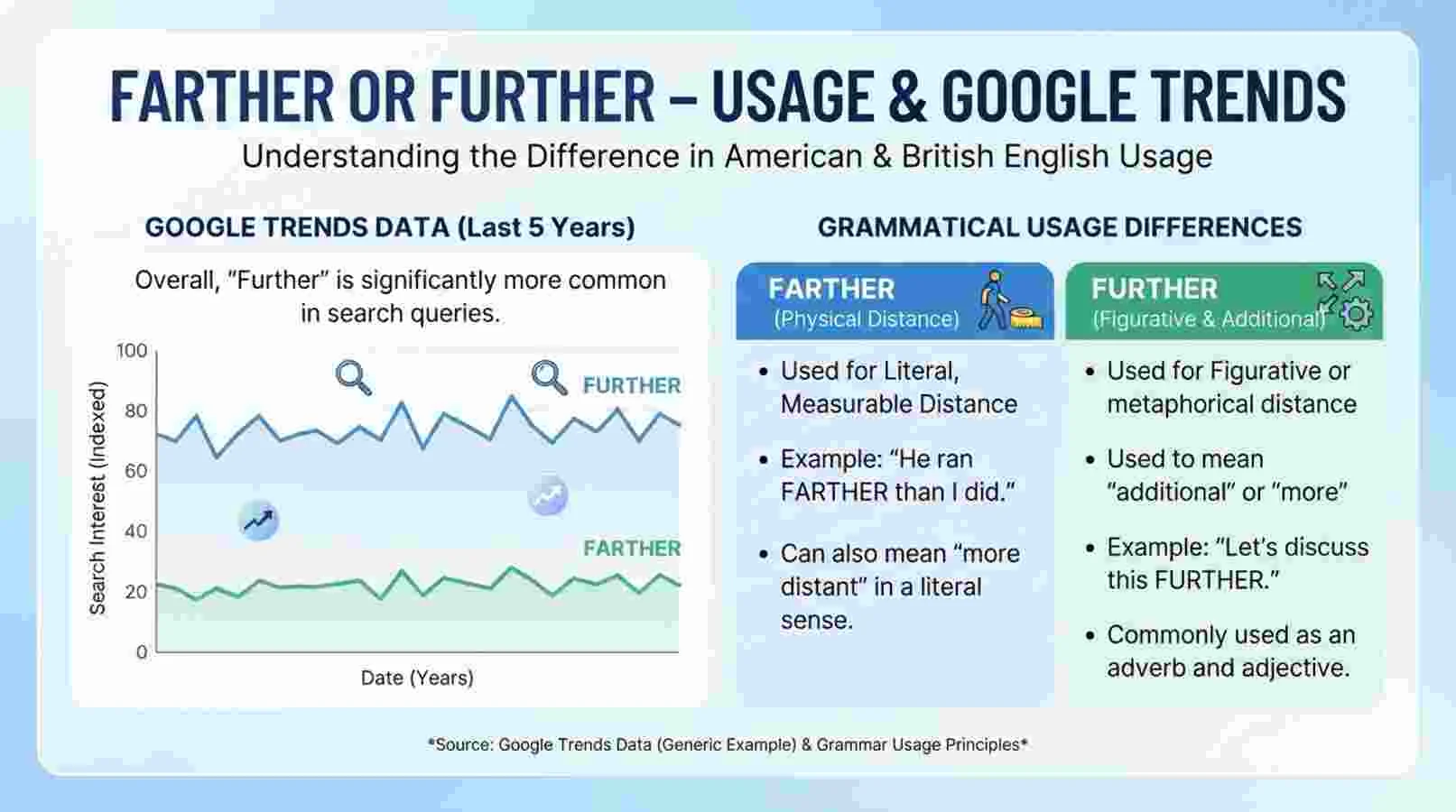
People search for farther or further because they want to understand the difference between these words. The topic is especially useful for students, English learners, teachers, editors, and professional writers.
Both words appear in searches from English-speaking countries and international audiences.
Search Interest by Country
The topic is relevant in countries such as:
- United States: People often look for grammar rules and correct word usage.
- United Kingdom: Readers want to understand the difference between the two words.
- Canada: Students and writers search for English spelling and grammar guidance.
- Australia: English learners and professionals look for usage examples.
- India: Students often search for simple explanations of confusing English words.
- Pakistan: English learners search for grammar rules and writing help.
Why Do People Search for These Words?
Common search reasons include:
- Understanding the difference between farther and further.
- Learning which word describes physical distance.
- Improving grammar and writing skills.
- Preparing for school tests and English exams.
- Writing professional emails and academic papers.
Google Trends note: These are relevant audience markets, not verified popularity rankings. Exact search interest changes over time. Google Trends can help compare the relative popularity of both terms by country and date.
You can explore the comparison directly through Google Trends: Farther vs Further.
Farther vs Further – Side-by-Side Comparison
The following table makes the difference easy to understand.
| Feature | Farther | Further |
| Main meaning | Greater physical distance | Additional or more |
| Physical distance | Yes | Yes |
| Extra information | Usually no | Yes |
| Progress | Rarely | Yes |
| Part of speech | Adjective / Adverb | Adjective / Adverb / Verb |
| Example | Walk farther | Further research |
| Common phrase | Farther away | Further details |
Remember: Farther usually refers to physical distance, while further has a wider range of meanings.
Frequently Asked Questions
1. What is the main difference between farther and further?
Farther usually describes physical distance. Further means additional, more, or greater progress. However, further can also describe physical distance.
2. Is farther or further correct in American English?
Both are correct in American English. Farther is generally preferred for physical distance, while further is used for additional information and progress.
3. Is farther or further correct in British English?
Both words are correct in British English. Farther often describes physical distance, but further is also commonly used for distance and additional meaning.
4. Can further be used for physical distance?
Yes. Further can describe physical distance. For example, “We walked further down the road” is correct.
5. Is further more formal than farther?
Further may sound more formal in phrases such as further information or further research. However, neither word is always more formal than the other.
6. How can I remember when to use farther or further?
Use farther when you mean measurable physical distance. Use further when you mean more, extra, or additional information.
7. Is it further away or farther away?
Both expressions are correct. Farther away is the traditional choice for physical distance, while further away is also widely accepted.
Conclusion
Understanding farther or further is easier when you remember their main meanings. Both words are correct, but they often serve different purposes in English writing and speaking.
Use farther when you talk about physical distance, such as the distance between two towns, buildings, or places. For example, “The airport is farther from my home.”
Use further when you mean extra information, more progress, or an additional amount. For example, “We need further details before making a decision.”
Keep in mind that further can also describe physical distance. This means you may see both words used correctly in similar sentences.
For students, bloggers, teachers, and professional writers, the best approach is to focus on meaning rather than memorizing strict rules. When you are unsure, ask yourself whether you mean actual distance or something additional.
With a little practice, you can use both words with confidence. These simple rules will help you write better sentences, avoid common grammar mistakes, and communicate your ideas clearly.

Mary Roach is an American science writer and bestselling author known for making unusual and complex scientific topics engaging, accessible, and humorous. Her books include Stiff, Packing for Mars, Gulp, and Fuzz.
Author at Simifind.com, sharing clear, informative content designed to help readers understand interesting topics and everyday questions.