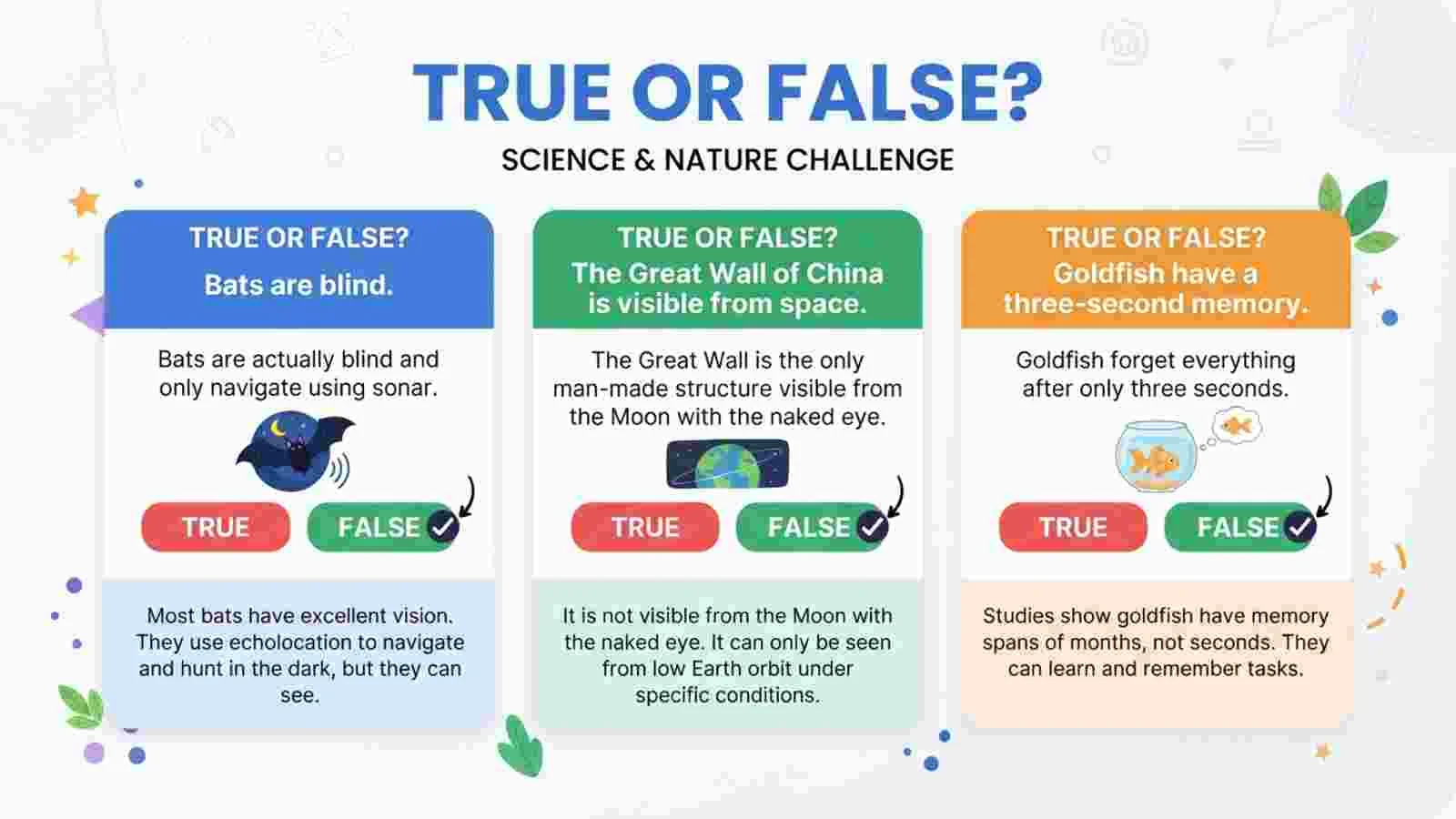
True or false questions are simple questions with only two possible answers — true or false. They are used in quizzes, games, tests and icebreakers because they are quick to answer and easy to score.
True or false questions are a simple and fun way to test what you know. They can help you learn new facts, check your memory, and enjoy games with friends. But what makes a statement true or false?
The answer depends on whether the statement matches the facts.
People search for true or false questions for many reasons. Students use them to prepare for school tests. Teachers use them to check learning.
Families and friends use them for fun quizzes, party games, and social media challenges. These questions are also useful in online quizzes, classroom activities, and general knowledge games.
Some people want easy questions for children. Others need hard questions about science, history, sports, or everyday life. The right questions can make learning simple and enjoyable.
In this guide, you will learn what true or false questions mean, how they work, and how to write them correctly.
You will also find examples, common mistakes, and answers to popular questions. Whether you are planning a quiz or studying for an exam, this guide will help you use true or false questions with confidence.
True or False Questions – Quick Answer
True or false questions ask you to decide whether a statement is correct or incorrect. You usually choose one of two answers: True or False.
For example:
- The sun rises in the east. — True
- Fish can live naturally without water. — False
- A week has seven days. — True
- All birds can fly. — False
These questions are easy to answer and simple to understand. They are common in school tests, online quizzes, games, and general knowledge activities.
A good true or false question presents a clear statement. The person answering must know the facts or use careful thinking to choose the right answer.
The Origin of True or False Questions
The phrase true or false comes from two basic English words. True means correct or in line with facts. False means wrong or not in line with facts.
The word true comes from Old English trīewe, which meant faithful or trustworthy. The word false comes through Old French from Latin falsus, meaning deceptive or mistaken.
People have used statements to test knowledge for a long time. As formal education and written exams developed, true-or-false tests became a simple way to check what students knew.
These questions are still popular because they are quick to answer and easy to mark. Teachers can use them to test facts, while websites can use them to create interactive quizzes.
The phrase itself does not have different British and American spellings. The main difference is how writers use punctuation and style when forming the question.
British English vs American English Spelling
British English and American English use the same spelling for true or false questions. There is no standard UK or US spelling difference in this phrase.
However, writers may use different punctuation or formatting styles.
| Feature | British English | American English |
| Phrase | True or false questions | True or false questions |
| Spelling of true | True | True |
| Spelling of false | False | False |
| Common test label | True/False | True/False |
| Example | Are these statements true or false? | Are these statements true or false? |
| Hyphenated form | True-or-false questions | True-or-false questions |
The phrase true-or-false may use hyphens when it comes before a noun as a compound modifier, as in “a true-or-false quiz.” Many writers also use “true or false quiz” without hyphens, especially in informal content.
Both forms are widely understood. Follow your school, publisher, or website style guide when one is provided.
Which Spelling Should You Use?
Since the phrase has the same spelling in British and American English, you do not need to choose a regional version.
Your choice should depend on your audience and purpose.
In the United States, teachers and quiz makers usually use familiar terms such as “true or false quiz,” “quiz questions,” and “answer key.” Short, direct instructions work best.
In the United Kingdom and other Commonwealth countries, the same terms work well. For formal study materials, it is best to follow local school or exam guidelines.
For readers everywhere, simple words and clear statements work best. Avoid slang, confusing phrases, and facts that may change from one country to another.
For example, “A triangle has three sides” is clear to almost everyone. A question about a country’s school rules may need more context.
Wherever you use them, keep the statements clear and the facts correct. Well-written questions matter more than repeating the same words.
Common Mistakes with True or False Questions
True or false questions are easy to create, but a few mistakes can make them confusing.
1. Writing unclear statements
Incorrect: The weather is always hot.
This statement is too broad because weather changes by place and season.
Better: Summer temperatures are often higher than winter temperatures in many regions.
2. Using tricky words
Words such as always, never, all, and none can make a question harder than needed.
Example: All mammals live on land. — False.
Some mammals, such as whales, live in water.
3. Including two ideas in one statement
Incorrect: The Earth moves around the Sun and the Moon is a planet.
The statement contains two claims, so one part is true and the other is false.
Better: The Earth moves around the Sun. — True.
4. Forgetting the answer key
Always provide correct answers when creating a quiz for study or learning. Add a short explanation when it helps readers understand the fact.
5. Using outdated facts
Facts about population, records, and current events can change. Check reliable sources before publishing questions about them.
True or False Questions in Everyday Examples
True or false questions are useful in many settings. Here are common ways to use them.
In emails
Teachers and trainers can use them to check whether readers understand a lesson.
Example:
Subject: Quick Training Quiz
Please answer these true or false questions after reading the guide. Review your answers before sending your response.
In news and education
Schools and learning websites use true or false questions to help students review important facts.
Examples:
- The Pacific Ocean is the largest ocean on Earth. — True
- The human heart normally has five chambers. — False
On social media
Creators can post short quizzes to invite comments and encourage people to test their knowledge.
Example: True or false: Honey can last for a very long time when stored properly. — True
In formal writing
Use a clear label, numbered questions, and a separate answer key when preparing worksheets or exams.
Example:
- Water freezes at 0°C under standard atmospheric pressure. — True
- The Moon produces its own light. — False
Clear formatting helps readers focus on the facts rather than the layout.
True or False Questions – Google Trends and Usage Data
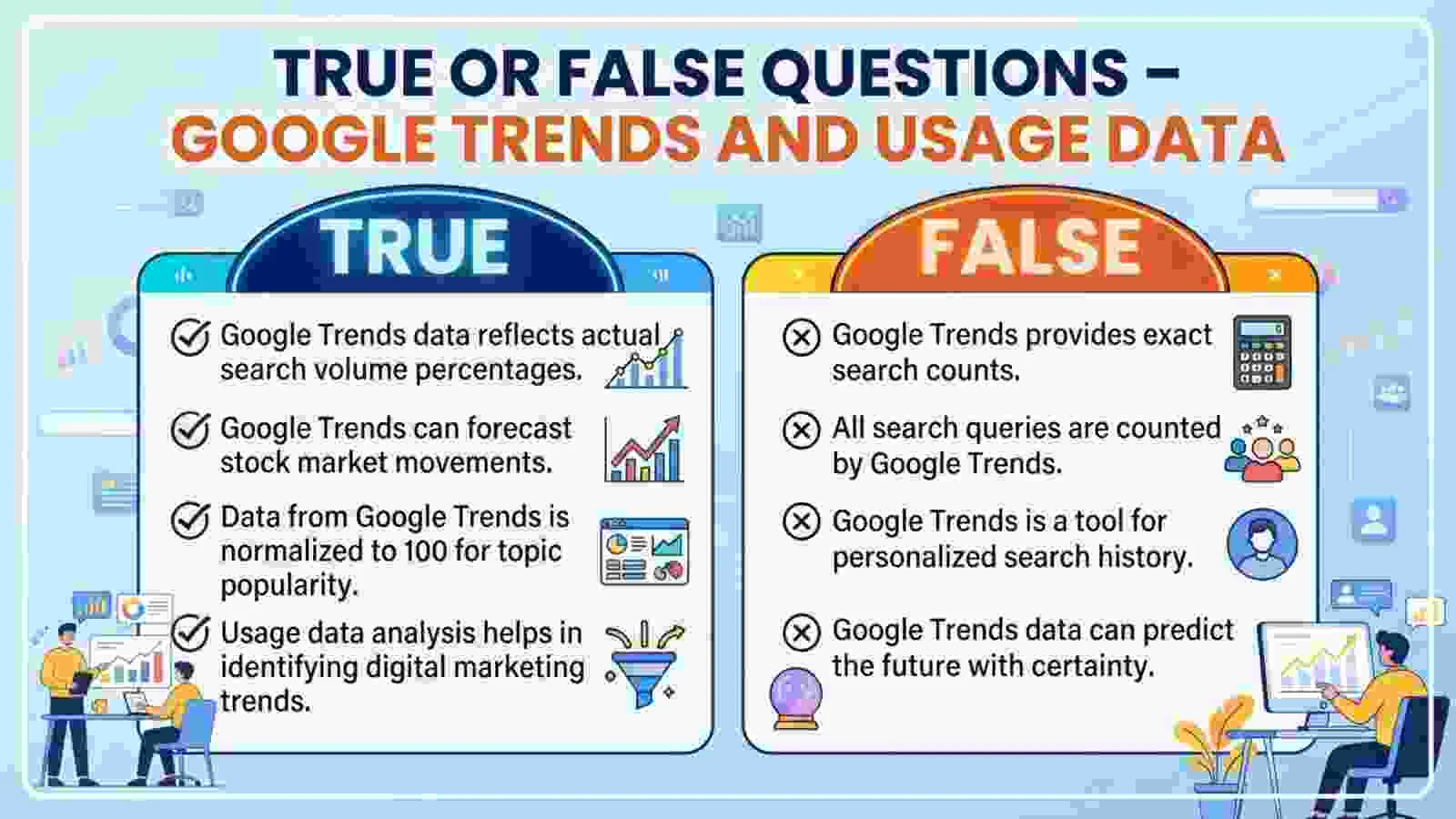
True or false questions are popular in education, online quizzes, classroom resources, and entertainment. People look for them when they need practice tests, printable worksheets, children’s activities, or quiz ideas.
Search interest can vary by country, school calendar, language, and user intent. Searches may rise around exam periods or when teachers prepare new lessons. Quiz creators may also look for themed questions about science, history, sports, or general knowledge.
Related search phrases include:
- Easy true or false questions
- True or false questions with answers
- Funny true or false questions
- Hard true or false questions
- True or false questions for kids
- General knowledge true or false quiz
There is no verified live Google Trends dataset included in this article, so exact country rankings, search volumes, and popularity changes cannot be confirmed here.
To see how popular these questions are right now, you can compare related phrases on Google Trends for your country and a recent time range — it shows which question topics people are searching for most.
True or False Questions: Comparison Table
The following table shows common types of true or false questions and how they differ.
| Question type | Main purpose | Example |
| General knowledge | Test common facts | A year usually has 12 months. — True |
| Science | Check scientific knowledge | Plants need light for photosynthesis. — True |
| History | Review past events | The Roman Empire began in the 20th century. — False |
| Children’s quiz | Make learning fun | A cat is a type of mammal. — True |
| Funny quiz | Entertain friends | Penguins can fly like eagles. — False |
| Classroom test | Check lesson knowledge | A noun can name a person, place, or thing. — True |
| Online quiz | Engage website visitors | The Moon orbits Earth. — True |
Each type serves a different purpose. Choose questions that match the age, knowledge, and interests of your audience.
FAQs About True or False Questions
1. What are true or false questions?
They are questions that ask you to decide whether a statement is correct or incorrect. You choose either true or false.
2. How do you write a good true or false question?
Write one clear statement that can be checked against reliable facts. Avoid confusing wording and make sure the answer is definite.
3. Are true or false questions the same in British and American English?
Yes. The phrase uses the same spelling in both varieties of English. Differences are mainly related to punctuation or house style.
4. Why do teachers use true or false questions?
Teachers use them to check students’ knowledge quickly. They are easy to mark and can cover many facts in a short test.
5. Can true or false questions have tricky answers?
Yes. Some statements use words such as “always” or “never,” which can change their meaning. Read every statement carefully before answering.
6. Where can I find true or false questions with answers?
You can find them on educational websites, quiz platforms, textbooks, and printable worksheets. Choose trusted sources when factual accuracy matters.
7. Are true or false questions good for SEO content?
Yes — quiz pages built on true or false questions can do well when each question is accurate, the answers are clear, and the page covers what readers actually want. Keep the questions organized by topic and give a short explanation with each answer.
8. What are some examples of true or false questions?
Here are a few simple ones: “The sun rises in the east.” — True. “Fish can live naturally without water.” — False. “A week has seven days.” — True. Each statement has only two possible answers — true or false.
9. Are there true or false questions for kids?
Yes — many true or false questions are made for children, using simple facts about animals, food, and everyday life, such as “A cat is a type of mammal. — True.” Keep the words simple and test one idea at a time.
10. Do all true or false quiz questions have answers?
The good ones do. Every true or false question should have one correct answer, and a short explanation makes the quiz more useful — for example, “All birds can fly. — False: penguins and ostriches cannot fly.” Always check the answer key before using a quiz for study.
Conclusion
True or false questions are a simple way to learn, test knowledge, and enjoy quizzes. They ask readers to decide whether a statement is correct or incorrect.
This makes them useful for students, teachers, families, quiz creators, and online learning websites.
The phrase true or false questions has the same spelling in British and American English. You do not need to change it for different regions.
Instead, focus on clear wording, correct facts, and a format that suits your audience.
When writing your own questions, keep each statement short and test one idea at a time. Avoid vague claims, check facts that may change, and include an answer key when needed.
If you share your quiz online, give it clear headings and group the questions by topic so readers can find the ones they want.
Whether you need easy questions for children, challenging science facts, or a fun quiz for friends, the best questions are fair, clear, and accurate.
Use these tips to create better quizzes and help readers learn with confidence.

Here’s a concise 2-line author bio suitable for Simifind.com:
James Dashner is an American bestselling author best known for The Maze Runner series and other popular young-adult fiction.
On Simifind.com, he shares clear, engaging insights and helpful content for readers interested in books, writing, and popular literature.