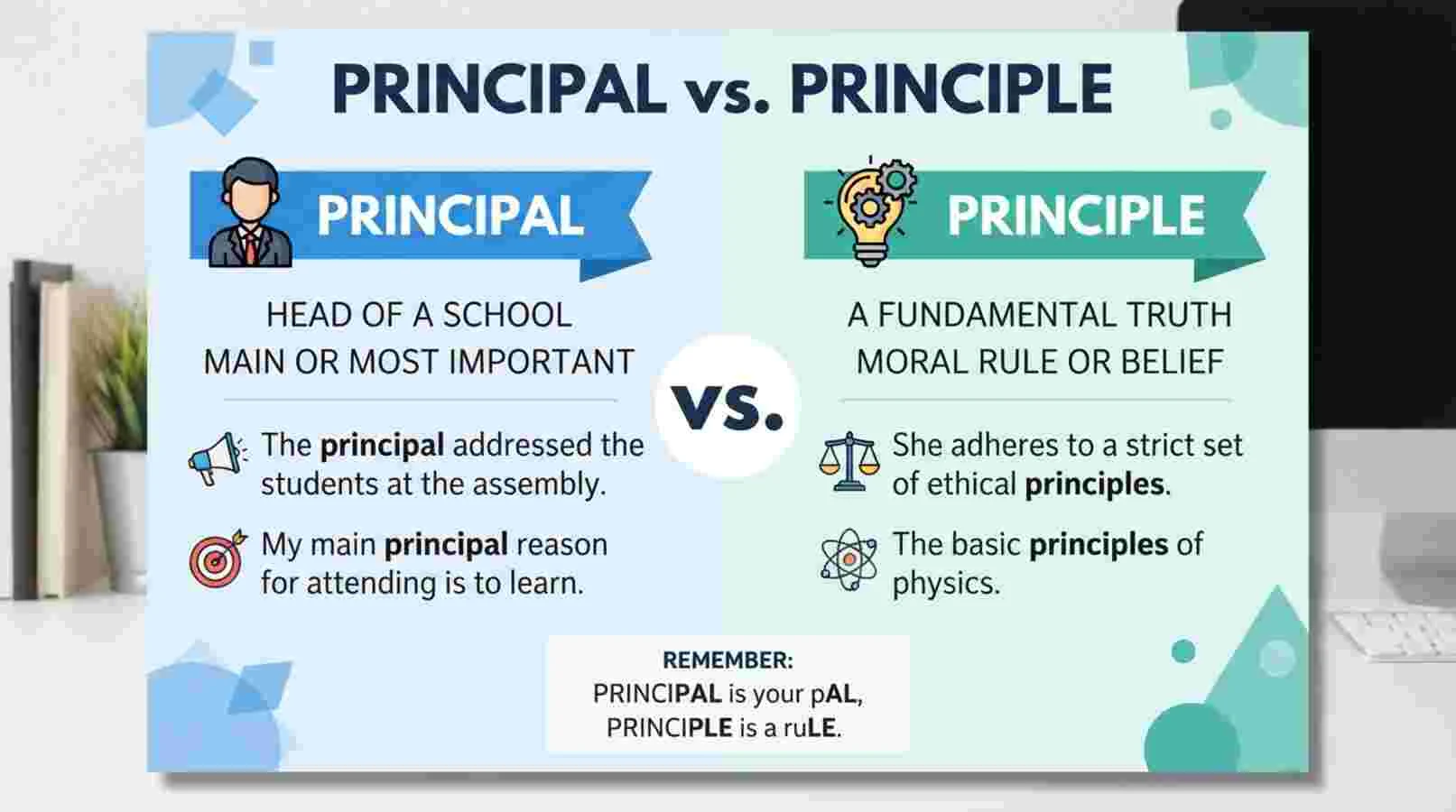
Principal means the main person or thing — the head of a school, the main sum of money in a loan, or the most important part. Principle means a rule or belief that guides behavior, like ‘honesty is a good principle.’
Have you ever stopped while writing because you were unsure whether to use principal or principle?
You are not alone. These two words sound exactly the same, but they have different meanings and uses. Choosing the wrong one can change the meaning of your sentence.
People often search for principal or principle when writing emails, school assignments, business reports, and formal documents.
The confusion is easy to understand because both words have the same pronunciation.
However, one usually refers to a person or something important, while the other refers to a rule, belief, or basic truth.
For example, a school principal is the person who manages a school. A principle is a rule or belief that guides someone’s actions.
In this guide, you will learn the difference between these words, their origins, spelling rules, and everyday uses.
You will also find simple examples, common mistakes, and helpful tips to remember the correct spelling.
Principal or Principle – Quick Answer
Principal and principle sound alike but have different meanings.
- Principal (noun): A person who leads a school or the main amount of money.
- Principal (adjective): The most important or main thing.
- Principle (noun): A basic rule, belief, value, or truth.
Examples:
- Our school principal welcomed the new students.
- Honesty is an important principle in life.
- The principal reason for the delay was bad weather.
- She believes in strong moral principles.
Easy memory trick: The principal is your pal at school. The word principle is linked to rules and beliefs.
The Origin of Principal and Principle
Both words come from Latin and share a common historical root. Their meanings developed over time, which explains why they look and sound so similar.
Principal comes from the Latin word principalis, meaning first, chief, or most important. It entered English through Old French. Over time, it became a word for a leader, the main person, or something of primary importance.
Principle comes from the Latin word principium, meaning beginning, foundation, or source. It developed into a word describing basic truths, rules, and beliefs that guide actions or decisions.
Although their origins are related, their modern meanings are different. Principal focuses on a person, position, or main thing. Principle focuses on an idea, rule, or belief.
British English vs American English Spelling
Unlike many British and American spelling differences, principal and principle are spelled the same in both English varieties.
There is no special American or British spelling rule that changes these words. The main difference is how people use them in sentences.
| Word | American English | British English | Meaning |
| Principal | Principal | Principal | School leader or main thing |
| Principle | Principle | Principle | Rule or belief |
| Principals | Principals | Principals | More than one principal |
| Principles | Principles | Principles | More than one rule or belief |
Examples in both varieties:
- American: The school principal spoke to the parents.
- British: The school principal spoke to the parents.
- American: We must follow ethical principles.
- British: We must follow ethical principles.
Both versions are correct. You do not need to change the spelling when writing for readers in the United States, United Kingdom, Canada, or Australia.
Which Spelling Should You Use?
The correct choice depends on what you want to say, not where your readers live.
For American English readers: Use principal when referring to a school leader, a main person, or the main amount of money. Use principle for a rule or belief.
For British English readers: Follow exactly the same spelling rules. Both words are standard in British writing.
For Commonwealth countries: Countries such as Canada, Australia, New Zealand, and Pakistan also use both spellings in the same way.
For global audiences: Focus on the meaning of your sentence. Ask yourself whether you are talking about a person or an important thing, or a rule or belief.
A simple rule can help: If you mean a school leader, choose principal. If you mean a moral rule, choose principle.
Common Mistakes with Principal or Principle
Many writers confuse these words because they have the same pronunciation. However, using the wrong spelling can make a sentence unclear.
Here are some common mistakes and their corrections.
| Incorrect sentence | Correct sentence |
| Our school principle is kind. | Our school principal is kind. |
| Honesty is a good principal. | Honesty is a good principle. |
| The principle reason is cost. | The principal reason is cost. |
| He follows strong principals. | He follows strong principles. |
| The school principle called me. | The school principal called me. |
Mistakes to avoid:
- Using principle when talking about a school leader.
- Using principal when talking about moral values.
- Confusing the main reason with a basic rule.
- Thinking that American and British English use different spellings.
- Forgetting that principal can describe something important.
Always check the meaning before choosing a spelling.
Principal or Principle in Everyday Examples
Both words appear in daily conversations, education, business, news, and formal writing. Understanding their uses can help you write more clearly.
1. In emails
- Dear Principal, I am writing to request a meeting about my child’s progress.
- Our company follows the principle of equal treatment.
2. In news articles
- The school principal announced new safety rules.
- The government introduced a new policy based on democratic principles.
3. On social media
- A good principal can inspire students to achieve their goals.
- Never compromise your principles for temporary success.
4. In formal writing
- The principal objective of this research is to examine climate change.
- The principle of equality is important in modern societies.
5. In education
- The principal welcomed students at the annual school event.
- Students should understand the basic principles of science.
6. In finance
- The borrower must repay the principal amount along with the agreed interest.
- The principle of compound interest helps explain how savings grow.
Principal or Principle – Google Trends and Usage Data
The search phrase principal or principle reflects a common English spelling and vocabulary problem. People search for it when they want to understand the difference between two words that sound alike.
Google Trends allows users to compare search interest by country, region, and time period. However, its scores are relative indexes from 0 to 100, not exact search volumes.
Country and audience relevance
| Country | Common search intent |
| United States | Principal vs principle meaning and school principal spelling |
| United Kingdom | Difference between principal and principle |
| Canada | English grammar and correct word usage |
| Australia | Principal or principle examples |
| Pakistan | English vocabulary, grammar, and spelling |
| India | Principal meaning, principle meaning, and sentence usage |
These are suggested audience and keyword-targeting angles, not verified country rankings from Google Trends.
Popular related search phrases:
- Principal vs principle
- Principal or principle difference
- Principal meaning in English
- Principle meaning with examples
- How to spell principal
- How to use principle in a sentence
- Principal and principle pronunciation
- Difference between principal and principle
The related phrases above show the different ways people ask this question — from the meaning of each word to examples of both in sentences.
For accurate country comparisons, check the Google Trends Explore tool and select your target countries and time range. Remember that exact search terms and broader topics can produce different results.
Principal vs Principle – Comparison Table
Use this table as a quick reference whenever you are unsure which word belongs in your sentence.
| Feature | Principal | Principle |
| Part of speech | Noun and adjective | Noun |
| Main meaning | Main, chief, or school leader | Rule, belief, or truth |
| Refers to a person | Yes | No |
| Refers to a rule | No | Yes |
| Refers to money | Yes | No |
| Plural form | Principals | Principles |
| Example | School principal | Moral principle |
| Memory trick | Principal is your pal | Principle means a rule |
Remember: Principal describes a person or something main. Principle describes a basic rule or belief.
FAQs About Principal or Principle
1. What is the main difference between principal and principle?
Principal refers to a school leader, main person, or most important thing. Principle refers to a basic rule, belief, or truth.
2. Is it school principal or school principle?
The correct phrase is school principal. It refers to the person who manages or leads a school.
3. Is it moral principal or moral principle?
The correct phrase is moral principle. It refers to a belief or rule about right and wrong.
4. Are principal and principle pronounced the same?
Yes. Both words are homophones. They sound the same but have different meanings and spellings.
5. Is principal an adjective or a noun?
Principal can be both. As a noun, it can mean a school leader or the original amount of a loan. As an adjective, it means main or most important.
6. Does British English use principle differently from American English?
No. Both varieties use the same spelling and meanings. The difference is not regional; it depends on the context.
7. What is an easy way to remember principal and principle?
Remember that a school principal can be your pal. Use principle when discussing rules, values, or beliefs.
8. What does principal mean?
Principal means the main person or thing — for example, the head of a school (‘the school principal’), or the main sum of money in a loan. As an adjective, it means the most important (‘the principal reason’).
9. What does principle mean?
Principle means a rule or belief that guides behavior — for example, ‘honesty is a good principle’ or ‘the principles of good design.’ It is always a noun; it is never a person.
10. What are some principal vs principle examples?
For example: ‘The principal addressed the students at assembly’ and ‘She paid off the principal on her loan.’ For principle: ‘Honesty is one of his core principles’ and ‘The design follows the principle of keeping things simple.’
Conclusion
Understanding the difference between principal or principle is important for clear and correct English writing.
Although these words sound the same, they have different meanings and uses. Principal refers to a school leader, the main person, or something that has the greatest importance.
It can also describe the original amount of money borrowed or invested. Principle, on the other hand, refers to a basic rule, belief, value, or truth that guides people’s actions.
Remember that neither American nor British English changes the spelling of these words. The correct choice depends on the meaning of your sentence.
If you are talking about a school leader, use principal. If you are discussing honesty, fairness, or other basic values, use principle.
A simple memory trick can make this difference easier to remember: your principal is your pal, while your principles are your rules.
Practice these examples in emails, assignments, and everyday conversations. With regular use, you will find it much easier to choose the correct word and avoid common spelling mistakes.

Here’s a concise 2-line author bio suitable for Simifind.com:
James Dashner is an American bestselling author best known for The Maze Runner series and other popular young-adult fiction.
On Simifind.com, he shares clear, engaging insights and helpful content for readers interested in books, writing, and popular literature.







