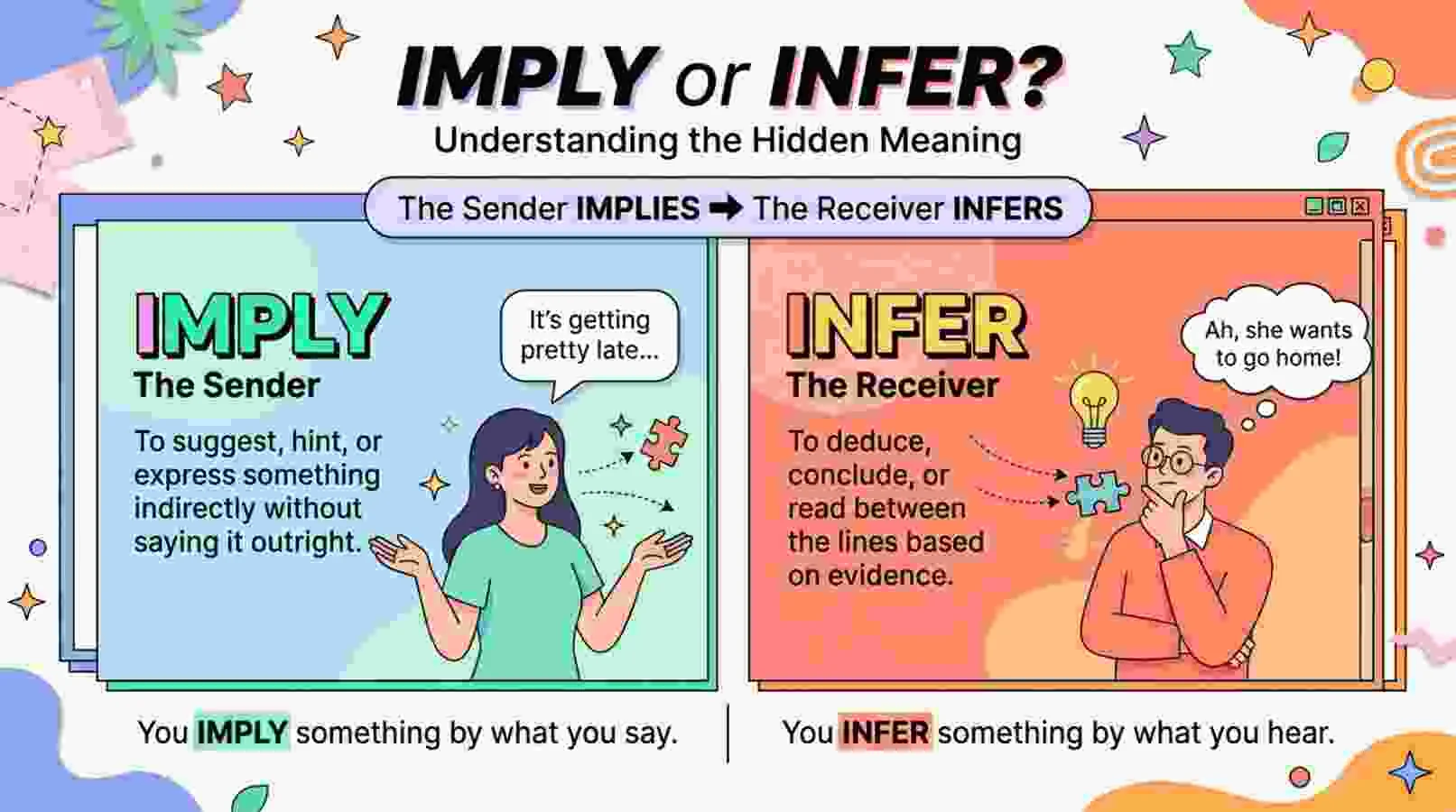
Imply means to suggest something without saying it directly — the speaker implies. Infer means to work out what someone means from what they said — the listener infers. The speaker implies; the listener infers.
Have you ever used imply when you meant infer?
These two words are easy to mix up because both relate to meaning, ideas, and information. However, they have different jobs in a sentence. Knowing the difference can help you speak and write with more confidence.
People often search for imply or infer because they want to know which word is correct in daily conversations, emails, schoolwork, and professional writing.
Both words describe how people share or understand information, but they are used from different points of view.
The simple rule is this: a speaker implies something, while a listener infers something. For example, if your friend says, “It is getting late,” they may imply that they want to leave. You may infer from their words that the visit is over.
In this guide, you will learn the meanings, origins, usage rules, common mistakes, and examples of both words. You will also discover how to choose the right word in different situations.
Imply or Infer – Quick Answer
Imply means to suggest something without saying it directly. Infer means to understand or reach a conclusion from clues, facts, or information.
Here is the easiest way to remember:
- Imply: To suggest an idea.
- Infer: To understand or work out an idea.
Examples:
- The teacher implied that the test would be difficult.
- The students inferred that they needed more time to study.
- Her smile implied that she was happy.
- I inferred from her smile that she was pleased.
Both words are correct, but they describe different actions. The person giving a hint implies, while the person receiving the hint infers.
The Origin of Imply or Infer
The words imply and infer have Latin roots. Both have been part of the English language for many years.
Imply comes from the Latin word implicare, which means to involve, fold, or connect something. It entered English through Old French and developed the meaning of suggesting an idea indirectly.
Infer comes from the Latin word inferre, which means to bring in or carry toward. Over time, it developed the meaning of reaching a conclusion from facts or evidence.
Although these words have related histories, their meanings are not the same.
The difference exists because each word describes a different side of communication. One person gives a message, while another person understands it.
British English vs American English Spelling
There is no spelling difference between British and American English for these words.
Both countries use:
- Imply
- Implies
- Implied
- Implying
- Infer
- Infers
- Inferred
- Inferring
The words have the same spelling and meaning in both forms of English. However, their use depends on the meaning of the sentence.
British English vs American English Comparison Table
| Word | British English | American English |
| Imply | Imply | Imply |
| Implies | Implies | Implies |
| Implied | Implied | Implied |
| Implying | Implying | Implying |
| Infer | Infer | Infer |
| Infers | Infers | Infers |
| Inferred | Inferred | Inferred |
| Inferring | Inferring | Inferring |
Example in British English: The report implies that the plan may fail.
Example in American English: The report implies that the plan may fail.
Both sentences are correct. There is no regional spelling change.
Which Spelling Should You Use?
You do not need to choose between British and American spelling for imply or infer. Both words are accepted worldwide.
However, you should choose the correct word based on what you want to say.
For American English readers:
Use imply when someone suggests an idea and infer when someone reaches a conclusion. Both are common in American writing.
For British and Commonwealth readers:
Follow the same rule. These words have identical meanings and spellings in British, Australian, Canadian, and other Commonwealth English.
For global English writing:
Use both words when needed. Focus on the speaker’s message and the reader’s understanding.
Professional advice: Before using either word, ask yourself one question: Is someone giving a hint, or is someone understanding a hint? This simple check will help you choose correctly.
Common Mistakes with Imply or Infer
Many people confuse these words because they are closely connected. Here are some common mistakes and their corrections.
1. Using imply instead of infer
Incorrect: I implied from his words that he was angry.
Correct: I inferred from his words that he was angry.
Why? You understood his message, so you should use inferred.
2. Using infer instead of imply
Incorrect: She inferred that she was unhappy without saying it.
Correct: She implied that she was unhappy without saying it.
Why? She suggested an idea without saying it directly.
3. Thinking both words have the same meaning
Although they are related, they are not interchangeable. One describes suggesting, and the other describes understanding.
4. Using the wrong past tense
- Imply → Implied
- Infer → Inferred
Remember that inferred has a double r, while implied has a different spelling pattern.
5. Confusing the speaker and listener
The speaker implies a message. The listener infers its meaning. Keeping these roles clear prevents most errors.
Imply or Infer in Everyday Examples
These words appear in daily conversations, emails, news reports, social media posts, and formal writing.
Here are some simple examples.
1. In Emails
- Your email implies that the deadline has changed.
- I inferred from your email that the meeting was canceled.
2. In News
- The latest report implies that prices may increase.
- Experts inferred from the data that the economy was slowing down.
3. On Social Media
- His post implies that he is unhappy with the decision.
- Many followers inferred that he was leaving the company.
4. In Formal Writing
- The study implies a strong link between education and employment.
- Researchers inferred the results from the available evidence.
5. In Everyday Conversations
- “You look tired” may imply that someone needs rest.
- I inferred from his silence that he did not agree.
Imply vs Infer: Side-by-Side Comparison
| Feature | Imply | Infer |
| Meaning | Suggest indirectly | Reach a conclusion |
| Action | Giving a hint | Understanding a hint |
| Person | Speaker or writer | Listener or reader |
| Example | She implied she was busy. | I inferred she was busy. |
| Past tense | Implied | Inferred |
| Main idea | Suggestion | Conclusion |
Imply or Infer – Google Trends & Usage Data
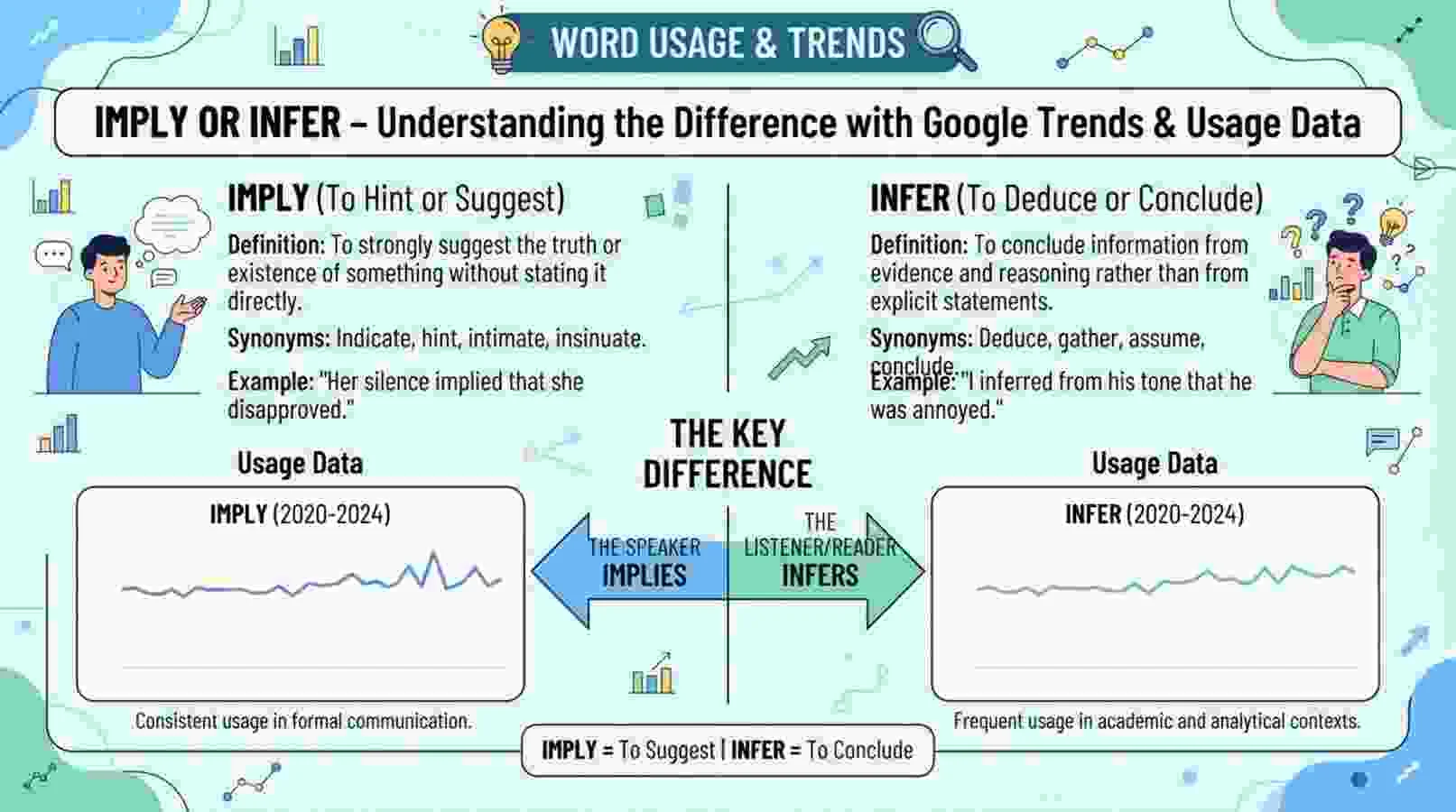
The search terms imply or infer are linked to English grammar, vocabulary, education, and writing skills.
People often search for these words when preparing for exams, improving their English, or checking the correct meaning of a sentence.
There is no spelling variation between the United States and the United Kingdom. Both words are used in academic and everyday English.
Common search contexts include:
- United States: Grammar lessons, writing help, and vocabulary questions.
- United Kingdom: English language learning and academic writing.
- Canada: Professional communication and grammar education.
- Australia: English vocabulary and school learning.
- India and Pakistan: Competitive exams, English grammar, and vocabulary improvement.
Google Trends popularity can change over time. Without a live Trends comparison, exact country rankings or search volumes should not be assumed.
For reliable research, compare both search terms using Google Trends. You can select different countries and time periods to study their search interest.
FAQs About Imply or Infer
1. What is the main difference between imply and infer?
Imply means to suggest something indirectly. Infer means to understand or reach a conclusion from information or clues.
2. Is imply the same as infer?
No. They are related but have different meanings. A speaker implies something, while a listener infers its meaning.
3. How do you use imply in a sentence?
Use imply when someone suggests an idea without saying it directly.
Example: Her words imply that she needs help.
4. How do you use infer in a sentence?
Use infer when someone reaches a conclusion from available information.
Example: I inferred from his actions that he was worried.
5. Can a person imply and infer at the same time?
Yes. A person can imply something while speaking and infer something from another person’s words.
6. Is inferred or implied correct?
Both are correct. Inferred is the past tense of infer, while implied is the past tense of imply.
7. Are imply and infer different in British and American English?
No. Both words have the same spelling, meaning, and usage in British and American English.
8. What does imply mean?
Imply means to suggest something without saying it directly — for example, ‘Her words imply that she needs help.’ The speaker or writer implies; the listener or reader works out the meaning.
9. What does infer mean?
Infer means to work out what someone means from what they said — for example, ‘I inferred from his silence that he did not agree.’ The listener or reader infers; the speaker or writer gives the hint.
10. What are some imply vs infer examples?
For imply: ‘The teacher implied that the test would be difficult.’ For infer: ‘The students inferred that they needed more time to study.’ The speaker implies; the listener infers.
11. Can you infer something, or imply something?
Both — but by different people. The speaker implies something (suggests it without saying it directly), and the listener infers something (works out the meaning from what was said). You infer what someone else implies.
Conclusion
Understanding the difference between imply or infer can make your English clearer and stronger.
Although these words are closely related, they describe two different actions. Imply means to suggest something without saying it directly.
Infer means to understand a message or reach a conclusion from available clues.
Remember this simple rule: the speaker implies, and the listener infers. For example, if someone says, “It is very cold outside,” they may imply that you should wear a jacket. You may infer from their words that warm clothes are needed.
Both words have the same spelling and meaning in British and American English. You do not need to worry about regional spelling differences. Instead, focus on the meaning and role of each word in your sentence.
Practice using these words in emails, conversations, schoolwork, and formal writing. With a little practice, you will know exactly when to use imply and when to use infer.

Mary Roach is an American science writer and bestselling author known for making unusual and complex scientific topics engaging, accessible, and humorous. Her books include Stiff, Packing for Mars, Gulp, and Fuzz.
Author at Simifind.com, sharing clear, informative content designed to help readers understand interesting topics and everyday questions.







