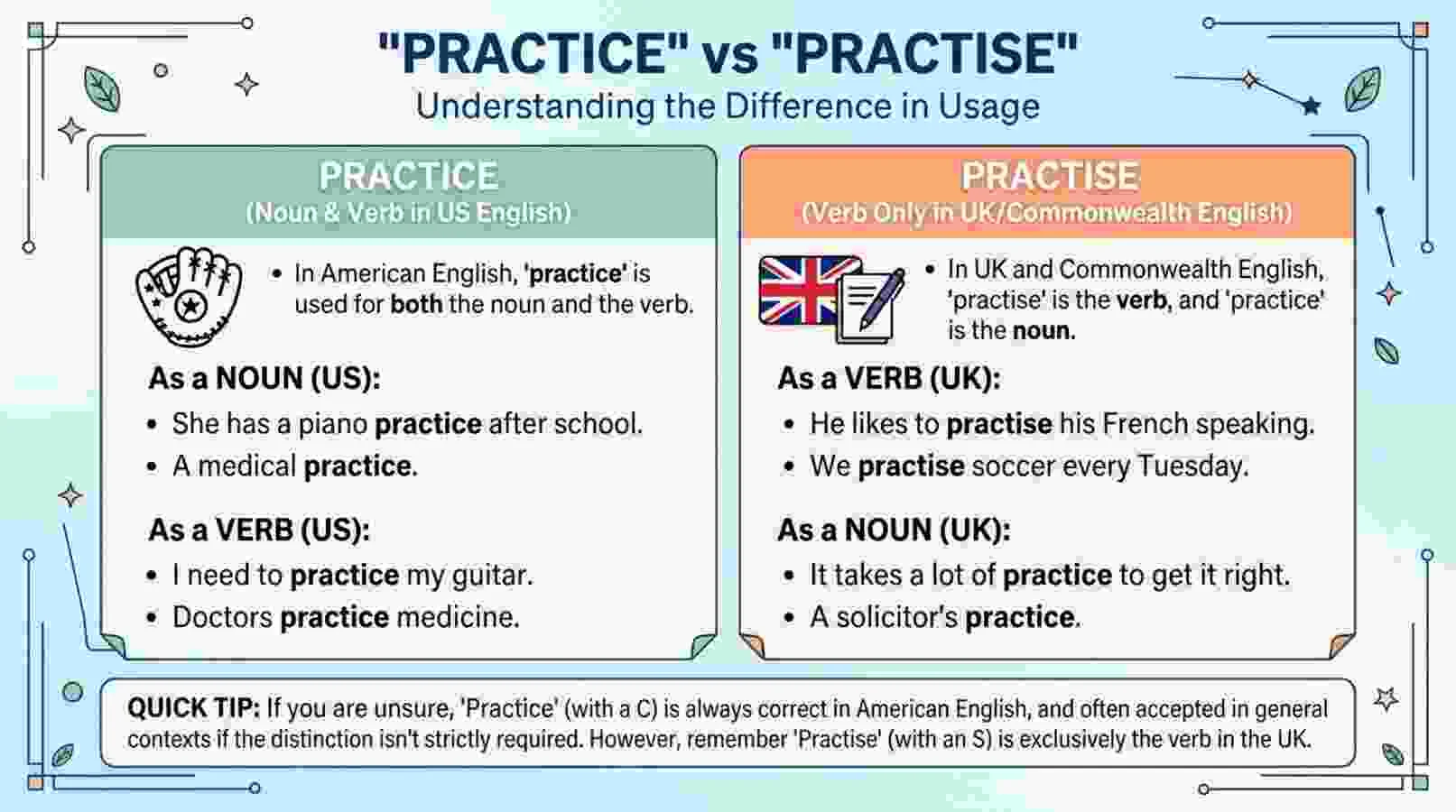
Practice is the noun in both British and American English, and the only spelling in American English. In British English, practise is the verb (‘I practise every day’) and practice is the noun (‘Daily practice helps’).
Have you ever stopped while writing to ask yourself whether practice or practise is the correct spelling?
You are not alone. Many English learners, students, teachers, and writers face this problem. Both words look almost the same, but their use depends on the type of English you follow.
The main difference is simple. American English uses practice as both a noun and a verb. British English uses practice as a noun and practise as a verb.
For example, you can say, “I need more practice” or “I need to practise every day” in British English. In American English, both sentences use “practice.”
This spelling difference can cause confusion in schoolwork, emails, professional documents, and online searches.
It is also important for writers who want to reach readers in the United States, United Kingdom, Canada, or Australia.
In this guide, you will learn the meaning, origin, spelling rules, common mistakes, and real-life examples of practice or practise.
Practice or Practise – Quick Answer
Both practice and practise are correct spellings. The right choice depends on whether you use American or British English.
- American English: Practice is used as both a noun and a verb.
- British English: Practice is a noun, while practise is a verb.
Examples:
- I need more practice before the exam.
- She will practise her English every morning. (British English)
- She will practice her English every morning. (American English)
Remember this simple rule: In British English, practice is a thing, and practise is an action. In American English, practice works for both.
The Origin of Practice or Practise
The word practice comes from the Old French word practique and the Latin word practicus, which are linked to action and practical work. Over time, the word became common in English.
The spelling difference developed as English changed in different regions. British English kept separate noun and verb forms. The noun became practice, while the verb became practise.
American English later adopted one spelling for both forms. As a result, Americans use practice for actions and things.
These differences are part of the wider changes between British and American English. Similar spelling variations can be seen in words such as:
- Advice and advise
- Licence and license
- Defence and defense
- Device and devise
Learning these patterns can help you improve your spelling and writing skills.
British English vs American English Spelling
The main difference between British and American English is how they use the word as a noun or verb.
British English follows a clear spelling rule. Use practice when talking about an activity, event, or training. Use practise when describing the action of doing something repeatedly to improve a skill.
American English uses practice in both cases.
Comparison Table
| Feature | British English | American English |
| Noun | Practice | Practice |
| Verb | Practise | Practice |
| Meaning | Training or action | Training or action |
| Example | Football practice | Football practice |
| Verb example | Practise daily | Practice daily |
| Spelling rule | Two forms | One form |
Example Sentences
British English:
- Regular practice helps you improve.
- I practise speaking English every day.
- They practise football after school.
American English:
- Regular practice helps you improve.
- I practice speaking English every day.
- They practice football after school.
Both versions are correct. The important thing is to follow one spelling system throughout your writing.
Which Spelling Should You Use?
Your choice depends on your target audience, location, and writing purpose.
For American Readers
Use practice for both nouns and verbs. This is the standard spelling in the United States.
Example: “I practice English for one hour every day.”
For British Readers
Use practice as a noun and practise as a verb.
Example: “I need more practice because I want to practise my speaking skills.”
For UK and Commonwealth Readers
British spelling is widely used in the United Kingdom and many Commonwealth settings, including Australia and New Zealand. Canadian English often uses practice for both noun and verb forms, so check the style guide of your publisher or organization.
For Global Online Writing
Choose the spelling that matches your main audience. If most of your readers are from the United States, use American English. If your readers are mainly from the UK, follow British English.
The best advice is to stay consistent. Do not switch between practice and practise without a clear reason.
Common Mistakes with Practice or Practise
Many writers use these words incorrectly because they look and sound almost the same. Here are some common mistakes and their corrections.
1. Using Practise as a Noun
Incorrect: I need more practise before the test.
Correct: I need more practice before the test.
In British and American English, the noun is always practice.
2. Using Practice as a British Verb
Incorrect: I practice the piano every day. (British English)
Correct: I practise the piano every day. (British English)
In American English, however, the first sentence is correct.
3. Mixing British and American Spelling
Incorrect: I need more practice, so I will practice daily. (Inconsistent with standard British spelling)
Correct: I need more practice, so I will practise daily. (British English)
4. Thinking Both Words Have Different Meanings
Practice and practise have the same basic meaning. Their difference is mainly grammatical and regional.
5. Forgetting the Part of Speech
Always ask yourself whether the word describes a thing or an action. This simple check helps you choose the right spelling.
Practice or Practise in Everyday Examples
These words appear in daily conversations, schoolwork, business emails, news articles, and social media posts.
In Emails
British English: “I will practise my presentation before the meeting.”
American English: “I will practice my presentation before the meeting.”
In News
British English: “The team will practise before the final match.”
American English: “The team will practice before the final match.”
On Social Media
British English: “Keep practising until you reach your goal!”
American English: “Keep practicing until you reach your goal!”
In Formal Writing
British English: “Regular practice is important for professional growth. Employees should practise their skills.”
American English: “Regular practice is important for professional growth. Employees should practice their skills.”
In Education
British English: “Students need more practice in grammar and should practise writing every day.”
American English: “Students need more practice in grammar and should practice writing every day.”
These examples show that the meaning stays the same, even when the spelling changes.
Practice or Practise – Google Trends & Usage Data
People search for practice or practise because they want to know which spelling is correct. The search is common among English learners, students, teachers, editors, and content writers.
Search interest can vary by country because different regions follow different spelling rules.
- United States: Practice is the standard spelling for both nouns and verbs.
- United Kingdom: Both forms are used, depending on the word’s grammatical role.
- Australia: British-style spelling is generally followed, with practice as a noun and practise as a verb.
- Canada: Practice is commonly used for both nouns and verbs.
- New Zealand: British-style spelling is generally followed.
Search Intent and Usage
| Search Term | Main Search Intent |
| Practice or practise | Find the correct spelling |
| Practice meaning | Understand the word |
| Practise meaning | Learn the verb form |
| Practice as a noun | Check grammar |
| Practise as a verb | Check British spelling |
| Practice in American English | Learn US spelling |
| Practise in British English | Learn UK spelling |
Google Trends interest changes over time. Exact popularity rankings and search volumes should be checked in Google Trends or a keyword research tool rather than guessed. Both spellings are widely searched, because readers in different regions follow different spelling rules.
Practice vs Practise: Side-by-Side Comparison
| Word | Part of Speech | British English | American English |
| Practice | Noun | Correct | Correct |
| Practise | Verb | Correct | Not standard |
| Practice | Verb | Not standard | Correct |
| Practising | Verb form | Correct | Not standard |
| Practicing | Verb form | Not standard | Correct |
| Practised | Verb form | Correct | Not standard |
| Practiced | Verb form | Not standard | Correct |
FAQs About Practice or Practise
1. Is practice or practise correct?
Both are correct. Practice is used for nouns in British English and for nouns and verbs in American English. Practise is the British English verb form.
2. Is practice a noun or a verb?
Practice is a noun in both British and American English. It is also a verb in American English.
3. Is practise only used in British English?
Yes. Practise is the standard verb spelling in British English and other varieties that follow the same spelling rule.
4. How do you spell practice in American English?
Always use practice, whether you are talking about training or performing an action.
5. How do you spell practise in British English?
Use practise when describing an action. Use practice when referring to training, preparation, or an activity.
6. Is it practising or practicing?
Both are correct, depending on the English variety. British English uses practising, while American English uses practicing.
7. Is it practice or practise every day?
In American English, write “practice every day.” In British English, write “practise every day” because it describes an action.
8. What is the difference between practice and practise?
In British English, practice is the noun and practise is the verb; in American English, practice is both the noun and the verb. The difference is about the word’s job in the sentence and the variety of English you are using.
9. Which is the verb, practice or practise?
In British English, practise is the verb (“I practise every day”) and practice is only the noun. In American English, practice is the verb (“I practice every day”) — Americans never use practise.
10. Do Americans use practise?
No — in American English, practice is used for both the noun and the verb, so practise is not standard in the United States. If you see “practise” in American writing, it is usually a typo.
Conclusion
The difference between practice or practise is easy to understand once you know the spelling rules of British and American English.
Both words have the same basic meaning, but their use depends on your audience and writing style.
In British English, practice is a noun, while practise is a verb. For example, you need practice to improve, and you must practise regularly to build a skill. In American English, practice is used for both forms.
If you write for a UK audience, remember the noun-and-verb rule. If your readers are from the United States, use practice in every situation.
For international content, choose one English style and follow it throughout your article.
Good spelling makes your writing clear and professional. Once you learn this simple rule, you will no longer need to guess which form to use.
Keep practising your English, and your writing will improve with time.

Mary Roach is an American science writer and bestselling author known for making unusual and complex scientific topics engaging, accessible, and humorous. Her books include Stiff, Packing for Mars, Gulp, and Fuzz.
Author at Simifind.com, sharing clear, informative content designed to help readers understand interesting topics and everyday questions.