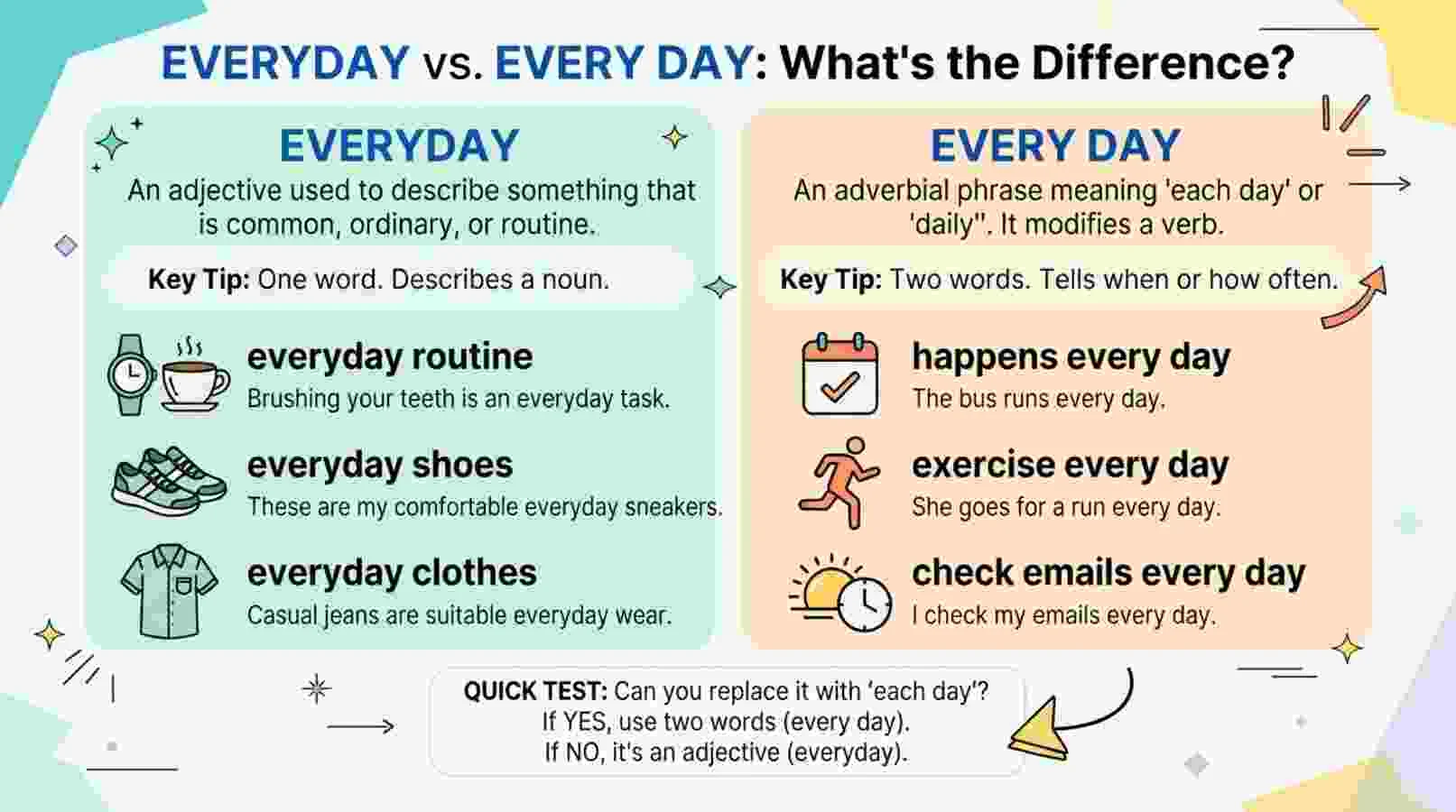
Everyday is an adjective meaning ordinary or daily — ‘everyday shoes’, ‘everyday life’. Every day is a phrase meaning each day — ‘I walk every day’. Everyday describes a thing; every day describes when something happens.
Have you ever stopped while writing and wondered whether to use everyday or every day?
You are not alone. These two forms look almost the same, sound the same, and have similar meanings.
However, they do not work in the same way. Using the wrong form can make your sentence unclear or grammatically incorrect.
The main difference is simple. Everyday is one word. It is an adjective that describes something common or normal.
Every day is two words. It means each day or daily. For example, you can say, “These are my everyday shoes,” or “I wear these shoes every day.”
Many readers look up this word because they want to improve their grammar, write better emails, and avoid spelling mistakes.
This guide explains the meaning, origin, spelling rules, and correct usage of both forms. You will also find simple examples, common mistakes, and answers to frequently asked questions.
Everyday or Every Day – Quick Answer
The correct choice depends on what you want to say. Everyday describes something usual or common, while every day means each day.
- Everyday: This is my everyday bag.
- Every day: I carry this bag every day.
A simple trick can help you remember the difference: if you can replace the words with “each day,” use every day. If you describe a noun, use everyday.
The Origin of Everyday or Every Day
The word everyday comes from the combination of “every” and “day.” Over time, these words joined to form one adjective. It describes things that are normal, regular, or part of daily life.
The phrase every day has a different grammatical role. It keeps the two words separate because “every” describes how often something happens, while “day” refers to a single day.
Both forms have been used in English for many years. Their different spelling styles developed because they serve different purposes in a sentence.
British English vs American English Spelling
There is no spelling difference between British and American English in this case. Both writing styles use everyday as one word and every day as two words.
The difference is based on grammar, not location.
| Form | Meaning | Example |
| Everyday | Normal or common | Everyday clothes are comfortable. |
| Every day | Each day | I study English every day. |
| Everyday life | Daily life | Exercise is part of everyday life. |
| Every day at work | Daily frequency | She reads every day at work. |
Both American and British writers follow these same rules in school, business, newspapers, and formal writing.
Which Spelling Should You Use?
Your choice depends on the meaning of your sentence, not the country where your readers live.
- For US readers: Use everyday for common things and every day for daily actions.
- For UK readers: Follow the same grammar rules in British English.
- For Commonwealth countries: Countries such as Canada, Australia, and Pakistan also use both forms in the same way.
- For global writing: Keep the difference clear to make your content easy to understand.
If you are writing an article, email, school assignment, or business report, always check the role of the words before choosing a spelling.
Common Mistakes with Everyday or Every Day
Many writers mix up these forms because they look and sound alike. Here are some common errors and their corrections.
| Incorrect | Correct | Reason |
| I exercise everyday. | I exercise every day. | It means each day. |
| These are my every day shoes. | These are my everyday shoes. | It describes the shoes. |
| She cooks everyday meals every day. | She cooks everyday meals every day. | Both forms have different roles. |
| Everyday, I read a book. | Every day, I read a book. | It describes frequency. |
| This is an every day problem. | This is an everyday problem. | It describes a common problem. |
Quick tip: Replace “every day” with “each day.” If the sentence still makes sense, use two words.
Everyday or Every Day in Everyday Examples
Understanding these forms becomes easier when you see them in real-life situations.
1. Emails
- Everyday: These are our everyday office tasks.
- Every day: I check my emails every day.
2. News Writing
- Everyday: Rising prices affect everyday life.
- Every day: The team publishes new reports every day.
3. Social Media
- Everyday: Sharing everyday moments makes life special.
- Every day: I post pictures every day.
4. Formal Writing
- Everyday: Good communication is an everyday business need.
- Every day: Employees must review their work every day.
5. Personal Conversations
- Everyday: This is my everyday routine.
- Every day: I walk to school every day.
Everyday or Every Day – Google Trends & Usage Data
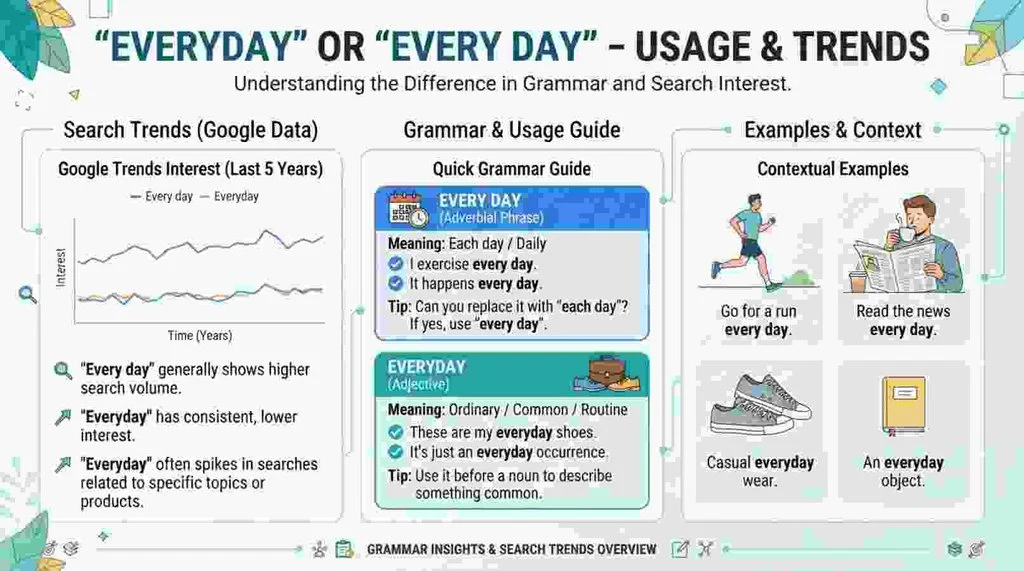
Both forms are common in English-speaking countries. However, their search intent is slightly different.
If you look up everyday or every day, you usually want a grammar explanation, a spelling comparison, or simple writing advice.
| Search Context | Common User Interest |
| United States | Grammar and spelling rules |
| United Kingdom | Correct everyday usage |
| Canada | English writing and grammar |
| Australia | Spelling and sentence examples |
| Pakistan | English learning and grammar |
The phrase “every day” is widely used when people discuss daily habits, routines, and activities. “Everyday” often appears in topics about daily life, common products, clothing, and regular experiences.
Google Trends popularity can change over time. Without a live Trends comparison, exact country rankings or search volumes should not be assumed.
Everyday vs Every Day: Side-by-Side Comparison
| Feature | Everyday | Every Day |
| Spelling | One word | Two words |
| Grammar | Adjective | Adverbial phrase |
| Meaning | Normal or common | Each day |
| Usage | Describes a noun | Describes frequency |
| Example | Everyday clothes | I work every day. |
| Correct in US English | Yes | Yes |
| Correct in UK English | Yes | Yes |
FAQs About Everyday or Every Day
1. Is everyday one word or two words?
Everyday is one word when it works as an adjective. It describes something normal, common, or usual.
2. Is every day always two words?
Yes. When you mean each day or daily, write every day as two separate words.
3. What is the difference between everyday and every day?
Everyday describes a noun, while every day tells how often an action happens.
4. Is everyday grammatically correct?
Yes. Everyday is correct when used as an adjective, such as “everyday clothes” or “everyday activities.”
5. Is every day correct in formal writing?
Yes. Every day is correct in formal writing when you want to express daily frequency.
6. Do British and American English use everyday differently?
No. Both British and American English follow the same spelling and grammar rules for these forms.
7. How can I remember everyday or every day?
Use “each day” as a replacement test. If it works, write every day as two words. Otherwise, everyday may be the correct adjective.
8. What does every day mean?
Every day means each day — it describes how often something happens, for example, “I read every day.”
9. What are some everyday examples?
Everyday examples include everyday clothes, everyday shoes, everyday life, and everyday tasks — things that are normal or common.
10. How do you use everyday and every day in a sentence?
Use everyday before a noun, as in “These are my everyday shoes.” Use every day after a verb to say how often something happens, as in “I wear these shoes every day.”
Conclusion
Understanding the difference between everyday or every day can make your English writing clearer and more accurate.
Although these forms look almost identical, they have different grammatical roles. Everyday is one word and works as an adjective.
It describes something common, normal, or part of daily life. For example, “These are my everyday shoes.”
On the other hand, every day is two words and means each day. For example, “I wear these shoes every day.” This small spelling difference can change the meaning of your sentence.
Remember that British and American English follow the same rules. You do not need to choose a different spelling for different audiences.
Instead, focus on the meaning and position of the words in your sentence.
The easiest way to avoid mistakes is to replace every day with “each day.” If the sentence still makes sense, use two words.
With regular practice, you can use both forms with confidence in emails, articles, schoolwork, and professional writing.

Here’s a concise 2-line author bio suitable for Simifind.com:
James Dashner is an American bestselling author best known for The Maze Runner series and other popular young-adult fiction.
On Simifind.com, he shares clear, engaging insights and helpful content for readers interested in books, writing, and popular literature.







