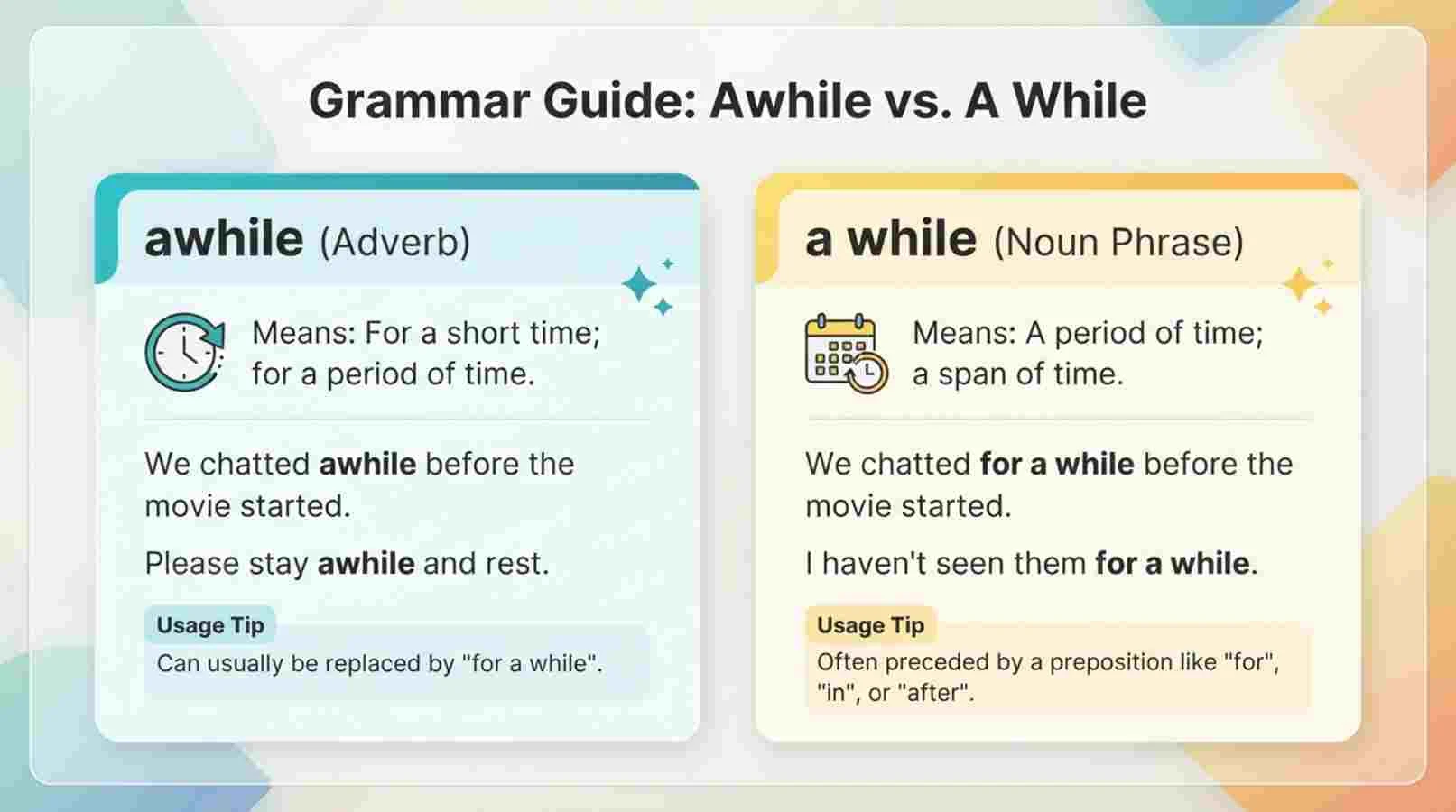
Have you ever stopped while writing because you were unsure whether to use awhile or a while?
You are not alone. Many people mix up these two forms because they look almost the same and sound alike. However, they have different uses in English.
The good news is that both spellings are correct. The main difference is how they work in a sentence. Awhile is an adverb that means for a short time.
A while is a noun phrase that refers to a period of time. This small difference can change how you write a sentence.
People often search for awhile or a while when writing emails, school assignments, social media posts, or professional documents.
They want to know which form sounds natural and follows standard grammar rules.
In this guide, you will learn the meaning, origin, spelling rules, and correct usage of both forms.
You will also see simple examples, common mistakes, and helpful tips to choose the right form every time.
Awhile or A While – Quick Answer
Both awhile and a while are correct, but they have different grammatical roles.
- Awhile: An adverb that means for a short time.
- A while: A noun phrase that means a period of time.
Examples:
- Please wait awhile.
- Please wait for a while.
Both sentences are correct. The first uses an adverb, while the second uses a noun phrase with the preposition “for.”
Quick trick: If you use the word “for” before the phrase, choose a while.
The Origin of Awhile and A While
The words awhile and a while come from the same English words. Their roots go back to Old English, where “while” referred to a period of time.
Over time, English speakers began using these forms in different ways. The two-word form, “a while,” works as a noun phrase. The one-word form, “awhile,” developed as an adverb.
Both forms became part of standard English. Their meanings are closely linked, but their grammar is different.
Today, writers use “a while” after prepositions and “awhile” when they want to describe how long an action lasts.
British English vs American English Spelling
There is no major spelling difference between British and American English for these words. Both varieties accept awhile and a while.
The correct choice depends on grammar, not location.
| Feature | Awhile | A While |
| Spelling | One word | Two words |
| Grammar | Adverb | Noun phrase |
| Meaning | For a short time | A period of time |
| British English | Correct | Correct |
| American English | Correct | Correct |
| Example | Stay awhile. | Stay for a while. |
British English examples:
- I rested awhile after work.
- I have not seen her for a while.
American English examples:
- Sit awhile and relax.
- We talked for a while.
Both forms are accepted in the US, UK, Canada, and other English-speaking countries.
Which Spelling Should You Use?
Your choice should depend on the sentence structure and your target audience. Both forms are understood around the world.
For American English: Use “awhile” when you need an adverb. Use “a while” after a preposition.
For British English: Follow the same grammar rule. Both spellings are standard.
For Commonwealth countries: Writers in Canada, Australia, New Zealand, and other Commonwealth regions also use both forms.
For global writing: Choose the form that fits your sentence. Do not change the spelling based on the country.
The best advice is to focus on grammar rather than regional spelling preferences.
Common Mistakes with Awhile and A While
Many writers use these forms incorrectly because they look and sound similar. Here are some common mistakes and their corrections.
| Incorrect Usage | Correct Usage | Reason |
| Wait for awhile. | Wait for a while. | “For” needs a noun phrase. |
| Stay a while. | Stay awhile. | Both can work, depending on structure. |
| I rested for awhile. | I rested for a while. | Use two words after “for.” |
| It took awhile. | It took a while. | “A while” is the noun phrase here. |
| Sit for awhile. | Sit for a while. | Correct noun phrase after “for.” |
Helpful tip: Try replacing the phrase with “for some time.” If the sentence needs a noun phrase, use “a while.” If it needs an adverb, use “awhile.”
Awhile or A While in Everyday Examples
Both forms appear in daily communication. You can use them in emails, news stories, social media, and formal writing.
1. In Emails
- Please wait awhile while I check the details.
- I will contact you again after a while.
2. In News
- The team rested awhile before the next match.
- The road remained closed for a while.
3. On Social Media
- Let’s relax awhile and enjoy the day.
- I have not posted anything for a while.
4. In Formal Writing
- The committee paused awhile before making its decision.
- The report remained under review for a while.
5. In Everyday Conversations
- Come and sit awhile.
- We talked for a while yesterday.
These examples show that both forms are useful in everyday English.
Awhile or A While – Google Trends and Usage Data
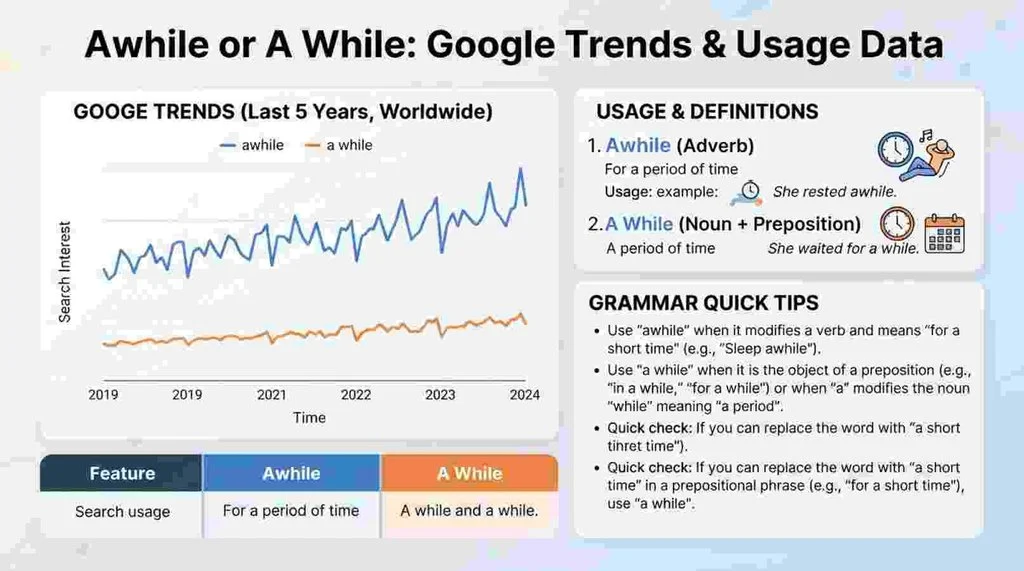
Both forms are common in English writing and online searches. People often search for “awhile or a while” when checking grammar, spelling, and sentence structure.
The search interest may vary by country and writing context. However, both forms are used in American and British English.
| Search Context | Common Usage |
| United States | Both forms |
| United Kingdom | Both forms |
| Canada | Both forms |
| Australia | Both forms |
| New Zealand | Both forms |
| Online grammar searches | Both forms |
Why do people search for this keyword?
- To understand the difference between one word and two words.
- To improve grammar and spelling.
- To write better emails and messages.
- To avoid mistakes in school and professional writing.
- To understand when to use “for a while.”
Note: This is a general usage comparison, not verified Google Trends data or a live country-by-country ranking.
Awhile vs A While – Side-by-Side Comparison
Here is a simple comparison to help you remember the difference.
| Comparison | Awhile | A While |
| Word form | One word | Two words |
| Part of speech | Adverb | Noun phrase |
| Main meaning | For a short time | A period of time |
| Used after “for” | No | Yes |
| Example | Rest awhile. | Rest for a while. |
| Grammar role | Describes an action | Names a period of time |
Remember that both forms can express a similar idea, but their grammatical roles are different.
Frequently Asked Questions (FAQs)
1. Is awhile one word or two words?
Both forms are correct. “Awhile” is one word and works as an adverb. “A while” is two words and works as a noun phrase.
2. Is awhile grammatically correct?
Yes. Awhile is a correct English adverb. For example, “Please stay awhile” is grammatically correct.
3. Is it correct to say for awhile?
No. In standard English, use “for a while.” The word “for” needs a noun phrase in this construction.
4. What is the difference between awhile and a while?
“Awhile” means for a short time, while “a while” refers to a period of time. Their grammatical roles are different.
5. Is awhile American or British English?
Both American and British English accept “awhile.” It is not limited to one country.
6. Should I write wait awhile or wait a while?
Both are correct. You can write “wait awhile” or “wait for a while.” The first uses an adverb, while the second uses a noun phrase.
7. Is a while longer correct?
Yes. “A while longer” is correct because “a while” acts as a noun phrase. For example, “Please wait a while longer.”
Conclusion
Choosing between awhile or a while is easy once you understand their grammatical roles. Both forms are correct in English, but they do not work in exactly the same way.
“Awhile” is an adverb that means for a short time. “A while” is a noun phrase that refers to a period of time.
The easiest rule to remember is to use a while after the preposition “for.” For example, write “I waited for a while,” not “I waited for awhile.”
When no preposition is needed, you can use “awhile,” as in “Please sit awhile.”
These rules apply to American English, British English, and other major English varieties. You do not need to worry about regional spelling changes.
Whether you are writing an email, a school assignment, a social media post, or a formal report, choosing the correct form will make your writing clearer.
Practice these simple examples, and you will soon know when to use each form without confusion.

Mary Roach is an American science writer and bestselling author known for making unusual and complex scientific topics engaging, accessible, and humorous. Her books include Stiff, Packing for Mars, Gulp, and Fuzz.
Author at Simifind.com, sharing clear, informative content designed to help readers understand interesting topics and everyday questions.







