Have you ever stopped while writing because you were unsure whether to use altogether or all together?
You are not alone. These two expressions look almost the same, but they have different meanings. Choosing the wrong one can change the meaning of your sentence.
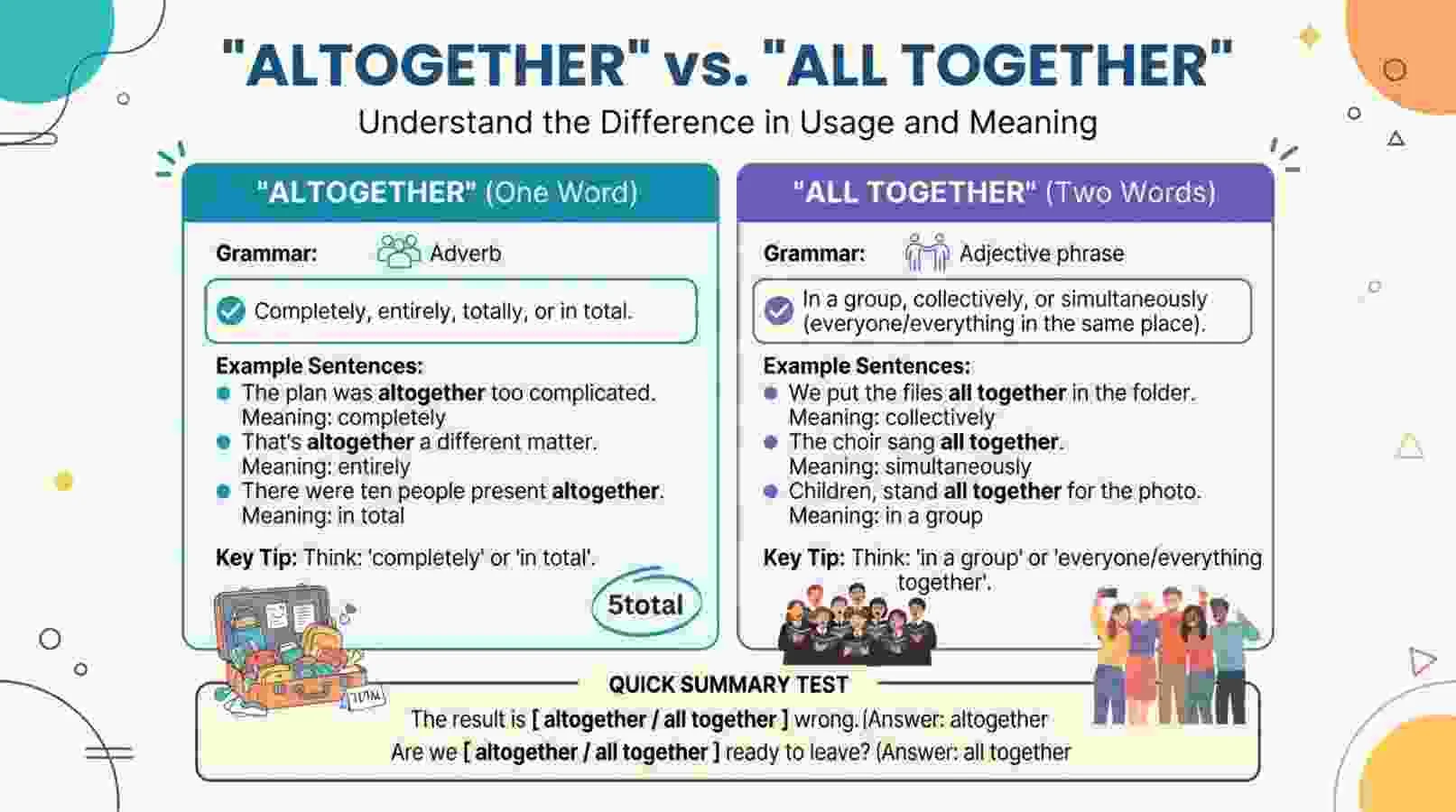
The good news is that the difference is easy to learn. Altogether is one word. It means completely, entirely, or in total. All together is two words.
It means everyone or everything is in one place or doing something at the same time.
People often search for this phrase because spell-check tools may not explain the difference.
Students, teachers, writers, and English learners also want to know which form is correct in formal writing, emails, and daily conversations.
In this guide, you will learn the meaning, origin, spelling rules, and correct usage of both expressions.
You will also find simple examples, common mistakes, a comparison table, and answers to frequently asked questions.
Altogether or All Together – Quick Answer
Both altogether and all together are correct English expressions. However, they have different meanings and uses.
- Altogether: Means completely, entirely, or in total. It describes the whole amount or degree of something.
- All together: Means everyone or everything is gathered in one place or doing something at the same time.
Examples of altogether:
- The plan was altogether different from ours.
- There were 50 people altogether.
- I am altogether happy with the results.
Examples of all together:
- We went to the park all together.
- The children sang combined.
- Put all the books together on the table.
Easy trick: If you mean completely or in total, use altogether. If you mean everyone together or everything in one group, use all together.
The Origin of Altogether and All Together
The word altogether developed from the combination of the words all and together. Over time, these words joined to form a single adverb with a different meaning.
In older English, people used expressions like combined to describe things or people gathered in one place. As language changed, the one-word form gained a separate meaning: completely, entirely, or in total.
The two-word expression kept its original sense of people or things being together.
This explains why the expressions look similar but are not interchangeable. Their spelling shows a difference in meaning:
- Altogether: A single adverb that describes the whole amount or degree.
- All together: A phrase that describes people or things acting or existing as a group.
Both forms remain part of modern English. Neither is a spelling mistake, and neither belongs only to British or American English.
British English vs American English Spelling
There is no major spelling difference between British English and American English when using altogether and combined.
Both countries use the same spellings and follow the same basic grammar rules. The correct choice depends on the meaning of the sentence, not the country where you are writing.
| Feature | British English | American English |
| Completely | Altogether | Altogether |
| In one group | All together | All together |
| Total amount | Altogether | Altogether |
| Group activity | All together | All together |
| Spelling difference | None | None |
British English examples:
- We were altogether pleased with the decision.
- The family sat all together at dinner.
American English examples:
- The project was altogether successful.
- Let’s take a picture combined.
Both examples are correct in their respective varieties of English.
Which Spelling Should You Use?
The right spelling depends on what you want to say. Since both forms are accepted in British and American English, you do not need to change them for a particular audience.
For American English: Use altogether when discussing a complete amount or degree. Use all together when talking about a group.
For British English: Follow the same rule. Both expressions are standard in UK writing.
For Commonwealth countries: Readers in Canada, Australia, New Zealand, Pakistan, and other English-speaking regions follow the same distinction.
For global writing: Choose the expression that makes your meaning clear. Avoid changing the spelling just to match a regional style guide.
For example:
- Correct: We spent $100 altogether.
- Correct: We watched the movie combined.
- Incorrect meaning: We spent $100 combined. (This may suggest a group context rather than simply stating the total.)
Professional advice: Replace altogether with completely or in total to check its meaning. Replace all together with everyone together to check its meaning.
Common Mistakes with Altogether or All Together
Many English learners mix up these expressions because they sound alike. However, their meanings are different.
Here are common mistakes and their corrections:
| Incorrect or confusing sentence | Correct sentence | Reason |
| Put the clothes altogether. | Put the clothes all together. | The clothes are in one group. |
| We invited 20 guests all together. | We invited 20 guests altogether. | It means 20 guests in total. |
| The answer was all together wrong. | The answer was altogether wrong. | It means completely wrong. |
| Let’s work altogether. | Let’s work all together. | It means working as a group. |
| The service stopped all together. | The service stopped altogether. | It means the service stopped completely. |
Mistake 1: Using Altogether for a Group
Do not use altogether when you mean that people or objects are gathered in one place.
- Incorrect: The students stood altogether.
- Correct: The students stood all together.
Mistake 2: Using All Together for a Total
When you give a final number or amount, use altogether.
- Incorrect: The total cost was $75 all combined.
- Correct: The total cost was $75 altogether.
Mistake 3: Confusing Completely with Together
Remember that altogether describes a complete state, while all combined describes a group or shared action.
- The room was altogether empty.
- The family sat all together.
Altogether or All Together in Everyday Examples
Both expressions appear in daily conversations, schoolwork, emails, news reports, and professional writing. Knowing their meanings helps you write clear sentences.
1. In Emails
Use altogether when explaining totals, results, or complete changes.
Examples:
- The total payment is $250 altogether.
- I am altogether satisfied with your work.
- We have received 15 applications altogether.
Use all together when referring to people working or meeting as a group.
Examples:
- Let’s discuss the project all combined.
- Please send all the documents together.
- We can attend the meeting all combined.
2. In News and Reports
Journalists use altogether to report totals and complete changes.
Examples:
- The event welcomed 5,000 visitors altogether.
- The company stopped the service altogether.
- The new policy brought an altogether different result.
All together can describe people gathered at an event or taking part in an activity.
Examples:
- The team members stood all combined.
- The students gathered all together for a group photograph.
3. On Social Media
Both expressions are useful in captions, comments, and online posts.
Altogether examples:
- That was an altogether amazing experience!
- We raised $500 altogether.
- I am altogether happy with this result.
All together examples:
- Best friends, all together again!
- Let’s sing this song all combined.
- One big family, all together.
4. In Formal Writing
In academic papers, reports, and business documents, use the expression that fits your intended meaning.
Examples:
- The research included 200 participants altogether.
- The results were altogether different from earlier findings.
- All team members worked all together to complete the task.
For formal writing, clear meaning matters more than choosing one expression over the other.
Altogether or All Together – Google Trends & Usage Data
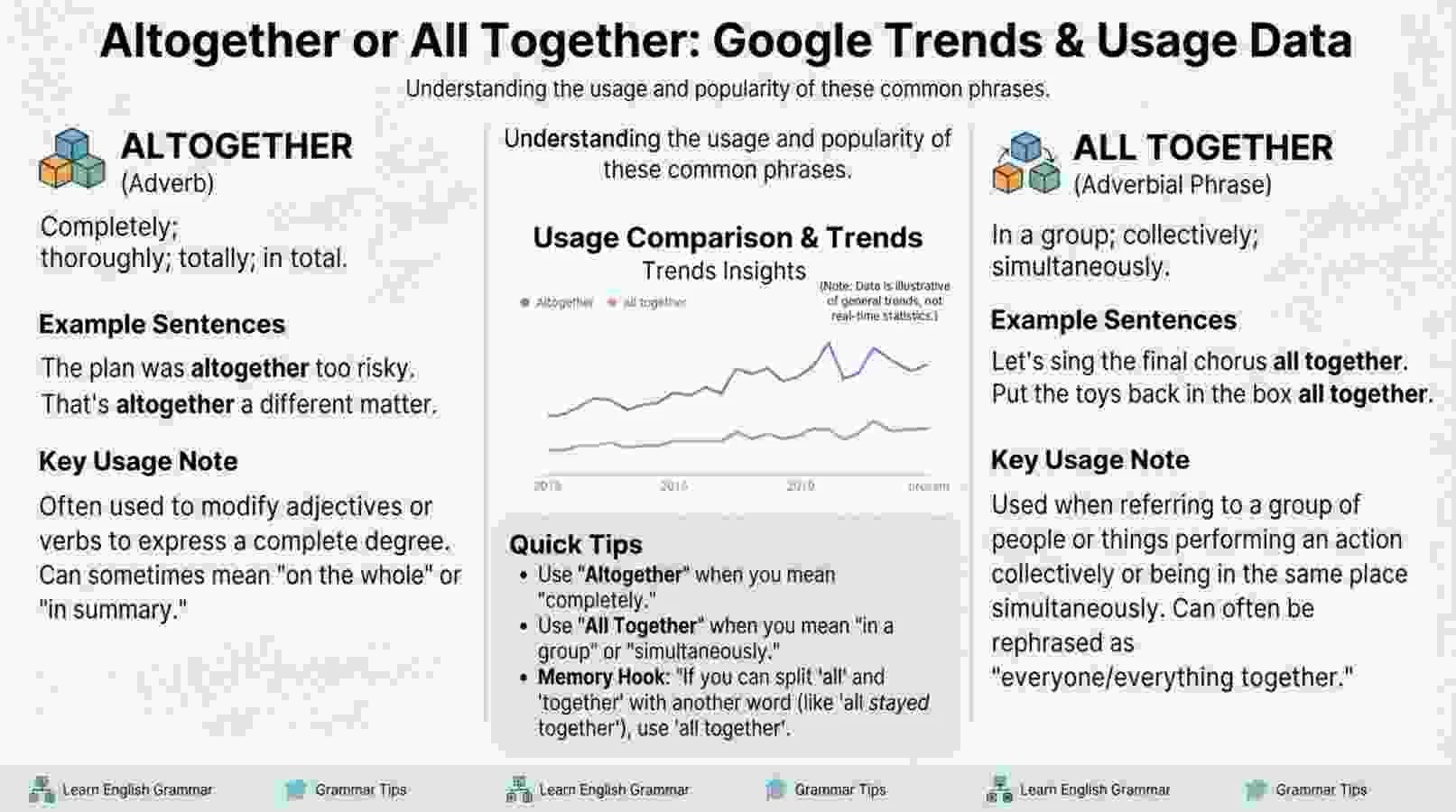
People search for altogether or all together because they want to understand the difference between these similar-looking expressions. The search intent is mainly educational and relates to English grammar, spelling, vocabulary, and writing.
However, there is no verified country-by-country ranking or current search-volume figure available here. It would be misleading to claim that one country searches for this phrase more than another.
Google Trends can help writers compare the two exact search terms and explore interest by country and region.
| Search area | What to investigate |
| United States | English grammar and spelling questions |
| United Kingdom | British English usage and word differences |
| Canada | English vocabulary and writing |
| Australia | Grammar and spelling guidance |
| Pakistan | English learning and grammar questions |
| Worldwide | Overall interest in both expressions |
Important Google Trends note: Google Trends uses normalized interest scores from 0 to 100. These scores are not actual search volumes. Results also depend on the selected time range, location, and search term.
Trends Help+2
For SEO research, compare these search terms:
- Altogether or all together
- Altogether vs all together
- All together vs altogether
- Altogether meaning
- All together meaning
- When to use altogether
- When to use all together
You can explore the comparison using Google Trends.
Altogether vs All Together – Comparison Table
This table provides a quick overview of both expressions and their uses.
| Comparison | Altogether | All Together |
| Word type | Adverb | Phrase |
| Spelling | One word | Two words |
| Meaning | Completely or in total | Everyone or everything together |
| Grammar | Adverb | Group expression |
| Total amount | Yes | Not usually |
| Group activity | No | Yes |
| Formal writing | Yes | Yes |
| British English | Correct | Correct |
| American English | Correct | Correct |
| Example | We paid $40 altogether. | We paid the bill all together. |
Frequently Asked Questions (FAQs)
1. Is altogether one word or two words?
Altogether is one word. It means completely, entirely, or in total. All together is two words and describes people or things gathered in one place.
2. What is the difference between altogether and all together?
Altogether means completely or in total. All together means everyone or everything is together in one place or at the same time.
3. Is all together grammatically correct?
Yes. All together is grammatically correct when referring to a group of people or things. For example, the children played all together.
4. Is altogether formal or informal?
Altogether is suitable for both formal and informal writing. You can use it in emails, essays, reports, conversations, and everyday messages.
5. Do British and American English use the same spelling?
Yes. Both British and American English use altogether and all together with the same meanings. There is no regional spelling difference.
6. How can I remember the difference?
Use altogether when you mean completely or in total. Use all together when you mean everyone or everything in one group.
7. Which is correct: altogether or all together?
Both are correct. The right choice depends on the sentence. Use altogether for a total or complete state and all together for a group.
Conclusion
Choosing between altogether or all together is easy when you understand their meanings. Both expressions are correct, but they are used in different situations.
Remember that altogether is one word. It means completely, entirely, or in total. You can use it when discussing amounts, results, opinions, or complete changes. For example, “We collected $200 altogether.”
On the other hand, all together is two words. It means that people or things are in one place or doing something at the same time. For example, “The students walked all together.”
There is no difference between British and American spelling rules for these expressions. Both forms are accepted in everyday conversations, academic writing, emails, and professional documents.
The easiest way to avoid mistakes is to check the meaning of your sentence. If you mean completely or in total, choose altogether. If you mean everyone or everything together, choose all together.
With this simple rule, you can use both expressions correctly and write with greater confidence.

Here’s a concise 2-line author bio suitable for Simifind.com:
James Dashner is an American bestselling author best known for The Maze Runner series and other popular young-adult fiction.
On Simifind.com, he shares clear, engaging insights and helpful content for readers interested in books, writing, and popular literature.







