
Mrs. is the title for a married woman. Ms. is the neutral title for any woman, married or not — it does not reveal marital status. Miss is for an unmarried woman or girl. When in doubt, use Ms.
Choosing between married Ms or Mrs can feel confusing. Both titles are used before a woman’s name, but they have different meanings.
If you are writing a wedding invitation, sending a work email, filling out a form, or addressing a letter, the right choice can help you sound polite and professional.
The main difference is simple. Mrs. traditionally refers to a married woman, while Ms. does not reveal whether a woman is married.
Both are correct titles, and neither is wrong when used in the right context.
Many people search for “married Ms or Mrs” because they want to know which title fits a married woman.
Others want to avoid making a mistake in formal writing. Some women prefer Ms. because they want to keep their marital status private.
Others choose Mrs. because it matches their personal preference or social tradition.
In this guide, you will learn the meaning of Ms. and Mrs., their history, their use in British and American English, and how to choose the right title.
You will also find simple examples, common mistakes, and answers to popular questions.
Married Ms or Mrs – Quick Answer
Use Mrs. for a married woman who prefers that title. Use Ms. when you do not know her marital status or when she prefers a title that does not reveal it.
Both titles are correct. A woman’s personal choice matters most.
Examples:
- Mrs. Sarah Johnson — A married woman who uses Mrs.
- Ms. Sarah Johnson — A woman whose marital status is not stated, or who prefers Ms.
- Dear Ms. Johnson, — A polite and professional email greeting.
- Dear Mrs. Johnson, — A suitable greeting when you know she uses Mrs.
| Title | Meaning | Best use |
| Ms. | Does not state marital status | Work, formal letters, general use |
| Mrs. | Traditionally indicates a married woman | When the woman prefers this title |
| Miss | Traditionally indicates an unmarried woman | When the person prefers Miss |
Quick tip: If you are unsure, choose Ms. in most professional situations. If the woman has told you her preferred title, use that instead.
The Origin of Married Ms or Mrs
The titles Ms., Mrs., and Miss have a long history in English. They developed from the word mistress, which was once used as a respectful title for a woman.
Over time, English speakers began using different forms of this title. Miss became common for unmarried women. Mrs. became linked to married women. Ms. later developed as a title that does not identify a woman’s marital status.
How Mrs. Developed
Mrs. is an abbreviation of mistress. It was traditionally used before the name of a married woman. In older social customs, a woman’s title often showed her marital status.
For example:
- Mrs. Emily Brown
- Mrs. Thomas Brown, in older naming traditions
Today, most women use their own names with Mrs. if they prefer it. The title does not require a woman to take her husband’s surname.
How Ms. Became Popular
Ms. became more widely accepted during the twentieth century. It offered a neutral alternative to Miss and Mrs. It became especially useful in workplaces, business letters, and public communication.
For example:
- Ms. Emily Brown
- Ms. Taylor Smith
The title does not tell readers whether the woman is married, single, divorced, or widowed.
The key point is that Mrs. traditionally signals marriage, while Ms. leaves marital status unstated. Modern usage gives women more freedom to choose the title they want.
British English vs American English Spelling
The use of Ms. and Mrs. is similar in British and American English. The main difference is often punctuation, not meaning.
American English commonly uses periods after both titles: Ms. and Mrs. British English often uses Ms and Mrs without periods. Both forms are accepted, depending on the style guide.
Comparison Table
| Feature | American English | British English |
| Married woman’s title | Mrs. | Mrs |
| Neutral title | Ms. | Ms |
| Traditional unmarried title | Miss | Miss |
| Formal greeting | Dear Mrs. Brown, | Dear Mrs Brown, |
| Neutral formal greeting | Dear Ms. Brown, | Dear Ms Brown, |
| Main difference | Periods are common | Periods are often omitted |
Examples in Both Styles
American English:
- Mrs. Olivia Wilson
- Ms. Olivia Wilson
- Dear Ms. Wilson,
British English:
- Mrs Olivia Wilson
- Ms Olivia Wilson
- Dear Ms Wilson,
Neither punctuation style is automatically wrong. The best choice depends on the country, publication, workplace, or style guide you follow.
For formal documents, keep the same style throughout the text.
Which Spelling Should You Use?
Your choice between Ms. and Mrs. should depend on the person’s preference and the situation. Country and writing style may also affect punctuation.
For the United States
In the United States, Ms. is widely used in professional and business settings. It is a safe choice when you do not know a woman’s preferred title.
Use Mrs. when you know the woman prefers it.
Example: Dear Ms. Anderson,
For the United Kingdom and Commonwealth Countries
In the United Kingdom, Ms and Mrs are both common. Many British style guides omit the period after titles.
Usage can vary across Commonwealth countries, so follow local conventions and the person’s preference.
Example: Dear Mrs Anderson,
For Global Communication
If you are writing to someone in another country, Ms. is often a practical choice when their marital status or title preference is unknown.
For example, in an international business email, you can write:
Dear Ms. Ahmed,
If the person signs her emails as Mrs. Ahmed, follow her preferred title in future messages.
For Forms and Official Documents
Some official forms ask for a title, while others do not require one. If the title is optional, you can leave it blank when appropriate. If a form requires a title, select the option that matches your preference and the form’s instructions.
Remember that a title is not always part of a person’s legal name.
Common Mistakes with Married Ms or Mrs
People often confuse Ms. and Mrs. because both appear before women’s names. These are the most common mistakes and how to avoid them.
Mistake 1: Thinking Every Married Woman Must Use Mrs.
Incorrect assumption: Every married woman should be called Mrs.
Correction: A married woman can choose Ms. if she prefers it. Marriage does not require a change of title.
Mistake 2: Using Mrs. Without Knowing the Preference
Possible mistake: Addressing a business contact as Mrs. based only on an assumption that she is married.
Better choice: Use Ms. when her preferred title is unknown.
Mistake 3: Thinking Ms. Means Unmarried
Incorrect: Ms. means the woman is single.
Correct: Ms. does not state whether a woman is married.
Mistake 4: Assuming Mrs. Requires a Husband’s Surname
Incorrect assumption: A woman must use her husband’s surname with Mrs.
Correction: A woman may use Mrs. with the name she chooses, according to her preference and local naming customs.
Mistake 5: Mixing Punctuation Styles
Inconsistent: Ms. Brown in one paragraph and Mrs Brown in another, when following one style guide.
Correction: Use the punctuation rules required by your chosen style guide.
Married Ms or Mrs in Everyday Examples
The best way to understand these titles is to see how they work in real situations.
1. In Emails
If you do not know a person’s title preference, Ms. is usually a safe professional option.
Example:
Dear Ms. Carter,
Thank you for your email. I will send the requested documents by Friday.
Kind regards,
Alex
If she has told you that she prefers Mrs., use that title instead.
2. In News and Articles
News reports may use Ms. or Mrs. based on the publication’s style guide and the person’s preference.
Examples:
- Ms. Carter announced the new policy.
- Mrs. Carter attended the school meeting.
The title does not change the person’s role or professional position.
3. On Social Media
People may use titles in profiles, announcements, and public posts. However, many users prefer to use their names without a title.
Examples:
- Congratulations to Mrs. Carter on her new home!
- Welcome, Ms. Carter, to our team!
Use the title the person prefers, especially in public posts.
4. In Formal Letters
For a formal letter, choose a title that matches the recipient’s preference.
Examples:
Dear Ms. Patel,
Dear Mrs. Patel,
If you do not know which title she uses, Ms. is generally a suitable choice.
5. On Wedding Invitations
Wedding invitations may follow traditional etiquette or a modern style.
Example:
Mrs. Emily Davis and Mr. James Davis
However, the exact format depends on the couple’s preferences, the invitation style, and local customs. Do not assume every married woman wants to be addressed as Mrs.
Married Ms or Mrs – Google Trends & Usage Data
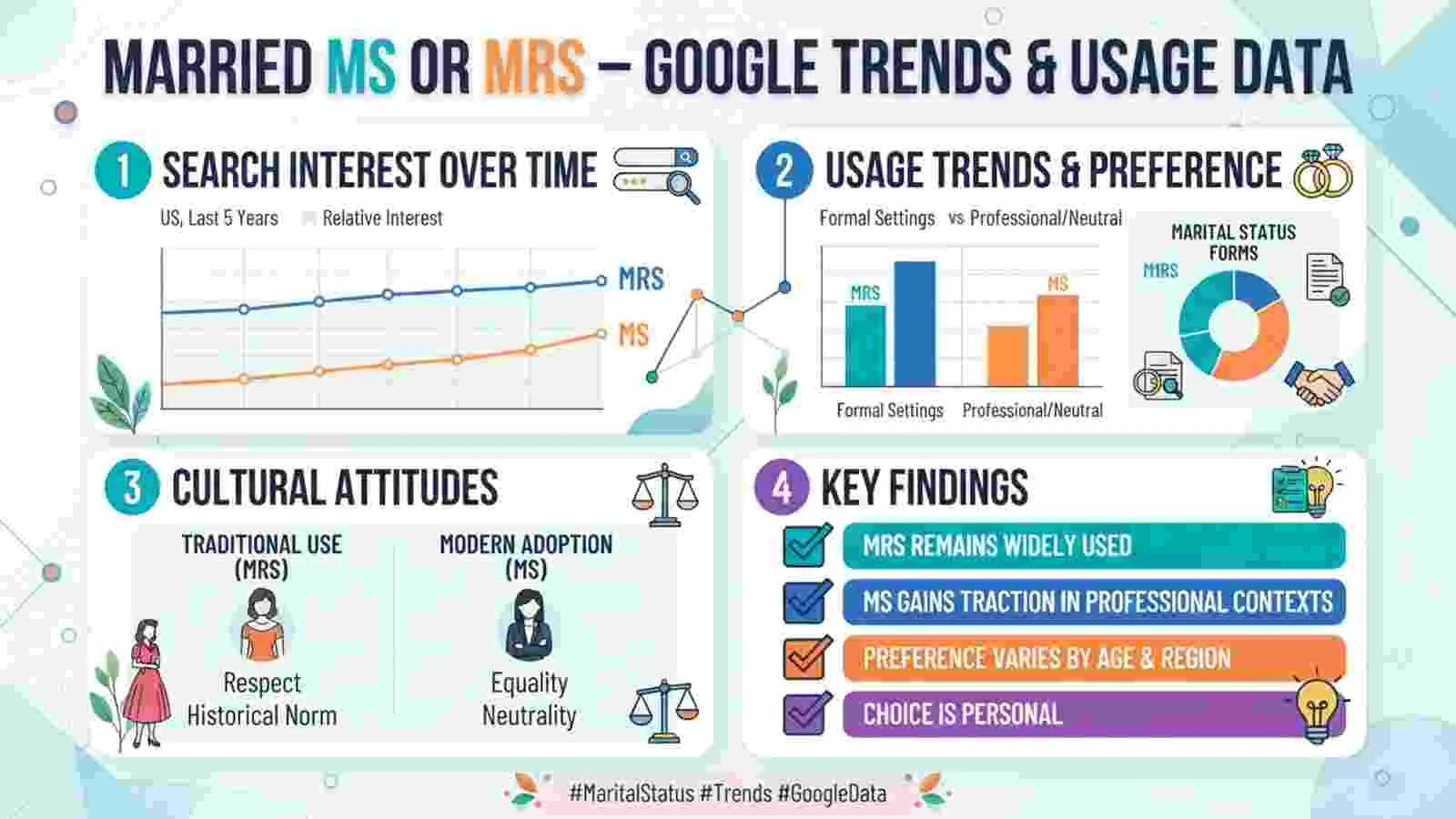
People search for terms such as “married Ms or Mrs,” “Ms vs Mrs,” and “is Ms for married women” when writing letters, completing forms, or learning English etiquette.
These searches reflect a practical language question: which title is correct, and when should each one be used?
Why People Search for Ms vs Mrs
Common search reasons include:
- Choosing a title for a business email.
- Completing a job application or official form.
- Addressing wedding invitations.
- Learning English grammar and etiquette.
- Understanding the difference between Ms., Mrs., and Miss.
Popularity by Country
Ms. and Mrs. are used in many English-speaking countries, including the United States, the United Kingdom, Canada, and Australia. Their punctuation and social use can vary by region.
However, exact search rankings and country-by-country search volumes require current Google Trends or keyword research data. Without verified data, it would be misleading to claim that one country searches for these terms more than another.
For SEO content, related phrases worth covering include:
- Married Ms or Mrs
- Ms vs Mrs
- Difference between Ms and Mrs
- Can a married woman use Ms?
- Should I use Ms or Mrs in an email?
- What title should I use for a married woman?
These related phrases address different forms of the same search intent. Use them naturally in headings and answers instead of repeating the same keyword too often.
Comparison Table: Ms vs Mrs vs Miss
| Feature | Ms. | Mrs. | Miss |
| Marital status | Not stated | Traditionally married | Traditionally unmarried |
| Professional use | Very common | Common when preferred | Used when preferred |
| Privacy | Keeps status unstated | Usually signals marriage | Traditionally signals unmarried status |
| Suitable when status is unknown | Yes | Not usually the safest choice | Not usually the safest choice |
| Requires a husband’s surname | No | No | No |
| British punctuation | Often Ms | Often Mrs | Miss |
| American punctuation | Ms. | Mrs. | Miss |
The table shows the traditional meanings, but personal preference is more important than assumptions based on marital status.
Frequently Asked Questions
1. Should a married woman use Ms. or Mrs.?
A married woman can use either title. Mrs. traditionally indicates that she is married, while Ms. does not reveal marital status. Her preference should guide your choice.
2. Is Ms. correct for a married woman?
Yes. Ms. is correct for a married woman. It is a neutral title that does not state whether someone is married.
3. Does Mrs. always mean married?
Mrs. traditionally indicates a married woman. However, titles are also a matter of personal choice, and modern usage may not always follow traditional rules.
4. Is Ms. more professional than Mrs.?
Neither title is automatically more professional. Ms. is often useful in workplaces because it does not make assumptions about marital status. Mrs. is also professional when it matches the person’s preference.
5. Should I use Ms. or Mrs. in an email?
Use the title the recipient prefers. If you do not know, Ms. is usually a safe and respectful choice.
6. Can a married woman keep her maiden name and use Mrs.?
Yes. A married woman may keep her original surname and use Mrs. if she prefers. Naming customs and official requirements may vary by country.
7. What is the difference between Ms., Mrs., and Miss?
Ms. does not state marital status. Mrs. traditionally refers to a married woman. Miss traditionally refers to an unmarried woman. In modern use, people may choose the title that suits them best.
8. What does Ms. mean?
Ms. (pronounced “miz”) is a neutral title for a woman. It does not state whether she is married, single, divorced or widowed. It is the female equivalent of “Mr.” and is commonly used in professional and formal writing.
9. How do you address a married woman?
Use the title she prefers. If you know she uses Mrs., write “Dear Mrs. [Surname],”. If you do not know her preference, use Ms. — “Dear Ms. [Surname],” — in formal letters and emails.
Conclusion
Choosing between married Ms or Mrs is easier when you understand what each title means.
Mrs. traditionally refers to a married woman, while Ms. is a neutral title that does not reveal marital status. Both are correct, and the best choice depends on the woman’s preference and the situation.
For professional emails, business letters, and international communication, Ms. is often the simplest choice when you do not know someone’s preferred title.
If a woman uses Mrs., it is respectful to address her that way. The same principle applies to Miss and other forms of address: avoid making assumptions based on age, appearance, or marital status.
Remember that British and American English may use different punctuation.
American writing commonly uses Ms. and Mrs., while British writing often uses Ms and Mrs. without periods. Follow your chosen style guide and stay consistent.
Most importantly, being married does not mean a woman must use Mrs. She can choose Ms. if that is what she prefers.
When in doubt, use a neutral title or politely ask how she would like to be addressed. This simple habit helps you communicate with confidence, clarity, and respect.

Mary Roach is an American science writer and bestselling author known for making unusual and complex scientific topics engaging, accessible, and humorous. Her books include Stiff, Packing for Mars, Gulp, and Fuzz.
Author at Simifind.com, sharing clear, informative content designed to help readers understand interesting topics and everyday questions.







