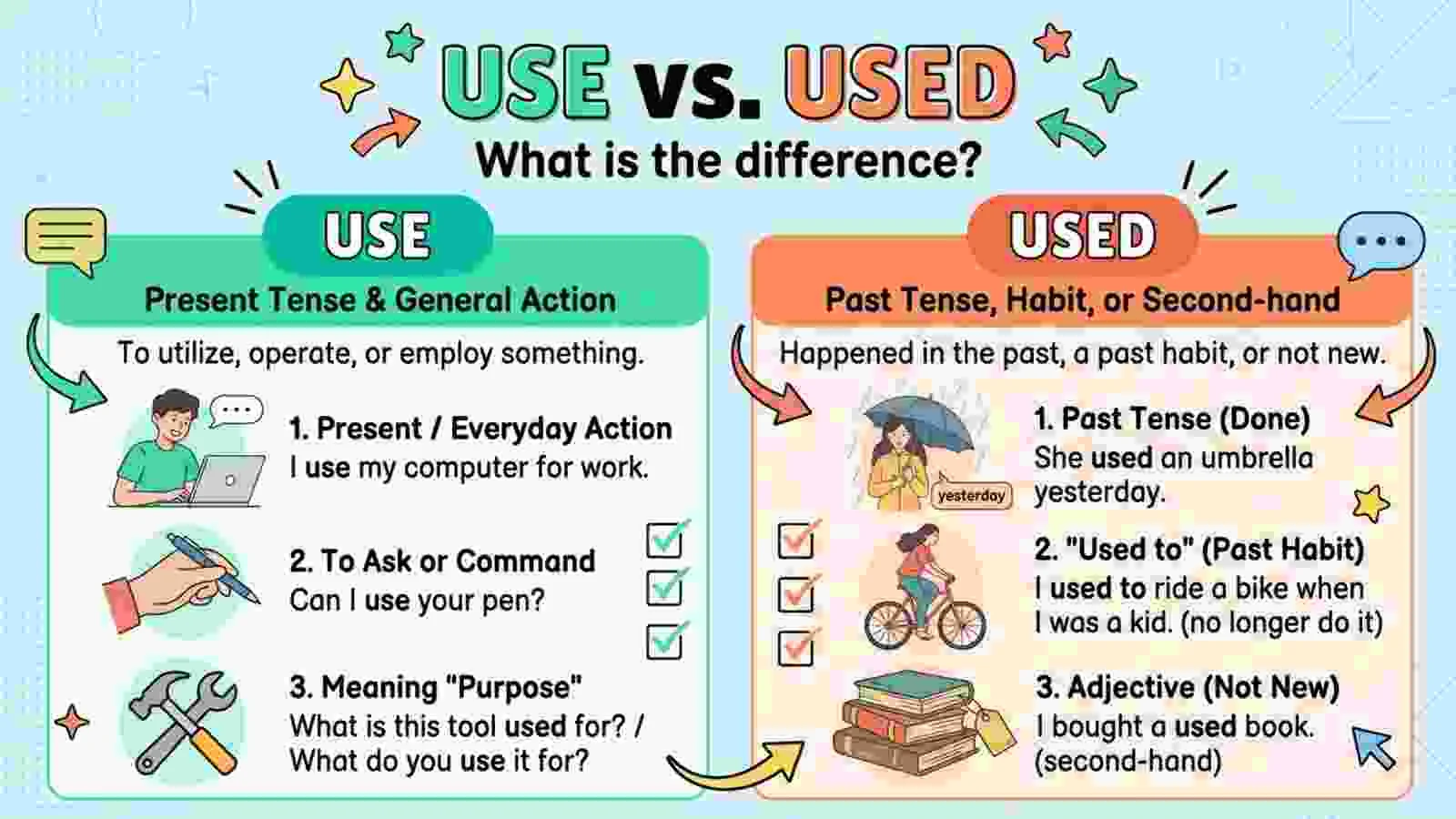
Use and used are different forms of the same verb. Use = the base form (I use it every day; used to + verb for past habits). Used = the past tense and past participle (I used it yesterday; I have used it before). As an adjective, used means second-hand (a used car). Do not write ‘use to’ when you mean the past habit — it is ‘used to’.
Have you ever stopped while writing and wondered whether to use “use” or “used”?
You are not alone. These two words look almost the same, but they work in different ways. Choosing the right word can make your English clear and correct.
The word use often describes something you do now, something you do often, or something you plan to do.
The word used often talks about an action in the past. It can also describe something that is not new. In some sentences, both words are correct, but their meanings change.
People search for “use or used” because they want to improve their grammar, write better emails, and avoid common spelling and tense errors.
English learners may also find it hard to know when to add the letter d to a verb.
The good news is that the rule is simple. Once you learn how these words work, you can use them with more confidence.
This guide explains their meanings, grammar rules, common mistakes, and everyday examples. You will also learn how to choose the right word for school, work, and formal writing.
Use or Used – Quick Answer
Use is the base form of the verb. It can describe a present action, a habit, or a future action.
Used is the past form and past participle of the verb. It can also work as an adjective.
Examples:
- I use my phone every day.
- I used my phone yesterday.
- She has used this tool before.
- This is a used car.
Use “use” for the base verb and “used” when the sentence calls for the past form, past participle, or adjective.
Quick Comparison Table
| Word or phrase | Meaning | Example |
| Use | Base verb | I use a pen. |
| Used | Past verb | I used a pen. |
| Have used | Present perfect | I have used this app. |
| Used to | Past habit or state | I used to play tennis. |
| Be used to | Be familiar with something | I am used to cold weather. |
| Used item | Not new | He bought a used bike. |
The Origin of Use and Used
The word use comes from Old French user, which meant to use or make use of something. It traces back to Latin uti, meaning to use or employ.
Over time, English adopted the word and gave it several meanings. Today, we use it to talk about tools, objects, skills, time, and actions.
The word used developed as the past form of “use.” In English, many regular verbs form their past tense by adding -ed or -d. For example:
- Like → Liked
- Love → Loved
- Change → Changed
- Use → Used
The final letter e in “use” means that only d is added to form “used.”
Both British and American English use these spellings. There is no regional spelling difference between them. The main difference is how each word works in a sentence.
British English vs American English Spelling
British and American English use use and used in the same way. Neither variety requires a different spelling.
However, pronunciation can help you understand the difference. As a verb, “use” often sounds like yooz. The past form “used” usually ends with a /zd/ sound.
When “used” appears in phrases such as “used to,” its pronunciation may sound different in natural speech.
Comparison Table: Use vs Used
| Feature | Use | Used |
| Spelling | Use | Used |
| Word form | Base verb | Past form or past participle |
| Present example | I use this desk. | Not usually used alone for a present action |
| Past example | Not used as the simple past | I used this desk. |
| Present perfect | Not used after “have” alone | I have used this desk. |
| Adjective | Not usually an adjective in this sense | A used desk |
| British English | Correct | Correct |
| American English | Correct | Correct |
Examples in Both Varieties
British English:
- I use the train to get to work.
- I used the train yesterday.
American English:
- I use the subway to get to work.
- I used the subway yesterday.
The words follow the same grammar rules in both examples. The main difference is the choice of “train” or “subway,” not the spelling of “use” or “used.”
Which Spelling Should You Use?
Your choice depends on the meaning and grammar of your sentence, not the country where your reader lives.
For American English
Use “use” for the base verb and “used” for the past form.
- I use this software at work.
- I used this software last year.
For British English and Commonwealth Countries
Follow the same rules. Both words are standard in the UK, Pakistan, Australia, Canada, and other English-speaking settings.
- We use this method in class.
- We used this method last term.
For Global English
If you write for an international audience, focus on clear sentence structure. Make sure the verb matches the time and meaning you want to express.
For example:
- Correct: She uses this app every day.
- Correct: She used this app yesterday.
- Incorrect: She use this app yesterday.
Remember that “uses” is the usual present form with he, she, or it. “Use” is used with I, you, we, and they in the simple present.
Common Mistakes with Use or Used
Many grammar errors happen when writers forget the role of each word. Here are common mistakes and their corrections.
1. Using Use for a Past Action
Incorrect: I use this laptop yesterday.
Correct: I used this laptop yesterday.
Use “used” when a completed action happened in the past.
2. Using Used After Did
Incorrect: Did you used my pen?
Correct: Did you use my pen?
After “did” or “did not,” use the base form of the verb.
More examples:
- Did she use the key?
- I did not use the computer.
3. Confusing Used To and Use To
Use used to in positive sentences about past habits or states.
- I used to live in London.
- She used to walk to school.
After “did,” use use to in questions and negative statements.
- Did you use to live here?
- I did not use to drink coffee.
In everyday English, some speakers prefer “never used to” or similar forms, but the key rule is that “did” takes the base form.
4. Confusing Used To and Be Used To
These phrases have different meanings.
- I used to wake up early. (This was a past habit.)
- I am used to waking up early. (This is normal for me now.)
After “be used to,” use a noun or an -ing verb form.
5. Forgetting the Third-Person -s
Incorrect: He use this tool every day.
Correct: He uses this tool every day.
In the simple present, add -s or -es for he, she, and it.
Use or Used in Everyday Examples
These words appear in daily conversations, emails, social media posts, news reports, and formal documents.
In Emails
- Present: I use this email address for work.
- Past: I used the wrong address by mistake.
In News Writing
- Present: Many people use public transport.
- Past: The team used new methods during the study.
On Social Media
- Present: I use this app to share photos.
- Past: I used this filter in my last post.
In Formal Writing
- Present: Researchers use several methods to study the issue.
- Past: Researchers used several methods to collect the data.
- Present perfect: The study has used data from several sources.
In Everyday Conversation
- “Can I use your phone?”
- “I used your charger yesterday.”
- “I have used this service before.”
The right form depends on the sentence. Look for time words such as “yesterday,” “every day,” and “already.” They often help you choose the correct verb form.
Use or Used – Google Trends and Usage Data
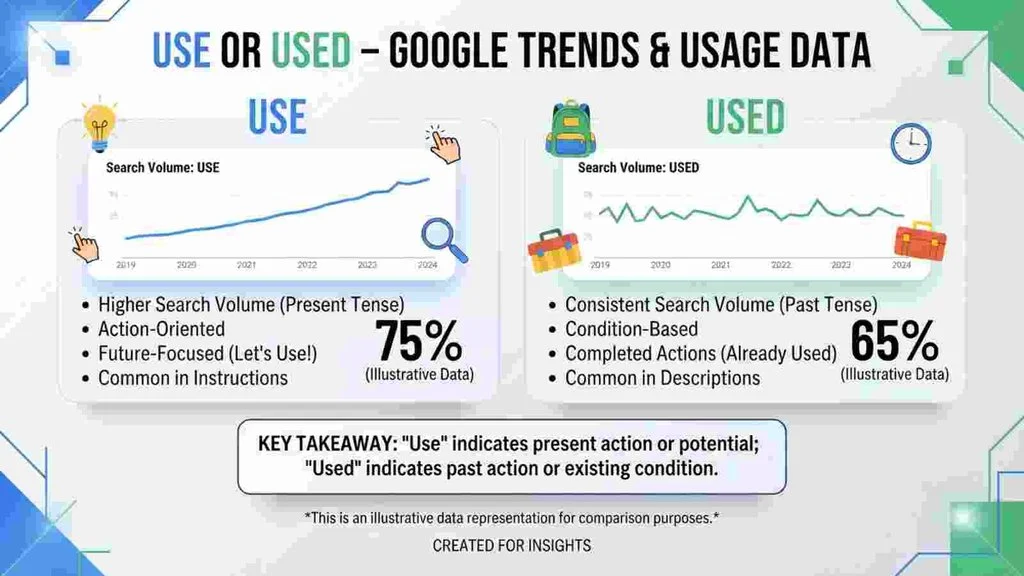
Both “use” and “used” are common English words. They appear in many searches because they serve different grammar roles and meanings.
People may search for these terms when learning English, checking sentence structure, writing school assignments, or trying to understand phrases such as “used to” and “be used to.”
Search interest can vary by country, language-learning needs, and context. For example, English learners may search for the difference between “use” and “used,” while shoppers may use “used” when looking for second-hand cars or furniture.
However, there is no single reliable popularity ranking for these two words without a defined date range, country, and search category. Google Trends reports relative search interest rather than exact search counts. A direct comparison should use the same time period and location for both terms.
For useful research, compare the phrases “use or used,” “used to grammar,” and “how to use use and used.” These more specific searches can help identify what readers want to learn.
Frequently Asked Questions
1. What is the main difference between use and used?
“Use” is the base form of the verb. “Used” is its past form and past participle. “Used” can also describe an item that is not new.
2. Is it correct to say “I use it yesterday”?
No. The correct sentence is “I used it yesterday” because the action happened in the past.
3. Should I say “Did you use it” or “Did you used it”?
Say “Did you use it?” After “did,” the main verb takes its base form.
4. What is the difference between used to and be used to?
“Used to” describes a past habit or state, such as “I used to swim.” “Be used to” means something is familiar or normal, as in “I am used to swimming.”
5. Is used a past tense verb?
Yes. “Used” is the simple past form of the regular verb “use.” It is also the past participle, as in “I have used it.”
6. Are use and used spelled differently in British and American English?
No. Both British and American English use the same spellings. The correct choice depends on grammar and meaning.
7. Can used be an adjective?
Yes. “Used” can describe something that is not new. For example, “She bought a used car.”
8. Use or used — which is correct?
Both are correct — they are different forms of the same verb. Use is the base form (I use it every day); used is the past form (I used it yesterday). Choose by the tense of your sentence.
9. What is the difference between used to and use to?
Use ‘used to’ for a past habit or state (I used to live in London). After ‘did’, drop the d and write ‘use to’ (Did you use to live here?).
10. When should I use ‘used’?
Use used for a past action (I used it yesterday), after have/has/had (I have used it before), and as an adjective for something not new (a used car).
11. How do you spell used?
U-S-E-D — used. Add a d to the base form use: use + d = used (the final e in use means you do not add -ed).
Conclusion
Choosing between use or used becomes easy when you understand the basic grammar rules.
“Use” is the base form of the verb, while “used” usually describes a past action or appears after helping verbs such as “have.” It can also describe an item that is not new.
Think about the time of the action before choosing a word. If you do something every day, write “I use it.” If you did it yesterday, write “I used it.”
If you use “did” in a question or negative sentence, return to the base form: “Did you use it?”
Also, learn the difference between “used to” and “be used to.” The first describes a past habit or state, while the second means something feels normal or familiar.
These rules are the same in British and American English. With a little practice, you can avoid common mistakes and write better sentences in emails, essays, and daily conversations.
Read your sentence once more before submitting it. A quick grammar check can make your writing clearer and more professional.
Continue Reading:

Here’s a concise 2-line author bio suitable for Simifind.com:
James Dashner is an American bestselling author best known for The Maze Runner series and other popular young-adult fiction.
On Simifind.com, he shares clear, engaging insights and helpful content for readers interested in books, writing, and popular literature.